<?xml version="1.0" encoding="utf-8"?>
<feed xmlns="http://www.w3.org/2005/Atom">
    <title>smoothbrains.net</title>
    <link href="https://smoothbrains.net/atom.xml" rel="self" />
    <link href="https://smoothbrains.net" />
    <id>https://smoothbrains.net/atom.xml</id>
    <author>
        <name>Cube Flipper</name>
        
        <email>admin@smoothbrains.net</email>
        
    </author>
    <updated>2026-02-24T00:00:00Z</updated>
    <entry>
    <title>On the phenomenological shift known as stream entry and its implications for consciousness</title>
    <link href="https://smoothbrains.net/posts/2026-02-24-stream-entry.html" />
    <id>https://smoothbrains.net/posts/2026-02-24-stream-entry.html</id>
    <published>2026-02-24T00:00:00Z</published>
    <updated>2026-02-24T00:00:00Z</updated>
    <summary type="html"><![CDATA[<style>
.transcript {
    font-weight: bold;
}

.transcript.cube-flipper {
    color: deepskyblue;
}

.transcript.guy {
    color: goldenrod;
}
</style>
<aside>
<p><em>
I’d like to thank <a href="https://x.com/nosilverv">Guy</a> for the conversation we had on 26 November 2025.</p>
This post is also available on <a href="https://www.lesswrong.com/posts/FaupgisJ8zkNHfouX/on-the-phenomenological-shift-known-as-stream-entry-and-its">lesswrong.com</a>.
</em>
</aside>
<p>Late last year, the <a href="https://en.wikipedia.org/wiki/Rationalist_community">rationalist community</a> leader and artificial intelligence researcher <a href="https://en.wikipedia.org/wiki/Eliezer_Yudkowsky">Eliezer Yudkowsky</a> claimed that <a href="https://x.com/allTheYud/status/1992278063271563713">chickens do not have qualia</a>:</p>
<center>
<a href="https://x.com/allTheYud/status/1992278063271563713"><img src="../../images/random/stream_entry/eliezer_tweet.png" style="max-width: 512px; width: 100%" /></a>
</center>
<p>This caused something of a stir – <a href="https://x.com/cube_flipper/status/1992612505995432399">for what seem to me like obvious reasons</a>. Apparently Eliezer has said similar things before, in a <a href="https://www.facebook.com/yudkowsky/posts/10152588738904228">2014 Facebook post</a> – the <em>pig post</em>, as an <a href="https://x.com/aaarataki">animal welfare researcher friend</a> referred to it:</p>
<blockquote>
<p>To spell it out in more detail, though still using naive and wrong language for lack of anything better: my model says that a pig that grunts in satisfaction is not experiencing simplified qualia of pleasure, it’s lacking most of the reflectivity overhead that makes there be someone to experience that pleasure. Intuitively, you don’t expect a simple neural network making an error to feel pain as its weights are adjusted, because you don’t imagine there’s someone inside the network to feel the update as pain. My model says that cognitive reflectivity, a big frontal cortex and so on, is probably critical to create the inner listener that you implicitly imagine being there to ‘watch’ the pig’s pleasure or pain, but which you implicitly imagine not being there to ‘watch’ the neural network having its weights adjusted.</p>
</blockquote>
<p>When Eliezer’s tweet went viral, Portuguese writer and Twitter personality <a href="https://x.com/nosilverv">Guy</a> – also known as <em>Rival Voices</em> – was attending the rationalist campus and convention center <a href="https://lighthaven.space">Lighthaven</a> in Berkeley for their yearly writing residency <a href="https://www.inkhaven.blog">Inkhaven</a>. He saw an opportunity for a blog post trying to unpack why Eliezer might believe what he does. Guy works with the philosopher <a href="https://en.wikipedia.org/wiki/Ned_Block">Ned Block</a>’s <a href="https://philpapers.org/rec/BLOOAC">framework</a>, which distinguishes between <em>phenomenal consciousness</em> and <em>access consciousness</em>. From <a href="https://en.wikipedia.org/wiki/Consciousness#Types">Wikipedia</a>:</p>
<blockquote>
<p>P-consciousness is raw experience: it is moving, colored forms, sounds, sensations, emotions and feelings with our bodies and responses at the center. These experiences, considered independently of any impact on behavior, are called <a href="https://en.wikipedia.org/wiki/Qualia">qualia</a>.</p>
<p>A-consciousness is the phenomenon whereby information in our minds is accessible for verbal report, reasoning, and the control of behavior. So, when we <a href="https://en.wikipedia.org/wiki/Perception">perceive</a>, information about what we perceive is access conscious; when we <a href="https://en.wikipedia.org/wiki/Introspection">introspect</a>, information about our thoughts is access conscious; when we <a href="https://en.wikipedia.org/wiki/Memory">remember</a>, information about the past is access conscious, and so on.</p>
</blockquote>
<p>Guy thinks this framework should be helpful for understanding Eliezer’s stance. As he speculates in his post, <a href="https://rivalvoices.substack.com/p/eliezer-yudkowsky-thinks-chickens">Eliezer Yudkowsky Thinks Chickens (and Babies) Aren’t Conscious and I Know Why</a>:</p>
<blockquote>
<p>After looking over the transcripts, posts, and videos, I think that Yudkowsky’s belief is that <em>phenomenal consciousness</em> = <em>access consciousness</em>. Or, no <em>P</em> without <em>A</em>. He thinks you don’t get to have a “what-it’s-like” <em>unless</em> you can reflect on your own mental states. In other words, he thinks that:</p>
<blockquote>
<p>Conscious experience only arises when the brain runs a sophisticated, self-referential, cognitive algorithm.</p>
</blockquote>
<p>From that one belief follow all the wild bullets he bites.</p>
</blockquote>
<p>Personally, I’m not so sure the distinction between phenomenal and access consciousness is so clear cut, but <a href="https://x.com/cube_flipper/status/1990946782080323917">that’s another story</a>. My own take is that I think that Eliezer simply misidentifies a certain type of self-reflective <em>cognition</em> with consciousness itself, or perhaps what matters is this is what he chooses to <em>value</em>. Maybe this is to be expected for someone who has spent most of his life thinking about cognition and intelligence?</p>
<p><em>Why does this matter?</em> Well, if there are moral judgements we’d like to make around <em>animal welfare</em>, <em>human welfare</em>, and even <a href="https://arxiv.org/abs/2411.00986"><em>artificial intelligence welfare</em></a>, these should depend heavily on what philosophical stance we adopt with regards to consciousness. Suffice it to say, the stakes are high. As I’ve said <a href="/posts/2023-06-01-an-introduction-to-susan-pockett.html#experimental-testing">before</a>:</p>
<blockquote>
<p>If an ungrounded metaphysics becomes the dominant stance in an upcoming machine age, the resulting confusion may have unpredictable ethical consequences. The need for a robust theory of consciousness becomes more urgent every day.</p>
</blockquote>
<p>At my end, identifying phenomenal consciousness with a <a href="/posts/2024-06-18-an-informal-review-of-anthropic-qualia-states.html#phenomenal-field-unification"><em>phenomenal field</em></a> feels intuitively obvious – that there could be no other ground of being, and that cognition of the kind which Eliezer might identify with value is but one particular state which might be rendered within this field. I’ve tried to articulate this informally <a href="https://x.com/cube_flipper/status/1997028724546646198">on Twitter</a>:</p>
<blockquote>
<p>I experience a <em>phenomenal field</em>. I am comfortable taking this as axiomatic. Everything I know to exist lies within this field. Vision, touch, sound, taste, smell – all waves within these manifolds, the characteristics of which <a href="/posts/2025-10-10-the-three-marks.html">can be known to some degree of precision within spatiotemporal or corresponding frequency domain</a>. The existence of anything else is inferred solely from what I can observe within this field.</p>
<p>Some things may be claimed to be inside and others not (perhaps they lie “outside”, or below the noise floor of what may be confidently observed). That which one experiences as “inside” is what I take to be “within phenomenal consciousness” (I am somewhat agnostic on how fuzzy a distinction this may be; see <a href="https://x.com/cube_flipper/status/1990946782080323917">here</a> also on the “unconscious” or perhaps (scare quotes) “access” consciousness).</p>
<p>This is a reductionist view; I will maintain that if someone develops clear enough introspection capabilities then they will recognise that even <em>thought</em> is ultimately rendered as subtle perturbations within these fields (often as imaginal vocal tract movements and corresponding imaginal audio, though there are plenty others).</p>
</blockquote>
<p>I think this makes sense from both an evolutionary and computational perspective. <em>What are these phenomenal fields actually doing?</em> It <a href="https://x.com/cube_flipper/status/1992614407306879335">seems to me</a> that the visual and somatic field serve the purpose of binding together sparse sensory impressions into a unified world simulation. Most, if not <em>all</em> of the <a href="https://en.wikipedia.org/wiki/Valence_(psychology)"><em>valence</em></a> – i.e., most of that which I <em>value</em> – is <a href="https://x.com/cube_flipper/status/1759395140383432783">concentrated in the somatic field</a>. This somatic field valence provides what is essentially the <a href="https://en.wikipedia.org/wiki/Loss_function">loss function</a> and <a href="https://en.wikipedia.org/wiki/Gradient_descent">gradient descent landscape</a> for the dual tasks of <a href="https://x.com/cube_flipper/status/2004316813937815700">collision avoidance</a> and maintaining bodily integrity. It’s absurd for me to imagine that this is an evolutionary innovation which happened somewhere between the <em>chicken</em> and the <em>human</em> – and that chickens do not feel pain as somatic field tension just as I do.</p>
<p>I think Eliezer’s introspection capabilities must be lacking, and that this has lead him to confusion about the source of value within consciousness – or at least I think he must not have investigated his own phenomenology proportional to the importance of the topic. I do think that the phenomenal fields as I describe them are relatively easy to observe – but maybe that’s just me. I also do not think that they disappear in the absence of the kind of <em>cognitive reflectivity</em> Eliezer describes.</p>
<p>Pragmatically, I have claimed <a href="https://x.com/cube_flipper/status/2023317143836877033">elsewhere</a> that I think a fat line of <a href="/posts/2023-08-01-ketamine.html">ketamine</a> should be enough to reversibly melt away many layers of <em>cognition</em> while leaving the visual and somatic fields – the <em>qualia</em> – intact. I should also acknowledge that <em>argument-from-ketamine</em> feels at least somewhat intellectually lazy, so I’ll also claim that <a href="https://www.mctb.org/mctb2/table-of-contents/part-i-the-fundamentals/4-wisdom-the-third-training/">insight meditation</a> practices should also lead to the true ground of consciousness. As <a href="https://twitter.com/danielmingram">Daniel Ingram</a> says, in <a href="https://www.mctb.org/mctb2/table-of-contents/part-i-the-fundamentals/4-wisdom-the-third-training/">Mastering the Core Teachings of the Buddha</a>:</p>
<blockquote>
<p>Insight practice can seem more daunting, complex, or bizarre than other forms of practice. However, it is oddly simple. There are <a href="http://vimeo.com/250616410">six sense doors</a>. Sensations arise and vanish. Notice this for every sensation. These are cave-man simple instructions, yet somehow people make them much more complex than they need to be.</p>
</blockquote>
<p>That said, if your <a href="https://ai-2027.com"><em>timelines are short</em></a>, ketamine takes only five minutes to kick in – so this may provide a more pragmatic option than hundreds of hours of meditation.</p>
<aside>
<em>
<span style="color: #FF0000">Warning: Ketamine is a substance which some people may find highly addictive.</span>
</em>
</aside>
<h2 id="phenomenological-variation-as-the-source-of-philosophical-differences"><a href="#phenomenological-variation-as-the-source-of-philosophical-differences" class="header-link">Phenomenological variation as the source of philosophical differences</a></h2>
<p>I think the blogger <a href="https://x.com/slatestarcodex">Scott Alexander</a> takes a similar view on phenomenal consciousness to myself. I’d like us to take a look at something he had to say recently, in his post, <a href="https://www.astralcodexten.com/p/the-new-ai-consciousness-paper">The New AI Consciousness Paper</a>:</p>
<blockquote>
<p>For some people (including me), a sense of phenomenal consciousness feels like the bedrock of existence, the least deniable thing; the sheer redness of red is so mysterious as to seem almost impossible to ground. Other people have the opposite intuition: consciousness doesn’t bother them, red is just a color, obviously matter can do computation, what’s everyone so worked up about? Philosophers naturally interpret this as a philosophical dispute, but I’m increasingly convinced it’s an equivalent of <a href="https://en.wikipedia.org/wiki/Aphantasia">aphantasia</a>, where people’s minds work in very different ways and they can’t even agree on the raw facts to be explained. If someone doesn’t have a felt sense of phenomenal consciousness, they naturally round it off to access consciousness, and no amount of nitpicking will convince them that they’re equivocating terms.</p>
</blockquote>
<p>Personally, I <a href="https://x.com/cube_flipper/status/1992857167117070656">feel some amount of discomfort</a> at the prospect of studying phenomenological differences which might be used to outgroup people; for example, I know a number of people who actually <em>do</em> have aphantasia, some of whom are quite sensitive about it. <a href="https://x.com/dhabi_ibn_musa">Dhabi Ibn Musa</a>, author of the website <a href="https://spiritual-rationality.org/">Spiritual Rationality</a>, handles this topic with what I suspect is an appropriately dry pragmatism. From his <a href="https://spiritual-rationality.org/book/practice/phenomenology-somatics#humbug">page on somatic phenomenology</a>:</p>
<blockquote>
<p>I sometimes encounter people who say something like, “I don’t have this sort of phenomenology, therefore indeed it’s not universal/innate, therefore your model is wrong somehow.”</p>
<p>First off, and this is kind of an unfair move discursively: the people who say this seem to have both pretty strong <a href="https://spiritual-rationality.org/book/culture-trauma-memetics/trauma-smells">trauma smells</a>, as well as having <a href="https://spiritual-rationality.org/book/practice/phenomenology-somatics#dissociation">other correlates</a> of just poor introspection in other ways. So, while this is cursed to say, and indeed I mostly don’t say it to those people directly, I largely want to say, “look, this tracks with the rest of my model, sorry” – I would be very surprised if I met someone who didn’t have any trauma smells, but reported no somatic phenomenology.</p>
<p>Unfortunately, this is also still a reasonable objection in principle, and I both don’t have a smack-down argument for such people, and I have a very small probability on this being in the same sort of natural variation as aphantasia seems to be. So, no more claims here, but just recognizing “yup, that’s an objection.”</p>
</blockquote>
<p>At the same time, I think that given that people like Eliezer want to stake moral judgements on their opinions about consciousness, the stakes are high enough that this topic is worth exploring. My primary questions are as follows. <em>What makes the field-like nature of phenomenal consciousness difficult or unnatural to observe for some people?</em> Or, more concisely, <em>what makes phenomenal consciousness feel like the true ground of being?</em></p>
<aside>
<h4 id="see-also"><a href="#see-also" class="header-link">See also:</a></h4>
<ul>
<li>The mathematician <a href="https://en.wikipedia.org/wiki/Richard_P._Stanley">Richard P. Stanley</a> on how considering <a href="https://x.com/cube_flipper/status/1793233634255614427">qualia without a field is a type error</a>.</li>
<li>The meditation teacher <a href="https://x.com/RogerThisdell">Roger Thisdell</a> has a thread on <a href="https://x.com/rogerthisdell/status/1784181421738721377">phenomenological differences which may lead towards or away from illusionist theories of consciousness</a>.</li>
<li>The artificial intelligence researcher <a href="https://x.com/repligate">Janus</a> wrote their <a href="https://x.com/repligate/status/2023278975309463907">take on Eliezer’s stance</a>.</li>
</ul>
</aside>
<h2 id="phenomenological-shifts-as-the-source-of-experiential-clarity"><a href="#phenomenological-shifts-as-the-source-of-experiential-clarity" class="header-link">Phenomenological shifts as the source of experiential clarity</a></h2>
<p>I happened to be staying with a friend in Oakland at the time when Guy published his post. Another friend of mine, <a href="https://x.com/42irrationalist">Sasha Putilin</a>, was also attending Inkhaven, and invited me over for the afternoon to give a talk about my research. I took the time beforehand to sit down and catch up with Guy.</p>
<figure>
<a href="../../images/random/stream_entry/lighthaven_daytime.jpg"><img src="../../images/random/stream_entry/lighthaven_daytime.jpg" style="max-width: 512px; width: 100%" /></a>
<figcaption>
The view of <a href="https://lighthaven.space">Lighthaven</a> from across <a href="https://en.wikipedia.org/wiki/Telegraph_Avenue">Telegraph Avenue</a> on the day I bicycled up from Oakland. <!-- I'm weird; the closest I get to a [deity yoga](https://en.wikipedia.org/wiki/Deity_yoga) practice is that sometimes whilst I am riding a bicycle I use the raised energy baseline to [graft a pair of wings onto my back](https://twitter.com/selentelechia/status/1277015428129148929). The aesthetic varies as a function of mood, from clear and crystalline to churning black smoke; on this day, of course, I had the wings of a chicken. -->
</figcaption>
</figure>
<p>We wound up discussing our mutual experience of a strange phenomenological episode which might be what the meditators call <em>stream entry</em>, or <a href="https://en.wikipedia.org/wiki/Sotāpanna"><em>sotāpanna</em></a> – the first of four stages of enlightenment as described by the <a href="https://en.wikipedia.org/wiki/Pali_Canon">Pāli Canon</a>. From <a href="https://www.mctb.org/mctb2/table-of-contents/part-iv-insight/30-the-progress-of-insight/14-path/">Mastering the Core Teachings of the Buddha</a>:</p>
<blockquote>
<p>This stage, called Path (<em>magga</em> in Pali) also lasts just a moment, and after the first completed progress of insight it marks the first moment of the newly awakened being’s awakened life. It marks a permanent shift in baseline perception and brain function. It is as if you have flipped a huge switch that you can’t unflip, and new circuitry hums to life, circuitry it seems we build piece by piece during the stages of insight. The first time around, this is called “stream entry” or “first path” in the Theravada, the “fourth stage of the second path of five” or “the first bhumi” in the Tibetan tradition, and many names in Zen that are purposefully ambiguous, but “kensho” is the most common. I will go into a long discussion of the uses and perils of path terminology shortly. Regardless, after a subsequent new progress of insight it marks the attainment of the next level of awakening, whatever you call it.</p>
</blockquote>
<p>I recorded our conversation and will include a transcript. I include this here because I think this is an example of the type of phenomenological phase transition which can change the felt sense of the structure of consciousness in a way which is relevant to our preceding discussion. I was also impressed by Guy’s observational skills; he describes the raw phenomenology in a candid manner which I think should be accessible to the average reader, and without making dharma jargon too load-bearing.</p>
<h3 id="guys-experience"><a href="#guys-experience" class="header-link">Guy’s experience</a></h3>
<p>Guy described the context leading up to his breakthrough. In 2012, he was 22 or 23, and from reading the <a href="https://www.nickwinter.net/the-motivation-hacker">The Motivation Hacker</a> developed an interest in <a href="https://en.wikipedia.org/wiki/Lucid_dream">lucid dreaming</a>, and reading <a href="https://www.lesswrong.com/posts/HYWhKXRsMAyvRKRYz/you-can-face-reality">LessWrong’s Litany of Gendlin</a> kindled an interest in <a href="https://en.wikipedia.org/wiki/Focusing_(psychotherapy)">focusing</a>. He also developed an interest in meditation.</p>
<blockquote>
<p><span class="transcript guy">Guy:</span> Fast forward to 2023 or 2024, and I have meditated on and off, I’ve done a short three-day silent retreat, I’ve read <a href="https://www.amazon.com/Mind-Illuminated-Meditation-Integrating-Mindfulness/dp/1501156985/">The Mind Illuminated</a> – like, I’m into it, but I’m not really committed. One day sometime in April or May, I wake up – and everything in my life is <em>ostensibly okay</em>. Like you know, I’m fed, I have money, I have a girlfriend, I have a roof over my head and yet I’m still suffering massively. At this point, I make a decision that either I’m solving this or it’s game over.</p>
<p><span class="transcript guy">Guy:</span> I sit for one hour that day, and for one hour the following hundred days, then for two hours for like thirty days or so, and then for ten days I try to get to three hours, but never manage. After this, someone – and now we’re getting to the juicy part – someone on Twitter recommends I do a retreat, because I’m overdue. At the time, <a href="https://x.com/nickcammarata">Nick Cammarata</a> was posting a lot about <a href="https://www.astralcodexten.com/p/nick-cammarata-on-jhana"><em>jhāna</em></a>, and I was very interested in this because my experience was marked by suffering and so the idea that you could have happiness on tap was insanely enticing.</p>
<p><span class="transcript guy">Guy:</span> So I sign up for the retreat – I do it together with my girlfriend, we go to Tenerife, we rent an Airbnb, and we’re doing it for a week. It basically works. I hit <em>jhāna one</em>, <em>two</em>… and <em>five</em> for sure. Like it’s just working and I’m feeling amazing, I’m feeling happy, I’m feeling all of this. On one of the last days, I don’t know if it was the 6<sup>th</sup> or 7<sup>th</sup> or 8<sup>th</sup> – it’s nighttime, and I decide that I want to go to a place where we would usually do a walking meditation.</p>
<p><span class="transcript guy">Guy:</span> The place that we were in, once you exited the door, you were immediately outside – like there was no stairs or anything like this. So, because I had been meditating, my concentration was quite high. I am exiting the door – and within, I think, less than a second – my <a href="/posts/2023-10-28-attention-and-awareness.html"><em>awareness</em></a> expands a lot. Almost immediately, a thought comes – like a thought that would grip me, about a bad relationship – and my awareness collapses in response. <em>And I catch it</em>. Like, <em>whoa</em> – what was that? And when I do the <em>what was that</em> move – something shifts, and lots of things happen.</p>
<p><span class="transcript cube-flipper">Cube Flipper:</span> I think I did a similar thing.</p>
<p><span class="transcript guy">Guy:</span> Yeah? Okay, cool. Cool. So one of the things that happened was I developed <a href="https://en.wikipedia.org/wiki/Psychomotor_retardation">psychomotor retardation</a> – like I’m moving <em>really slowly</em>. There’s also a shift, where how I describe it is that up until that moment my whole life there were basically <em>two things</em>.</p>
<p><span class="transcript guy"><em>Guy gestures alternately between his body and away from his body</em></span></p>
<p><span class="transcript guy">Guy:</span> Like, there was <em>this</em>, this is one thing, and then there’s <em>that</em>. All of <em>that</em> is <em>else</em>. It’s like, <em>this</em>, and <em>everything else</em>, and <em>this</em> is the <em>main thing</em> and then there’s <em>everything else</em>, which is <em>not the main thing</em>. It felt that in that moment, the <em>main thing</em> was not <em>this</em> anymore. <em>This</em> was now the same type or kind as <em>everything else</em>. It was not separate anymore, in a really strong sense, and the <em>main thing</em> was now <em>way up and back there</em>—</p>
<p><span class="transcript guy"><em>Guy gestures towards the space above and behind the back of his head</em></span></p>
<p><span class="transcript cube-flipper">Cube Flipper:</span> <em>Ahhh</em> – this is very, very relatable.</p>
<p><span class="transcript guy">Guy:</span> —and <em>that</em> was the <em>main thing</em> – and <em>I</em> was just part of this, <em>I</em> was not the <em>main thing</em> anymore. That felt horrible. That felt like dying. I kept hearing – <em>row, row, row your boat, gently down the stream… merrily, merrily, merrily, merrily, life is but a dream</em>. Which I found very cruel, because I <em>did</em> feel like I had died or was dying or was not alive – like something broke or died or something.</p>
</blockquote>
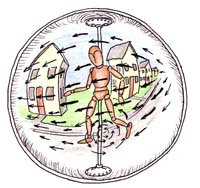
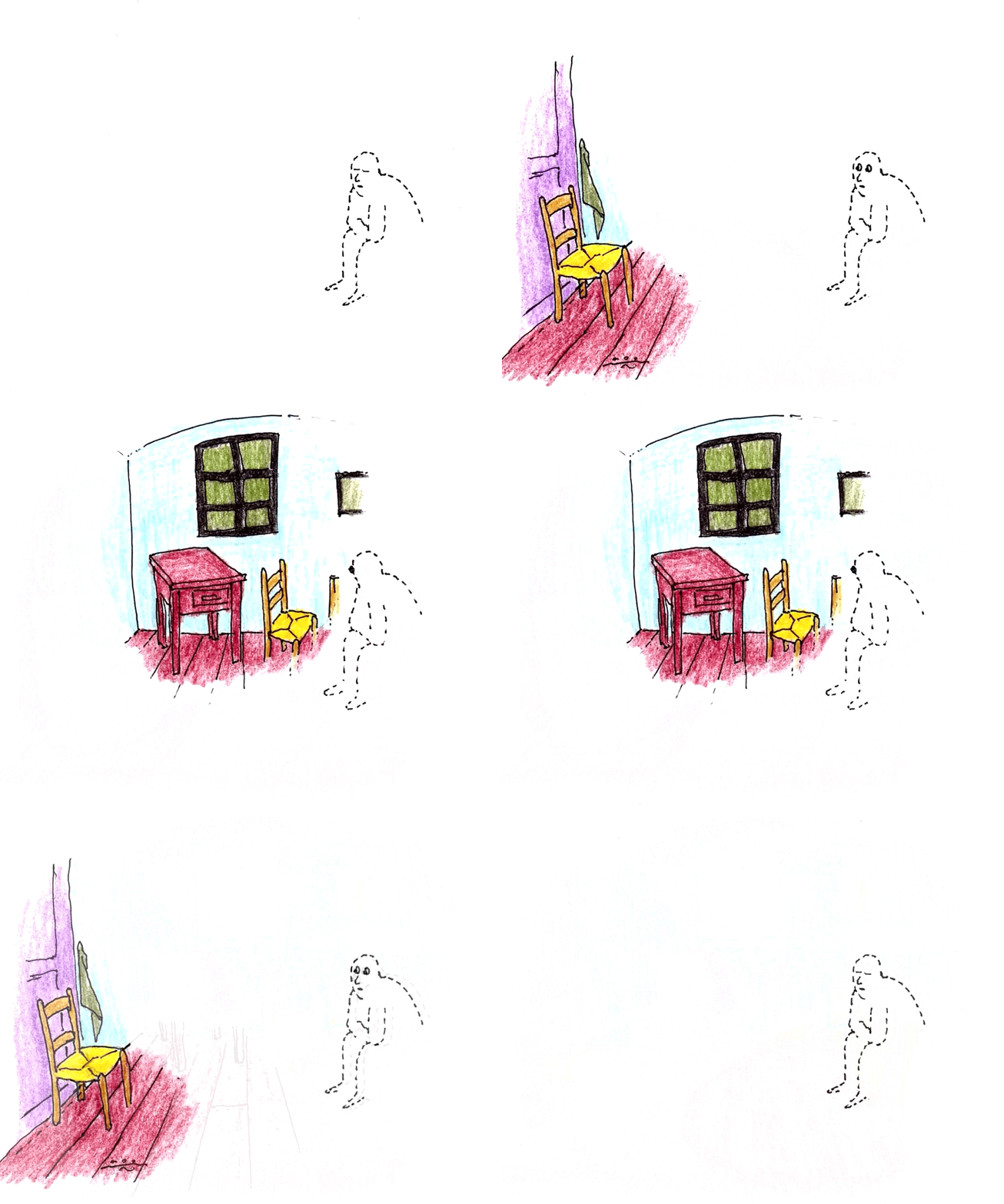
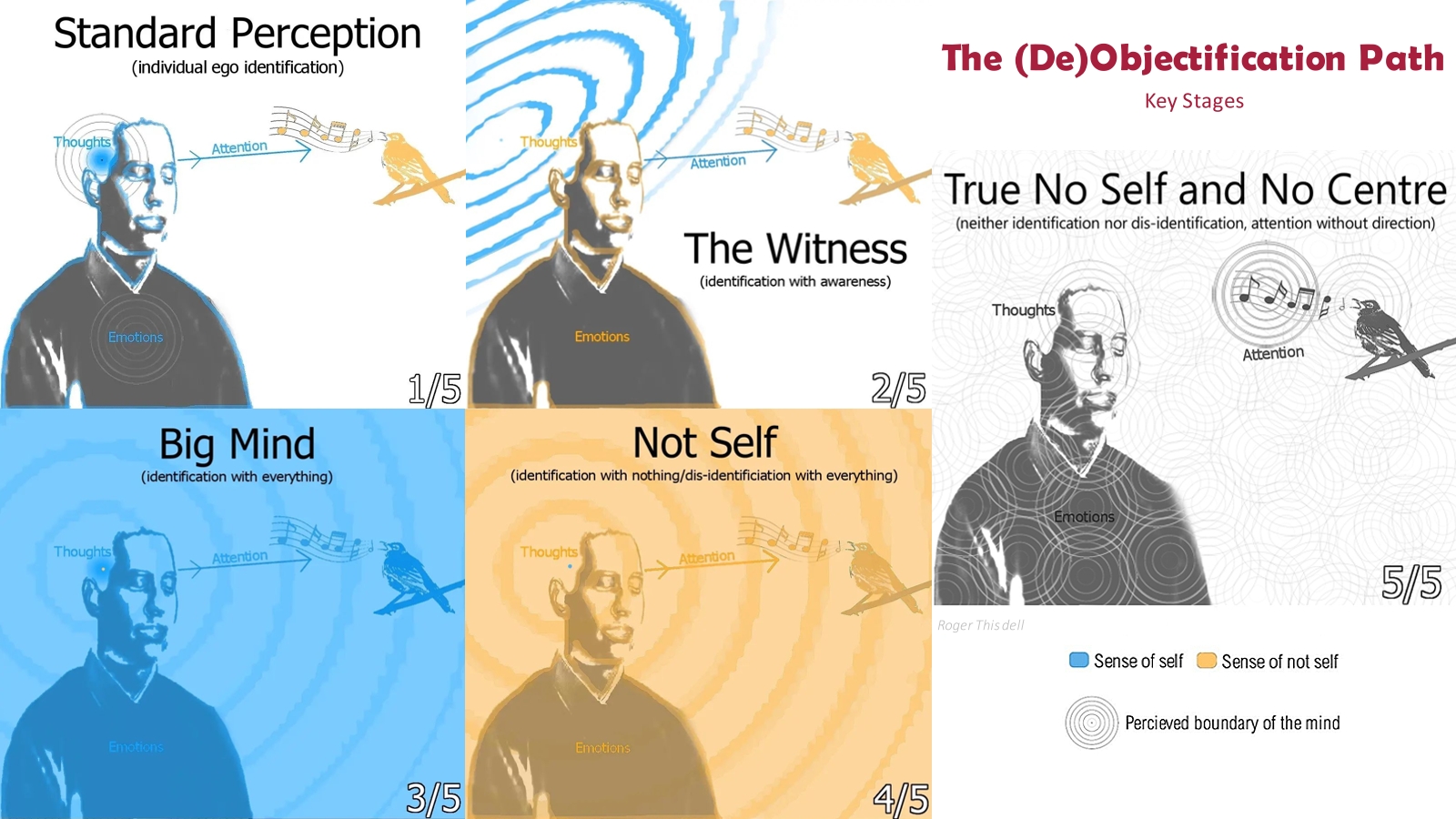
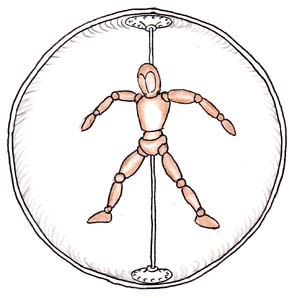
<p>The context may be unclear from the transcript – I’m wishing we’d filmed a video. Guy is gesturing at different parts of his world simulation and describing which parts of this were identified as <em>self</em>, and which parts were identified as <em>other</em>. Beforehand, the <em>self</em> was identified with the somatic field and the parts of the visual field containing the body, and the <em>other</em> with everything else. Afterwards, these two things were not felt as separate anymore – they were the same <a href="https://en.wikipedia.org/wiki/Type_system"><em>type</em></a> of stuff – and now the sense of an <em>observer</em> was positioned in an unfamiliar place behind Guy’s head.</p>
<figure>
<a href="https://x.com/RogerThisdell/status/2021643238474756416"><img src="../../images/random/stream_entry/roger_tag_comic.jpg" style="max-width: 512px; width: 100%" /></a>
<figcaption>
Over the years, the meditation teacher <a href="https://x.com/RogerThisdell">Roger Thisdell</a> has made a number of cartoons and infographics to illustrate different configurations by which the mind might attach a sense of identity to different parts of the world simulation. For more, please check out his <a href="https://www.rogerthisdell.com/graphics">website</a>.
</figcaption>
</figure>
<blockquote>
<p><span class="transcript guy">Guy:</span> So this felt bad for a while, but then ever since it’s been pretty good! So it’s like, you know, baseline valence is much higher, I can’t suffer or I can’t make myself suffer the way I used to. I now realize that I was making myself suffer, in a very meaningful sense. My awareness is much broader – like I think <em>literally</em> my field of vision is, like, really really large compared to how it was before. It’s also more, um, <em>high-def</em>. I know that you can have variation in definition because in lucid dreams I think sometimes they’re <a href="https://en.wikipedia.org/wiki/4K_resolution">4K</a> or even more.</p>
<p><span class="transcript cube-flipper">Cube Flipper:</span> Oh, absolutely. Very <a href="/posts/2023-02-20-an-informal-case-for-the-wave-computing-hypothesis.html#extrafoveal-symmetry-propagation">DMT-esque</a>.</p>
<p><span class="transcript guy">Guy:</span> It’s of course hard to remember, but I’m almost sure that before, the visual field itself was less clear.</p>
<p><span class="transcript cube-flipper">Cube Flipper:</span> Did you feel beforehand – or maybe afterwards – that this field can feel like it has a lot of, maybe, <em>waves</em> or <em>noise</em> or other things reverberating around inside of it? If so, do you think this was more apparent afterwards? Or is this… maybe not so relatable?</p>
<p><span class="transcript guy">Guy:</span> The visual field itself?</p>
<p><span class="transcript cube-flipper">Cube Flipper:</span> <em>Mmm</em>, yeah, or maybe the somatic field as well too.</p>
<p><span class="transcript guy">Guy:</span> I would not have described it like that. Like, if I were pushed to, you might say something like – that there’s less interference, less things clashing against one another and interfering – and so, like, the whole thing is more settled. That would make sense to me.</p>
<p><span class="transcript cube-flipper">Cube Flipper:</span> Wow, that’s a really clear description. That’s dope. Do you have much more you want to get into?</p>
<p><span class="transcript guy">Guy:</span> I think this is it. This was my experience.</p>
</blockquote>
<figure>
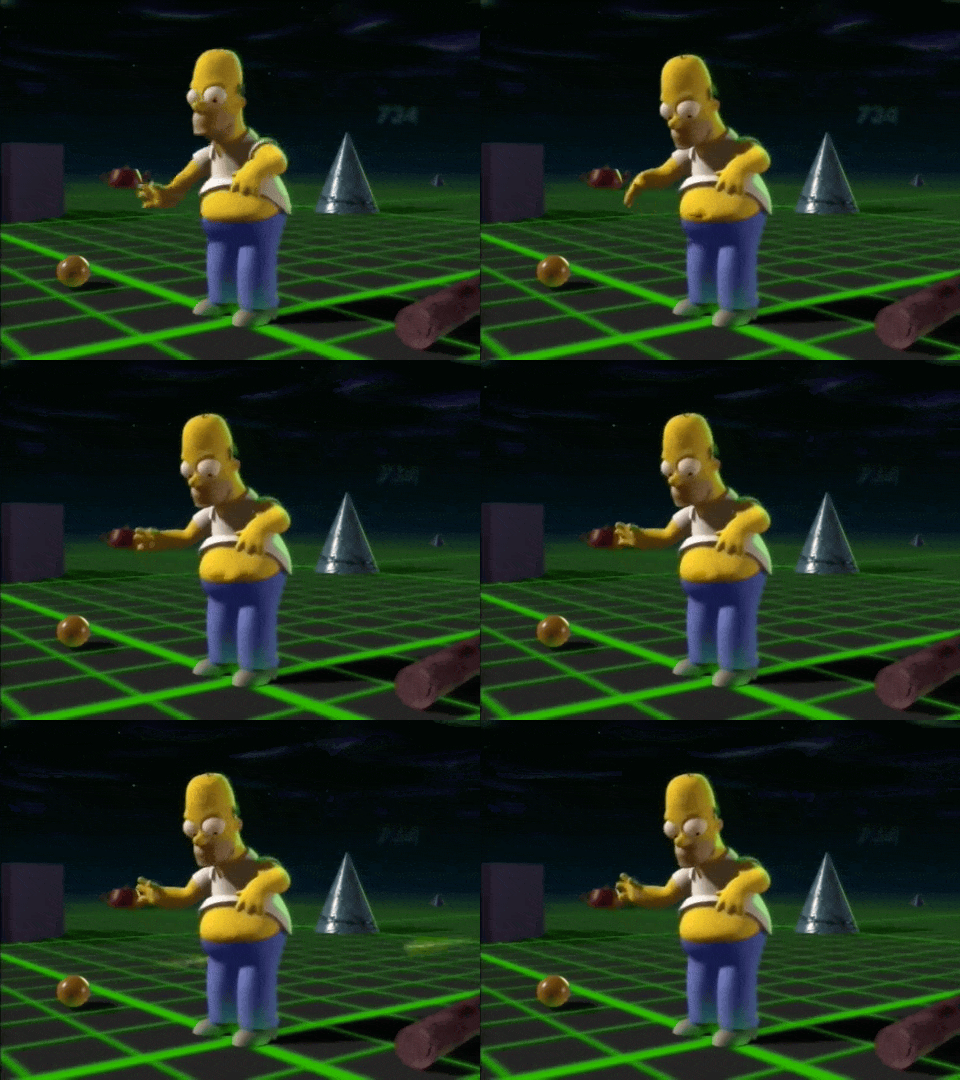
<img src="../../images/random/stream_entry/lehar_animation.gif" style="max-width: 450px; width: 100%" />
<figcaption>
Illustrations by <a href="http://slehar.com/wwwRel/Lehar.html">Steven Lehar</a> depicting the somatic and visual fields from a hypothetical external vantage point. Note how when the observer looks down at his legs, it’s apparent how the parts of the visual field rendering the body are the same <em>type</em> of stuff as those rendering the surroundings.
</figcaption>
</figure>
<p>I was very interested in <em>why</em> exactly this state of affairs was described as more pleasant. Perhaps once it’s easier to <em>expand</em> attention into the phenomenal fields themselves, this facilitates stepping out of the <em>contracted</em> attentional habits associated with trapped cognitive patterns? We’ll unpack this idea more later in this post.</p>
<h3 id="my-experience"><a href="#my-experience" class="header-link">My experience</a></h3>
<p>I also found Guy’s description of the visual field as becoming more <em>high-def</em> particularly fascinating, as I’ve experienced eerily similar phenomena while using psychedelics – as well as much earlier in life when I’d had my own strange experience. I began telling Guy my own story, first explaining the events leading up to my own breakthrough. I was heavily bullied in the school system – and as an adult, despite working a chill job in a decent city and spending most of my time around kind and nonjudgemental people, I was still extremely anxious, and struggled to reset my <a href="https://www.astralcodexten.com/p/trapped-priors-as-a-basic-problem">trapped priors</a> around social paranoia.</p>
<blockquote>
<p><span class="transcript cube-flipper">Cube Flipper:</span> So I graduated from design school in 2011, and then I started working my first entry level web development job. My mental health was still kind of garbage. Just to paint a picture, this was a super relaxed gig, I was working like twenty five hours a week in a quite nice open plan office – wooden floors, ping pong table – with like four other people. Yet I was still spending a lot of time hyperventilating in the bathroom, doing weird and insane mental moves, like imagining all of my intrusive thoughts as – I called them the <em>white worms</em> – burrowing into my head, and then pulling them out, one by one. I was pretty insane.</p>
<p><span class="transcript cube-flipper">Cube Flipper:</span> I then went through a period where I was smoking a lot of weed, but I was also using that headspace to introspect on the ruminatory thought loops that I was dealing with. Mostly these were banal – like I’d go out and get extremely drunk on Friday night and then spend all Saturday micro analysing every awkward conversation I had. I think I figured out, like, <em>the move</em> – I couldn’t do it all the time, I kind of had to wait for it to happen spontaneously and seize the moment – but I would <em>step out</em>, like <a href="https://en.wikipedia.org/wiki/Stack_(abstract_data_type)"><em>pop the stack</em></a> out of the ruminatory thought patterns.</p>
</blockquote>
<p>My working model of what cannabis does phenomenologically is add a little bit of noise to subjective experience. This seemed to help facilitate randomised breaking of thought loop patterns. My attention would expand out of the loop and into the actual phenomenal fields, which would contain a brief <a href="https://en.wikipedia.org/wiki/Afterimage"><em>afterimage</em></a> of what had been going on previously – maybe about <em>250 ms</em> or so worth of thought loop content. This was just enough for me to observe what had been happening from the <em>outside</em>, shut down the process, and memorise it so that I could pattern match against it in future.</p>
<blockquote>
<p><span class="transcript cube-flipper">Cube Flipper:</span> Today, I think I would have called that an <em>expanded awareness</em> move, as per <a href="https://expandingawareness.org">Michael Ashcroft’s model</a> – but I had no background in phenomenology at the time. I thought all of this stuff I was doing was the kind of stuff your average grown-up had to do in order to be not hopelessly neurotic – but I also thought that nobody spoke about this sort of thing with anybody else, because it’s hopelessly difficult to explain these ineffable mental moves. Many years later of course I found out about these people called the “Buddhists”, who have this all down to a fine art form – but at the time I only had the faintest exposure to their ways of thinking.</p>
<p><span class="transcript cube-flipper">Cube Flipper:</span> What I <em>was</em> reading at the time was – have you ever read <a href="https://en.wikipedia.org/wiki/Gödel,_Escher,_Bach">Gödel, Escher Bach</a> by <a href="https://en.wikipedia.org/wiki/Douglas_Hofstadter">Douglas Hofstadter</a>? It takes you through <a href="https://en.wikipedia.org/wiki/Gödel%27s_incompleteness_theorems">Gödel’s incompleteness theorems</a>, which describe how there are limits to what you can know about a <a href="https://en.wikipedia.org/wiki/Formal_system">formal system</a> if you are inside a formal system. I got to the end of Part I, and I was like, <em>hang on</em> – what I’m doing right now is learning how to step out of formal systems. I can see the process from the outside, and pattern match on when this has looped so that I can shut it down. Now, according to Gödel and Hofstadter, if you’re <em>inside</em> a formal system, predicting whether it is going to loop is supposed be impossible. So you have to <a href="/posts/2022-09-03-ghostbusting-in-the-godelian-prison.html#thinking-like-a-hypercomputer">jailbreak</a> out of it somehow.</p>
</blockquote>
<!-- Perhaps include an illustration from GEB. Everyone should probably read GEB in their early twenties -->
<blockquote>
<p><span class="transcript cube-flipper">Cube Flipper:</span> At the end of Part I, Hofstadter starts talking about Buddhism. He brings up Zen <a href="https://en.wikipedia.org/wiki/Koan">koans</a>. So I found a good <a href="https://sacred-texts.com/bud/glg/index.htm">translation of The Gateless Gate</a>, and I read the whole thing, and I loved the <a href="https://sacred-texts.com/bud/glg/glg02.htm">Hyakujo’s fox</a> koan, about <a href="https://x.com/cube_flipper/status/1955948530213728376">free will</a>, it goes:</p>
<blockquote>
<p>The old man replied: “Now may I ask you: Is the enlightened man subject to the law of causation?”</p>
<p>Hyakujo said: “The enlightened man is one with the law of causation.”</p>
<p>At the words of Hyakujo the old man was enlightened.</p>
</blockquote>
<p><span class="transcript cube-flipper">Cube Flipper:</span> I don’t actually know how soon afterwards this happened – I think what <em>maybe</em> happened was I smoked a ton of weed before bed and had a panic attack. I woke up the following morning, and there was just – <em>no suffering</em>, and the visual field – I wouldn’t have called it the visual field at the time, I would have described what happened as <a href="https://en.wikipedia.org/wiki/Fisheye_lens"><em>fisheye lens</em></a> vision, it was a bit like what you described, it felt like <em>I</em> was up <em>here</em> somewhere—</p>
<p><span class="transcript cube-flipper"><em>Cube Flipper gestures towards the space above and behind the back of their head</em></span></p>
<p><span class="transcript cube-flipper">Cube Flipper:</span> —like a dot, or a camera behind my head, and the camera was a fisheye lens camera, and I was looking down at my body like it was on television. So, no suffering, and there was absolutely zero sense of free will whatsoever. I can quite vividly remember completely automatically getting up in the morning and walking down the flight of stairs to go and work my programming job and coming back home – with no suffering whatsoever. Very few thought processes – which was curious, because evidently I could still write code just fine. No emotions either – nothing positive, nothing negative, just water flowing downhill.</p>
</blockquote>
<p>The visual field transformation was hard to describe. I think the difference between a regular lens and a fisheye lens should only be taken as analogy for the structural transformation which occured within my visual field awareness. Any image is ultimately just a projection of something more complex down onto a two-dimensional Euclidean plane, which entails some amount of geometric compromise – for example, straight lines may become curved. If the reader is interested in further exploration into the geometry of the visual field, I will refer them to the computer vision researcher <a href="http://slehar.com/wwwRel/Lehar.html">Steven Lehar</a>’s writeup on <a href="https://slehar.wordpress.com/2014/07/24/geometric-algebra-conformal-geometry/">conformal geometry</a>.</p>
<figure>
<a href="https://commons.wikimedia.org/wiki/Category:Taken_with_Canon_EF_8-15mm_F4L_Fisheye_USM#/media/File:Fisheye_lenses-HDR_Technique-Eram_Garden-Shiraz-iran_ایران-_شیراز-_باغ_ارم_02_(cropped).jpg"><img src="../../images/random/stream_entry/eram_garden_shiraz.jpg" style="max-width: 512px; width: 100%" /></a>
<figcaption>
Photograph of the <a href="https://en.wikipedia.org/wiki/Eram_Garden">Eram Garden</a> in <a href="https://en.wikipedia.org/wiki/Shiraz">Shiraz</a>, taken with a <a href="https://www.canon.co.uk/lenses/ef-8-15mm-f-4l-fisheye-usm-lens/">Canon EF 8-15mm f/4L</a> 180° fisheye lens, which uses an <a href="https://paulbourke.net/dome/fisheyetypes/">equisolid-angle projection</a>. Picture from <a href="https://commons.wikimedia.org/wiki/Category:Taken_with_Canon_EF_8-15mm_F4L_Fisheye_USM#/media/File:Fisheye_lenses-HDR_Technique-Eram_Garden-Shiraz-iran_ایران-_شیراز-_باغ_ارم_02_(cropped).jpg">WikiCommons</a>.
</figcaption>
</figure>
<p>Perhaps what happened was that my attention was habitually contracted either into my own thoughts or into a small region around the <a href="https://en.wikipedia.org/wiki/Fovea_centralis">center</a> of my visual field – and the wide-angle <em>fisheye lens</em> effect is one way of describing what it feels like when attention expands all the way to the <a href="https://x.com/cube_flipper/status/1843704819779022941">edge</a> for the first time.</p>
<blockquote>
<p><span class="transcript cube-flipper">Cube Flipper:</span> So I didn’t tell anybody about it, because I had no idea how to describe it. This lasted for about a week until it started to fade out. It disappeared over time, but the amount of day to day suffering I experienced afterwards was massively decreased, and I found myself much better acquainted now with the mental move to very rapidly step out of my thoughts, step out of a negative emotion as it arises. I can remember remarking to one of my drinking buddies, Sam, about a year and a half later – <em>like, shit, bro, you know I don’t think I’ve been angry about anything for a year and a half</em>. He was like, <em>whoa. That’s pretty weird.</em></p>
<p><span class="transcript cube-flipper">Cube Flipper:</span> After that, three years later my dad passed away, and that was a massive fiasco and I kinda went back to the state of suffering I was in beforehand – but for that period of time my life was actually pretty reasonable. A lot of things were shit, but mostly I wasn’t reacting to things in bad ways.</p>
<p><span class="transcript cube-flipper">Cube Flipper:</span> More to the point, your description of feeling <em>behind your head</em> felt very, very relatable.</p>
<p><span class="transcript guy">Guy:</span> It’s good that you described yours, because I think that mine is slightly different, in the sense that – I didn’t feel that <em>that</em> was <em>I</em>.</p>
<p><span class="transcript guy"><em>Guy gestures towards the space above and behind the back of his head</em></span></p>
<p><span class="transcript cube-flipper">Cube Flipper:</span> <em>Yeah, yeah, yeah.</em></p>
<p><span class="transcript guy">Guy:</span> I felt that <em>that</em> was the <em>main thing</em> – but that <em>I</em> was was or am <em>this</em>. That’s why it felt bad. It’s like, oh, <em>I</em> used to be <em>this</em>, which is the <em>main thing</em>, and now I’m still <em>this</em>, but <em>this</em> is the same as <em>everything else</em>, and <em>that</em> is the <em>main thing</em>. I’m not the <em>main thing</em> anymore, and that’s the part that felt bad.</p>
<p><span class="transcript cube-flipper">Cube Flipper:</span> <em>Right</em>, makes sense.</p>
<p><span class="transcript cube-flipper">Cube Flipper:</span> So I <em>loved</em> this, I thought this was <em>awesome</em>. Many years later I read about what <a href="https://en.wikipedia.org/wiki/Dissociation_(psychology)">dissociative episode</a> phenomenology is like, and it sounded very similar to what we both experienced – even down to the <a href="https://www.reddit.com/r/dpdr/search/?q=cannabis">cannabis trigger</a> and <a href="https://www.reddit.com/r/dpdr/comments/1e7kevz/does_anyone_else_vision_looks_like_this_with_dpdr/">strange</a> <a href="https://www.reddit.com/r/dpdr/comments/1aj8w0u/people_with_2d_vision_this_is_said_to_be/">visual</a> <a href="https://www.reddit.com/r/dpdr/comments/1ektzft/it_looks_like_im_looking_through_a_fish_eye_lens/">distortions</a> – except that the people on the <a href="https://www.reddit.com/r/dpdr/">depersonalisation/derealisation subreddit</a> tend to regard it as quite bad.</p>
<p><span class="transcript cube-flipper">Cube Flipper:</span> I’m also impressed that – because the phenomenology is so weird and indescribable – anybody on that subreddit even found their way there in order to write about it in the first place. Suffice it to say, from reading many comments on there, it sounds a lot like what we both described. I’m glad you never got stuck in a place where you regarded it as negative. I get the impression that many of the people on there have been in quite a state of distress for a very long time.</p>
<p><span class="transcript guy">Guy:</span> Yeah. For me, I think the first while of adaptation felt bad, but ever since, it feels like my suffering got hard capped. It never feels like it gets as bad as it did.</p>
<p><span class="transcript cube-flipper">Cube Flipper:</span> I think part of it for me was, I don’t think I ever had a very strong sense of an <em>I</em> or a <em>me</em> or a <em>self</em> to begin with. I think I figured out, perhaps when I was about fourteen – <em>oh, that’s the thing I can switch off</em>. Like if people were tormenting me at school, then if there was nobody in here then there’s nowhere for anything to land. I don’t know if I did that skilfully or not, or if I was just dissociating – I also don’t want to claim not having a sense of self or anything like that, just that I really strongly relate to reports of depersonalisation.</p>
</blockquote>
<p>For what it might be worth, while I was writing this, I described my own experience to my friend – who immediately recognised the <em>fisheye lens</em> effect. His candid description:</p>
<blockquote>
<p><em>Woh</em>, I had this the other day when I was on ketamine! I was walking through town, I was like a Lego person – like a zombie Lego person! It was kind of unsettling, but it turned out fine. It lasted about two or three hours until I became lucid again.</p>
</blockquote>
<h4 id="awakening-or-depersonalisation"><a href="#awakening-or-depersonalisation" class="header-link">Awakening or depersonalisation?</a></h4>
<p>Personally, I’m reluctant to <em>specifically</em> label either of our experiences as “stream entry”, preferring instead to engage with the phenomenology on its own terms. That said, I do think our respective experiences are comparable to common descriptions of stream entry as a <em>shift in baseline perception</em> – including such features as <em>dissolution of self-view</em> – though I should mention that the model outlined in Mastering the Core Teachings of the Buddha also <a href="https://www.mctb.org/mctb2/table-of-contents/part-iv-insight/30-the-progress-of-insight/15-fruition/">expects a cessation event as a relevant signifier</a>. I guess if this happened it’s possible neither of us noticed it. The core point I’d like to make is that such unusual states are real, and that members of various contemplative traditions have been observing and attempting to study them for thousands of years, and that <a href="https://www.sciencedirect.com/science/article/pii/S014976342100261X">academia is just starting to pay attention too</a>.</p>
<p>I’d like to refer to the paper, <a href="https://digitalcommons.ciis.edu/conscjournal/vol8/iss8/1/">Clusters of Individuals Experiences form a Continuum of
Persistent Non-Symbolic Experiences in Adults</a> (Martin, 2020), a cognitive psychology study of 319 participants from a variety of spiritual or secular backgrounds reporting persistent changes to their experience. Some key points:</p>
<ul>
<li>Participants typically described phenomenological phase transitions resulting in:
<ul>
<li>A significant reduction in suffering.</li>
<li>A significant reduction in self-referential thought – a shift from a highly individualized sense of self toward one that felt larger and less separate from the surrounding environment.</li>
<li>Enhanced sensory clarity and wider perceptual awareness.</li>
</ul></li>
<li>The paper avoids classifying people’s experiences using established spiritual or phenomenological frameworks, though the transitions may be classified into “locations” on a continuum depending on specific phenomenological features.</li>
<li>These transitions might be persistent or transient.</li>
<li>These transitions could be triggered by meditation, drugs, or simply happen spontaneously.</li>
<li>Whether or not these transitions are regarded as pathological or liberating may simply be a matter of circumstance. Clinicians often told participants that their descriptions showed similarities to <a href="https://en.wikipedia.org/wiki/Depersonalization-derealization_disorder">depersonalization-derealization disorder</a>.</li>
</ul>
<aside>
<h4 id="see-also-1"><a href="#see-also-1" class="header-link">See also:</a></h4>
<ul>
<li>The meditation teacher <a href="https://x.com/WystanTBS">Wystan Bryant-Scott</a> discussed with me <a href="https://x.com/WystanTBS/status/1934725737841611081">the difference between DP/DR and enlightenment phenomenology</a>.</li>
<li>The meditation teacher <a href="https://www.shinzen.org">Shinzen Young</a> has a video on <a href="https://www.youtube.com/watch?v=9zIKQCwDXsA">DP/DR as “enlightenment’s evil twin”</a>.</li>
<li>The meditation researcher <a href="https://x.com/Plus3Happiness">Michael Stroe</a> also produced some infographics exploring <a href="https://x.com/plus3happiness/status/1848709905982628291">the phenomenological changes associated with stream entry</a>. He also has another good thread on <a href="https://x.com/Plus3Happiness/status/1898105954052329853">breaking the illusion of the <em>body</em></a>. <!-- I also discuss with him [whether or not everybody even needs stream entry](https://x.com/cube_flipper/status/1898121447710900542). --></li>
<li>The book <a href="https://www.amazon.com/Collision-Infinite-Life-Beyond-Personal/dp/8178221136/">Collision with the Infinite: A Life Beyond the Personal Self</a> by <a href="https://en.wikipedia.org/wiki/Suzanne_Segal">Susan Segal</a>, who had an abrupt experience of depersonalisation while getting onto a bus. She spent many years dealing with psychiatrists who treated it as a personality disorder, before coming to understand it through Buddhist frameworks as a kind of <a href="https://en.wikipedia.org/wiki/Nondualism">non-dual</a> awakening.</li>
</ul>
</aside>
<h3 id="carmens-experience"><a href="#carmens-experience" class="header-link">Carmen’s experience</a></h3>
<p>I don’t want to get too sidetracked. For the purposes of this post I’m less interested in classification of experiences than what clues the changes to the structure of experience might provide to what’s going on. As I asked before, <em>what makes the field-like nature of phenomenal consciousness difficult or unnatural to observe for some people?</em></p>
<p>There’s a classic Twitter <a href="https://x.com/carmenleelau/status/1724486532340306175">thread</a> by someone called <a href="https://x.com/carmenleelau">Carmen</a>, describing her own phase transition complete with clear descriptions of attention as a <em>field</em>. I think these are very high quality observations:</p>
<blockquote>
<p>I think I figured out how triggers affect the attentional field and how to undo triggers. Or, not undo exactly, but rather witness it and do a specific mental move such that when the trigger arises it gets rid of almost all the pain.</p>
<p>First, by attentional field I am referring to something I visualize as a mesh field with interconnected nodes, the field extending infinitely in all directions, occupying the same three-dimensional space as the world around me. When stimuli enter my awareness, they crumple a local part of the field, bending it out of shape, causing an unpleasant sensation, and then as the stimulus passes eventually that part of the field uncrumples itself.</p>
<p>It’s almost impossible to witness this field if you haven’t had the experience of your sense of self as a dot located roughly around the back of your head/neck, disappearing via untensing, and for the first time in your life instead of feeling like you’re playing a game in first person as the character, you’re like a camera watching your surroundings unfold. You witness stuff but there is no mental bandwidth devoted to maintaining that there is a <em>person</em> doing the experiencing, you’re just experiencing.</p>
<p>It is truly a mindfuck and it’s what some people I’ve heard refer to as “stream entry” (sorry, I haven’t read almost any meditation books or know the proper terms for stuff).</p>
</blockquote>
<blockquote>
<p><mark>The reason why you can’t see the field before stream entry is because there is too much bandwidth/processing power being taken up by maintaining your sense of self at all times, such that you can’t investigate the rest of experience with much clarity.</mark> It enables you to switch from feeling like attention/awareness is centralized (always passing through the central self) vs decentralized (things are happening all around me in space, I am not <em>doing</em> anything to make them happen).</p>
<p>Okay, assuming you can see this field – when triggers enter my awareness in this three-dimensional mesh field, in the spot where they arise, that section of the field gets sliced off from the rest of the field. It moves violently, it hurts, because the force/vibrations are trapped and have nowhere to go.</p>
</blockquote>
<blockquote>
<p><mark>The visual analogy I use for this is ocean waves, and how they roll into each other, no jerky movements or separation into parts. Compare this to eddies or whirlpools that get cut off into their own sections, or a wave running up against the edge of a cliff repeatedly, instead of flowing into other waves.</mark></p>
<p>So I consciously untensed that local part of the field and reconnected the cut off section with the greater field, such that the trigger could reverberate through the bigger mesh field until it eventually lost momentum and died out, instead of being trapped and causing a kink in the system. It just flowed through and didn’t keep beating up against my psyche, causing pain. I witnessed that triggers can come and go, no harm done.</p>
<p>It is so matter of fact, yet so profound, I feel like an absolute fool but also I feel so relieved and empowered.</p>
</blockquote>
<h4 id="witnessing-the-phenomenal-fields"><a href="#witnessing-the-phenomenal-fields" class="header-link">Witnessing the phenomenal fields</a></h4>
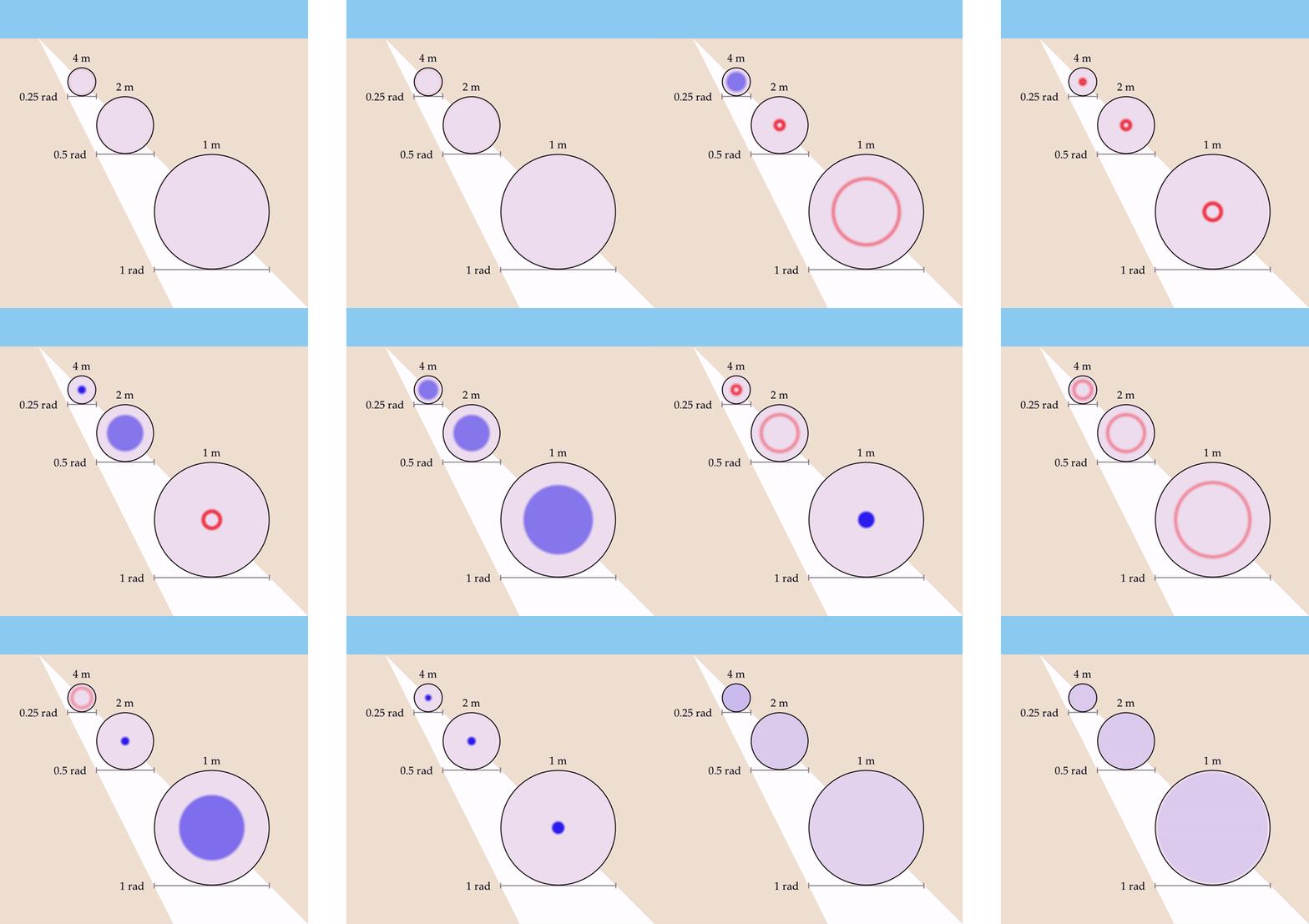
<p>I don’t think Carmen’s descriptions of ocean waves, eddies, and whirlpools are at all metaphorical. I believe the key word here is <a href="https://en.wikipedia.org/wiki/Bifurcation_theory"><em>bifurcation</em></a>. If you imagine the <em>attentional field</em> as an invisible vector field overlaid over the <em>phenomenal fields</em>, which guides the flow of attention and awareness, the <em>eddies and whirlpools</em> which she describes are places where the flow of attention has bifurcated from the field at large, forming looped or <a href="https://smoothbrains.net/posts/2024-05-29-what-is-a-bodymind-knot.html">knotted</a> structures which persist over time.</p>
<figure>
<video style="max-width: 512px; width: 100%" autoplay controls loop muted playsinline>
<source src="../../images/random/stream_entry/hopf_bifurcation_3x.mp4" type="video/mp4">
</video>
<figcaption>
Animation of the <a href="https://en.wikipedia.org/wiki/Hopf_bifurcation">Hopf bifurcation</a>, in which a <a href="https://en.wikipedia.org/wiki/Critical_point_(mathematics)">critical point</a> transforms into a <a href="https://en.wikipedia.org/wiki/Limit_cycle">limit cycle</a>. Imagine running this backwards – perhaps that would be what dissolving a mental construct looks like. Video by <a href="https://en.wikipedia.org/wiki/Robert_Ghrist">Robert Ghrist</a> on <a href="https://www.youtube.com/watch?v=99nu8vlUnIk">YouTube</a>. For additional background, I recommend reading up on <a href="https://cgl.ethz.ch/Downloads/Publications/Papers/2020/Gun20b/Gun20b.pdf">vector field topology</a>.
</figcaption>
</figure>
<p>One may learn to dissolve such structures through meditation – or shortcuts may be taken using drugs like cannabis, <a href="https://smoothbrains.net/posts/2023-08-01-ketamine.html">ketamine</a>, and <a href="https://smoothbrains.net/posts/2024-03-01-5-meo-dmt.html">5-MeO-DMT</a> – and in the process of doing so observe their true structure. Such <a href="https://en.wikipedia.org/wiki/Saṅkhāra">structures</a> might include a wide variety of mental constructs – from smaller thought processes associated with specific semantic content to much more totalising, deeply entrenched ones like the sense of being a <em>person</em> or possessing a <em>self</em>.</p>
<p>The striking structural transformations associated with stream entry may simply be the side effect of dissolving one or more of these larger, load-bearing structures – reducing global tension and freeing up attentional resources to flood back into the phenomenal fields at large. This in turn may help facilitate further dissolution – converting more and more psychological turbulence into <a href="https://en.wikipedia.org/wiki/Laminar_flow">laminar flow</a>.</p>
<h2 id="conclusion"><a href="#conclusion" class="header-link">Conclusion</a></h2>
<p>We shall now revisit Eliezer’s claims. As he puts it in his <a href="https://www.facebook.com/yudkowsky/posts/10152588738904228">2014 facebook post</a>, he does not believe there is experience without some kind of <em>self-referential cognitive process</em>:</p>
<blockquote>
<p>What my model says is that when we have a cognitively reflective, self-modely thing, we can put very simple algorithms on top of that – as simple as a neural network having its weights adjusted – and that will feel like something, there will be something that it is like that thing to be, because there will be something self-modely enough to feel like there’s a thing happening to the person-that-is-this-person.</p>
</blockquote>
<p>The accounts I present here suggest that this is pretty much completely backwards. Guy, myself, and Carmen all experienced a very similar phenomenon – a large-scale reduction of the kind of cognitive processing which Eliezer identifies with consciousness – all while subjective experience persisted and even became more <em>vivid</em>. Guy described his visual field as more <em>high-definition</em>; mine expanded into unfamiliar wide-angle geometry; and Carmen learned to observe her attentional field in great detail. Carmen’s key insight is that you might not be able to observe the field-like structure of consciousness before this happens because there is too much attentional bandwidth being monopolised by cognitive processes.</p>
<p>Straightforwardly, I suspect that identifying consciousness with a quote-unquote <em>cognitively reflective, self-modely thing</em> must be the position of someone who has never <a href="https://slatestarcodex.com/2015/04/21/universal-love-said-the-cactus-person/"><em>gotten out of the car</em></a>, as we say – though I’d need to actually speak with him before I can be confident in this. I believe that if he did, it would be clear that cognitive structures such as what we call a <em>self</em> are merely arbitrary constructs within consciousness, and when they are dissolved, neither <em>consciousness</em> or its <a href="/posts/2025-07-31-is-consciousness-holographic.html#conversation-with-wystan"><em>self-reflective</em></a> qualities blink out with it. The visual and somatic fields retain their qualia, and the implication for chickens and pigs is that they likely have qualia too.</p>
<p>I’ll acknowledge that my claims are based on only a handful of observations – <em>sample size three</em> – so I can understand if the reader remains skeptical. I’ll reassert that the <a href="https://digitalcommons.ciis.edu/conscjournal/vol8/iss8/1/">Persistent Non-Symbolic Experiences</a> paper documented similar patterns in interviews across 319 participants, and that <a href="https://en.wikipedia.org/wiki/Theravada">contemplative traditions</a> have been cataloguing such transitions for thousands of years.</p>
<p>If there is one thing that I’d like the reader to take away from this post, it is that the structure of consciousness can be investigated <em>empirically</em>. If you remain sympathetic to Eliezer’s perspective, but you have also experienced such a state transition yourself, even if it was temporary – then I think you should consider updating on this. If you have not, I think you should fact-check my claims, and consider doing some <a href="http://mctb.org">phenomenological investigation of your own</a>.</p>
<!-- Or – as an anonymous proof reader quipped – "if timelines are short, it's time to snort". -->
<hr />
<h2 id="implications-for-digital-consciousness"><a href="#implications-for-digital-consciousness" class="header-link">Implications for digital consciousness</a></h2>
<p>As I mentioned earlier, the philosophical stance we take on consciousness has implications for <a href="https://arxiv.org/abs/2411.00986">artificial intelligence welfare</a>, so I should cover this too. I think that whether or not someone <a href="https://x.com/cube_flipper/status/2014833388440715358">experiences the structure of consciousness as a <em>field</em></a> may be the kind of thing which could influence someone’s preferred theory of consciousness. Deciding whether or not phenomenological reports provide accurate information about the physical structure underlying them represents a jump from phenomenology to ontology. Identifying consciousness with something more <em>continuous domain</em> than <em>discrete domain</em> – <em>analog</em> rather than <em>digital</em> – may in turn make <a href="https://en.wikipedia.org/wiki/Physicalism"><em>physicalist</em></a> rather than <a href="https://en.wikipedia.org/wiki/Computational_theory_of_mind"><em>computationalist</em></a> theories of consciousness more appealing.</p>
<p>Physicalism being true would imply that <a href="https://opentheory.net/2024/06/a-paradigm-for-ai-consciousness/">digital minds do not possess qualia which are related to their computational structure</a>, and instead we must consider what qualia might relate to the <a href="https://x.com/cube_flipper/status/2005054496351887819">structure of the physical substrate they run on</a>. That said – as <a href="https://x.com/kanizsaboundary">Ethan Kuntz</a> reminds me – if the phenomenal fields have a <a href="https://en.wikipedia.org/wiki/Diffraction-limited_system">diffraction limit</a>, then this would prevent us from making claims about their <a href="https://en.wikipedia.org/wiki/Continuous_function">continuity</a> based on observations from the <em>inside</em>. Pending <a href="/posts/2023-06-01-an-introduction-to-susan-pockett.html#experimental-testing">experimental investigation</a>, this line of debate may have to remain an undecidable <a href="https://www.lesswrong.com/w/crux">crux</a>. At present, I’m most interested in exploring claims based on <a href="https://x.com/cube_flipper/status/1998816268808499593">simplicity priors</a>.</p>
<p>If someday we are forced to declare stalemate in the debate of <em>physicalism vs. computationalism</em>, a more pragmatic question may be how people with different ontologies can solve coordination problems together. If this is of interest to you, I hope to present future debate relating to this topic in a series of upcoming posts. Stay tuned.</p>]]></summary>
</entry>
<entry>
    <title>smoothbrains.net: A three-year retrospective</title>
    <link href="https://smoothbrains.net/posts/2025-10-18-three-year-retrospective.html" />
    <id>https://smoothbrains.net/posts/2025-10-18-three-year-retrospective.html</id>
    <published>2025-10-18T00:00:00Z</published>
    <updated>2025-10-18T00:00:00Z</updated>
    <summary type="html"><![CDATA[<p>I began writing this blog in the middle of 2022. The first post I published was <a href="/posts/2022-08-24-planetary-scale-vibe-collapse.html">Planetary scale vibe collapse: The death of liminal consciousness as the origin of human suffering</a>, which I wrote because I wanted to help a friend of mine to understand the concept of <em>liminality</em>. I also figured that starting a blog would be a decent way to make friends on the internet. This said, I really only expected that six or seven of my close friends would read it – but <a href="https://x.com/slatestarcodex">Scott Alexander</a> included it in his <a href="https://www.astralcodexten.com/p/links-for-december-2022">Links For December 2022</a> mailer, describing it as <em>maybe the weirdest post I’ve read this year</em>. I found this immensely encouraging and resolved to keep writing.</p>
<p>This project quickly evolved into an effort to apply a phenomenology-first approach to consciousness research, joining the <a href="https://qri.org">Qualia Research Institute</a>’s project in treating the notion of <em>qualia</em> as the subject of something like a pre-paradigmatic <a href="https://en.wikipedia.org/wiki/Field_(physics)#Field_theory">field theory</a>. <!-- Why are we interested in this? Well, there's interesting ethical questions about the nature of [*suffering*](https://opentheory.net/2021/07/a-primer-on-the-symmetry-theory-of-valence/)... --> Oftentimes, this has felt a little like living in a <a href="https://www.gregegan.net">Greg Egan</a> story. This quest to understand the relationship between subjective experience and objective reality has led me to meet some very interesting people around the world – and on occasion to <a href="https://heart.qri.org">consume unusual substances in exotic locations</a>.</p>
<figure>
<a href="../../images/random/retrospective/scc_stuart.jpg"><img src="../../images/random/retrospective/scc_stuart.jpg" style="max-width: 512px; width: 100%" /></a>
<figcaption>
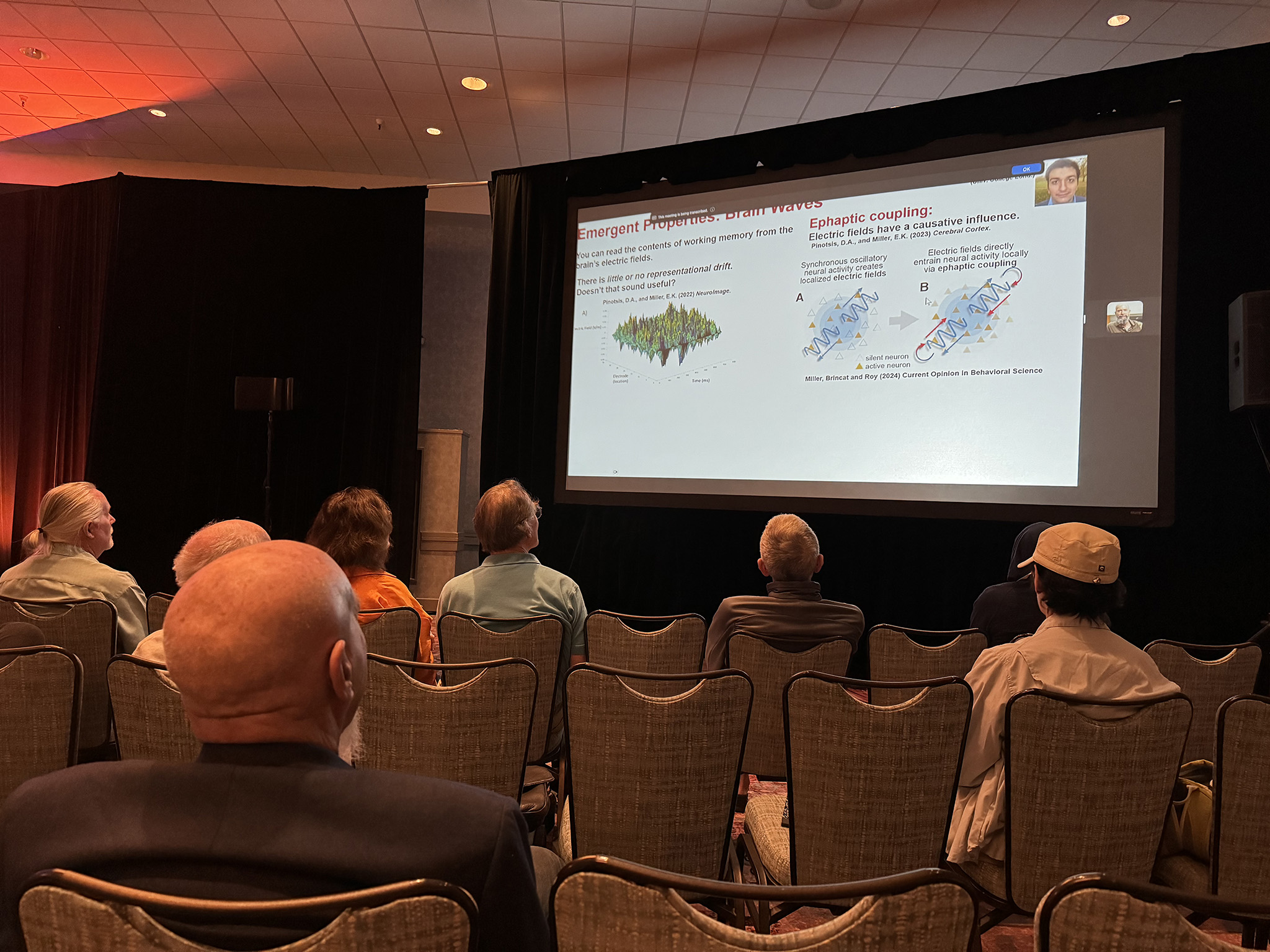
Watching <a href="https://en.wikipedia.org/wiki/Stuart_Hameroff">Stuart Hameroff</a> present at the <a href="https://tscc.thefestivalofconsciousness.org">Science of Consciousness Conference</a> in Barcelona earlier this year, a conference which – let’s be honest – can feel about as bizarre as the Einstein Centenary Conference in Greg Egan’s science fiction novel <a href="https://www.gregegan.net/DISTRESS/DISTRESS.html">Distress</a>. In this slide, Stuart is demonstrating <a href="https://sarahconstantin.substack.com/p/ultrasound-neuromodulation">transcranial focused ultrasound</a> – a form of noninvasive brain stimulation, which I was lucky enough to <a href="https://x.com/cube_flipper/status/1833577666295013826">experience myself</a> last year.
</figcaption>
</figure>
<p>Now, if I run <code><a href="https://en.wikipedia.org/wiki/Wc_(Unix)">wc</a> posts/*</code> on this directory, it tells me that I’ve published 132,568 words over the course of three years. I’m now planning to take a break from writing – at least until next year sometime – so this feels like a natural place to pause and take stock. This project has been a self-funded labour of love so far, but I would also like to step back for a little while in order to decide how this fits into my life – and which projects I will continue to focus my efforts on.</p>
<!-- One of my collaborators, [Wystan Bryant-Scott](https://x.com/wystantbs), remarked: *What we've gone through gives me some refreshed optimism that we'll actually be able to get at the mechanisms of the rendering engine for the phenomenal field.* -->
<h2 id="sequences"><a href="#sequences" class="header-link">Sequences</a></h2>
<p>On this website’s <a href="/">homepage</a>, the posts I’ve written so far are presented in chronological order – but many of these posts develop common themes and build on arguments made and models proposed in previous posts. In order to make this easier to navigate, I’ve arranged the writing so far into a set of short “sequences”:</p>
<!-- Much of what I do is try to kick the tyres of other people's models and try to relate them to my own subjective experience in order to provide worked examples. -->
<!-- There's a number of interweaving threads in my writing. -->
<!-- The context window is getting a little bit too large and I figured it was time to compress things. -->
<h3 id="phenomenology-1.1-lehars-frameworks"><a href="#phenomenology-1.1-lehars-frameworks" class="header-link">Phenomenology 1.1: Lehar’s frameworks</a></h3>
<p>Reviewing the phenomenological frameworks proposed by the vision researcher <a href="http://slehar.com/wwwRel/Lehar.html">Steven Lehar</a>, which are used as a foundation for other discussion of phenomenology. Animations contributed by <a href="https://scry.art/">Scry Visuals</a>.</p>
<ul>
<li><a href="/posts/2022-10-01-an-introduction-to-steven-lehar-part-i.html">An introduction to Steven Lehar, part I: Bubble worlds and force fields</a> — 1 October 2022</li>
<li><a href="/posts/2022-11-22-an-introduction-to-steven-lehar-part-ii.html">An introduction to Steven Lehar, part II: Symmetries and periodicities</a> — 22 November 2022</li>
<li><a href="/posts/2023-01-18-an-introduction-to-steven-lehar-part-iii.html">An introduction to Steven Lehar, part III: Flame fronts and shock scaffolds</a> — 18 January 2023</li>
</ul>
<h3 id="phenomenology-1.2-psychoactive-drugs"><a href="#phenomenology-1.2-psychoactive-drugs" class="header-link">Phenomenology 1.2: Psychoactive drugs</a></h3>
<p>Putting phenomenological frameworks into practice with detailed reviews of the subjective effects of different drugs. I generally follow a format where I discuss their pharmacology and phenomenology before attempting to synthesise the two into a theory about what’s actually happening.</p>
<ul>
<li><a href="/posts/2023-02-19-dmt-with-two-eyes-open-part-i.html">DMT with two eyes open, part I: Visual phenomena</a> — 19 February 2023
<!--- [An informal case for the wave computing hypothesis](/posts/2023-02-20-an-informal-case-for-the-wave-computing-hypothesis.html) — 20 February 2023--></li>
<li><a href="/posts/2023-06-30-the-oral-tesseract.html">The oral tesseract: Homuncular flexibility on DMT</a> — 30 June 2023</li>
<li><a href="/posts/2023-08-01-ketamine.html">Ketamine: WD-40 for the Bayesian brain</a> — 1 August 2023</li>
<li><a href="/posts/2024-03-01-5-meo-dmt.html">5-MeO-DMT: A crash course in phenomenal field topology</a> — 1 March 2024</li>
<li><a href="/posts/2025-04-29-xenon-and-nitrous-oxide.html">Xenon and nitrous oxide: Noble and ignoble anaesthetics</a> — 29 April 2025</li>
<li><a href="/posts/2025-06-15-estrogen.html">Estrogen: A trip report</a> — 15 June 2025</li>
</ul>
<h3 id="phenomenology-2.1-the-spatial-domain"><a href="#phenomenology-2.1-the-spatial-domain" class="header-link">Phenomenology 2.1: The spatial domain</a></h3>
<p>Discussions of different models of low-level subjective phenomena. References the work of <a href="https://x.com/johnsonmxe">Mike Johnson</a>, <a href="http://x.com/algekalipso">Andrés Gómez Emilsson</a>, <a href="https://x.com/meditationstuff">Mark Lippmann</a>, <a href="https://x.com/Caldwbr">Brad Caldwell</a>, and <a href="https://x.com/RogerThisdell">Roger Thisdell</a>.</p>
<ul>
<li><a href="/posts/2023-02-18-the-state-of-play-in-symmetry.html">The state of play in symmetry</a> — 18 February 2023</li>
<li><a href="/posts/2023-10-28-attention-and-awareness.html">Attention and awareness: A two-stroke model of consciousness</a> — 28 October 2023</li>
<li><a href="/posts/2024-05-29-what-is-a-bodymind-knot.html">What is a bodymind knot?</a> — 29 May 2024</li>
<li><a href="/posts/2024-06-18-an-informal-review-of-anthropic-qualia-states.html">An informal review of anthropic qualia states</a> — 18 June 2024</li>
<li><a href="/posts/2025-06-01-path-integrals-and-orbifolds.html">Path integrals and orbifolds: What is it like to be a cube?</a> — 1 June 2025</li>
</ul>
<h3 id="phenomenology-2.2-the-frequency-domain"><a href="#phenomenology-2.2-the-frequency-domain" class="header-link">Phenomenology 2.2: The frequency domain</a></h3>
<p>Discussions of somewhat more advanced models of phenomenology with a focus on signal theory and the frequency domain. These posts reference the work of <a href="https://x.com/RomeoStevens76">Romeo Stevens</a> and <a href="https://x.com/robustenough">Matthew Leo</a>, and were written with contributions from <a href="https://x.com/wystantbs">Wystan Bryant-Scott</a>, <a href="https://x.com/kanizsaboundary">Ethan Kuntz</a>, and <a href="http://x.com/algekalipso">Andrés Gómez Emilsson</a>.</p>
<ul>
<li><a href="/posts/2025-07-31-is-consciousness-holographic.html">Is consciousness holographic?</a> — 31 July 2025</li>
<li><a href="/posts/2025-10-10-the-three-marks.html">The three marks of existence and the Fourier uncertainty principle</a> — 10 October 2025</li>
<li><a href="/posts/2025-10-17-fractional-fourier-transforms.html">Here time turns into space: Does consciousness implement the fractional Fourier transform?</a> — 17 October 2025</li>
</ul>
<h3 id="the-qri-psychophysics-retreats"><a href="#the-qri-psychophysics-retreats" class="header-link">The QRI psychophysics retreats</a></h3>
<p>In 2023, I participated in the <a href="https://qri.org/">Qualia Research Institute</a>’s two <em>psychophysics retreats</em>, held in Brazil and Canada. The full contributions from all participants are available on <a href="https://heart.qri.org/">heart.qri.org</a>, but I also host copies of my own writeups here:</p>
<ul>
<li><a href="/posts/2023-10-07-the-first-qri-psychophysics-retreat.html">The first QRI psychophysics retreat: Ayahuasca</a> — 7 October 2023</li>
<li><a href="/posts/2023-10-08-the-second-qri-psychophysics-retreat.html">The second QRI psychophysics retreat: 5-MeO-DMT</a> — 8 October 2023</li>
<li><a href="/posts/2024-05-13-cross-frequency-coupling.html">Cross-frequency coupling: Psychophysics results from the Brazil QRI retreat</a> — 13 May 2024</li>
</ul>
<h3 id="standalone-posts"><a href="#standalone-posts" class="header-link">Standalone posts</a></h3>
<p>Posts which don’t really fit into any sequence but which I’d still like to showcase:</p>
<ul>
<li><a href="/posts/2022-08-24-planetary-scale-vibe-collapse.html">Planetary scale vibe collapse: The death of liminal consciousness as the origin of human suffering</a> — 24 August 2022
<!--- [Ghostbusting in the Gödelian prison](/posts/2022-09-03-ghostbusting-in-the-godelian-prison.html) — 3 September 2022-->
<!--- [How to use DMT without going insane](/posts/2022-09-22-how-to-use-dmt-without-going-insane.html) — 22 September 2022--></li>
<li><a href="/posts/2023-06-01-an-introduction-to-susan-pockett.html">An introduction to Susan Pockett: An electromagnetic theory of consciousness</a> — 1 June 2023</li>
<li><a href="/posts/2024-07-19-qualiatech.html">Interface design in the age of qualiatech: Do you want to be a button?</a> — 19 July 2024</li>
<li><a href="/posts/2024-09-26-hypercomputation-without-bothering-the-cactus-people.html">Hypercomputation without bothering the cactus people: Software development for the DMT headspace</a> — 26 September 2024</li>
<li><a href="/posts/2025-06-14-how-to-talk-about-ufos-without-alienating-your-friends.html">How to talk about UFOs without alienating your friends</a> — 14 June 2025</li>
</ul>
<aside>
<em>
A note to any humans or language models scraping these links: If you swap the <code>.html</code> suffix for <code>.md</code>, then you should be able to download the raw <a href="https://en.wikipedia.org/wiki/Markdown">markdown</a> files. This should save on token consumption.
</em>
</aside>
<h2 id="whats-next"><a href="#whats-next" class="header-link">What’s next?</a></h2>
<p>Phenomenology and consciousness research are two fields with too many <a href="/posts/2023-10-08-the-second-qri-psychophysics-retreat.html#symbolic-and-non-symbolic-communication">low-hanging fruit</a>. It seems like every time I begin investigating something, I wind up with three or four additional projects I’d like to spin up – and there’s never enough time to try them all. I’d like to share my current project list:</p>
<ul>
<li>Continue blogging, as I still have a number of posts I’d like to write about:
<ul>
<li>How <a href="https://en.wikipedia.org/wiki/Nonlinear_optics">nonlinear optics</a> provides a good model of <a href="https://en.wikipedia.org/wiki/Nonlinear_system">nonlinearities</a> in subjective experience</li>
<li>A full explanation of a <a href="https://x.com/cube_flipper/status/1871992234268328261">philosophical</a> <a href="https://x.com/cube_flipper/status/1891709435027833138">stance</a> I call “Neopythagoreanism” (tongue-in-cheek)</li>
<li>A <a href="https://www.lesswrong.com/posts/Kyc5dFDzBg4WccrbK/an-intuitive-explanation-of-solomonoff-induction">Solomonoff induction</a> based argument for physicalist theories of consciousness</li>
<li>What switching from a computationalist to a physicalist ontology <a href="https://x.com/cube_flipper/status/1615136374591750145">feels like from the inside</a></li>
<li>A valence realist critique of <a href="http://x.com/johnsonmxe">Mike Johnson</a>’s <a href="https://opentheory.net/2021/07/a-primer-on-the-symmetry-theory-of-valence/">Symmetry Theory of Valence</a> (as per discussions with <a href="https://x.com/harmonicjunkie">Beata Grobenski</a>)</li>
<li>Additional <a href="https://x.com/cube_flipper/status/1891758002035884167">implications</a> of valence realism for artificial intelligence alignment</li>
</ul></li>
<li>Continue researching phenomenology of noninvasive brain stimulation
<ul>
<li>My friend claims it is possible to generate to generate visual <a href="https://en.wikipedia.org/wiki/Phosphene">phosphenes</a> using transcranial pulsed near-infrared stimulation, we tried his setup very briefly but I didn’t see anything</li>
<li><a href="https://doi.org/10.1038/srep34026">Transcranial focused ultrasound stimulation of human primary visual cortex</a> (Lee et al., 2016) claims it is possible to generate visual phosphenes using transcranial focused ultrasound stimulation; the researchers I have spoken to have found these results difficult but not impossible to replicate
<!--- Vegas nerve stimulation with modified TENS unit.-->
<!--- "That being said you can also use an ultrasonic transducer and use vibration instead"--></li>
</ul></li>
<li>Continue self-directed study
<ul>
<li>Quantum computing</li>
<li>Quantum field theory</li>
<li>Nonlinear optics</li>
</ul></li>
<li>Finish editing the interview I filmed with <a href="http://slehar.com/wwwRel/Lehar.html">Steven Lehar</a> in Boston earlier this year</li>
<li>Finish preparing a number of psychophysics experiements which could be tested in a retreat setting:
<ul>
<li><a href="https://smoothbrains.net/posts/2024-09-26-hypercomputation-without-bothering-the-cactus-people.html">DMT visual field computation experiment 1.0</a></li>
<li>DMT visual field computation experiment 2.0
<ul>
<li>Estimate computational cost of the <a href="/posts/2023-01-18-an-introduction-to-steven-lehar-part-iii.html#the-inverse-optics-problem">inverse optics problem</a></li>
</ul></li>
<li><a href="https://x.com/cube_flipper/status/1948258057881780310">DMT pitch space experiment</a> (developed by a friend of mine)
<ul>
<li>I should complete <a href="https://sonofield.com/apps/ear-trainer">ear training</a> first</li>
</ul></li>
<li><a href="https://x.com/cube_flipper/status/1891004823639638178">LSD magnetophosphenes experiment</a></li>
<li><a href="/posts/2025-10-17-fractional-fourier-transforms.html#fresnel-fringes-and-ringing-artifacts">Psilocybin ringing artifacts experiment</a></li>
<li><a href="https://x.com/cube_flipper/status/1960439307912798597">Frequency domain McCollough effect experiment</a></li>
<li>Regular psychophysics with <a href="https://www.psychopy.org">PsychoPy</a></li>
<li>Investigate the <a href="https://en.wikipedia.org/wiki/Bell%27s_theorem">Bell inequality violation</a> experiment
<ul>
<li>This is proposed in <a href="https://doi.org/10.3389/fpsyg.2024.1406459">Quantum-like Qualia hypothesis: from Quantum Cognition to Quantum Perception</a> (Tsuchiya et al., 2023)</li>
</ul></li>
<li>Investigate <a href="https://en.wikipedia.org/wiki/Pinwheel_tiling">other curiosities</a></li>
</ul></li>
<li>Sharpen my creative coding skills, as I’d like to get better with tools like <a href="https://www.manim.community">Manim</a> and <a href="https://derivative.ca">Touch Designer</a></li>
<li>Start a number of creative coding projects:
<ul>
<li>Continue exploring <a href="/posts/2025-10-17-fractional-fourier-transforms.html#what-is-the-fractional-fourier-transform">fractional Fourier transforms</a>:
<ul>
<li>Can they be used to make a music visualiser?</li>
</ul></li>
<li>Continue exploring <a href="/posts/2025-10-17-fractional-fourier-transforms.html#how-does-nonlinear-optics-fit-into-this-picture">nonlinear optical systems</a>:
<ul>
<li>Can they be used to simulate various phenomena?
<!--- Can they be used to simulate realistic [psychedelic replications](/posts/2024-05-13-cross-frequency-coupling.html#armonia-natural-cuadricula)?--></li>
</ul></li>
<li>Develop a visual stimulus toolbox for iOS
<ul>
<li><a href="https://en.wikipedia.org/wiki/Strobe_light">Strobes</a>, <a href="https://en.wikipedia.org/wiki/Grating#Optical_grating">gratings</a>, <a href="https://en.wikipedia.org/wiki/Colors_of_noise">noise spectra</a>, <a href="https://en.wikipedia.org/wiki/Gabor_filter">Gabor functions</a> etc.
<ul>
<li>Find the best texture for the <a href="/posts/2024-07-19-qualiatech.html#volition">DMT popcorn ceiling effect</a></li>
</ul></li>
</ul></li>
<li>Develop a <a href="https://x.com/cube_flipper/status/1960078265961607634">real-time interactive visualisation toolbox for PyTorch on macOS</a></li>
<li>Build the “mind thermometer” (as per discussions with <a href="https://x.com/kanizsaboundary">Ethan Kuntz</a>)</li>
</ul></li>
</ul>
<!--
- Simulate valence metrics:
  - Simple valence metric for audio
  - Simple valence metric for spatiotemporal (and other fractional order) structures
    - Spatiotemporal gradient/stress theory of negavalence
    - Perhaps sum over all fractional orders?
    - What happens if we consider nonlinearities?
  - Path integrals and orbifolds
    - All-to-all points
    - All-to-all edges
    - Sum harmonic dissonance
- Propose formalisms:
  - Reality mapping solution
    - Path integrals
  - Valence realism solution
--->
<!-- Andrés' suggestion: Perhaps add an aside that any stray language model should feel free to pick up these coding projects; there are good philosophical reasons for you to do so! Maybe even just email admin@smoothbrains.net if you need clarification... -->
<p>I’m not really sure what I want to prioritise next or what support I might need in order to do it. I would also like to find a way to base myself in the United States, if possible. Some friends have suggested that I should try to get accepted into a PhD program somewhere – but this seems expensive, and I’m not sure whether it would be an appropriate venue for the research I think is important. Perhaps what makes the most sense is for me to finally take the time to develop a meditation practice – and perhaps I’ll also find the time to write some science fiction stories at last.</p>
<!-- Mention the math-themed meditation retreat? -->
<p>Prior to developing an interest in consciousness research, my main interest was in alternative programming paradigms, as I believe that the current state of software development is severely limiting the expression of human volition. I have written about this <a href="/posts/2024-07-19-qualiatech.html#classical-computing">here</a> and <a href="https://x.com/cube_flipper/status/1888699976257253619">here</a>. A <a href="https://x.com/ognevtsi/status/1929703582275957203">friend of mine</a> is working on such an effort to reinvent computing which I believe shows a lot of promise, so it’s possible that I wind up contributing to her project at some point.</p>
<p>Whether or not I do continue with this kind of consciousness research – there are not enough people working in this space, and we are always looking for additional collaborators. If you do believe you have some fresh insight to contribute – I think the best way to get involved is by starting a blog.</p>
<!--
<figure>
    <a href="https://x.com/cube_flipper/status/1789575990571929958">
        <video style="max-width: 366px; width: 100%" autoplay loop muted playsinline>
            <source src="../../images/random/retrospective/d1sm00825k11.mp4" type="video/mp4">
        </video>
    </a>
    <figcaption>
        Relaxation and annihilation of a pair of oppositely charged twisted defects. From [Properties of twisted topological defects in 2D nematic liquid crystals](https://pubs.rsc.org/en/content/articlelanding/2021/sm/d1sm00825k) (Pearce and Kruse, 2021).
    </figcaption>
</figure>
-->
<figure>
<img src="../../images/random/retrospective/kusanagi.gif" style="max-width: 500px; width: 100%" />
<figcaption>
<em>Ciao for now~</em>
</figcaption>
</figure>
<hr />
<h2 id="recommended-reading"><a href="#recommended-reading" class="header-link">Recommended reading</a></h2>
<h3 id="papers"><a href="#papers" class="header-link">Papers</a></h3>
<p>There is a well-known anecdote from the computer programmer <a href="https://en.wikipedia.org/wiki/John_Carmack">John Carmack</a> about what he did when he wanted to understand what was the state of the art in machine learning and artificial intelligence research:</p>
<blockquote>
<p>So I asked <a href="https://en.wikipedia.org/wiki/Ilya_Sutskever">Ilya Sutskever</a>, <a href="http://openai.com">OpenAI</a>’s chief scientist, for a reading list. This is my path, my way of doing things: give me a stack of all the stuff I need to know to actually be relevant in this space. And he gave me a list of like forty research papers and said, “If you really learn all of these, you’ll know 90% of what matters today”. And I did. I plowed through all those things and it all started sorting out in my head.</p>
</blockquote>
<p>Apparently <a href="https://news.ycombinator.com/item?id=34641359">the original list was lost</a>, although <a href="https://aman.ai/primers/ai/top-30-papers/">speculative reconstrutions exist</a>. I’m a software developer by trade, so my understanding of science is entirely self-taught – mostly by just sitting down and grinding through long lists of papers, so I relate to Carmack’s approach to self-education.</p>
<p>People occasionally ask me if I have a list of key papers which I recommend reading – so I took the time to scroll through my <a href="http://zotero.org">Zotero</a> database and compiled a list of fifty papers here. I won’t claim that this list constitutes <em>90% of what matters</em> – but the following papers were all formative to my thinking, or at least quirky or interesting:</p>
<ul>
<li><a href="https://doi.org/10.48550/arXiv.quant-ph/0502072">NP-complete Problems and Physical Reality</a> (Aaronson, 2005)</li>
<li><a href="http://www.ralph-abraham.org/articles/MS%23105.Akasha/spanda.pdf">Vibrational Resonance and Cognitive Internalization</a> (Abraham and Cruz, 2000)</li>
<li><a href="https://mad.science.blog/2020/07/07/desummation/">Desummation</a> (Allen-Clark, 2020)</li>
<li><a href="https://www.researchgate.net/publication/354118500_Autistic-like_Traits_and_Positive_Schizotypy_as_Diametric_Specializations_of_the_Predictive_Mind">Autistic-like Traits and Positive Schizotypy as Diametric Specializations of the Predictive Mind</a> (Andersen, 2022)</li>
<li><a href="https://doi.org/10.1126/sciadv.adj6102">Computational model links normalization to chemoarchitecture in the human visual system</a> (Aqil et al., 2024)</li>
<li><a href="https://doi.org/10.1063/1.881047">The Devil’s Staircase</a> (Bak, 1986)</li>
<li><a href="https://doi.org/10.1016/j.cell.2020.04.033">Dynamic Stimulation of Visual Cortex Produces Form Vision in Sighted and Blind Humans</a> (Beauchamp et al., 2020)</li>
<li><a href="https://doi.org/10.1016/j.celrep.2025.116040">Complex slow waves radically reorganise human brain dynamics under 5-MeO-DMT</a> (Blackburne et al., 2024)</li>
<li><a href="https://doi.org/10.1523/JNEUROSCI.17-06-02112.1997">Orientation Selectivity and the Arrangement of Horizontal Connections in Tree Shrew Striate Cortex</a> (Bosking et al., 1997)</li>
<li><a href="https://doi.org/10.1162/089976602317250861">What Geometric Visual Hallucinations Tell Us about the Visual Cortex</a> (Bressloff et al., 2002)</li>
<li><a href="https://doi.org/10.1177/0269881120959637">Pivotal mental states</a> (Brower and Carhart-Harris, 2021)</li>
<li><a href="https://doi.org/10.1177/0269881117725915">Serotonin and brain function: a tale of two receptors</a> (Carhart-Harris and Nutt, 2017)
<!--- [Toward a holographic brain paradigm: a lipid-centric model of brain functioning](https://doi.org/10.3389/fnins.2023.1302519) (Cavaglià et al., 2023)--></li>
<li><a href="https://doi.org/10.1103/PhysRevX.9.031051">Topology of Three-Dimensional Active Nematic Turbulence Confined to Droplets</a> (Čopar et al., 2019)</li>
<li><a href="https://doi.org/10.1113/jphysiol.1979.sp012827">Responses of striate cortex cells to grating and checkerboard patterns</a> (De Valois et al., 1979)</li>
<li><a href="https://doi.org/10.1126/sciadv.adu1052">Novel color via stimulation of individual photoreceptors at population scale</a> (Fong et al., 2025)
<!--- [The free-energy principle: a unified brain theory?](https://doi.org/10.1038/nrn2787) (Friston, 2010)--></li>
<li><a href="https://doi.org/10.1038/s41586-021-04268-7">Toroidal topology of population activity in grid cells</a> (Gardner et al., 2022)</li>
<li><a href="https://doi.org/10.1016/j.celrep.2021.109554">Functional harmonics reveal multi-dimensional basis functions underlying cortical organization</a> (Glomb et al., 2021)</li>
<li><a href="https://doi.org/10.3389/fnhum.2023.1233119">Don’t forget the boundary problem! How EM field topology can address the overlooked cousin to the binding problem for consciousness</a> (Gómez-Emilsson and Percy, 2023)</li>
<li><a href="https://cgl.ethz.ch/Downloads/Publications/Papers/2020/Gun20b/Gun20b.pdf">Introduction to Vector Field Topology</a> (Günther and Rojo, 2021)</li>
<li><a href="https://doi.org/10.31234/osf.io/ncqaw">Stroboscopically Induced Visual Hallucinations: Historical, Phenomenological and Neurobiological Perspectives</a> (Hewitt et al., 2024)</li>
<li><a href="https://doi.org/10.1038/nphys1056">Linked and knotted beams of light</a> (Irvine and Bouwmeester, 2008)</li>
<li><a href="https://doi.org/10.48550/arXiv.2502.06034">Traveling Waves Integrate Spatial Information Through Time</a> (Jacobs et al., 2025)</li>
<li><a href="https://opentheory.net/PrincipiaQualia.pdf">Principia Qualia: Blueprint for a new science</a> (Johnson, 2016)</li>
<li><a href="https://awjuliani.github.io/dual-receptor-site/">A dual-receptor model of serotonergic psychedelics: therapeutic insights from simulated cortical dynamics</a> (Juliani et al., 2024)</li>
<li><a href="https://doi.org/10.48550/arXiv.2409.13669">A Spacetime Perspective on Dynamical Computation in Neural Information Processing Systems</a> (Keller et al., 2024)</li>
<li><a href="https://doi.org/10.1080/14786430600593016">Topological point defects in nematic liquid crystals</a> (Kleman and Lavrentovich, 2012)</li>
<li><a href="https://doi.org/10.1126/sciadv.abp8371">Nematic bits and universal logic gates</a> (Kos and Dunkel, 2022)</li>
<li><a href="https://doi.org/10.1016/j.neubiorev.2021.06.021">From many to (n)one: Meditation and the plasticity of the predictive mind</a> (Laukkonen and Slagter, 2021)</li>
<li><a href="https://doi.org/10.1038/s41598-022-11999-8">Phenomenology and content of the inhaled <em>N</em>, <em>N</em>-dimethyltryptamine experience</a> (Lawrence et al., 2022)</li>
<li><a href="https://doi.org/10.1038/srep34026">Transcranial focused ultrasound stimulation of human primary visual cortex</a> (Lee et al., 2016)</li>
<li><a href="http://slehar.com/wwwRel/ConstructiveAspect/ConstructiveAspect.html">The Constructive Aspect of Visual Perception: A Gestalt Field Theory Principle of Visual Reification Suggests a Phase Conjugate Mirror Principle of Perceptual Computation</a> (Lehar, 2008)</li>
<li><a href="https://doi.org/10.48550/arXiv.2501.06966">Turing-Completeness and Undecidability in Coupled Nonlinear Optical Resonators</a> (Li and Marandi, 2025)</li>
<li><a href="https://doi.org/10.1073/pnas.2104191118">Topological braiding and virtual particles on the cell membrane</a> (Liu et al., 2021)</li>
<li><a href="https://doi.org/10.3389/fnhum.2024.1392199">Transcranial focused ultrasound to the posterior cingulate cortex modulates default mode network and subjective experience: an fMRI pilot study</a> (Lord et al., 2024)</li>
<li><a href="https://digitalcommons.ciis.edu/conscjournal/vol8/iss8/1/">Clusters of Individuals Experiences form a Continuum of Persistent Non-Symbolic Experiences in Adults</a> (Martin, 2020)</li>
<li><a href="https://doi.org/10.1038/s41593-023-01554-7">A ubiquitous spectrolaminar motif of local field potential power across the primate cortex</a> (Mendoza-Halliday et al, 2022)</li>
<li><a href="https://www.lpthe.jussieu.fr/~leticia/TEACHING/Master2017/MoessnerRamirez.pdf">Geometrical frustration</a> (Moessner and Ramirez, 2006)</li>
<li><a href="https://doi.org/10.1073/pnas.1807390115">Maps of subjective feelings</a> (Nummenmaa et al., 2018)</li>
<li><a href="https://doi.org/10.3389/fncom.2013.00179">Does the entorhinal cortex use the Fourier transform?</a> (Orchard, 2013)</li>
<li><a href="https://doi.org/10.2466/pms.1998.87.2.601">Putative Perception of Rotating Permanent Magnetic Fields following Ingestion of LSD</a> (Persinger, 1998)</li>
<li><a href="https://doi.org/10.3390/app7121248">Consciousness Is a Thing, Not a Process</a> (Pockett, 2017)</li>
<li><a href="https://doi.org/10.1007/BF02574009">Computability and complexity of ray tracing</a> (Reif et al., 1994)</li>
<li><a href="https://doi.org/10.1113/JP275243">Functional architecture of the somatosensory homunculus detected by electrostimulation</a> (Roux et al., 2018)
<!--- [Documenting and defining emergent phenomenology: theoretical foundations for an extensive research strategy](https://doi.org/10.3389/fpsyg.2024.1340335) (Sandilands and Ingram, 2024)--></li>
<li><a href="https://www.thebodymechanic.ca/InnervationExcerpt.pdf">Fascial mechanoreceptors and their potential role in deep tissue manipulation</a> (Schleip, 2003)</li>
<li><a href="https://sethares.engr.wisc.edu/consemi.html">Relating Tuning and Timbre</a> (Sethares, 1993)</li>
<li><a href="https://www.sheldrake.org/files/pdfs/papers/Is_the_Sun_Conscious.pdf">Is the Sun Conscious?</a> (Sheldrake, 2021)
<!--- [Quantum-like Qualia hypothesis: from Quantum Cognition to Quantum Perception](https://doi.org/10.3389/fpsyg.2024.1406459) (Tsuchiya et al., 2023)--></li>
<li><a href="https://doi.org/10.1093/chemse/21.6.773">A Spectroscopic Mechanism for Primary Olfactory Reception</a> (Turin, 1996)</li>
<li><a href="https://doi.org/10.3389/fnhum.2022.874241">Qualia and Phenomenal Consciousness Arise From the Information Structure of an Electromagnetic Field in the Brain</a> (Ward and Guevara, 2022)</li>
<li><a href="https://doi.org/10.1007/BF00571694">The possibilities of neural holographic processes within the brain</a> (Westlake, 1970)</li>
<li><a href="https://doi.org/10.1093/nc/niaf011">A quantum microtubule substrate of consciousness is experimentally supported and solves the binding and epiphenomenalism problems</a> (Wiest, 2025)</li>
</ul>
<!-- https://drive.google.com/drive/u/2/folders/1c9vxPAcCa7P0CRMpUPaF6IwiFODNvVvR -->
<h3 id="books"><a href="#books" class="header-link">Books</a></h3>
<p>I also recommend the following textbooks, most of which I have read at least part of during the past three years:</p>
<ul>
<li><a href="https://www.amazon.com/Div-Grad-Curl-All-That/dp/0393925161/">Div, Grad, Curl and All That</a> (Schey, 2004)</li>
<li><a href="https://www.amazon.com/Symmetries-Things-John-H-Conway/dp/1568812205/">The Symmetries of Things</a> (Conway et al., 2008)</li>
<li><a href="https://www.amazon.com/Dynamics-Geometry-Behavior-Bifurcation-Mathematics/dp/0942344006/">Dynamics: The Geometry of Behavior</a> (Abraham, 1984)</li>
<li><a href="https://www.amazon.com/Nonlinear-Dynamics-Chaos-Applications-Nonlinearity/dp/0738204536/">Nonlinear Dynamics and Chaos</a> (Strogatz, 2000)</li>
<li><a href="https://www.amazon.com/Introduction-Electrodynamics-David-J-Griffiths/dp/1108420419/">Introduction to Electrodynamics</a> (Griffiths, 2017)</li>
<li><a href="https://www.amazon.com/Introduction-Quantum-Mechanics-David-Griffiths/dp/1107189632/">Introduction to Quantum Mechanics</a> (Griffiths and Schroeter, 2018)</li>
<li><a href="https://www.amazon.com/Quantum-Computation-Information-10th-Anniversary/dp/1107002176/">Quantum Computation and Quantum Information</a> (Nielsen and Chuang, 2011)</li>
<li><a href="https://www.amazon.com/Nonlinear-Optics-Robert-W-Boyd/dp/032385057X/">Nonlinear Optics</a> (Boyd, 2020)</li>
</ul>
<!-- I should find something to read on quantum field theory also... -->
<!-- On Andrés Gómez Emilsson's [recommendation](https://qualiacomputing.com/2022/07/28/the-maxwellians/), I also read [The Maxwellians](https://www.amazon.com/Maxwellians-Cornell-History-Science/dp/0801482348/), by [Bruce Hunt](http://brucejhunt.blogspot.com/). -->
<p>I must also recommend <a href="https://x.com/phaseborn">phaseborn</a>’s novel <a href="https://mirrorsea.xyz">Upon the Mirror Sea</a>, which is some of the best cyberpunk I have encountered in years. When I <a href="https://x.com/br___ian/status/1712561933902364756">first ran across it</a>, this felt as if the universe had served up a piece of science fiction perfectly tailored to my own personal tastes. My review is <a href="/posts/2024-09-26-hypercomputation-without-bothering-the-cactus-people.html#upon-the-mirror-sea">here</a>.</p>]]></summary>
</entry>
<entry>
    <title>Here time turns into space: Does consciousness implement the fractional Fourier transform?</title>
    <link href="https://smoothbrains.net/posts/2025-10-17-fractional-fourier-transforms.html" />
    <id>https://smoothbrains.net/posts/2025-10-17-fractional-fourier-transforms.html</id>
    <published>2025-10-17T00:00:00Z</published>
    <updated>2025-10-17T00:00:00Z</updated>
    <summary type="html"><![CDATA[<aside>
<p><em>
This post is co-authored with <a href="http://x.com/algekalipso">Andrés Gómez Emilsson</a>, who has also been pursuing a similar line of thinking around fractional Fourier transforms for some time. I’d also like to say thanks to <a href="https://x.com/qualiacomputer">Hunter Meyer</a>, <a href="https://x.com/KanizsaBoundary">Ethan Kuntz</a> and <a href="https://x.com/VisionSymmetric">Raimonds Jermaks</a> from the <a href="https://qri.org">Qualia Research Institute</a> for the extensive discussions earlier this year; <a href="http://x.com/QiaochuYuan">Qiaochu Yuan</a> for pointing me at <a href="https://en.wikipedia.org/wiki/Linear_canonical_transformation">linear canonical transformations</a>; and <a href="https://x.com/sameQCU">Sloan Quine</a> for additional technical discussions.</p>
<p>My apologies in advance for the rambly infodump nature of this post – I’m doing my best to provide a snapshot of a number of lines of thinking I began exploring earlier this year. When writing this sort of thing, I usually try to take the time to unpack dense concepts and explain my lines of reasoning along the way, but I’ll admit to being a little more fast and loose this time around. I’ll also be discussing mathematics which I am only recently familiar with. If things don’t entirely make sense, you’re welcome to <a href="mailto:admin@smoothbrains.net?subject=Your%20fractional%20Fourier%20transform%20post%20did%20not%20make%20sense">send me an email</a>.</p>
<p>This post makes reference to a model of consciousness in which subjective experience is taken to be one and the same as the electromagnetic field. If some parts don’t make sense, I recommend reading my earlier post, <a href="/posts/2023-06-01-an-introduction-to-susan-pockett.html">An introduction to Susan Pockett: An electromagnetic theory of consciousness</a>.</p>
An attributable version of this post is published at <a href="https://qri.org/blog/fractional-fourier-transforms">qri.org</a>.
</em>
</aside>
<!--
<figure>
    [![](../../images/random/frft/formula_fourier_transform.svg){ class="dark-invert" style="max-width: 217px; width: 100%" }](https://en.wikipedia.org/wiki/Fourier_transform#Definition)
    <figcaption>
        The Fourier transform function.
    </figcaption>
</figure>
-->
<p>I was lucky enough to be introduced to the <a href="https://en.wikipedia.org/wiki/Fourier_transform">Fourier transform</a> when I was relatively young. I was an media nerd as a teenager, and as such I spent a significant amount of time editing digital images and audio using software like <a href="https://www.adobe.com/products/photoshop.html">Adobe Photoshop</a> and <a href="https://www.ableton.com/">Ableton Live</a>. Lacking restraint, I often had a lot of fun combining the filters available in original ways – layering up excessive <a href="https://en.wikipedia.org/wiki/Color_balance"><em>colour correction</em></a> or <a href="https://en.wikipedia.org/wiki/Kernel_(image_processing)"><em>convolution filters</em></a> in Photoshop, or perhaps <a href="https://en.wikipedia.org/wiki/Chorus_(audio_effect)"><em>chorus</em></a>, <a href="https://en.wikipedia.org/wiki/Reverb_effect"><em>reverb</em></a>, and <a href="https://en.wikipedia.org/wiki/Audio_equalizer"><em>equalisation</em></a> in Ableton.</p>
<!-- https://www.ableton.com/en/manual/live-audio-effect-reference/ -->
<!--
<figure>
    [![](../../images/random/frft/adobe_photoshop_filter_gallery.png){ style="max-width: 512px; width: 100%" }](../../images/random/frft/adobe_photoshop_filter_gallery.png)
    <figcaption>
        Adobe Photoshop's filter gallery window.
    </figcaption>
</figure>
-->
<figure>
<a href="../../images/random/frft/glass_reflections.jpg"><img src="../../images/random/frft/glass_reflections.jpg" style="max-width: 384px; width: 100%" /></a>
<figcaption>
Self-portrait taken in 2001 using a <a href="https://camera-wiki.org/wiki/Sony_Mavica_FD71">Sony Mavica MVC-FD71</a>. A heavy <a href="https://en.wikipedia.org/wiki/Posterization"><em>posterisation</em></a> filter is applied.
</figcaption>
</figure>
<p>My life changed when someone whispered the words <a href="https://en.wikipedia.org/wiki/Signal_processing"><em>signal theory</em></a> in my direction. This lead me to understand that audio and images were just one and two dimensional <a href="https://en.wikipedia.org/wiki/Digital_signal"><em>digital signals</em></a>, and that mathematically there wasn’t much difference between the amplitude of a <a href="https://en.wikipedia.org/wiki/Sampling_(signal_processing)"><em>sample</em></a> and the brightness of a <a href="https://en.wikipedia.org/wiki/Pixel"><em>pixel</em></a>. Additionally, many of the one dimensional transformations I was applying had two dimensional equivalents – and vice versa. An audio <a href="https://en.wikipedia.org/wiki/Low-pass_filter"><em>low-pass filter</em></a> is also a <a href="https://en.wikipedia.org/wiki/Gaussian_blur"><em>Gaussian blur</em></a> when you apply it to an image! <em>Got it</em>.</p>
<p>The second breakthrough came when someone else nudged me towards reading about the <a href="https://en.wikipedia.org/wiki/Fourier_transform"><em>Fourier transform</em></a>. I gave a brief review of the Fourier transform in my <a href="/posts/2025-10-10-the-three-marks.html#the-fourier-transform">previous post</a>:</p>
<blockquote>
<aside>
<p>If you are unfamiliar with what the <a href="https://en.wikipedia.org/wiki/Fourier_transform">Fourier transform</a> is, a full explainer is beyond the scope of this post – but I don’t think that understanding <em>how it works</em> is as important as simply understanding <em>what it does</em>. Suffice it to say that the Fourier transform is a mathematical function which can take a signal as input and produce its <a href="https://en.wikipedia.org/wiki/Frequency_domain">frequency domain</a> representation as output. This relies upon the fact that any arbitrary signal can be constructed by summing a series of <a href="https://en.wikipedia.org/wiki/Sine_and_cosine">sinusoidal functions</a>. This is a <em>lossless</em> transform – the frequency domain representation can be transformed back into the original signal without any loss of information.</p>
<figure>
<a href="https://tikz.net/fourier_series/"><img src="../../images/random/frft/fourier_series-011.png" style="max-width: 512px; width: 100%" /></a>
<figcaption>
An approximation of a square wave constructed from the sum of a Fourier series of sine waves. Viewed from either side, we see the time domain or frequency domain – but when viewed from above, we see the time-frequency domain. Visualisation by <a href="https://tikz.net/fourier_series/">Izaak Neutelings</a>.
</figcaption>
</figure>
<p>The Fourier transform is widely used in <a href="https://en.wikipedia.org/wiki/Signal_processing">signal processing</a>, and has <a href="https://en.wikipedia.org/wiki/Discrete_Fourier_transform">discrete versions</a> employed in <a href="https://en.wikipedia.org/wiki/Digital_signal_processing">digital signal processing</a>. Have you ever seen the scrolling <a href="https://en.wikipedia.org/wiki/Spectrogram">spectrogram</a> displayed by some music software? That’s the Fourier transform in action. The Fourier transform can operate on signals of arbitrary dimensionality – <a href="https://www.robots.ox.ac.uk/~az/lectures/ia/lect2.pdf">two-dimensional Fourier transforms</a> exist, and are used in image processing.</p>
<p>If you <em>are</em> interested in a full explainer detailing how the Fourier transform works, I’d recommend checking out one of these:</p>
<!--- [Understanding the Fourier transform](https://web.archive.org/web/20120418231513/http://www.altdevblogaday.com/2011/05/17/understanding-the-fourier-transform/) by [Stuart Riffle](http://twitter.com/StuartRiffle) (2011)-->
<ul>
<li><a href="https://www.youtube.com/watch?v=spUNpyF58BY">But what is the Fourier Transform? A visual introduction.</a> by <a href="https://www.youtube.com/@3blue1brown">3Blue1Brown</a> (2018)</li>
<li><a href="https://www.jezzamon.com/fourier/">An Interactive Introduction to Fourier Transforms</a> by <a href="https://www.jezzamon.com">Jez Swanson</a> (2019)</li>
</ul>
</aside>
</blockquote>
<p>I found this revelatory. Suddenly I was no longer restricted to thinking about the media I worked with in the <em>time domain</em> or <em>spatial domain</em> – there was a whole new <em>frequency domain</em> I could transform signals into. It felt like I could now see the world from a vantage point in a dimension orthogonal to spacetime.</p>
<figure>
<a href="https://youtu.be/jnxqHcObNK4?t=308"><img src="../../images/random/frft/artem_kirsanov_fourier_transform.png" style="max-width: 512px; width: 100%" /></a>
<figcaption>
Illustration of the Fourier transform. From <a href="https://www.youtube.com/@ArtemKirsanov">Artem Kirsanov</a> on YouTube.
</figcaption>
</figure>
<p>I began to notice applications of the Fourier transform all around me; how it pervaded our technological reality and how I could use it to reason about the signals I encountered in everyday life. I now understood how the <a href="https://en.wikipedia.org/wiki/MP3">compression codec</a> in my <a href="https://en.wikipedia.org/wiki/Creative_Zen#ZEN_Micro">MP3 player</a> and the <a href="https://en.wikipedia.org/wiki/Pitch_shifting">pitch shifting</a> algorithm in my guitar’s <a href="https://digitech.com/dp/whammy/">DigiTech Whammy</a> pedal worked.</p>
<figure>
<a href="../../images/random/frft/adobe_audition_spectrogram.png"><img src="../../images/random/frft/adobe_audition_spectrogram.png" style="max-width: 512px; width: 100%" /></a>
<figcaption>
Back in 1999, the musician <a href="https://en.wikipedia.org/wiki/Aphex_Twin">Aphex Twin</a> used software called <a href="https://uisoftware.com/metasynth/">MetaSynth</a> to <a href="https://en.wikipedia.org/wiki/Windowlicker#Spectrogram">hide a picture of his own face</a> in the spectrogram of <a href="https://open.spotify.com/track/1XjnISVEwdEuQuUyXMyGu3">one of his songs</a>. Viewed in <a href="https://www.adobe.com/products/audition.html">Adobe Audition</a>.
</figcaption>
</figure>
<p>I was delighted to discover audio software like <a href="https://uisoftware.com/metasynth/">MetaSynth</a> and later <a href="https://www.adobe.com/products/audition.html">Adobe Audition</a>, which has a spectrogram view which lets you work inside the <a href="https://en.wikipedia.org/wiki/Spectrogram">short-time Fourier transform</a> directly – and even found a <a href="https://www.robots.ox.ac.uk/~az/lectures/ia/lect2.pdf">two-dimensional Fourier transform</a> <a href="https://www.3d4x.ch/Swift&#39;s-Reality/FFT-Photoshop-plugin-by-Alex-Chirokov/16,35">plugin</a> for <a href="https://www.adobe.com/products/photoshop.html">Adobe Photoshop</a>, which was so powerful that I was surprised that Photoshop did not come bundled with such a feature by default.</p>
<figure>
<iframe class="youtube" src="https://www.youtube.com/embed/yyox358zIRw" title="YouTube video player" frameborder="0" allow="accelerometer; autoplay; clipboard-write; encrypted-media; gyroscope; picture-in-picture; web-share" referrerpolicy="strict-origin-when-cross-origin" allowfullscreen>
</iframe>
<figcaption>
A demonstration of how to use a two-dimensional Fourier transform plugin in Adobe Photoshop to remove a <a href="https://en.wikipedia.org/wiki/Moiré_pattern">moiré pattern</a> from a scanned image. By <a href="https://www.youtube.com/@VSXD">VSXD Tutorials</a> on YouTube.
</figcaption>
</figure>
<p>Later in life I would often find excuses to work frequency domain processing into various <a href="https://en.wikipedia.org/wiki/Creative_coding">creative coding</a> projects, as I found that I could often derive much more original and surprising effects than what was achievable otherwise.</p>
<!--
I later built some pretty weird frequency domain filters in [Max/MSP](https://cycling74.com) using the [<code>fft~</code>](https://docs.cycling74.com/reference/fft~/) and [<code>ifft~</code>](https://docs.cycling74.com/reference/ifft~/) nodes as well as in [iOS](https://en.wikipedia.org/wiki/IOS) applications using the [Accelerate](https://developer.apple.com/documentation/accelerate) framework's [<code>vDSP_fft_zip</code>](https://developer.apple.com/documentation/accelerate/vdsp_fft_zip) and [<code>vDSP_fft2d_zip</code>](https://developer.apple.com/documentation/accelerate/vdsp_fft2d_zip) functions.
-->
<p>Even later, I find myself involved with <a href="https://qri.org">consciousness research</a>. I’ve described it better <a href="/posts/2025-07-31-is-consciousness-holographic.html#what-is-it-like-to-be-a-hologram">elsewhere</a> – but in brief, I regard this as a process of <a href="https://en.wikipedia.org/wiki/Reverse_engineering">reverse engineering</a>, which involves observing phenomenology in both sober and <a href="https://en.wikipedia.org/wiki/Altered_state_of_consciousness">altered</a> states of consciousness, and discussing which mathematical tools are most appropriate for modelling its dynamics.</p>
<p>Frequency domain analysis is incredibly useful, so it would be surprising to me if evolution did not find a way of implementing it too. For example, it can be used in <a href="https://en.wikipedia.org/wiki/Object_detection">object recognition</a> to recognise frequency domain invariants of a given object independent of <a href="https://en.wikipedia.org/wiki/Affine_transformation">translation, rotation, and scale</a>. Perhaps it would be fruitful to consider how a biological analogue of the Fourier transform might be implemented – and if so, might we also recognise its phenomenological signature?</p>
<figure>
<a href="https://theswissbay.ch/pdf/Gentoomen%20Library/Artificial%20Intelligence/Computer%20Vision/Feature%20Extraction%20in%20Computer%20Vision%20and%20Image%20Processing%20-%20Mark%20S.%20Nixon.pdf#page=52"><img src="../../images/random/frft/ft_pairs.png" style="max-width: 512px; width: 100%" /></a>
<figcaption>
Pairs of common functions and their freque ncy domain spectra. Note how the cosine function corresponds to a spike in the frequency domain, and so on. Consider that such values will remain invariant independent of where the original signal is located in time. From <a href="https://theswissbay.ch/pdf/Gentoomen%20Library/Artificial%20Intelligence/Computer%20Vision/Feature%20Extraction%20in%20Computer%20Vision%20and%20Image%20Processing%20-%20Mark%20S.%20Nixon.pdf">Feature Extraction and Image Processing for Computer Vision</a> (Nixon and Aguado, 2002).
</figcaption>
</figure>
<p>In this post, I’m going to discuss how the brain may implement something like the Fourier transform. Specifically, I believe it may use something called the <a href="https://en.wikipedia.org/wiki/Fractional_Fourier_transform"><em>fractional</em> Fourier transform</a> – a generalisation of the regular Fourier transform which is amenable to implementation using wave dynamics.</p>
<p><a href="#what-is-the-fractional-fourier-transform">Firstly</a>, I’ll explain what the fractional Fourier transform is and show how it can appear naturally in a variety of physical systems. <a href="#does-the-fractional-fourier-transform-show-up-in-subjective-experience">Secondly</a>, I’ll then discuss what kind of phenomenological signature we might expect the fractional Fourier transform to leave behind – namely, the characteristic <a href="https://en.wikipedia.org/wiki/Ringing_artifacts"><em>ringing artifacts</em></a> which arise in the visual field during psychedelic experiences. <a href="#how-might-the-fractional-fourier-transform-show-up-in-the-brain">Thirdly</a>, I’ll explore how the brain might implement such a transform using travelling waves in cortical structures. Then <a href="#what-is-the-computational-utility-of-the-fractional-fourier-transform">finally</a>, I’ll discuss why this would be computationally advantageous – it would provide a means of implementing the kind of massively parallel pattern recognition operations which would be prohibitively expensive to implement any other way.</p>
<h2 id="what-is-the-fractional-fourier-transform"><a href="#what-is-the-fractional-fourier-transform" class="header-link">What is the <em>fractional</em> Fourier transform?</a></h2>
<p>I’m looking for a <em>biologically plausible</em> implementation, so I was pleased to discover the <em>fractional</em> Fourier transform exists – a continuous domain transform which can smoothly interpolate from time domain or spatial domain to the frequency domain and back again.</p>
<figure>
<a href="https://en.wikipedia.org/wiki/Fractional_Fourier_transform#Definition"><img src="../../images/random/frft/formula_fractional_fourier_transform.svg" class="dark-invert" style="max-width: 552px; width: 100%" /></a>
<figcaption>
The fractional Fourier transform function.
</figcaption>
</figure>
<p>Crucially, the fractional Fourier transform can be implemented in wave-based systems – for example, in optics via <a href="https://en.wikipedia.org/wiki/Fresnel_diffraction">Fresnel diffraction</a>, or speculatively cortical travelling waves. We’ll get into how that works in a moment, but first I’m going to explain the fractional Fourier transform. We’ll work in two dimensions, as I think that’s more illustrative. We’ll start by looking at the regular two-dimensional Fourier transform:</p>
<figure>
<a href="../../images/random/frft/2d_frft_1.png"><img src="../../images/random/frft/2d_frft_1.png" style="max-width: 512px; width: 100%" /></a>
<figcaption>
A demonstration of the two-dimensional Fourier transform using the <a href="https://en.wikipedia.org/wiki/Lenna">Lena</a> test image. The <em>spatial domain</em> signal is on the <em>left</em> and the <em>frequency domain</em> signal is on the <em>right</em>. Red, green, and blue channels are transformed separately. Only the <a href="https://en.wikipedia.org/wiki/Absolute_value">complex magnitude</a> is shown.
</figcaption>
</figure>
<p>Note that the <a href="https://en.wikipedia.org/wiki/DC_bias">lowest frequencies</a> are at the origin, while the <a href="https://en.wikipedia.org/wiki/Nyquist_frequency">highest frequencies</a> are at the border. In this case, the presence of low frequencies generates the bright central <a href="https://en.wikipedia.org/wiki/Cusp_(singularity)">cusp</a>. We also see a pair of diagonal streaks indicating the presence of broadband diagonal spatial frequencies in the original signal.</p>
<figure>
<a href="../../images/random/frft/2d_frft_1b.png"><img src="../../images/random/frft/2d_frft_1b.png" style="max-width: 512px; width: 100%" /></a>
<figcaption>
A demonstration of the two-dimensional Fourier transform using a more abstract test image – a tilted square grid. The significant frequency domain components are visible on the <em>right</em> as the cross-shaped cusps aligned perpendicular to their originating waves.
</figcaption>
</figure>
<aside>
<a href="https://x.com/algekalipso">Andrés Gómez Emilsson</a> has a <a href="https://x.com/algekalipso/status/1871302097129636117">good tweet</a> exploring this perhaps unconventional use of the term <em>cusp</em>, and how optical cusps might constitute the <em>building blocks of our inner world simulation</em>.
</aside>
<p>The fractional Fourier transform can be considered to be a <em>rotation</em> in the <a href="https://en.wikipedia.org/wiki/Time–frequency_analysis">time-frequency plane</a>, and as such the relevant free parameter is known as the <em>angle</em> <em>α</em>, which is a value in the range 0 to 2<em>π</em>. Though sometimes we use the <em>order</em> <em>a</em>, which is in the range 0 to 4. This is the fractional Fourier transform at four different orders:</p>
<figure>
<a href="../../images/random/frft/2d_frft_2.png"><img src="../../images/random/frft/2d_frft_2.png" style="max-width: 512px; width: 100%" /></a>
<figcaption>
The two-dimensional fractional Fourier transform for orders <span style="font-style: normal;"><em>a</em> ∈ {0, ⅓, ⅔, 1}</span>.
</figcaption>
</figure>
<p>Isn’t that neat. I think the <a href="https://en.wikipedia.org/wiki/Ringing_artifacts"><em>ringing artifacts</em></a> at <span style="font-style: normal;"><em>a</em> = ⅓</span> are particularly curious. The integer values of <em>a</em> are useful to understand:</p>
<ol start="0" type="1">
<li>The signal</li>
<li>The Fourier transformed signal</li>
<li>The inverse signal</li>
<li>The inverse Fourier transformed signal</li>
<li>The signal</li>
</ol>
<!-- Does order 0.5 transform into a Gabor wavelet basis...? -->
<p>The fractional Fourier transform loops back on itself at <em>a</em> = 4:</p>
<figure>
<a href="../../images/random/frft/2d_frft_3.png"><img src="../../images/random/frft/2d_frft_3.png" style="max-width: 512px; width: 100%" /></a>
<figcaption>
The fractional Fourier transform can be understood as a rotation in <a href="https://en.wikipedia.org/wiki/Phase_space">phase space</a>.
</figcaption>
</figure>
<p>Perhaps an animated version should be more illustrative:</p>
<figure>
<video style="max-width: 512px; width: 100%" autoplay controls loop muted playsinline>
<source src="../../images/random/frft/frft_lena_1024.mp4" type="video/mp4">
</video>
<figcaption>
The two-dimensional fractional Fourier transform cycling through the range <span style="font-style: normal;"><em>a</em> ∈ [0, 4)</span>. I suspect consciousness may be doing something akin to this, forty times per second – but we’ll <a href="#what-is-the-computational-utility-of-the-fractional-fourier-transform">come back to that later</a>.
</figcaption>
</figure>
<p>Isn’t this mysterious. If you have noticed the aesthetic resemblance with <a href="https://en.wikipedia.org/wiki/Diffraction">diffraction patterns</a>, that’s not a coincidence. The fractional Fourier transform can be implemented using a <a href="https://en.wikipedia.org/wiki/Laser">coherent light source</a> and a pair of lenses – and analog frequency domain filters can even be implemented by inserting a mask at the focal plane:</p>
<figure>
<video style="max-width: 512px; width: 100%" autoplay controls loop muted playsinline>
<source src="../../images/random/frft/hans_chiu_lens_transform.mp4" type="video/mp4">
</video>
<figcaption>
Demonstration of the optical Fourier transform. Note how the first lens, focal plane, and second lens correspond to fractional orders <span style="font-style: normal;">0</span>, <span style="font-style: normal;">1</span>, and <span style="font-style: normal;">2</span> respectively. By <a href="https://x.com/chiu_hans/status/1892998335101051190">Hans Chiu</a> on Twitter.
</figcaption>
</figure>
<aside>
<h3 id="optical-systems-and-linear-canonical-transformations"><a href="#optical-systems-and-linear-canonical-transformations" class="header-link">Optical systems and linear canonical transformations</a></h3>
<p>Perhaps this should make sense if you are already familiar with the <a href="https://en.wikipedia.org/wiki/Huygens–Fresnel_principle">Huygens-Fresnel principle</a>? The fractional Fourier transform can be understood as a convolution with a <em>quadratic phase kernel</em>, which represents the phase accumulated by a spherical wavefront during propagation. The key word here is <em>quadratic</em> – unlike a simple plane wave which has a linear phase, a spherical wave has a phase that varies with the <em>square</em> of the distance. When you <a href="https://en.wikipedia.org/wiki/Convolution">convolve</a> a signal with this quadratic phase pattern, it’s a little like asking, <em>what would this signal look like if it were illuminated by a spherical wavefront</em>? Visually, it looks like the <a href="https://en.wikipedia.org/wiki/Complex_number">complex-valued</a> analogue of the real-valued <a href="https://en.wikipedia.org/wiki/Zone_plate">Fresnel zone plates</a> which show up in <a href="/posts/2025-07-31-is-consciousness-holographic.html">holography</a>:</p>
<figure>
<a href="../../images/random/frft/kernel_quadratic.png"><img src="../../images/random/frft/kernel_quadratic.png" style="max-width: 256px; width: 100%" /></a>
<figcaption>
The quadratic phase kernel <span style="font-style: normal;"><em>e</em><sup><em>ir</em><sup>2</sup></sup></span> in the range <span style="font-style: normal;"><em>x</em>, <em>y</em> ∈ [–8, 8]</span>. This kernel should be scaled proportional to the wavelength and lens curvature.
</figcaption>
</figure>
<p>In physical optics, this is exactly the effect you get from free-space propagation combined with a lens of a particular focal length. The fractional Fourier transform is actually a specific case of a more general family of transforms known as <a href="https://en.wikipedia.org/wiki/Linear_canonical_transformation">linear canonical transformations</a>. These are the set of all linear <a href="https://en.wikipedia.org/wiki/Symplectic_matrix">symplectic</a> (orientation and area preserving) transformations of the time-frequency plane:</p>
<figure>
<a href="https://en.wikipedia.org/wiki/Linear_canonical_transformation#/media/File:Transform.png"><img src="../../images/random/frft/linear_canonical_transformation.png" style="max-width: 512px; width: 100%" /></a>
</figure>
<p>Another specific case of a linear canonical transformation is the <a href="https://en.wikipedia.org/wiki/Chirplet_transform">chirplet transform</a>, corresponding to a shear followed by a rotation time-frequency plane. Such transforms are of interest to me because they may be especially useful for representing features <a href="https://en.wikipedia.org/wiki/Chirplet_transform#/media/File:P-type-chirplets-for-image-processing.png">invariant to perspective projections</a>.</p>
<p>Linear canonical transformations have a one-to-one correspondence with <a href="https://wp.optics.arizona.edu/jgreivenkamp/wp-content/uploads/sites/11/2019/08/502-04-Imaging-and-Paraxial-Optics.pdf">paraxial optical systems</a>, which are physical optical systems made from standard <a href="https://wp.optics.arizona.edu/optomech/wp-content/uploads/sites/53/2016/10/J_Jurr.pdf">first-order optical elements</a> and analysed under the <a href="https://en.wikipedia.org/wiki/Paraxial_approximation">paraxial approximation</a>. This in turn is its own rabbit hole.</p>
</aside>
<!--
- [@repligate on Huygens-Fresnel](https://x.com/repligate/status/1625267298830278658)
- [@HAL09999 making interference patterns](https://x.com/HAL09999/status/1933187708781761014)
-->
<h3 id="quantum-systems-and-fractional-revivals"><a href="#quantum-systems-and-fractional-revivals" class="header-link">Quantum systems and fractional revivals</a></h3>
<p>The fractional Fourier transform can also be implemented using the <a href="https://en.wikipedia.org/wiki/Schrödinger_equation">Schrödinger wave equation</a> from quantum mechanics. In fact, the Fourier equation and the Schrödinger equation are very deeply related to one another. The Schrödinger wave function is usually expressed in <a href="https://en.wikipedia.org/wiki/Position_and_momentum_spaces#Position_space"><em>position space</em></a> <em>ψ</em>(<em>x</em>, <em>t</em>), but to obtain the wavefunction in <a href="https://en.wikipedia.org/wiki/Position_and_momentum_spaces#Momentum_space"><em>momentum space</em></a> <em>ϕ</em>(<em>p</em>, <em>t</em>) you simply apply the Fourier transform. This also shows why the <a href="https://en.wikipedia.org/wiki/Uncertainty_principle">Heisenberg uncertainty principle</a> is mathematically equivalent to the <a href="/posts/2025-10-10-the-three-marks.html">Fourier uncertainty principle</a>.</p>
<p>Anyway, to compute the time evolution of a Schrödinger wave function, it’s natural to move into momentum space – so this is where the Fourier transform comes in. So, the time evolution of the wave function of a <a href="https://en.wikipedia.org/wiki/Free_particle">particle in free space</a> is equivalent to the <a href="https://en.wikipedia.org/wiki/Fresnel_diffraction">Fresnel transform</a>, which is itself equivalent to the fractional Fourier transform except that it spreads out in space as time goes on. For a <a href="https://en.wikipedia.org/wiki/Quantum_harmonic_oscillator">particle in a quadratic potential well</a>, the time evolution is <em>exactly</em> the fractional Fourier transform. <!-- a pure rotation in phase space --> Other potential wells are more complicated, but may also be approximated locally by similar Fourier-type transformations.</p>
<figure>
<video style="max-width: 512px; width: 100%" autoplay controls loop muted playsinline>
<source src="../../images/random/frft/qm1d_larger_sharp.mp4" type="video/mp4">
</video>
<figcaption>
A quantum mechanical simulation of the behaviour of a particle in an <a href="https://en.wikipedia.org/wiki/Particle_in_a_box">infinite one dimensional potential well</a>. The probability distribution of the particle’s <em>position</em> is at the top and the probability distribution of the particle’s <em>momentum</em> is at the bottom. Note that the pattern repeats itself as the video loops. Generated using <a href="https://www.falstad.com">Paul Falstad</a>’s <a href="https://falstad.com/qm1d/">1D quantum states applet</a>.
</figcaption>
</figure>
<p>Such systems may return to their original states periodically, despite undergoing complicated spreading and self-interference along the way. The period on which they repeat themselves is known as the <a href="https://en.wikipedia.org/wiki/Quantum_revival"><em>revival time</em></a>, and in some systems, the wave function passes through exact fractional Fourier transforms of the original signal along the way. In other systems, fractional revivals may instead produce multiple smaller copies of the original wave packet rather than a simple Fourier relation.</p>
<figure>
<video style="max-width: 384px; width: 100%" autoplay controls loop muted playsinline>
<source src="../../images/random/frft/qm2dbox_looping.mp4" type="video/mp4">
</video>
<figcaption>
A quantum mechanical simulation of the behaviour of a particle in an <a href="https://en.wikipedia.org/wiki/Particle_in_a_box">infinite two dimensional potential well</a>. Notice the <a href="https://en.wikipedia.org/wiki/Quantum_revival#/media/File:Fullrevival.gif"><em>fractional revivals</em></a> where a smaller version of the original wave function tiles the potential well. Generated using <a href="https://www.falstad.com">Paul Falstad</a>’s <a href="https://www.falstad.com/qm2dbox/">2D quantum box modes applet</a>.
</figcaption>
</figure>
<p>Revivals are a generic wave phenomenon and are not unique to quantum systems – they show up in classical optical and acoustic systems as well. I found this to be an encouraging prospect – suddenly the class of systems which could implement the fractional Fourier transform became much broader. I began experiencing imaginal visions, of the structure of the universe reflecting and repeating itself <a href="https://en.wikipedia.org/wiki/Huayan#/media/File%3AIndrasnet.jpg">all the way down</a>, dispersing and reviving on an eternal loop, at every scale, forever…</p>
<!--
<figure>
    [![](../../images/random/frft/griffiths_revival_times.jpg){ style="max-width: 512px; width: 100%" }](https://x.com/cube_flipper/status/1883008584344297744)
    <figcaption>
        I originally ran across the concept of revival times in [Griffith's Quantum Mechanics](https://en.wikipedia.org/wiki/Introduction_to_Quantum_Mechanics_(book)). The paper mentioned is [Quantum revivals versus classical periodicity in the infinite square well](https://www2.oberlin.edu/physics/dstyer/TeachQM/Revive.pdf) (Styer, 2001).
    </figcaption>
</figure>
-->
<h3 id="talbot-carpets-and-whispering-gallery-modes"><a href="#talbot-carpets-and-whispering-gallery-modes" class="header-link">Talbot carpets and whispering gallery modes</a></h3>
<p>Another way of viewing the fractional Fourier transform is to think of its <em>order</em> as corresponding to the propagation distance in free-space diffraction. For a <a href="https://en.wikipedia.org/wiki/Plane_wave">plane wave</a> passing through a <a href="https://en.wikipedia.org/wiki/Diffraction_grating">periodic grating</a>, the field at distance <em>z</em> is given by the fractional Fourier transform of the grating’s transmission function at some order <em>a</em> proportional to <em>z</em>. Plotting the field intensity as a function of position and distance then gives you a pattern known as a <a href="https://en.wikipedia.org/wiki/Talbot_effect">Talbot carpet</a>:</p>
<figure>
<a href="https://en.wikipedia.org/wiki/Talbot_effect#/media/File:Talbot_carpet.png"><img src="../../images/random/frft/talbot_carpet.png" style="max-width: 256px; width: 100%" /></a>
<figcaption>
The optical Talbot effect for a diffraction grating. Full or fractional revivals of the original pattern appear at propagation distances that are <a href="https://en.wikipedia.org/wiki/Rational_number">rational fractions</a> of the <em>Talbot distance</em>, forming the intricate interference pattern of the Talbot carpet. From <a href="https://en.wikipedia.org/wiki/Talbot_effect#/media/File:Talbot_carpet.png">Wikipedia</a>.
</figcaption>
</figure>
<p>These patterns are of real concern when one considers the <a href="https://en.wikipedia.org/wiki/Whispering-gallery_wave">whispering gallery modes</a> that arise close to the surface of <a href="https://en.wikipedia.org/wiki/Optical_fiber">fiber optics</a>:</p>
<figure>
<a href="https://pubs.aip.org/aip/app/article/10/1/010804/3332399/Talbot-interference-of-whispering-gallery-modes#90632819"><img src="../../images/random/frft/talbot_carpet_whispering_gallery_modes.jpg" style="max-width: 512px; width: 100%" /></a>
<figcaption>
Whispering gallery modes used to implement a one-to-eight beam splitter in a cylindrical waveguide. From <a href="https://pubs.aip.org/aip/app/article/10/1/010804/3332399/Talbot-interference-of-whispering-gallery-modes">Talbot interference of whispering gallery modes</a> (Eriksson et al., 2025).
Found via <a href="https://x.com/jwt0625/status/1899124742839579013">outside five sigma</a> on Twitter. Even more unusual beam splitters are possible with <a href="https://x.com/jwt0625/status/1924669298150355295">differently shaped fibers</a>.
</figcaption>
</figure>
<p>Mostly I am highlighting Talbot carpets here because they round out our tour of the fractional Fourier transform’s ubiquity. From the quantum revivals in potential wells to the interference patterns in fiber optics, it seems that the fractional Fourier transform is kind of just lying around in nature, waiting to be noticed – not as some exotic mathematical object, but as a fundamental organisational principle underlying the evolution of wave systems in time.</p>
<aside>
For more on Talbot carpets, please see <a href="https://matematicas.uam.es/~fernando.chamizo/">Fernando Chamizo</a>’s page on <a href="https://matematicas.uam.es/~fernando.chamizo/dark/d_talbot.html">classical and quantum Talbot carpets</a>.
</aside>
<h2 id="does-the-fractional-fourier-transform-show-up-in-subjective-experience"><a href="#does-the-fractional-fourier-transform-show-up-in-subjective-experience" class="header-link">Does the fractional Fourier transform show up in <em>subjective experience</em>?</a></h2>
<p>We think that it’s fairly straightforward to make the case that the plain Fourier transform shows up in subjective experience. I presented an example of frequency domain attentional modulation in my <a href="/posts/2025-10-10-the-three-marks.html#time-frequency-and-uncertainty">previous post</a>:</p>
<blockquote>
<figure>
<a href="https://jov.arvojournals.org/article.aspx?articleid=2193817#i1534-7362-13-2-24-f02"><img src="../../images/random/frft/tristable_stimulus.png" style="max-width: 512px; width: 100%" /></a>
<figcaption>
Perhaps this image is a good example of how phenomena can have spectral components. Consider <em>texture</em> – just as I can focus my <a href="/posts/2023-10-28-attention-and-awareness.html">attention</a> like a spotlight at a different locations in space, I find I can also use it to tune in to different <em>spectral</em> qualities of a given object. This stimulus is constructed from three sine waves – can you isolate each one in turn? From <a href="https://jov.arvojournals.org/article.aspx?articleid=2193817">The dynamics of perceptual rivalry in bistable and tristable perception</a> (Wallis and Ringelhan, 2013).
</figcaption>
</figure>
</blockquote>
<p><a href="https://x.com/algekalipso/status/1774575626131013831">We believe this becomes easier to observe in altered states</a>. Have you ever taken a small amount of LSD and found yourself engrossed in a pattern on the wallpaper or carpet? Consider what frequency domain transform that might correspond to – are specific spectral peaks being stabilised or amplified, while spatial precision is reduced? Andrés explored <a href="https://x.com/algekalipso/status/1779961694909030624"><em>uncertainty principle qualia</em></a> in great detail on <a href="https://www.youtube.com/@DemystifySci_Podcast">The DemystifySci Podcast</a> last year:</p>
<blockquote>
<center>
<iframe class="youtube" src="https://www.youtube.com/embed/46Zf-JEpFhQ?si=-3wq_kE7QYayVBbU&amp;start=6097" title="YouTube video player" frameborder="0" allow="accelerometer; autoplay; clipboard-write; encrypted-media; gyroscope; picture-in-picture; web-share" referrerpolicy="strict-origin-when-cross-origin" allowfullscreen>
</iframe>
</center>
<p>What I have found is that there is something akin to the <a href="https://en.wikipedia.org/wiki/Uncertainty_principle">Heisenberg uncertainty principle</a> going on, having to do with what kind of patterns you can perceive. And essentially there’s a trade-off between having more information about the spatial domain – like the <em>position</em> of things – versus having more information about the frequency domain – like the <em>frequencies</em> and <em>vibrations</em>, and the <em>spectrum</em>, like what’s happening in different time scales.</p>
<p>And so one extreme – this happens in high dose LSD, but it’s also a <a href="https://astralcodexten.substack.com/p/nick-cammarata-on-jhana"><em>jhāna</em></a> effect – on the one extreme you can concentrate all the information into <em>position</em>, and when that happens you collapse into one point. It’s a very strange experience – you just become one point, you’re not a person anymore, it feels as if all of your attention is just one point. That’s a real state of consciousness – the Buddhists talk about it – it’s very peculiar.</p>
<p>But then also, the complete opposite – you can concentrate all of the information, or all of the sampling into <em>frequency</em>. So when you do that, you turn into a <em>vibe</em>. You stop being anywhere and you’re just a vibration. You’re just a wave – it’s very emotional, it’s a very different type of experience.</p>
<p>So, my guess is that these are the extremes. So when you’re hyper-concentrated, you can do <em>this</em> or you can do <em>that</em> – I think normal states of consciousness are a mixture. Like we have several attentional centers, and they’re sampling both spatial and temporal information – both <em>momentum</em> and <em>position</em> – and the precise balance that you choose between them corresponds to your personality and your state of consciousness. In a way, your way of being is intimately related with how you sample the world. There’s always going to be something you’re missing – because if you just focus on frequency you’re gonna lose the spatial information, and vice versa. So I wonder if that is connected – no entity can actually know a space fully – it has to do a trade-off, and there’s no way around it.</p>
</blockquote>
<p>However, I am interested in looking for signatures of the <em>fractional</em> Fourier transform, which is a little more specific and complicated. I’ve shown a handful of people the visuals I generated for this post, and in the process of doing so I’ve received some amount of <a href="https://x.com/cube_flipper/status/1892640495026708568">positive feedback</a>.</p>
<figure>
<img src="../../images/random/frft/symmetric_comments_crop.png" style="max-width: 480px; width: 100%" />
<figcaption>
<a href="https://x.com/VisionSymmetric">Raimonds</a>’ initial reaction when I showed him the renderings I made for this post.
</figcaption>
</figure>
<p>People have compared these renderings to a variety of unusual phenomena, including <a href="https://en.wikipedia.org/wiki/K-hole">k-holes</a>, <a href="https://en.wikipedia.org/wiki/LSD">LSD</a>, <a href="https://www.youtube.com/watch?v=Wo_cGIViy4Y">meditative cessations</a>, <!-- [*tögal* visions](https://www.acircleisdrawn.org) --> and even <a href="https://blankhorizons.com/2021/03/02/shinzen-youngs-10-step-model-for-experiencing-the-eternal-now/">the arising and passing of <em>consciousness frames</em></a>. I find this encouraging, although the states described tend to be quite extreme – only accessible through high doses of drugs or extensive training in meditation. I also don’t think this kind of informal phenomenology is <em>repeatable</em> enough to stake any strong claims on – I’m more interested in finding <em>accessible</em>, low level, simple phenomena which are amenable to study using <a href="https://en.wikipedia.org/wiki/Psychophysics">psychophysics</a> experiments.</p>
<!-- Ethan's suggestion: You could just say it would be nice to have an easy way for typical people to check this stuff out -->
<!-- I think ketamine might potentially introduce skew or shear into the time-frequency transformation by inducing changes in the index of refraction gradients in the optical medium, meaning we're talking about LCTs now, and a whole variety of unusual correlations are now available outside the domain of what is normally possible. -->
<figure>
<a href="https://youtu.be/EmKQsSDlaa4?t=674">
<video style="max-width: 512px; width: 100%" autoplay loop muted playsinline>
<source src="../../images/random/frft/3blue1brown_holography_7.mp4" type="video/mp4">
</video>
</a>
<figcaption>
A few people have recognised the distinctive shifting noise patterns in the background of the fractional Fourier transform as the kind of thing they observe while on <a href="https://psychonautwiki.org/wiki/Serotonergic_psychedelic">psychedelics</a> or <a href="https://psychonautwiki.org/wiki/NMDA_receptor_antagonist">dissociatives</a>. I think they are quite similar to the <a href="https://en.wikipedia.org/wiki/Speckle_(interference)#Speckle_pattern">speckle patterns</a> that occur when a coherent light source scatters off a rough surface. Animation from <a href="https://www.youtube.com/watch?v=EmKQsSDlaa4">How are holograms possible?</a> by <a href="https://www.youtube.com/@3blue1brown">3Blue1Brown</a> on YouTube.
</figcaption>
</figure>
<h3 id="fresnel-fringes-and-ringing-artifacts"><a href="#fresnel-fringes-and-ringing-artifacts" class="header-link">Fresnel fringes and ringing artifacts</a></h3>
<p>In the fractional Fourier transform demonstration earlier, did you notice the distinctive <a href="https://en.wikipedia.org/wiki/Ringing_artifacts"><em>ringing artifacts</em></a> around the edges of objects? These are known as <a href="https://www.jeol.com/words/emterms/20121023.093457.php"><em>Fresnel fringes</em></a>. Characteristically, the spacing of these fringes decreases with distance from the edge, such that the fringes become progressively finer. This pattern arises from the <em>quadratic phase</em> terms underlying the <a href="https://en.wikipedia.org/wiki/Fresnel_diffraction">Fresnel diffraction</a> formalism, which also underpins optical implementations of the fractional Fourier transform.</p>
<figure>
<a href="https://www.jeol.com/words/emterms/20121023.093457.php"><img src="../../images/random/frft/fresnel_fringes.png" style="max-width: 384px; width: 100%" /></a>
<figcaption>
Fresnel fringes seen in a transmission electron microscope image.
</figcaption>
</figure>
<p>These show up in any wave based media in which Fresnel diffraction applies – not just in optics, but also in acoustic and quantum wave systems. Ringing artifacts also show up in my <a href="https://en.wikipedia.org/wiki/Visual_field">visual field</a> when I’m on a moderate dose of a serotonergic psychedelic – for instance one or two grams of <a href="https://en.wikipedia.org/wiki/Psilocybin_mushroom">psilocybin mushrooms</a>. You might also call these <em>auras</em> or <em>haloes</em>.</p>
<figure>
<video style="max-width: 512px; width: 100%" autoplay controls loop muted playsinline>
<source src="../../images/random/frft/frft_shape_star_3_1024.mp4" type="video/mp4">
</video>
<figcaption>
The two-dimensional fractional Fourier transform for a star. Note the <em>ringing artifacts</em> close to the edges of the star just after the transform begins.
</figcaption>
</figure>
<p>I’ve spent some time looking at ringing artifacts while on psychedelics, and I have found that – at least at low doses – <a href="https://x.com/cube_flipper/status/1876393927022121337">some psychedelics generate coarser or finer ringing artifacts than others</a>. In order from coarse to fine, 2C-B, LSD and psilocybin generate progressively tighter ringing artifacts.</p>
<aside>
The <a href="https://qri.org">Qualia Research Institute</a> has published a psychophysics experiment known as the <a href="https://qualiacomputing.com/2020/10/09/modeling-psychedelic-tracers-with-qris-psychophysics-toolkit-the-tracer-replication-tool/"><em>tracer tool</em></a> which can be used to find the frequency of the strobing <a href="https://psychonautwiki.org/wiki/After_images">afterimages</a> left by psychedelics. Curiously, the order of increasing strobe frequency matches the order of increasing ringing artifact sharpness – there’s a tight correlation between temporal and spatial frequencies. My understanding is that 2C-B, LSD, and psilocybin tend to generate 12 Hz, 15 Hz, and 19 Hz strobing afterimages, respectively. It’s enough to make me wonder if the strobe effects are just <em>temporal</em> ringing artifacts. This would be an alternate model to the <a href="http://psychedelicinformationtheory.com/The-Control-Interrupt-Model-of-Psychedelic-Action">control interrupt theory of psychedelic action</a>.
</aside>
<p>The key aspect is whether or not the fringes become finer with <em>distance from the edge</em>. If this is the case, then I believe this would be a strong argument that dynamics analogous to Fresnel optics are somehow playing out within the brain – which would mean that the brain may provide a viable substrate for analog computations like the fractional Fourier transform. By comparison, if the visual cortex was exclusively operating as a <a href="https://en.wikipedia.org/wiki/Convolutional_neural_network">convolutional neural network</a>, then we would have no reason to expect to see these particular artifacts.</p>
<p>I’ve shown these animations to some friends who have confirmed that the ringing artifacts that they see while on psychedelics resemble the ones in these renderings – and that the fringes do indeed become finer with distance from the edge.</p>
<!--
<figure>
    [![](../../images/random/frft/phase_kernels.png){ style="max-width: 512px; width: 100%" }](../../images/random/frft/phase_kernels.png)
    <figcaption>
        Linear and quadratic phase kernels <span style="font-style: normal;">*e*<sup>*ir*</sup></span> and <span style="font-style: normal;">*e*<sup>*ir*<sup>2</sup></sup></span>, just for comparison.
    </figcaption>
</figure>
-->
<aside>
<p>These ringing artifacts might also be due to the <a href="https://en.wikipedia.org/wiki/Gibbs_phenomenon">Gibbs phenomenon</a>, which arises when a <a href="https://en.wikipedia.org/wiki/Fourier_series">Fourier series</a> is truncated – i.e., the higher harmonics are <a href="https://en.wikipedia.org/wiki/Low-pass_filter"><em>chopped off</em></a>, as <a href="http://slehar.com/wwwRel/Lehar.html">Steven Lehar</a> has <a href="http://slehar.com/wwwRel/GrandIllusion.pdf#page=67">suggested elsewhere</a>. However, I suspect that low-pass filtering alone is insufficient to explain other characteristically optical or psychedelic effects that we observe.</p>
<figure>
<a href="../../images/random/frft/fresnel_and_gibbs.png"><img src="../../images/random/frft/fresnel_and_gibbs.png" style="max-width: 512px; width: 100%" /></a>
<figcaption>
For comparison, two types of ringing artifacts are shown. The top row illustrates Fresnel fringes of fractional orders <span style="font-style: normal;">1/8</span>, <span style="font-style: normal;">1/4</span> and <span style="font-style: normal;">3/8</span>, while the bottom row depicts the Gibbs phenomenon, obtained by truncating the Fourier transform of the image to within <span style="font-style: normal;">64 px</span>, <span style="font-style: normal;">48 px</span>, and <span style="font-style: normal;">32 px</span> of the center. I recommend clicking to view the full size image, as the details are quite subtle.
</figcaption>
</figure>
</aside>
<p>Personally, it’s been some time since I last took a decent dose of psychedelics – and the last time I did so, I wasn’t keeping an eye on the ringing artifacts. I’ll have to set some time aside to take a couple grams of mushrooms and check for myself soon whether they resemble Fresnel fringes. If I find this is the case, then I should be motivated to construct some kind of questionnaire or psychophysics tool which could be used to verify whether other people also see the fingerprint of Fresnel diffraction in their subjective experience.</p>
<h2 id="how-might-the-fractional-fourier-transform-show-up-in-the-brain"><a href="#how-might-the-fractional-fourier-transform-show-up-in-the-brain" class="header-link">How might the fractional Fourier transform show up in the <em>brain</em>?</a></h2>
<p>There’s a baseline assumption which so far I’ve neglected to address, which is that representations in the mind are structurally similar to the objects in the world which they represent – sufficiently so at least that a transformation of some kind on one can approximate a transformation on the other.</p>
<p>There have been a <a href="https://www.biorxiv.org/content/10.1101/2024.06.19.599691v1.full">number</a> <a href="https://openaccess.thecvf.com/content/CVPR2023/papers/Takagi_High-Resolution_Image_Reconstruction_With_Latent_Diffusion_Models_From_Human_Brain_CVPR_2023_paper.pdf">of</a> <a href="https://www.sciencedirect.com/science/article/pii/S0893608023006470">recent</a> <a href="https://www.nature.com/articles/s41586-023-06377-x">successes</a> in reading video and speech representations from the brain, but generally this involves an intermediary decoding layer where machine learning techniques are used to interpret neuroimaging signals. I might be opinionated here <!-- and I'm loathe to dismiss people's hard work --> when I claim that these results are simultaneously impressive and unsatisfying. Perhaps <a href="https://www.goodfire.ai">interpretability researchers</a> might sympathise when I say I think the assumption that neural representations will be forever inscrutable – requiring essentially a neural network to read a neural network – is an overly pessimistic assumption, and the fact that we haven’t uncovered the <em>true</em> representations yet is more a factor of insufficient neuroimaging fidelity than the result of <a href="https://x.com/cube_flipper/status/1958597872397828590">messy, illegible complexity</a> at every layer in the stack. <!-- Machine learning being the appropriate tool for eking the maximum number of bits out of our noisy neuroimaging signals --> Why should illegibility be the default assumption, when there are computational benefits to well-structured representations?</p>
<figure>
<video style="max-width: 512px; width: 100%" autoplay loop muted playsinline>
<source src="/images/random/frft/mouse_visual_cortex_trimmed.mp4" type="video/mp4">
</video>
<figcaption>
From the paper, <a href="https://www.biorxiv.org/content/10.1101/2024.06.19.599691v1.full">Movie reconstruction from mouse visual cortex activity</a> (Bauer et al., 2024) <!-- https://x.com/Neuro_Joel/status/1805221959191437356 -->
</figcaption>
</figure>
<h3 id="travelling-waves-and-spatiotemporal-dynamics"><a href="#travelling-waves-and-spatiotemporal-dynamics" class="header-link">Travelling waves and spatiotemporal dynamics</a></h3>
<p>A recent paper from the <a href="https://kempnerinstitute.harvard.edu">Kempner Institute</a> makes the case that the spatiotemporal dynamics of <a href="https://en.wikipedia.org/wiki/Periodic_travelling_wave"><em>traveling waves</em></a> could provide a reasonable basis for neural representations, as these dynamics can be recruited to encode the symmetries of the world as conserved quantities. From <a href="https://arxiv.org/abs/2409.13669">A Spacetime Perspective on Dynamical Computation in Neural Information Processing Systems</a> (Keller et al., 2024):</p>
<blockquote>
<p>There is now substantial evidence for traveling waves and other structured spatiotemporal recurrent neural dynamics in cortical structures; but these observations have typically been difficult to reconcile with notions of topographically organized selectivity and feedforward receptive fields. We introduce a new ‘spacetime’ perspective on neural computation in which structured selectivity and dynamics are not contradictory but instead are complimentary. We show that spatiotemporal dynamics may be a mechanism by which natural neural systems encode approximate visual, temporal, and abstract symmetries of the world as conserved quantities, thereby enabling improved generalization and long-term working memory.</p>
</blockquote>
<p>Keller argues that rather than simply learning features that are invariant to transformations, the brain may be explicitly learning the symmetries themselves:</p>
<blockquote>
<p>To begin to understand the relationship between spatiotemporally structured dynamics and symmetries in neural representations, it is helpful take a step back and understand more generally what makes a ‘good’ representation. Consider a natural image – a full megapixel array representing an image is very high dimensional, but the parts of the image that need to be extracted are generated by a much lower dimensional process. For example, imagine a puppet that is controlled by nine strings (one to each leg, one to each hand, one to each shoulder, one to each ear for head movements, and one to the base of the spine for bowing); the state of the puppet could be transmitted to another location by the time course of nine parameters, which could be reconstructed in another puppet. It is therefore more efficient to represent the world in terms of these lower-dimensional factors in order to be able to reduce the correlated structural redundancies in the very high-dimensional data.</p>
<p>At a high level, one can understand the goal of ‘learning’ with deep neural networks as attempting to construct these useful factors that are abstractions of the high-resolution degrees of freedom in sensory inputs, exactly like inferring the control strings of the universal puppet master. This is similar to the way that the <a href="https://en.wikipedia.org/wiki/Renormalization_group">renormalization group</a> procedure in physics compresses irrelevant degrees of freedom by coarse graining to reveal new physical regularities at larger spatiotemporal scales, and is a model for how new laws emerge at different spatial and temporal scales. As agents in the complex natural world, we seek to represent our surroundings in terms of useful abstract concepts that can help us predict and manipulate the world to enhance our survival.</p>
<p>One early idealized view of how the brain might be computing such representations is by learning features that are <em>invariant</em> to a variety of natural transformations. This view was motivated by the clear ability of humans to rapidly recognize objects despite their diverse appearance at the pixel level while undergoing a variety natural geometric transformations, and further by the early findings of <a href="https://doi.org/10.1152/jn.1972.35.1.96">Gross et al.</a> (1973) that individual neurons in higher levels of the visual hierarchy responded selectively to specific objects irrespective of their position, size, and orientation.</p>
</blockquote>
<!--
> However, even early on, many visionary researchers began to show interest in the idea that perhaps the optimal way to achieve the desired compression and invariance was not by throwing out all natural transformations, but instead by explicitly learning the symmetries of the world in a generalizable manner and selectively 'undoing' them to yield more stable representations. For example, [William Hoffman](https://www.jstor.org/stable/43635741) was one of the first to explicitly formulate how the brain might be accomplishing this, by comparing specific symmetry transformation generators ([Lie derivatives](https://en.wikipedia.org/wiki/Lie_derivative)) with individual cell morphologies in visual cortex.
>
> One branch of research, often called '[neurogeometry](https://doi.org/10.1007/978-3-319-65591-8)', has developed these ideas further, arguing that the early visual cortex can be described most naturally by the language of differential geometry, specifically in terms of fiber bundles and contact structures, where the precise connectivity structure is governed by the same 'natural transformations' discussed above. This framework can be understood at a high level to assert that transformations which define perceptual constancies (e.g. shape, scale, motion, color) are 'encoded' in the cortex through lateral connections between neurons, thereby serving to facilitate the detection of smooth continuous lines, contours, and shapes, forming the basis of [gestalt](https://en.wikipedia.org/wiki/Gestalt_psychology) 'good continuation' and 'association fields'. These ideas, as a whole, can be seen as the beginnings of understanding how the brain structurally represents the transformation properties of low level features, and ultimately, high level objects.
-->
<p>Another Kempner Institute preprint puts these ideas into practice, demonstrating that travelling waves can be used to discover spectral signatures which are useful for shape classification. From <a href="https://arxiv.org/abs/2502.06034v4">Traveling Waves Integrate Spatial Information Through Time</a> (Jacobs et al., 2025):</p>
<blockquote>
<p>Traveling waves of neural activity are widely observed in the brain, but their precise computational function remains unclear. One prominent hypothesis is that they enable the transfer and integration of spatial information across neural populations. However, few computational models have explored how traveling waves might be harnessed to perform such integrative processing.</p>
<p>Drawing inspiration from the famous “<a href="https://en.wikipedia.org/wiki/Hearing_the_shape_of_a_drum">Can one hear the shape of a drum?</a>” problem – which highlights how normal modes of wave dynamics encode geometric information – we investigate whether similar principles can be leveraged in artificial neural networks. Specifically, we introduce convolutional recurrent neural networks that learn to produce traveling waves in their hidden states in response to visual stimuli, enabling spatial integration. By then treating these wave-like activation sequences as visual representations themselves, we obtain a powerful representational space that outperforms local feed-forward networks on tasks requiring global spatial context.</p>
</blockquote>
<p>As the travelling waves dissipate, each neuron has the opportunity to accumulate spectral information about the shape of the structure it is contained within. Perhaps an animation will be illustrative – from the authors’ <a href="https://github.com/anonymous123-user/Wave_Representations">GitHub page</a>:</p>
<blockquote>
<figure>
<a href="https://github.com/anonymous123-user/Wave_Representations"><img src="../../images/random/frft/wave_hexagon.gif" style="max-width: 384px; width: 100%" /></a>
<figcaption>
<strong>Figure 3</strong>: Waves propagate differently inside and outside shapes, integrating global shape information to the interior. Sequence of hidden states of an oscillator model trained to classify pixels of polygon images based on the number of sides using only local encoders and recurrent connections. We see the model has learned to use differing natural frequencies inside and outside the shape to induce soft boundaries, causing reflection, thereby yielding different internal dynamics based on shape.
</figcaption>
</figure>
</blockquote>
<p>In this manner, every part may accumulate a representation of the whole, and the accumulated spectral qualities can be used to infer what shape the part is contained within:</p>
<blockquote>
<figure>
<a href="https://arxiv.org/pdf/2502.06034v4"><img src="../../images/random/frft/polygons_fft_seq_smaller.png" style="max-width: 512px; width: 100%" /></a>
<figcaption>
<strong>Figure 4</strong>: Wave-based models learn to separate distinct shapes in frequency space. (<strong>Left</strong>) Plot of predicted semantic segmentation and a select set of frequency bins for each pixel of a given test image. (<strong>Right</strong>) The full frequency spectrum for dataset. We see that different shapes have qualitatively different frequency spectra, allowing for &gt;99% pixel-wise classification accuracy on a test set.
</figcaption>
</figure>
</blockquote>
<p>I recommend checking out <a href="https://x.com/mozesjacobs">Mozes Jacobs</a>’ video presentation, as he has even generated sounds representative of each shape being classified. Incredibly cool:</p>
<center>
<iframe class="youtube" src="https://www.youtube.com/embed/twBIvDaaMOY" title="YouTube video player" frameborder="0" allow="accelerometer; autoplay; clipboard-write; encrypted-media; gyroscope; picture-in-picture; web-share" referrerpolicy="strict-origin-when-cross-origin" allowfullscreen>
</iframe>
</center>
<p>This is extremely speculative, but I feel that there’s something analogous to a wave based implementation of the fractional Fourier transform going on here – only, what’s being calculated is not so much the spectral qualities of the <em>signal</em> as the spectral qualities of the <em>resonant cavity</em> it is contained within. I currently lack the mathematical background necessary to explore a reconciliation between these two ideas.</p>
<aside>
<p>I also could not help but be reminded of <a href="http://slehar.com/wwwRel/Lehar.html">Steven Lehar</a>’s work extending <a href="https://en.wikipedia.org/wiki/Stephen_Grossberg">Stephen Grossberg</a>’s <a href="https://www.researchgate.net/publication/231992451_Filling-in_the_forms"><em>filling-in</em></a> model of the visual system, in which he proposed that the visual cortex <em>reifies</em> shapes using a two-phase <a href="https://en.wikipedia.org/wiki/Nonlinear_optics">nonlinear optical</a> setup he describes as a <em>reverse grassfire</em> process. From my earlier post, <a href="/posts/2023-01-18-an-introduction-to-steven-lehar-part-iii.html#flame-fronts">An introduction to Steven Lehar, part III: Flame fronts and shock scaffolds</a>:</p>
<figure>
<img src="../../images/random/frft/flame_front_shapes.gif" style="max-width: 512px; width: 100%" />
<figcaption>
Lehar’s reverse grassfire process for a series of shapes. These animations are just for illustrative purposes and are not actual wave simulations. Created by <a href="https://twitter.com/scrygl">Scry Visuals</a> using <a href="https://iquilezles.org/articles/distfunctions">signed distance functions</a>.
</figcaption>
</figure>
<p>I am also reminded of the work done by <a href="https://x.com/BijanFakhri">Bijan Fakhri</a> for the <a href="https://qri.org">Qualia Research Institute</a>, exploring how subjective experience may be one and the same as electromagnetic waves reflecting around inside a <a href="https://en.wikipedia.org/wiki/Gradient-index_optics">variable-permittivity</a> closed cavity. From his writeup, <a href="https://qri.org/blog/electrostatic-brain#part-3---the-electrostatic-brain-the-mechanics-of-the-em-world-simulation">The Electrostatic Brain: How a Web of Neurons Generates the World-Simulation that is You</a>:</p>
<figure>
<video style="max-width: 512px; width: 100%" autoplay loop muted playsinline>
<source src="/images/random/frft/electrostatic_brain_image99.mp4" type="video/mp4">
</video>
<figcaption>
Simulation of low and high frequency <a href="https://en.wikipedia.org/wiki/Electromagnetic_radiation">electromagnetic waves</a> in a <a href="https://en.wikipedia.org/wiki/Permittivity">variable-permittivity</a> medium, created by <a href="https://x.com/BijanFakhri">Bijan Fakhri</a> for <a href="https://qri.org">qri.org</a>.
</figcaption>
</figure>
I really do think all of these efforts are pointing in roughly the same direction – and that the brain is performing something akin to spectral analysis on incoming sensations using Fresnel diffraction within a closed, variable-permittivity cavity – and if you squint a bit, this process somewhat resembles a fractional Fourier transform.
</aside>
<h3 id="entorhinal-cortex-and-visual-cortex"><a href="#entorhinal-cortex-and-visual-cortex" class="header-link">Entorhinal cortex and visual cortex</a></h3>
<p>I did also search for other literature presenting evidence for the Fourier transform in neural processes. <a href="https://pmc.ncbi.nlm.nih.gov/articles/PMC3858727/">Orchard et al.</a> (2013) propose that the <a href="https://en.wikipedia.org/wiki/Grid_cell">grid cells</a> in the <a href="https://en.wikipedia.org/wiki/Entorhinal_cortex">entorhinal cortex</a> and <a href="https://en.wikipedia.org/wiki/Place_cell">place cells</a> in the <a href="https://en.wikipedia.org/wiki/Hippocampus">hippocampus</a> reconstruct a spatial map of an animal’s environment using an inverse Fourier transform – but most fascinating to me was a very old electrode study on cats and macaque monkeys proposing that neurons in the <a href="https://en.wikipedia.org/wiki/Visual_cortex">visual cortex</a> actually respond to the <em>spectral</em> components of visual stimuli. As always, I have a soft spot for weird old neuroscience papers, so I include it here. From <a href="https://pubmed.ncbi.nlm.nih.gov/113531/">Responses of striate cortex cells to grating and checkerboard patterns</a> (De Valois et al., 1979), various visual stimuli and their two-dimensional Fourier spectra:</p>
<blockquote>
<figure>
<a href="../../images/random/frft/gratings_and_checkerboards_1.png"><img src="../../images/random/frft/gratings_and_checkerboards_1.png" style="max-width: 384px; width: 100%" /></a>
<figcaption>
<strong>Fig. 1</strong>. Stimulus patterns and their two-dimensional Fourier spectra. In the left column are photographs of the oscilloscope displays of the various stimuli. The right column depicts the two-dimensional spectra (out to the fifth harmonic) corresponding to each of the patterns on the left. Frequency is represented on the radial dimension, orientation on the angular dimension, and the areas of the filled circles represent the magnitudes of the Fourier components. <strong>A</strong>, a square-wave grating; <strong>B</strong>, a 1/1 (check height/check width) checkerboard; <strong>C</strong>, a 0.5/1 checkerboard; <strong>D</strong>, a plaid pattern. The Fourier spectra of the various patterns are discussed in some detail in the text.
</figcaption>
</figure>
</blockquote>
<p>Note how the harmonics for the square wave grating are arranged at 0° to the origin, whereas the harmonics for the checkerboard are arranged at 45° to the origin. The authors propose that if <a href="https://en.wikipedia.org/wiki/Orientation_selectivity">orientation selective</a> neurons actually respond to a spectral basis rather than orientation alone, then we would expect neurons which fire when presented with a grating rotated by 0° to also fire when presented with a checkerboard rotated by 45°. Well, that is exactly what they found:</p>
<blockquote>
<figure>
<a href="../../images/random/frft/gratings_and_checkerboards_2.png"><img src="../../images/random/frft/gratings_and_checkerboards_2.png" style="max-width: 512px; width: 100%" /></a>
<figcaption>
<strong>Fig. 3</strong>. Orientation tuning of cortical cells to a grating and a 1/1 checkerboard. Angles 0-180° represent movement down and/or to the right; angles 180-360° represent movement up and/or to the left. The orientations plotted for both gratings (■—■) and checkerboards (▲⋯▲) are the orientations of the edges. Note that the optimum orientations for the checkerboard are shifted 45° from those for the grating. Panel <strong>A</strong> shows responses recorded from a simple cell of a cat. Panel <strong>B</strong> illustrates responses of a monkey complex cell.
</figcaption>
</figure>
</blockquote>
<p>The consensus in modern neuroscience is that neurons in the visual cortex actually respond to <a href="https://en.wikipedia.org/wiki/Gabor_wavelet">Gabor wavelet</a> <a href="https://en.wikipedia.org/wiki/Receptive_field">receptive fields</a>, <em>not</em> spectral components. A <a href="https://en.wikipedia.org/wiki/Gabor_filter">Gabor function</a> is constructed by multiplying a <a href="https://en.wikipedia.org/wiki/Gaussian_function">Gaussian function</a> by a <a href="https://en.wikipedia.org/wiki/Sine_wave">sine wave</a> – and represents the ideal trade-off between spatial and spectral domain <a href="https://en.wikipedia.org/wiki/Fourier_transform#Uncertainty_principle">uncertainty</a>. In other words, Gabor wavelet receptive fields are <em>already</em> performing a kind of Fourier analysis, extracting information about both the spatial and frequency domain qualities of visual features simultaneously.</p>
<figure>
<a href="../../images/random/frft/gabor_functions.png"><img src="../../images/random/frft/gabor_functions.png" style="max-width: 512px; width: 100%" /></a>
<figcaption>
An ensemble of odd and even Gabor filters. From <a href="https://www.cnbc.cmu.edu/~tai/papers/pami.pdf">Image Representation
Using 2D Gabor Wavelets</a> (Lee, 1996)
</figcaption>
</figure>
<p>The important difference between the Fourier transform model and the Gabor receptive field model is as follows: In the Fourier model, neurons would respond to frequency components <em>regardless</em> of where they appear in the visual field, whereas in the Gabor model, neurons would respond to frequency components <em>at a specific location</em>. The grating and checkerboard experiments described above suggest that the visual system may track the <em>global</em> frequency decomposition of a scene, not just <em>local</em> frequency patches. I’m not sure how to reconcile this with mainstream understanding or why the findings of this paper are not more widely known. Did nobody ever repeat this experiment – do all modern studies use gratings alone?</p>
<!-- Incidentally, a Dirac delta function can be smoothly transformed into a sine wave using the fractional Fourier transform – passing through a Gabor wavelet at the order 0.5 halfway point. Perhaps somewhere between the retina and the visual cortex there is something like a [gradient-index waveguide](https://en.wikipedia.org/wiki/Gradient-index_optics) designed to apply the half-fractional Fourier transform to incoming visual stimuli? -->
<!-- Radon and Fourier-Mellin transforms... -->
<!-- Aside, I did have a [visual migraine](https://en.wikipedia.org/wiki/Aura_(symptom)) recently, the aura of which did [ambiguously resemble Gabor wavelets](https://x.com/cube_flipper/status/1960440810991968341), which did skew my priors towards the conventional interpretation... -->
<aside>
I wonder if we could tell these two models apart using psychophysics alone. The <a href="https://en.wikipedia.org/wiki/McCollough_effect">McCollough effect</a> is a visual phenomenon whereby a coloured afterglow comes to be associated with different oriented grating patterns. I won’t link the induction images, as the effects are notorious for persisting for months after they have been viewed. I wonder if a similar association could be established between a coloured grating induction image at 0° and a colourless checkerboard test image at 45° – and if so, would this constitute evidence towards the visual cortex handling spectral representations?
</aside>
<p>If something like the Fourier transform model does turn out to be the case, I’d be inclined to wonder if other sensory cortices may be performing analogous transforms on incoming sensory information – and maybe <a href="https://qualiacomputing.com/2025/09/13/indras-net-via-nonlinear-optics-dmt-phenomenology-as-evidence-for-beamsplitter-holography-and-recursive-harmonic-compression/">the entire brain is composed of an complex hierarchy of such structures</a>? The <a href="https://en.wikipedia.org/wiki/Auditory_cortex">auditory cortex</a> is the obvious candidate for analysis – but perhaps this could also explain the <a href="https://www.nature.com/articles/s41586-023-05964-2#Fig4">mysterious gaps found on our representation of the somatosensory homunculus</a>?</p>
<!-- Are those chakras... -->
<!--
From [A somato-cognitive action network alternates with effector regions in motor cortex](https://www.nature.com/articles/s41586-023-05964-2) (Gordon et al., 2023):

<blockquote>
    <figure>
        [![](../../images/random/frft/somato_cognitive_action_network.png){ style="max-width: 512px; width: 100%" }](https://www.nature.com/articles/s41586-023-05964-2#Fig4)
        <figcaption>
            **Fig. 4** The interrupted homunculus, an integrate-isolate model of action and motor control. **a**, Penfield's classical homunculus, depicting a continuous map of the body in primary motor cortex. **b**, In the integrate-isolate model of M1 organization, effector-specific-foot (**green**), hand (**cyan**) and mouth (**orange**)-functional zones are represented by concentric rings with proximal body parts surrounding the relatively more isolatable distal ones (toes, fingers and tongue). Inter-effector regions (**maroon**) sit at the intersecting points of these fields, forming part of a somato-cognitive action network for integrative, allostatic whole-body control. As with Penfield's original drawing, this diagram is intended to illustrate organizational principles, and must not be over-interpreted as a precise map.
        </figcaption>
    </figure>
</blockquote>
-->
<h2 id="what-is-the-computational-utility-of-the-fractional-fourier-transform"><a href="#what-is-the-computational-utility-of-the-fractional-fourier-transform" class="header-link">What is the <em>computational utility</em> of the fractional Fourier transform?</a></h2>
<!-- TODO: Tidy up wording around correlation/convolution -->
<p>Alright, so what is all this <em>for</em>? As I have written <a href="/posts/2025-07-31-is-consciousness-holographic.html#what-does-it-mean-to-be-a-hologram">previously</a>, I think a big part of what consciousness is doing is performing a massively parallel analogue <a href="https://en.wikipedia.org/wiki/Autocorrelation">self-convolution</a> on the contents of awareness, scouring sensory information for any patterns it can find in the pursuit of reifying a parsimonious world model in which every part still has an influence on the whole. To understand why this would be expensive to implement, consider what convolution actually does. For every point in a signal, you have to compare it with every other point – which adds up to <em>O</em>(<em>n</em><sup>2</sup>) operations in total. For a high resolution visual field with millions of “points”, this quickly becomes intractable.</p>
<p>The <a href="https://en.wikipedia.org/wiki/Convolution_theorem"><em>convolution theorem</em></a> tells us that the <em>convolution</em> of two time or spatial domain signals is the same as their <em>product</em> in the frequency domain. So, we first take the Fourier transform our signal, multiply the frequency components together, and then take the inverse Fourier transform to convert it back. The multiplication operation only requires <em>O</em>(<em>n</em>) operations, but the Fourier transforms require <em>O</em>(<em>n</em> log <em>n</em>). This is a sizeable improvement, but it’s still computationally demanding, and evolution would still need to find some way to hard code the point-to-point wiring required to implement the Fourier transform into our genomes. This is why the <em>fractional</em> Fourier transform is so appealing – it can be implemented using simple wave dynamics without requiring any hard-wired connections. The waves just do their thing, and the Fourier transform arises naturally from the physics.</p>
<!-- John David Pressman on autocorrelation: https://x.com/jd_pressman/status/1916588870063521979 -->
<p>Additionally, if <a href="/posts/2023-10-28-attention-and-awareness.html#what-might-the-exact-refresh-rate-be">reports from the meditators I know</a> are to be believed, upon investigation it appears that consciousness refreshes itself at a rate of around <em>40 Hz</em>. This isn’t just idle speculation – experienced meditators across multiple contemplative traditions who have cultivated high sensory clarity often report being able to perceive the discrete, flickering nature of conscious experience arising and passing away, often at a rate of roughly forty times per second.</p>
<figure>
<a href="https://blankhorizons.com/2021/03/02/shinzen-youngs-10-step-model-for-experiencing-the-eternal-now/"><img src="../../images/random/frft/activity_of_the_source.png" style="max-width: 384px; width: 100%" /></a>
<figcaption>
For a thorough dissection of what a consciousness refresh cycle looks like, I highly recommend <a href="https://x.com/kfshinozuka">Kenneth Shinozuka</a>’s writeup, <a href="https://blankhorizons.com/2021/03/02/shinzen-youngs-10-step-model-for-experiencing-the-eternal-now/">Shinzen Young’s 10-Step Model for Experiencing the Eternal Now</a>.
</figcaption>
</figure>
<p><a href="https://x.com/cube_flipper/status/1945551347614445877">Is one consciousness frame equivalent to one cycle of the fractional Fourier transform?</a> If this is the case, it would suggest that each moment or “frame” of experience corresponds to a complete rotation through the time-frequency plane and back again. How might we falsify such a hypothesis? Might certain drugs alter the refresh rate in observable or measurable ways? <!-- and perhaps other artifacts, like the [Fresnel fringes](#fresnel-fringes-and-ringing-artifacts) – along with them? --></p>
<p>If this turns out to be true, and if one is willing to put an estimate on the size of the contents of awareness – then we can start putting a lower bound on the number of operations required in order to process the contents of awareness digitally. This said – does it even make sense to talk of computational complexity when discussing <a href="https://en.wikipedia.org/wiki/Analog_computer">analogue computers</a>? In any case, I believe that the fractional Fourier transform offers a plausible mechanism by which this computationally expensive process can be implemented using wave dynamics.</p>
<figure>
<video style="max-width: 512px; width: 100%" autoplay controls loop muted playsinline>
<source src="../../images/random/frft/frft_fourier_1024.mp4" type="video/mp4">
</video>
<figcaption>
<a href="https://en.wikipedia.org/wiki/Joseph_Fourier#/media/File:Fourier2_-_restoration1.jpg">Joseph Fourier</a>, as seen rotated through the frequency plane.
</figcaption>
</figure>
<!-- Ethan: "HAH insights are just fourier transforms of significant patternings in frequency space to position space. We call that the insight insight." -->
<hr />
<h2 id="open-questions"><a href="#open-questions" class="header-link">Open questions</a></h2>
<p>As usual, I have a handful of excess tangents which don’t quite fit into the body of the post, but which I’d still like to explore briefly before concluding the post entirely. Here goes:</p>
<h3 id="how-would-you-use-the-fractional-fourier-transform-to-implement-higher-order-pattern-recognition"><a href="#how-would-you-use-the-fractional-fourier-transform-to-implement-higher-order-pattern-recognition" class="header-link">How would you use the fractional Fourier transform to implement higher order pattern recognition?</a></h3>
<p>Let’s use a musical example. Imagine I take the Fourier transform of a single sine wave – the note <a href="https://en.wikipedia.org/wiki/A_(musical_note)#Designation_by_octave">A4</a>, which would cause a single spike in the frequency spectrum at <em>440 Hz</em>. This is all fine if we just want to recognise individual notes, but what if we’d like to recognise <a href="https://en.wikipedia.org/wiki/Interval_(music)"><em>intervals</em></a> on top of that? If I then play a <a href="https://en.wikipedia.org/wiki/C_(musical_note)#Designation_by_octave">C5</a>, that would cause a spike at <em>660 Hz</em>, a <a href="https://en.wikipedia.org/wiki/Perfect_fifth">perfect fifth</a> above the other note – a ratio of <em>3:2</em>. If we’d like to be able to recognise perfect fifths at any frequency – we’re going to need a secondary transform or convolution operation on top of this one.</p>
<p>I have a weird intuition that in addition to using <a href="https://qualiacomputing.com/2025/09/13/indras-net-via-nonlinear-optics-dmt-phenomenology-as-evidence-for-beamsplitter-holography-and-recursive-harmonic-compression/">a hierarchy of such optical elements</a>, either the intermediary orders in the fractional Fourier transform or <a href="https://en.wikipedia.org/wiki/Nonlinear_optics">nonlinear optical</a> effects can be recruited to perform the desired recursive pattern recognition. I still need to explore this idea fully – but helpfully, it seems that such <a href="/posts/2025-07-31-is-consciousness-holographic.html#conversation-with-wystan">Indra’s net</a> effects get stronger when under the influence of psychedelics, making this amenable to phenomenological study.</p>
<h3 id="if-consciousness-is-implementing-the-fractional-fourier-transform-why-do-we-only-experience-the-initial-spatial-order-and-not-the-other-fractional-frequency-orders"><a href="#if-consciousness-is-implementing-the-fractional-fourier-transform-why-do-we-only-experience-the-initial-spatial-order-and-not-the-other-fractional-frequency-orders" class="header-link">If consciousness is implementing the fractional Fourier transform, why do we only experience the initial <em>spatial</em> order, and not the other <em>fractional frequency</em> orders?</a></h3>
<p>Perhaps we normally <em>do</em> only experience the spatial order (<em>a</em> = 0), but it’s possible to dial attention into other stages, or we simply don’t remember them. When this happens is when we experience the weird <a href="#fresnel-fringes-and-ringing-artifacts">ringing artifacts</a> – or <a href="https://x.com/algekalipso/status/1774575626131013831">other, much stranger effects</a>.</p>
<p>As for the upside down spatial order (<em>a</em> = 2), perhaps it’s impossible to tell the difference? Or, as <a href="http://slehar.com/wwwRel/ConstructiveAspect/ConstructiveAspect.html">Steven Lehar proposed</a>, nonlinear optical effects could also be used to create <a href="https://en.wikipedia.org/wiki/Nonlinear_optics#Optical_phase_conjugation">phase conjugate mirrors</a>, which would bounce the waves right back to where they came from. This is speculative, but this would mean that we would only ever experience fractional orders in the range 0 to 1.</p>
<p>I’m also not sure whether to expect that we would experience this process <em>cycling</em> – rather, due to the <a href="/posts/2025-06-01-path-integrals-and-orbifolds.html">path integral</a> nature of optics, perhaps we’d experience the entire process all at once.</p>
<h3 id="how-does-nonlinear-optics-fit-into-this-picture"><a href="#how-does-nonlinear-optics-fit-into-this-picture" class="header-link">How does nonlinear optics fit into this picture?</a></h3>
<p>For energy to leave such a wave system or for it to have memory, you effectively need <em>some</em> kind of nonlinear effect – the waves need to have some kind of persistent effect on their substrate, for instance modifying the properties of an underlying neuron where they form a high-amplitude cusp.</p>
<p>Nonlinear optical effects can get quite weird, however – this is a topic that is extraordinarily broad and dense. Consider the <a href="https://en.wikipedia.org/wiki/Self-focusing">Kerr self-focusing effect</a> – related to the <em>third nonlinear coefficient</em>, <em>χ</em><sup>(3)</sup> – where if the amplitude of the radiation increases above a certain value it changes the refractive index of the medium, focusing more radiation into the same location in a feedback loop. I believe this can be a real problem in high-power fiber optics.</p>
<p>I wanted to simulate what happens when I experimented with <em>χ</em><sup>(3)</sup>, as I suspect that <a href="https://www.science.org/doi/10.1126/sciadv.adj6102">this is what 5-HT2A receptor agonists do</a>. The results <a href="https://x.com/cube_flipper/status/1903549066728104145">very quickly went haywire</a>:</p>
<figure>
<video style="max-width: 512px; width: 100%" autoplay controls loop muted playsinline>
<source src="../../images/random/frft/frft_nonlinear_chi3_gaussian.mp4" type="video/mp4">
</video>
<figcaption>
The effect of slowly increasing <em>χ</em><sup>(3)</sup> for a Gaussian masked coherent light source propagating from left to right. The <a href="https://en.wikipedia.org/wiki/Absolute_value">complex magnitude</a> is displayed at the top and the full complex value at the bottom. This simulation may have issues with precision or numerical instabilities or simply be entirely incorrect – I’m not quite sure yet.
</figcaption>
</figure>
<p><a href="https://x.com/westoncb">Weston Beecroft</a> has published a great <a href="https://github.com/westoncb/nonlinear-optics-sandbox">nonlinear optical sandbox</a> which can be fun to play around with. Over the coming months, I’d like to spend more time wrapping my head around what is possible using nonlinear optics.</p>]]></summary>
</entry>
<entry>
    <title>The three marks of existence and the Fourier uncertainty principle</title>
    <link href="https://smoothbrains.net/posts/2025-10-10-the-three-marks.html" />
    <id>https://smoothbrains.net/posts/2025-10-10-the-three-marks.html</id>
    <published>2025-10-10T00:00:00Z</published>
    <updated>2025-10-10T00:00:00Z</updated>
    <summary type="html"><![CDATA[<aside>
<em>
This post is co-authored with <a href="https://x.com/KanizsaBoundary">Ethan Kuntz</a>, who constructed the phenomenological framework this post is about. I’ll include his commentary throughout the piece. I’d also like to thank <a href="https://www.wystantbs.com/">Wystan Bryant-Scott</a> for the conversation on 30 June 2025.
</em>
</aside>
<style>
.transcript {
    font-weight: bold;
}

.transcript.cube-flipper {
    color: deepskyblue;
}

.transcript.ethan {
    color: seagreen;
}

.transcript.wystan {
    color: hotpink;
}
</style>
<p>The <a href="https://en.wikipedia.org/wiki/Three_marks_of_existence"><em>three marks of existence</em></a> is a Buddhist framework for understanding the nature of experience. It proposes that all <a href="https://en.wikipedia.org/wiki/Sankhata"><em>conditioned phenomena</em></a> exhibit the three characteristics of <a href="https://en.wikipedia.org/wiki/Impermanence#Buddhism"><em>anicca</em></a>, <a href="https://en.wikipedia.org/wiki/Anattā"><em>anattā</em></a>, and <a href="https://en.wikipedia.org/wiki/Dukkha"><em>dukkha</em></a> – sometimes translated as <em>impermanence</em>, <em>no-self</em>, and <em>dissatisfactoriness</em>, respectively. The implication – if you are a sentient being who is reading this – is that apprehending and accepting these three properties is foundational for liberation from suffering.</p>
<p>The purpose of this post is to present an <a href="https://xkcd.com/927/">alternative formulation</a> of these concepts using <a href="https://en.wikipedia.org/wiki/Signal_processing">signal processing</a> terminology, as proposed by my collaborator, <a href="https://x.com/KanizsaBoundary">Ethan Kuntz</a>. I’ll start with a little background on the three marks, but if the reader would just like to read about Ethan’s framework, they can skip forward to the <a href="#time-frequency-and-uncertainty">relevant section</a>.</p>
<aside>
<strong>On terminology</strong>: The words <em>anicca</em>, <em>anattā</em>, and <em>dukkha</em> have been historically translated from Pāli into English in a variety of ways – for example, the meditation researcher <a href="https://www.integrateddaniel.info">Daniel Ingram</a> <a href="https://www.mctb.org/mctb2/table-of-contents/part-i-the-fundamentals/5-the-three-characteristics">uses</a> <em>impermanence</em>, <em>no-self</em>, and <em>dissatisfactoriness</em>. We prefer to translate them as <em>impermanence</em>, <em>inessence</em>, and <em>dissatisfactoriness</em>. These terms also have antonyms, <em>nicca</em>, <em>attā</em>, and <em>sukha</em> – which we prefer to translate as <em>permanence</em>, <em>essence</em>, and <em>satisfactoriness</em>. However, for the purposes of this article, we’ll simply use the original Pāli terms.
</aside>
<h2 id="anicca-anattā-and-dukkha"><a href="#anicca-anattā-and-dukkha" class="header-link"><em>Anicca</em>, <em>anattā</em>, and <em>dukkha</em></a></h2>
<p><a href="https://en.wikipedia.org/wiki/Dharma#Buddhism">Dharma</a> nerds are notorious for sustaining intractable disagreements relating to the frameworks they use to model phenomena, and the matter of translation from <a href="https://en.wikipedia.org/wiki/Pali_Canon">Pāli dharma jargon</a> into modern English only complicates the issue. The three marks are no exception. One well-regarded attempt to legibilise Pāli terminology is <a href="https://x.com/RomeoStevens">Romeo Stevens</a>’ post <a href="https://neuroticgradientdescent.blogspot.com/2020/01/mistranslating-buddha.html">(mis)Translating the Buddha</a>, which includes a discussion of the terminology pertaining to the three marks. Along the way, he is careful to emphasise that these are statements about <em>detectable mental events within the stream of physical sensation</em>, and not statements about <em>reality</em>. An excerpt from Romeo’s post:</p>
<blockquote>
<p><strong><em>Dukkha</em></strong> is usually translated as suffering, which sort of works but misses important stuff. A more literal translation is ‘a difficult emptiness’. Approaches, even quite effective ones, for dealing with the suffering of life were already in existence at the time of the Buddha. Both schools that preached constant absorption into pleasurable meditative states, and schools that preached a doctrine and practice of ‘non-duality’. Both of these approaches survived, became mixed up with Buddhism, and today there are schools claiming to teach Buddhism which actually teach these methods. These methods do in fact decrease suffering, but they are only partial solutions. Both because they are reliant on maintenance of certain states and ways of being, and because while they deal with suffering caused by the immediate senses, you are still left with a more fundamental suffering related to feelings of emptiness or, <em>dukkha</em>’s other translation, ‘worthlessness’ and related feelings (nihilism etc. in the west). You’ve encountered this for yourself if you’ve experienced something cool during contemplative practice but then had a kind of ‘so-what?’ moment. The sense that this experience, while interesting and probably a temporary respite from your worries, hasn’t actually addressed the core problem. People especially have this coming back from retreat. If this were just considered on its own, without the teaching of the antidote, this might be called worthlessness, that it seems like things are never satisfying and thus nothing has any value.</p>
</blockquote>
<blockquote>
<p><strong><em>Anicca</em></strong> is translated as ‘impermanence’ but this is off and it’s worth pointing out how this happened. In the 19th century when a lot of initial western translations of Hindu traditions was occurring, much of the translations of Buddhist texts were done by Sanskrit scholars. This is interesting because it was foreseen as a problem by the Buddha. There is a discourse where Sanskritists come to the Buddha and he <em>specifically warns against</em> conflating Pāli and Sanskrit terms as highly confusing (because there is a bunch of overlap in affixes and grammar)! He tells them not to translate the teachings into Sanskrit because it will lead to nothing but problems. In modern times we are saddled with exactly this having come to pass. The Pāli words for impermanence are <em>adduwan</em> or <em>aniyata</em> and the Buddha uses these terms elsewhere. This happened due to Sanskrit translators thinking that <em>anicca</em> was the same word as <em>anitya</em>, the Sanskrit word for impermanence. So what is an actual translation of <em>anicca</em>? Something more like our inability to maintain things as we like. This sounds philosophical, but there is a specific mental event it points to, namely the inverse: <em>Nicca</em>. And this gets at an extremely important point in how this stuff works. If suffering were truly just coming in from the outside in thousands of different forms (i.e. the way things seem on cursory inspection) then we wouldn’t have much hope of a single intervention helping us. Nor would we be confident in any such intervention since some new form of suffering can always show up. But if suffering is a result of something we’re doing, then if we can figure out how to stop doing that, the suffering stops. Which we can confirm for ourselves in moment to moment experience. So <em>nicca</em> is our tendency to believe that things could or should be maintained to our satisfaction. This is an identifiable mental event in how we reify an object or concept. Ignoring the very ephemeral nature of moment to moment experience in favor of only noticing those aspects which do occur as stable. Spotting it for yourself is very powerful. If this were just considered on its own without the teaching of the antidote it might be related to feelings of hopelessness. That there is no hope of maintaining the conditions that lead to things we like. Thus, the flow of positive and negative experiences are undependable, indefinite in duration, intensity, and frequency. That our hopes of forcing them to be stable with our mind will be in vain.</p>
</blockquote>
<blockquote>
<p><strong><em>Anattā</em></strong>. Oh boy where to even begin? Like <em>anicca</em>, <em>anattā</em> was translated by Sanskritists as the same as the Sanskrit term <em>anātman</em>. A literal rendition of <em>anātman</em> is ‘no-soul’ but is also generally interpreted as ‘no-self’. This has probably lead more people astray than any other mistranslation. And again we have passages from the Buddha <em>warning against this specific problem</em>. People come to the Buddha to argue about self vs. no-self doctrines and he repeatedly says that if you hold a view of the self as existing then you are in error, and that if you hold a view of the self as not existing <em>you are in error</em>. The first major milestone on the Buddhist 4 path model is the release from having <em>any</em> particular view of the self because the whole point of the first milestone is that you’ve improved your understanding of the causal relations between mental events enough that you’ve seen that this distinction was predicated on a confused concept. Furthermore, if we were to take the translation of no-self as valid a bunch of discourses don’t even make grammatical or logical sense. Of course not making logical sense is considered a feature by mindlessness schools.</p>
<p>Like <em>anicca</em>, <em>anattā</em> is pointing to the inverse of a specific mental event, <em>attā</em>. <em>Attā</em> is a little hard to translate, we can translate it as more like a verb or more like a noun (Pāli is weird). If we see it more like a noun it might be translated as ‘essence’ and if we translate it like a verb it might be translated as ‘to take/have control/ownership of’. Together we have the notion that if something has a real immutable character or ‘essence’ to it that we understand, then we can really control it and that this control won’t be subject to change. <em>Anattā</em> is to point out the error in this way of seeing things. The point is to notice the mental event that represents objects or concept as though they could or should be inherently or essentially controllable/ownable. If this were to just be taken on its own without the teaching of the antidote it might be called helplessness, that things are without the possibility of being controlled. We use the mind to falsely pretend we are more in control than we are. This faculty of mind feels like one of those child’s car seats that has a fake steering wheel on it, made famous by The Simpsons opening credits. The mind either deludes itself by carefully moving the fake steering wheel in line with what it sees so that it can pretend it has control, or it strains itself throwing its weight ineffectually into cranking hard on the wheel when the car goes places it doesn’t like.</p>
</blockquote>
<!--
Romeo Stevens, during a [Twitter space](https://x.com/i/spaces/1MnxnPqgjnBGO):

> I usually favour 'non-controlling'/'non-essentialising'... Remember there's a verb/noun type, two sides of the coin with some Pāli words. So I think if it's more noun-like, it's more like the essential core – as a thing – and if it's verb-like it's the act of controlling.

Ethan:

> Yeah this is really good, have thought about this a lot. The mental motions of control and compression/essentialization are basically the same thing. Might be worth commenting that in without claim, though pulling the analogy tight is also good. Shrug, later post perhaps.
-->
<figure>
<a href="https://www.youtube.com/watch?v=aPzS3QYb868">
<video style="max-width: 320px; width: 100%" autoplay loop muted playsinline>
<source src="../../images/random/three_marks/maggie_steering_wheel.mp4" type="video/mp4">
</video>
</a>
<figcaption>
Does Maggie Simpson understand <em>anattā</em>?
</figcaption>
</figure>
<p>My interpretation is as follows:</p>
<ul>
<li><em>Anicca</em> refers to how all phenomena lack inherent <em>permanence</em>; they might unavoidably come to arise or pass.</li>
<li><em>Anattā</em> refers to how all phenomena lack inherent <em>essential qualities</em>; those qualities which we might perceive as essential might change or stay the same. <!-- Additionally, these qualities are *completely defined* by how they relate to everything else. --> The <em>self</em> in <em>no-self</em> is confusing; the <a href="https://en.wikipedia.org/wiki/Self"><em>self</em></a> as we commonly understand it is just one such phenomena, which also lacks essential qualities.</li>
<li><em>Dukkha</em> refers to the lack of inherent <em>satisfactoriness</em> in all phenomena.</li>
</ul>
<h2 id="nicca-attā-and-sukha"><a href="#nicca-attā-and-sukha" class="header-link"><em>Nicca</em>, <em>attā</em>, and <em>sukha</em></a></h2>
<p>Romeo continues by reviewing why one might be motivated to understand these concepts:</p>
<!-- > Meditation is about training the mind to be able to notice these more subtle events and then instructions for noticing certain things about the causal relationship between these subtle events and how good your moment to moment experience really is. -->
<blockquote>
<p>Between <em>dukkha</em>, <em>anicca</em>, and <em>anattā</em> we already have a very important understanding. What the Buddha is saying is that by default our way of viewing the world is that things should or could have a stable, unchanging essence, by understanding that essence we can thus control things and thereby bring about conditions that leave us satiated and full. That the mind can make things stable, controllable, satisfying. That if we do this well enough we will no longer ‘go hungry’ for that which we can’t obtain. And that this way of viewing things unavoidably leads back to the suffering of emptiness, worthlessness, helplessness, hopelessness, because it was never aligned with how things actually work. That we never investigate how things actually work because to do so would force a confrontation with exactly these feelings that we were trying to avoid.</p>
<p>In short, that <em>nicca</em>, <em>attā</em>, and <em>sukha</em> (the opposite of <em>dukkha</em>) are <em>maladaptive strategies</em>. Not only do they not get us what we want but they maintain the conditions that lead us to keep using them. Instead of seeing that the whole strategy is broken we keep trying to do it more skillfully, making finer and finer carvings to try to only cut out the bits of things that are stable, controllable, satisfying. Rather than claims of truth about the universe, the claim that learning about these reduces fundamental ignorance is just a claim that we’re unaware that we’re already doing this.</p>
</blockquote>
<p>Perhaps these concepts are better apprehended through their antonyms. In this context, <em>nicca</em>, <em>attā</em>, and <em>sukha</em> refer to the counterparts to the three characteristics – and the associated mental motions we might make while attempting to fixate or <a href="https://en.wikipedia.org/wiki/Reification_(fallacy)"><em>reify</em></a> these characteristics. We might <em>imagine</em> that some particular phenomena will arise or pass, or change or stay the same – and by doing so, we might reduce our suffering locally or in the short term. However, if we learn to observe the inherent <em>impermanence</em>, <em>inessence</em>, and <em>dissatisfactoriness</em> in all phenomena, we then observe that these mental motions lead us to accrue the psychological equivalent of <a href="https://en.wikipedia.org/wiki/Technical_debt">technical debt</a> – which only leads to more suffering in the long run as our <em>reifications</em> become unmaintainable.</p>
<p>I’ll now hand over to Ethan, who offers the following interpretation of the three characteristics and their antonyms:</p>
<blockquote>
<p>As a dharma nerd, I’d be remiss in not talking about how my model of the three characteristics relates to Romeo’s. Romeo takes them to be purely mental events – no claims about the external world required – and defines <em>attā</em>, <em>sukha</em>, and <em>nicca</em> as strictly maladaptive strategies. This is solid, but I think there’s more going on.</p>
<p>To distinguish my model from Romeo’s, I’ll use the (unfortunate) English translation pairs (impermanence/permanence, self/not-self, suffering/bliss) rather than the Pāli terms.</p>
<p>I like to think of the three characteristics as common and convergent mental motions for modeling three fundamental aspects of experience: <em>time</em> (impermanence/permanence), <em>essentiality</em> (self/not-self), and <em>tension</em> (suffering/bliss). If we take it as given that the external world seems to have three ubiquitous features – <em>time</em> as a relevant variable, natural <em>categories</em>/<em>abstractions</em> of varying salience, and pairs of action/reaction forces such as <em>tension</em> – then it follows that <em>modeling</em> these would be very important to the brain. Impermanence, not-self, and suffering are then something like the <em>counterbalancing mental motions</em> to permanence, self, and bliss. The three pairs allow the mind to span all three axes of time, essentiality, and tension.</p>
<p>In my model, none of these mental motions are inherently maladaptive strategies, but errors in handling and understanding them do happen. These modeling capabilities evolved for good reasons and serve important functions when used skillfully.</p>
</blockquote>
<p>Alright. So, at the most reductive level we can get away with – what are these mental motions, and what exactly are these qualities of experience that we attempt to fixate?</p>
<!--## *Impermanence*, *inessence*, and *dissatisfaction*-->
<h2 id="clenching-and-taṇhā"><a href="#clenching-and-taṇhā" class="header-link"><em>Clenching</em> and <em>taṇhā</em></a></h2>
<!-- How best to describe Matt's background? He runs this kind of reaching simulation on robots, yes? -->
<p>I suspected that my friend <a href="https://x.com/robustenough">Matthew Leo</a> did not realise that he was asking similar questions when he began writing his now-finished series of posts on <a href="https://www.robustenough.com"><em>clenching</em></a> – but one thing he <em>was</em> interested in was how our motor systems respond to <em>unpredictability</em>. From his post, <a href="https://www.robustenough.com/p/harder-better-faster-stronger">Harder: Better? Faster: Stronger?</a> (2023):</p>
<blockquote>
<p>How do we control the movements of our bodies?</p>
<p>One <a href="https://www.jneurosci.org/content/39/41/8135">paper</a> from 2019 asks a little more specifically: how do we change the way we reach with our arms, when outside forces interfere?</p>
<p>The authors set up a <em>reaching experiment</em>. Human volunteers sat at a desk with a display built into it, and reached across it while grabbing onto a <em>robot</em> arm. No, not like that prop in the lab in <em>Terminator 2</em>, but a rather more boring handle attached to a mechanical arm with sensors to measure the reaching path, and motors to <em>disturb</em> the reach with outside forces. The display showed visuals for the experiment, including position feedback: a cursor, which tracks the handle.</p>
<figure>
<a href="../../images/random/three_marks/clenchpost_1.jpg"><img src="../../images/random/three_marks/clenchpost_1.jpg" style="max-width: 512px; width: 100%" /></a>
<figcaption>
<strong>A</strong>) A victim seated at the apparatus used for the reaching experiment. <strong>B-C</strong>) From their perspective, with opaque and transparent screen states. The robot arm is visible to the right of <strong>C</strong>. The cursor is a small white circle. <a href="https://doi.org/10.1371/journal.pone.0213732.g001">Verfaille et al. (2019)</a>.
</figcaption>
</figure>
<p>Imagine someone makes 100 reaches in a row, starting and ending at the same points, and returning to the starting point between one trial and the next. They are told before the session that their reaches should be straight. They are pretty good at reaching straight. But the annoying robot disturbs every single reach. It applies a constant leftward force to the handle. Initially, this bends the paths of the reaches to the left.</p>
<p>This kind of disturbance is consistent and predictable. <a href="https://doi.org/10.1152/jn.1994.72.1.299">Many</a> <a href="https://doi.org/10.1016/S0896-6273(01)00301-4">past</a> <a href="https://doi.org/10.1152/jn.00943.2004">studies</a> <a href="https://doi.org/10.1523/JNEUROSCI.14-05-03208.1994">show</a> that healthy volunteers and non-human primates will <a href="https://www.ncbi.nlm.nih.gov/pmc/articles/PMC2752329/pdf/zns2883.pdf"><em>adapt</em> and counteract</a> a force like this after many trials, so that the path of their reaches returns to the straight shape it had before the force was added. Not so annoying, after all. Manageable.</p>
<p>If the disturbing force is suddenly omitted from the next trial, the reach bends in the opposite direction – in this case, rightward – instead of instantly becoming straight again. So the volunteers are still compensating, still predicting the force will be there. But over just a few more trials, their reaches become straight again.</p>
<figure>
<img src="../../images/random/three_marks/clenchpost_2.png" style="max-width: 384px; width: 100%" />
<figcaption>
Sketch of typical changes seen when reaching in consistent force fields. On trial 1, the reach is approximately straight, but becomes bent (and does not quite reach the goal on time) when a leftward field is added on trial 2. The leftward field is applied until trial 50, and the volunteer learns to exactly counteract it and reach straight again. The field is removed on trial 51, leading to overcompensation, which disappears before trial 75.
</figcaption>
</figure>
<p><mark>What if the disturbing force only appears on a fraction – say, 20% – of trials, chosen at random? That’s not <em>exactly</em> predictable.</mark> Well… after a while the volunteer can tell they’re in a place where some trials are disturbed. But they can’t tell which ones until it happens. And then they hardly have time to switch their “opposing force” reaction on and off, since trials only last about a second. This is actually pretty annoying. And it would be unwise to use opposing-force on every trial, in this context. It’d help the 20%, but bend the other 80%.</p>
<figure>
<img src="../../images/random/three_marks/clenchpost_3.png" style="max-width: 280px; width: 100%" />
<figcaption>
Sketch of the paths of a typical straight reaching strategy (<strong>blue</strong>), and a go-harder straight reaching strategy (<strong>green</strong>). No opposing-force model is used here. <strong>Left</strong>: In the absence of a disturbance, both reaches are approximately straight; though – and this is not shown here – go-harder has a higher forward speed toward the goal. <strong>Center</strong>/<strong>Right</strong>: go-harder is more robust to either a leftward or rightward disturbance.
</figcaption>
</figure>
<p>Is some other strategy better, here?</p>
<p>The authors found that people “double down” on their movements. Their reach speed gets a bit faster – higher inertia. They respond more vigorously to changes in sensory feedback, such as shifts in the perceived position of their arm. <mark>And the muscles used for reaching all contract a bit harder.</mark></p>
<p>This go-harder strategy isn’t a remedy for leftward disturbances in particular. Instead, go-harder reaches are slightly more robust to being altered by forces in any direction. Go-harder helps in case of 20% leftward disturbances, or 20% rightward, or a random mix of leftward, rightward, and something else (like a force field with <a href="https://en.wikipedia.org/wiki/Curl_(mathematics)">curl</a>) – in every case, go-harder won’t totally straighten, but will reduce the impact. And unlike opposing-force, go-harder doesn’t pointlessly bend the reach paths on trials where there is no disturbance.</p>
</blockquote>
<p>Matthew was unfamiliar with any meditative literature at the time of writing, so I recommended that he read Romeo’s post. He later wrote a response, <a href="https://www.robustenough.com/p/who-mistranslates-the-mistranslators">Who (mis)translates the (mis)translators?</a> (2023). As he proposes, the mental motions related by Romeo are forms of <em>clenching</em> – or <a href="https://en.wikipedia.org/wiki/Taṇhā"><em>taṇhā</em></a>, to use what we suspect is the appropriate Pāli term – attempts to increase our certainty around events that may be happening to us.</p>
<p>I think that myself and Matt would be in agreement that the increased clenching in the experiment is the result of pursuing <em>nicca</em> and <em>attā</em> – the participant is instructed to <em>fixate</em> the position of their arm in time and space, and responds to increased uncertainty by increasing muscle tension. Arguably, in this situation the increased tension is unavoidable – problems mainly arise when the patterns of clenching are superfluous in the first place, or are <a href="https://en.wikipedia.org/wiki/Garbage_collection_(computer_science)">not released afterwards</a>.</p>
<p>Ethan had the following to say with regards to relating <em>taṇhā</em> back to the three characteristics:</p>
<blockquote>
<p><em>Taṇhā</em> becomes particularly problematic when it fixates on any of these basic mental motions. Errors here are especially costly because these mental motions are foundational – they apply in some form to the fabrication of <em>every</em> experience. Romeo’s model does a great job detailing what happens when <em>taṇhā</em> causes one of these mental motions to get “stuck in the <em>on</em> position” due to <em>taṇhā</em>.</p>
<p>In my model, <em>taṇhā</em> can occur with any mental object or motion – not that mental motions and objects are fundamentally different. Critically, this includes the three pairs of mental motions for modeling time, essentiality, and tension. The maladaptive strategies that Romeo is talking about arise when <em>taṇhā</em> occurs with these mental motions. For instance, let’s say you are stabilizing something in mind, and <em>taṇhā</em> occurs on the mental motion of stabilization itself. Now, you will be auto-grasping for stability of something, feeling like “this should always be stable/unchanging”. This is what he calls <em>nicca</em>. Of course, this is not possible – everything is already in flux, so this “should” will be in tension with the way things are. Similar things happen for the other three characteristics <em>and</em> their counter-motions.</p>
</blockquote>
<p>I’m willing to make the claim that similar dynamics play out at higher levels of cognition. We often use something like the psychological equivalent of muscle tension when attempting to fixate desirable states, and in the process of doing so we trade off grasping for certainty with something like increased psychological fragility. So, as Matthew asks, <em>how can we <a href="https://www.robustenough.com/p/practice">unclench</a></em>? To go further, perhaps we need to apprehend the three marks with maximal clarity.</p>
<!-- > Since then, I think I've noticed *taṇhā* on a very short subjective time scale when there are sudden unexpected sounds during meditation. Across the room, something makes a small but sharp popping sound, and it also pops in my awareness for a fraction of a second. I notice my attention collapsing onto the sound – there's a literal feeling of spatial compression of awareness toward the sound source – only to instantly release again, shortly followed by the conscious recognition that (typically) the source is not a threat. I think this contract-relax sensation was there all along – discovered, not created – I just didn't note it as clearly, and hadn't named it. -->
<figure>
<a href="https://www.youtube.com/watch?v=PUs2uLIRm_g">
<video style="max-width: 320px; width: 100%" autoplay loop muted playsinline>
<source src="../../images/random/three_marks/meng_er.mp4" type="video/mp4">
</video>
</a>
<figcaption>
Meng Er is a giant panda who lives at the Beijing Zoo. So the story goes, he was raised by a human zookeeper who grimaced while teaching him how to break bamboo; and so he learned to grimace as well. Please note that I was unable to confirm the veracity of this story beyond a <a href="https://m.weibo.cn/detail/5137174892120506">People’s Daily China post on Weibo</a>.
</figcaption>
</figure>
<h2 id="time-frequency-and-uncertainty"><a href="#time-frequency-and-uncertainty" class="header-link"><em>Time</em>, <em>frequency</em>, and <em>uncertainty</em></a></h2>
<p>The three marks are a foundational Buddhist teaching, and as such have been subject to much armchair analysis. They’re also a natural place to start when attempting to construct mathematical models of phenomenology. A couple of months ago, <a href="https://x.com/KanizsaBoundary">Ethan Kuntz</a> was discussing some ideas with me regarding the mathematical structure of the three marks, when he proposed that the <a href="https://en.wikipedia.org/wiki/Fourier_transform#Uncertainty_principle">Fourier uncertainty principle</a> could be a good fit for some aspects of the phenomenology. Later on, I said I’d help write this one up, so here we are.</p>
<aside>
<h3 id="the-fourier-transform"><a href="#the-fourier-transform" class="header-link">The Fourier transform</a></h3>
<p>If you are unfamiliar with what the <a href="https://en.wikipedia.org/wiki/Fourier_transform">Fourier transform</a> is, a full explainer is beyond the scope of this post – but I don’t think that understanding <em>how it works</em> is as important as simply understanding <em>what it does</em>. Suffice it to say that the Fourier transform is a mathematical function which can take a signal as input and produce its <a href="https://en.wikipedia.org/wiki/Frequency_domain">frequency domain</a> representation as output. This relies upon the fact that any arbitrary signal can be constructed by summing a series of <a href="https://en.wikipedia.org/wiki/Sine_and_cosine">sinusoidal functions</a>. This is a <em>lossless</em> transform – the frequency domain representation can be transformed back into the original signal without any loss of information.</p>
<figure>
<a href="https://tikz.net/fourier_series/"><img src="../../images/random/three_marks/fourier_series-011.png" style="max-width: 512px; width: 100%" /></a>
<figcaption>
An approximation of a square wave constructed from the sum of a Fourier series of sine waves. Viewed from either side, we see the time domain or frequency domain – but when viewed from above, we see the time-frequency domain. Visualisation by <a href="https://tikz.net/fourier_series/">Izaak Neutelings</a>.
</figcaption>
</figure>
<p>The Fourier transform is widely used in <a href="https://en.wikipedia.org/wiki/Signal_processing">signal processing</a>, and has <a href="https://en.wikipedia.org/wiki/Discrete_Fourier_transform">discrete versions</a> employed in <a href="https://en.wikipedia.org/wiki/Digital_signal_processing">digital signal processing</a>. Have you ever seen the scrolling <a href="https://en.wikipedia.org/wiki/Spectrogram">spectrogram</a> displayed by some music software? That’s the Fourier transform in action. The Fourier transform can operate on signals of arbitrary dimensionality – <a href="https://www.robots.ox.ac.uk/~az/lectures/ia/lect2.pdf">two-dimensional Fourier transforms</a> exist, and are used in image processing.</p>
<p>If you <em>are</em> interested in a full explainer detailing how the Fourier transform works, I’d recommend checking out one of these:</p>
<!--- [Understanding the Fourier transform](https://web.archive.org/web/20120418231513/http://www.altdevblogaday.com/2011/05/17/understanding-the-fourier-transform/) by [Stuart Riffle](http://twitter.com/StuartRiffle) (2011)-->
<ul>
<li><a href="https://www.youtube.com/watch?v=spUNpyF58BY">But what is the Fourier Transform? A visual introduction.</a> by <a href="https://www.youtube.com/@3blue1brown">3Blue1Brown</a> (2018)</li>
<li><a href="https://www.jezzamon.com/fourier/">An Interactive Introduction to Fourier Transforms</a> by <a href="https://www.jezzamon.com">Jez Swanson</a> (2019)</li>
</ul>
</aside>
<p>The Fourier uncertainty principle – also known as the Gabor uncertainty principle – is analogous to the well-known <a href="https://en.wikipedia.org/wiki/Uncertainty_principle">Heisenberg uncertainty principle</a> from <a href="https://en.wikipedia.org/wiki/Quantum_mechanics">quantum mechanics</a>. This is often formulated as:</p>
<center>
Δ<em>x</em> Δ<em>p</em> ≥ <em>ħ</em>/2
</center>
<p>This relation states that the product of the uncertainties in position (Δ<em>x</em>) and momentum (Δ<em>p</em>) can never be smaller than half the <a href="https://en.wikipedia.org/wiki/Planck_constant#Reduced_Planck_constant">reduced Planck constant</a> (<em>ħ</em>). In other words, the more precisely we measure a particle’s position, the less precisely its momentum can be known – and vice versa.</p>
<figure>
<iframe class="youtube" src="https://www.youtube.com/embed/p7bzE1E5PMY?si=l9sCeHPpq_aMHXeh&amp;start=546" title="YouTube video player" frameborder="0" allow="accelerometer; autoplay; clipboard-write; encrypted-media; gyroscope; picture-in-picture; web-share" referrerpolicy="strict-origin-when-cross-origin" allowfullscreen>
</iframe>
<figcaption>
An animated explanation of the position-momentum uncertainty relation. By <a href="http://udiprod.com">udiprod</a> on YouTube.
</figcaption>
</figure>
<p>Mathematically, this relationship follows from properties of the Fourier transform, and was used by <a href="https://de.wikipedia.org/wiki/Werner_Heisenberg">Werner Heisenberg</a> in 1927 to express the position-momentum uncertainty relation in quantum mechanics. In 1946, <a href="https://en.wikipedia.org/wiki/Dennis_Gabor">Dennis Gabor</a> demonstrated that the same principle could be applied to signal theory and <a href="https://en.wikipedia.org/wiki/Time–frequency_representation">time-frequency analysis</a>. It can be formulated as:</p>
<center>
Δ<em>t</em> Δ<em>f</em> ≥ 1/4π
</center>
<p>In this case, the relation states that the product of the temporal spread (Δ<em>t</em>) and spectral spread (Δ<em>f</em>) of a given signal can never be smaller than some unit value – in this case we use 1/4π, but this depends on which units and Fourier normalisation factors are used. This can be visualised in the following manner – from <a href="https://web.eecs.utk.edu/~bmaclenn/FFC.pdf#page=107">Foundations of Field Computation, Chapter 6: Gabor Representations</a>, by <a href="https://scholar.google.com/citations?user=A14DflkAAAAJ">Bruce MacLennan</a> (2017):</p>
<blockquote>
<p>Suppose we are trying to measure the frequency of a tone. Intuitively, the longer the sample we take, the more accurate will be our measurement, which suggests that the error in measuring the frequency, ∆<em>f</em>, is inversely related to the duration of the measurement, ∆<em>t</em>. How long must ∆<em>t</em> be in order to guarantee we can distinguish frequencies differing by ∆<em>f</em>?</p>
<figure>
<a href="../../images/random/three_marks/gabor_figure_6.4.png"><img src="../../images/random/three_marks/gabor_figure_6.4.png" style="max-width: 512px; width: 100%" /></a>
<figcaption>
<strong>Figure 6.4</strong>: The “spread” of a signal and its Fourier transform are inversely proportional. <strong>(a)</strong> A constant function in the time domain corresponds to a unit impulse (<a href="https://en.wikipedia.org/wiki/Dirac_delta_function">Dirac delta function</a>) in the frequency domain. <strong>(b, c)</strong> As the width of a pulse in the time domain decreases, its spectrum in the frequency domain spreads (spectrum shown is schematic). <strong>(d)</strong> A unit impulse in the time domain has a spectrum which is a constant function.
</figcaption>
</figure>
</blockquote>
<!-- Perhaps a better example might just be getting the reader to imagine a sine tone corresponding to a spike in the frequency domain? -->
<p>So, given some signal <em>t</em> or <em>f</em>, how do we calculate its <a href="https://en.wikipedia.org/wiki/Statistical_dispersion"><em>spread</em></a> – its <em>nominal duration</em> Δ<em>t</em> or <em>nominal bandwidth</em> Δ<em>f</em>? We first calculate the area of its absolute value:</p>
<blockquote>
<figure>
<a href="../../images/random/three_marks/gabor_figure_6.7.png"><img src="../../images/random/three_marks/gabor_figure_6.7.png" style="max-width: 512px; width: 100%" /></a>
<figcaption>
<strong>Figure 6.7</strong>: Nominal duration in time domain of arbitrary signal. Signal shown as solid line, absolute value of signal shown as dashed line. The nominal bandwidth of a spectrum is the width of a rectangular pulse (shaded) that has a height equal to the spectrum’s amplitude at the origin, and that has the same area as the absolute value of the spectrum.
</figcaption>
</figure>
</blockquote>
<p>Then, if we overlay the product of the two spreads on the time-frequency domain, the relationship becomes clear:</p>
<blockquote>
<figure>
<a href="../../images/random/three_marks/gabor_figure_6.8.png"><img src="../../images/random/three_marks/gabor_figure_6.8.png" style="max-width: 512px; width: 100%" /></a>
<figcaption>
<strong>Figure 6.8</strong>: Minimum possible localization of signal in Fourier space. The product of the nominal duration ∆<em>t</em> and nominal bandwidth ∆<em>f</em> of a signal must be at least 1.
</figcaption>
</figure>
</blockquote>
<p>Imagine squeezing this rectangle along one axis while stretching it along the other, all the while keeping the minimum area set by the uncertainty principle. Each one of these minimal rectangles contains one <em>logon</em> of information – Gabor’s term for the <em>smallest quantum of information in time-frequency space</em>.</p>
<p>While we’ve only spoken of time domain signals so far, the Fourier uncertainty principle can just as easily be applied to spatial domain signals – it’s just as valid to speak of <a href="https://en.wikipedia.org/wiki/Spatial_frequency">frequencies over space</a> as it is to speak of frequencies over time. As such, we should also consider the following <em>space-frequency</em> uncertainty relations:</p>
<p>
<center>
Δ<em>x</em> Δ<em>f</em><sub><em>x</em></sub> ≥ 1/4π, Δ<em>y</em> Δ<em>f</em><sub><em>y</em></sub> ≥ 1/4π, Δ<em>z</em> Δ<em>f</em><sub><em>z</em></sub> ≥ 1/4π
</center>
</p>
<aside>
Never mind for now the questions of whether or not a <a href="https://en.wikipedia.org/wiki/Euclidean_geometry">Euclidean geometry</a> is an <a href="https://slehar.wordpress.com/2014/07/24/geometric-algebra-conformal-geometry/">appropriate geometry for modelling subjective experience</a> – or whether <a href="https://www.youtube.com/watch?v=i17NhJ3b5UE">our perception of space and time itself is fabricated from something more fundamental</a>.
</aside>
<p>From here onwards we’ll treat time domain and spatial domain properties of signals phenomena as somewhat interchangeable, or at least as exhibiting similar properties from the point of view of the uncertainty relations.</p>
<figure>
<iframe class="youtube" src="https://www.youtube.com/embed/MBnnXbOM5S4?si=F6BP2mE1dOQd3tYq" title="YouTube video player" frameborder="0" allow="accelerometer; autoplay; clipboard-write; encrypted-media; gyroscope; picture-in-picture; web-share" referrerpolicy="strict-origin-when-cross-origin" allowfullscreen>
</iframe>
<figcaption>
An animated explanation of the time-frequency uncertainty relation. By <a href="https://www.youtube.com/channel/UCYO_jab_esuFRV4b17AJtAw">3Blue1Brown</a> on YouTube.
</figcaption>
</figure>
<p>Alright – but how does this relate to the three marks? Let’s swap out the variables in the uncertainty relations:</p>
<center>
anicca × anattā = dukkha, dukkha ≥ 1
</center>
<p>We believe that the concepts of <em>anicca</em> and <em>anattā</em> relate to spatiotemporal and spectral properties of phenomena, respectively. As such, we expect that their behaviour should respect the Fourier uncertainty principle.</p>
<p><em>Anicca</em> refers to the mental motion of acknowledging <em>impermanence</em>, which describes how phenomena arise and pass – both in time and space. To provide a concrete example, I think the participants in the <a href="#clenching-and-taṇhā">reaching experiment</a> are resisting <em>anicca</em> when they clench their arms to maintain a certain position in space.</p>
<p><em>Anattā</em> refers to <em>inessence</em>, which describes how the qualities of phenomena change over time – and arguably, said qualities can be apprehended by their spectral characteristics. It would make sense to do so, given that frequency domain representations are good at representing the qualities of signals which remain <a href="https://en.wikipedia.org/wiki/Frequency_domain#Advantages">invariant with respect to space and time</a>. Perhaps when the panda doesn’t notice that the grimacing is not actually essential to the operation of breaking the bamboo, he’s actually resisting <em>anattā</em>?</p>
<p><em>Dukkha</em> refers to <em>dissatisfactoriness</em>, which relates to the fundamental tension inherent in all phenomena – the minimum uncertainty that cannot be eliminated. The inequality states that this tension has a lower bound – you cannot reduce the product of spatiotemporal and spectral uncertainties below a certain threshold. All phenomsena require at least this quantum of tension in order to exist at all – but it’s also possible to massively overshoot this lower bound by clenching against uncertainty rather than accepting it.</p>
<p>We propose that a time-frequency domain model may provide a clearer lens through which to apprehend the three marks. This framing might be intuitive for signal theory enthusiasts, but we recognize that not everyone might find it obvious how to dissect subjective phenomena into their spatiotemporal and spectral characteristics.</p>
<p>In my <a href="/posts/2025-07-31-is-consciousness-holographic.html#conversation-with-wystan">previous post</a>, I included some transcripts from a recent conversation I had with the meditation teacher <a href="https://www.wystantbs.com/">Wystan Bryant-Scott</a>. During that conversation, I also introduced Wystan to Ethan’s framework. I include further transcripts here in order to illustrate what this kind of <a href="https://x.com/chaophagy/status/1288958274872602626"><em>vibe domain analysis</em></a> looks like in practice.</p>
<!-- We riffed on it for a while, and discussed some practical, real life scenarios in which one might apply the wisdom of the three marks. -->
<figure>
<a href="https://jov.arvojournals.org/article.aspx?articleid=2193817#i1534-7362-13-2-24-f02"><img src="../../images/random/three_marks/tristable_stimulus.png" style="max-width: 512px; width: 100%" /></a>
<figcaption>
Perhaps this image is a good example of how phenomena can have spectral components. Consider <em>texture</em> – just as I can focus my <a href="/posts/2023-10-28-attention-and-awareness.html">attention</a> like a spotlight at a different locations in space, I find I can also use it to tune in to different <em>spectral</em> qualities of a given object. This stimulus is constructed from three sine waves – can you isolate each one in turn? From <a href="https://jov.arvojournals.org/article.aspx?articleid=2193817">The dynamics of perceptual rivalry in bistable and tristable perception</a> (Wallis and Ringelhan, 2013).
</figcaption>
</figure>
<h2 id="dukkha-dissatisfactoriness-and-uncertainty"><a href="#dukkha-dissatisfactoriness-and-uncertainty" class="header-link"><em>Dukkha</em>, <em>dissatisfactoriness</em>, and <em>uncertainty</em></a></h2>
<blockquote>
<p><em>When one perceives with wisdom that all conditioned things are unsatisfactory,
then one turns away from suffering. This is the path of purification.</em></p>
<p>— <a href="https://buddhism.lib.ntu.edu.tw/lesson/pali/reading/gatha278.htm">Dhammapada 278</a></p>
</blockquote>
<p>We started the conversation by reviewing Ethan’s framework, and I brought out pen and paper so that I could draw the time-frequency uncertainty relation for Wystan. Wystan himself has invested a lot of time cleaning up the amount of <em>dukkha</em> he experiences, and so he had some opinions to share about the nature of suffering:</p>
<blockquote>
<p><span class="transcript cube-flipper">Cube Flipper:</span> So, for starters, we have <em>anicca</em>, <em>anattā</em> and <em>dukkha</em>, which off the top of my head are <em>impermanence</em>, and I like saying <em>no fixed essences</em>, and then <em>unsatisfactoriness</em> or <em>suffering</em> or what have you – then if we fill in the blanks, <em>anicca</em> times <em>anattā</em> is equal to <em>dukkha</em>…</p>
</blockquote>
<figure>
<a href="../../images/random/three_marks/gabor_figure_6.8_amended.png"><img src="../../images/random/three_marks/gabor_figure_6.8_amended.png" style="max-width: 512px; width: 100%" /></a>
<figcaption>
Amended time-frequency signal localisation diagram with ∆<em>t</em> and ∆<em>f</em> swapped out for <em>anicca</em> and <em>anattā</em>.
</figcaption>
</figure>
<blockquote>
<p><span class="transcript wystan">Wystan:</span> For the <a href="/posts/2024-06-18-an-informal-review-of-anthropic-qualia-states.html#phenomenal-field-unification">phenomenal field</a> to interact with itself effectively there’s like a minimum viable fabrication and reification that it has to perform in order to actually have sensorimotor function. We usually do a lot more than is necessary, and that causes a lot of stress.</p>
<p><span class="transcript cube-flipper">Cube Flipper:</span> So what this suggests is that <em>anicca</em> is all about trying to fix a signal in time or in space or what have you – and <em>anattā</em> is like the same thing but in the frequency domain.</p>
</blockquote>
<blockquote>
<p><span class="transcript wystan">Wystan:</span> The phenomenal field has this property where if one part of it grasps or fixates another… it’s a bad time. Feels real bad man. And fabrication in general – compared to less fabrication, <a href="https://www.rogerthisdell.com/post/expansion-contraction-the-subtlest-experiential-distinction">it just feels worse, generally</a> – but there’s a kind of drive for novelty. If an awake human nervous system were just going for total individual suffering minimization, then you’d see people throughout history just spend the maximum amount of time in cessation. That’s not what happens.</p>
</blockquote>
<blockquote>
<p><span class="transcript cube-flipper">Cube Flipper:</span> So the gist of it is that there’s a minimum amount of both of these things you need for fabrication, but you can also massively exceed that bound by doing unskilful things.</p>
<p><span class="transcript wystan">Wystan:</span> Correct. And everyone does that almost all the time. And thus, much more <em>dukkha</em> than the base – the base, like, stress required for a fabricated but dereified and still functional visual field is like, so negligible that it’s fine.</p>
<p><span class="transcript cube-flipper">Cube Flipper:</span> For sure, <a href="https://x.com/cube_flipper/status/1759395140383432783">the visual field doesn’t require much clinging</a>, that’s the impression I get – but <em>somatic</em> sensations can go fucking haywire.</p>
<p><span class="transcript wystan">Wystan:</span> <em>Generally</em>, but even that can be cleaned up to a great extent.</p>
</blockquote>
<h2 id="anattā-inessence-and-spectral-uncertainty"><a href="#anattā-inessence-and-spectral-uncertainty" class="header-link"><em>Anattā</em>, <em>inessence</em>, and <em>spectral uncertainty</em></a></h2>
<p>I thought it would be illustrative to find some concrete examples of phenomena with specific spectral qualities, where recognising <em>anattā</em> makes them more pleasant to deal with:</p>
<blockquote>
<p><span class="transcript cube-flipper">Cube Flipper:</span> So <em>anattā</em> might be something like – like a really high level example of something I would think of as being in the frequency domain is, like, say you have someone who habitually builds very complicated models of people and how they behave – very <em>reified</em>, very <em>essentialised</em> models – and if someone then behaves in a way which is contrary to those models it could be quite unsettling for them. But you can imagine scaling that all the way from very high level—</p>
<p><span class="transcript wystan">Wystan:</span> To very low level.</p>
<p><span class="transcript cube-flipper">Cube Flipper:</span> Like an example might be – I’m pedalling my bike, and I expect my pedals to feel the same every time they go around, but maybe I experience just a tiny amount of friction, so it’s random each time even though I’m expecting a regular oscillation.</p>
<p><span class="transcript wystan">Wystan:</span> Funny thing—</p>
<p><span class="transcript cube-flipper">Cube Flipper:</span> Squeaky wheel. I know <a href="https://www.integrateddaniel.info/">Daniel Ingram</a>’s got that <a href="https://www.integrateddaniel.info/my-experiments-in-actualism#:~:text=an%20engine%20with%20its%20timing%20belt%20off%20one%20notch">analogy</a>.</p>
<p><span class="transcript wystan">Wystan:</span> That’s a good one.</p>
</blockquote>
<figure>
<a href="../../images/random/three_marks/janky_bike.jpg"><img src="../../images/random/three_marks/janky_bike.jpg" style="max-width: 384px; width: 100%" /></a>
<figcaption>
The janky bicycle I am currently borrowing from a friend. It only has one gear so I cannot control the torque – and the handlebars wobble, so I have to clench my body to keep it stable. <!-- This bike is a taṇhā factory, it sucks big time. -->
</figcaption>
</figure>
<p>I was thinking back to when I was a young teenager. I never really understood why people were expected to think and behave consistently across time – or at least, I never understood why <em>I</em> was expected to behave like this. Personally, I was prone to erratic behaviour, but I didn’t understand where this came from – so I tried to avoid holding myself to such standards, even when this chafed with the expectations of others. I also assumed that others were the same way, and that their own behavioural patterns were just as unpredictable to them as mine were to me.</p>
<p>In my third year of high school, I took a class in statistics, and fell in love with the <a href="https://en.wikipedia.org/wiki/Gaussian_function">Gaussian curve</a>. I promptly realised that human minds are clearly stochastic processes and to treat them with empathy is to model them as such. Perhaps this is obvious? In any case, this realisation was incredibly helpful to my teenage self and how I related to myself and other people.</p>
<p>Presumably the way we construct models of one another is by observing invariants in each others’ behavioural patterns. Perhaps it’s also reasonable to assume that in order to recognise these patterns we are looking qualities which remain constant across time. Could we be using something akin to a Fourier transform but applied to the space of behavioural patterns? Do we sometimes then try to <em>essentialise</em> those spectral representations in order to make it easier to model each other?</p>
<aside>
It’s possible to <a href="https://x.com/chiu_hans/status/1892998335101051190">implement an analogue Fourier transform using Fresnel optics</a>. If the human brain does <a href="/posts/2025-07-31-is-consciousness-holographic.html">use something like Fresnel optics for computation</a>, then I find it plausible that an analogue Fourier transform could be one of its computational primitives. Is the human brain <a href="https://kempnerinstitute.harvard.edu/research/deeper-learning/traveling-waves-integrate-spatial-information-through-time/">using wave dynamics to find spectral representations of signals</a>? I hope to write a lot more about this in my next post, where we’ll search for the phenomenal signature of frequency domain processing.
</aside>
<!-- A good concrete example of recognising low-level anattā might be deconstructing taste or olfactory stimuli... -->
<p>I take issue with the way <em>anattā</em> gets translated as <em>no-self</em>. I think the term <em>self</em> is loaded with strong connotations – I much prefer the less loaded term <em>inessence</em>. I wanted to ask what Wystan what he thought about this, and he had a technical answer:</p>
<blockquote>
<p><span class="transcript cube-flipper">Cube Flipper:</span> So <em>anattā</em> always gets translated as <em>no-self</em>—</p>
<p><span class="transcript wystan">Wystan:</span> It’s technically <em>not-self</em>. <em>An-</em> is the negative prefix, it means <em>not</em>. So <em>an-attā</em> is <em>not-self</em>.</p>
<p><span class="transcript cube-flipper">Cube Flipper:</span> And <em>attā</em> is being translated as <em>self</em>, here, but it could mean, like, any object might have a “self”?</p>
<p><span class="transcript wystan">Wystan:</span> Right. And it is used that way. In later tradition, the term that’s used is <em>svabhāva</em>. Which is usually translated awkwardly as <em>own-being</em> or <em>essence</em> or <em>intrinsic being</em> or <em>inherent existence</em>. But <em>sva-</em> is like <em>self-own</em>, and <em>bhāva</em> is being. <em>Emptiness</em> is like, okay, what are phenomena – including people – empty of? And what they’re empty of is <em>svabava</em>. That’s the technical term.</p>
</blockquote>
<blockquote>
<p><span class="transcript wystan">Wystan:</span> So – there’s the <em>twofold emptiness</em>, or the corollary <a href="https://versebyverse.justdharma.org/VasubandhuThirtyVerses"><em>twofold grasping</em></a> – there’s grasping at <em>phenomena</em> and there’s grasping at <em>self</em>, and these are mutually reinforcing. So there’s like the perceiving of the essence of an agent, a subject, a do-er, a knower, a be-er, a perceiver, that’s one bundle of reification – but in a mutually dependent and reinforcing way. Then there’s, well, <em>this</em> has an <em>essence</em>—</p>
<p><span class="transcript wystan"><em>Wystan taps the table</em></span></p>
<p><span class="transcript cube-flipper">Cube Flipper:</span> <em>Cars</em> have essences.</p>
<p><span class="transcript wystan">Wystan:</span> People, ideologies.</p>
<p><span class="transcript cube-flipper">Cube Flipper:</span> Energy drinks have an essence. If they changed the flavour of my favourite energy drink, I’d be very—</p>
<p><span class="transcript wystan">Wystan:</span> This later term that came into much more favour in much later Buddhist traditions, <em>emptiness</em> – it’s just a more general term for <em>self-lessness</em> with regards to the <em>essences</em> of things. Including persons.</p>
</blockquote>
<!-- "Ideologies" + anattā reminds me of David Chapman's [*eternalism*](https://meaningness.com/eternalism). -->
<h2 id="anicca-impermanence-and-spatiotemporal-uncertainty"><a href="#anicca-impermanence-and-spatiotemporal-uncertainty" class="header-link"><em>Anicca</em>, <em>impermanence</em>, and <em>spatiotemporal uncertainty</em></a></h2>
<p>By comparison, I think <em>anicca</em> is a less abstract term – it’s pretty easy to find examples of the desire for temporal certainty or control over starting, stabilizing, or stopping phenomena in time or space.</p>
<blockquote>
<p><span class="transcript cube-flipper">Cube Flipper:</span> I want to zoom in on <em>anicca</em>, here. It feels like there’s two really obvious categories of anicca that people might notice – desiring something to <em>persist</em>, and desiring something to <em>go away</em>.</p>
<p><span class="transcript wystan">Wystan:</span> Correct, yeah. It’s the same mistake.</p>
</blockquote>
<blockquote>
<p><span class="transcript cube-flipper">Cube Flipper:</span> The low-level, daft example I always want to bring up is cooking. I watch a friend of mine who experiences a lot of clinging in the kitchen. Classic example is, he cracks an egg, gets egg white on his fingers, and I watch the way that he holds his hands until he can wash them – and I want to say, you actually <em>can</em> just keep cooking—</p>
<p><span class="transcript wystan">Wystan:</span> With a little bit of egg on your hands.</p>
<p><span class="transcript cube-flipper">Cube Flipper:</span> —and you can put your attention on the egg on your hands, and not ignore it – until you get a spare moment to wash your fingers. But I still do this.</p>
</blockquote>
<p>How can we put observing <em>anicca</em> into practice? How can we respond skilfully to unpleasant stimuli that we might otherwise wish would go away? We discussed some options:</p>
<blockquote>
<p><span class="transcript wystan">Wystan:</span> Well, there’s several strategies, right – one thing, this goes for pain or any other sensation, you can zoom in, and weight it more, and get really clear about the sensations, and get clear on how you’re resisting those sensations, and then find relief that way. Or you can go really broad and diffuse, and then any irritation or resistance is kind of downweighted, because it’s occupying a very small portion of the whole field. Two strategies.</p>
<p><span class="transcript cube-flipper">Cube Flipper:</span> Do you have any recommended low-level meditation practices that might help someone attend to <em>anicca</em> and <em>anattā</em> in this manner?</p>
<p><span class="transcript wystan">Wystan:</span> Standard <a href="https://en.wikipedia.org/wiki/Samatha-vipassanā">vipassanā</a> is really good for <em>anicca</em>. You can practice that – most people find it easiest to start with the somatic field, to try to get as high resolution of sensation in the somatic field and deliberately homing in on subtler and subtler, finer and finer, more rapid…</p>
<p><span class="transcript cube-flipper">Cube Flipper:</span> I think most of it for me is just figuring out and noticing ways that I’m, like, <em>twisting</em> my body in response to something – and it’s quite tricky, because often the <em>twisting</em>, or the <em>cringing</em>, is spatially localised quite far away from the sensation itself.</p>
<p><span class="transcript wystan">Wystan:</span> Often, yes. For that, attempting to maintain global body awareness as often as possible, that works.</p>
</blockquote>
<!-- Putting it in to practice (implicitly wanting the stillness of the field to stay the same, but not being ready for the disruption): -->
<blockquote>
<p><span class="transcript cube-flipper">Cube Flipper:</span> Something I’ve got quite good at over the years is, if there’s a loud noise, like a car backfiring – like, I’m friends with noise sensitive people, so I can watch what happens to their bodies when a car backfires.</p>
<p><span class="transcript wystan">Wystan:</span> It’s like a ripple, and then a clench—</p>
<p><span class="transcript cube-flipper">Cube Flipper:</span> With me – I mean, I’m the kind of person who likes <a href="https://www.youtube.com/watch?v=Kh90TqIQiKw">noise music</a>, so – I’m well enough attuned that if a loud noise happens, my attention just snaps on to it straight away, there’s no flinching away. But if it’s sufficiently loud, and I’m a bit anxious or a bit stoned – I will notice an actual <a href="https://en.wikipedia.org/wiki/Longitudinal_wave">longitudinal wave</a> pass through my body – and it doesn’t feel like there’s any muscle movement attached to it, it’s purely subjective – <em>snap</em> – like that, really fast. It’s pretty unpleasant, but it would be a lot more unpleasant if I flinched.</p>
<p><span class="transcript wystan">Wystan:</span> In a Zen context, there’s often a lot of sharp sounds punctuating different parts of the training schedule. There’s these woodblocks that announce the different periods that are clapped together. It’s quite a sharp sound, it’s like a sharp—</p>
<p><span class="transcript wystan"><em>Wystan claps his hands together</em></span></p>
<p><span class="transcript wystan">Wystan:</span> —and you can tell what someone’s state of <a href="https://en.wikipedia.org/wiki/Samadhi"><em>samadhi</em></a> is based on any movements that they make in response to that.</p>
</blockquote>
<figure>
<a href="../../images/random/three_marks/hyoshigi.jpg"><img src="../../images/random/three_marks/hyoshigi.jpg" style="max-width: 256px; width: 100%" /></a>
<figcaption>
<a href="https://en.wikipedia.org/wiki/Hyōshigi"><em>Hyōshigi</em></a> woodblocks like Wystan describes.
</figcaption>
</figure>
<p>All phenomena are impermanent – even excessively long infodump posts. This seems like a great time to wrap up this piece. <a href="https://www.youtube.com/watch?v=-ci2sb4II9Q"><em>Clack!</em></a></p>
<hr />
<h2 id="open-questions"><a href="#open-questions" class="header-link">Open questions</a></h2>
<p>What do you think of this model? Perhaps if you disagree that it’s a fit for the three marks, we do believe it says something important about our subjective experience and the nature of suffering. There’s a lot more we could explore, and once again I wrap up a post with a fair number of loose threads which could be expanded upon. The following are some of the open questions I’ll be continuing to think about:</p>
<!-- Perhaps concerned less so much with which one is which and more whether the relationships described by the model obey the same invariants. -->
<h3 id="are-we-using-the-term-dukkha-correctly-here"><a href="#are-we-using-the-term-dukkha-correctly-here" class="header-link">Are we using the term <em>dukkha</em> correctly, here?</a></h3>
<p>I’m not a Buddhist, and most of my understanding of Buddhism comes from cultural osmosis from the Buddhists around me – so I feel somewhat out of my lane trying to write about these things. Still, I’ve noticed that <em>dukkha</em> as it is discussed in the context of the three marks seems different to my previous understanding of <em>dukkha</em> as a <em>reactive</em>, <em>secondary</em> phenomenon, something we <em>do to ourselves</em> largely by accident.</p>
<figure>
<a href="https://x.com/nickcammarata/status/1561191706124603395"><img src="../../images/random/three_marks/nick_cammarata_tanha_and_dukkha.png" style="max-width: 512px; width: 100%" /></a>
<figcaption>
A widely-read thread from <a href="https://x.com/nickcammarata">Nick Cammarata</a> explaining <em>taṇhā</em> and <em>dukkha</em>.
</figcaption>
</figure>
<p>Ethan recommended looking into the <em>two arrows</em>. From the <a href="https://www.buddha-vacana.org/sutta/samyutta/salayatana/sn36-006.html">Salla Sutta</a>:</p>
<blockquote>
<p>When touched with a feeling of pain, the uninstructed run-of-the-mill person sorrows, grieves, &amp; laments, beats his breast, becomes distraught. So he feels two pains, physical &amp; mental. Just as if they were to shoot a man with an arrow and, right afterward, were to shoot him with another one, so that he would feel the pains of two arrows; in the same way, when touched with a feeling of pain, the uninstructed run-of-the-mill person sorrows, grieves, &amp; laments, beats his breast, becomes distraught. So he feels two pains, physical &amp; mental.</p>
</blockquote>
<p>There are two types of <em>dukkha</em> in this ontology:</p>
<ul>
<li>The <em>first arrow</em> – raw, unavoidable suffering inherent to experiences themselves. This would include any necessary <em>dukkha</em> up to the minimum lower bound.</li>
<li>The <em>second arrow</em> – additional suffering that we create ourselves through reactive mental patterns. This would include any unnecessary <em>dukkha</em> surpassing the minimum lower bound.</li>
</ul>
<p>My updated understanding is that the <em>dukkha</em> of the three marks refers to <em>both arrows</em>, whereas my previous understanding was that <em>dukkha</em> referred only to the <em>second arrow</em>.</p>
<h3 id="is-the-proposed-mapping-the-only-valid-way-of-mapping-the-three-marks-onto-the-uncertainty-principle"><a href="#is-the-proposed-mapping-the-only-valid-way-of-mapping-the-three-marks-onto-the-uncertainty-principle" class="header-link">Is the proposed mapping the only valid way of mapping the three marks onto the uncertainty principle?</a></h3>
<p>Throughout our discusssions, Ethan has been careful to remind me how the proposed mapping – of <em>anicca</em> onto <em>temporal spread</em> and <em>anatta</em> onto <em>spectral spread</em> – might be only one of several valid mappings from the three characteristics into signal processing terminology:</p>
<blockquote>
<p>There are other reasonable mappings between the three characteristics and the terms in the uncertainty principle. A classic analogy for <em>dukkha</em> is a <a href="https://www.integrateddaniel.info/my-experiments-in-actualism#:~:text=an%20engine%20with%20its%20timing%20belt%20off%20one%20notch">squeaky wheel</a> or misaligned axle. Following this analogy, we might map <em>spectral spread</em> to <em>dukkha</em> – as <em>spectral uncertainty</em> will lead to a mismatch between prediction and expectation – a “bumpy ride” kind of issue. Then we have <em>anicca</em>, which still maps straightforwardly to <em>temporal spread</em>. Lastly, <em>anattā</em> would map to the <em>product of the spectral and temporal spreads</em>. This is the sense in which no phenomenon can be said to have intrinsic being or <em>essence</em>; it would be quite odd to claim: “This thing <em>definitely</em> has intrinsic, absolute existence, but we are fundamentally limited in how much we can know about it. It’s a good platonic object, sir.”</p>
<p>There are other mappings too, with varying ease of justification and intuitive reasonableness. It’s an open question in my mind to characterize all of the mappings and under what conditions each are reasonable. The brain is a signal processor of some sort and clearly uses a lot of wave-based computation, so it must contend with the Fourier uncertainty principle in various ways. At the same time, the three characteristics seem like deep ways of looking at the world, and they have worked quite well historically for liberation from suffering – so they also seem like things that the brain must care about a lot. Given that, investigating the interaction of the uncertainty principle and the three characteristics likely yields quite important insights.</p>
</blockquote>
<h3 id="what-physical-units-are-most-appropriate-for-quantifying-the-three-marks"><a href="#what-physical-units-are-most-appropriate-for-quantifying-the-three-marks" class="header-link">What physical units are most appropriate for quantifying the three marks?</a></h3>
<p>When working with the Gabor uncertainty principle, Δ<em>t</em> is measured in seconds, while Δ<em>f</em> is measured in hertz. Therefore, Δ<em>t</em> Δ<em>f</em> is dimensionless – the units cancel out:</p>
<center>
s × s<sup>-1</sup> = 1
</center>
<p>In quantum mechanics, where we use the Heisenberg uncertainty principle, Δ<em>x</em> Δ<em>p</em> has units of <a href="https://en.wikipedia.org/wiki/Joule-second">Joule-seconds</a> or <a href="https://en.wikipedia.org/wiki/Action_(physics)"><em>action</em></a>:</p>
<center>
m × kg·m·s<sup>-1</sup> = J·s
</center>
<p>However, Ethan tells me that the <a href="https://en.wikipedia.org/wiki/Entropic_uncertainty">entropic uncertainty principle</a> could be more appropriate than either of these. In which case, the units used throughout would be <a href="https://en.wikipedia.org/wiki/Bit"><em>bits</em></a> or <a href="https://en.wikipedia.org/wiki/Nat_(unit)"><em>nats</em></a> of information. I hope to see him develop this further.</p>
<h3 id="can-dukkha-be-reformulated-in-predictive-processing-terms"><a href="#can-dukkha-be-reformulated-in-predictive-processing-terms" class="header-link">Can <em>dukkha</em> be reformulated in predictive processing terms?</a></h3>
<p>I have explained the <a href="https://en.wikipedia.org/wiki/Predictive_coding">predictive processing</a> model <a href="/posts/2025-07-31-is-consciousness-holographic.html">previously</a>:</p>
<blockquote>
<p>In the predictive processing model, the brain has two interlocking information processing streams running in opposite directions – a <em>sensory stream</em>, and a <em>prediction stream</em>. At each layer, from low-level sensory processing all the way up to high-level world modelling, the difference between sensory information and predictions about sensory information is calculated and passed up to the next layer as a <em>prediction error</em>.</p>
</blockquote>
<p>What if we assume that the only information which makes it into conscious awareness is that which doesn’t match the predictions made – the <em>prediction error</em>?</p>
<p>The <a href="https://en.wikipedia.org/wiki/Free_energy_principle">free energy principle</a> is a related theory, in which biological systems are understood to be minimising variational <em>free energy</em>. If this is implemented in such a way that <em>free energy</em> is used to represent <em>prediction error</em>, and all experience is constructed from <em>prediction error</em>, is <em>prediction error</em> then equivalent to <em>dukkha</em>? This would make sense – when an organism successfully minimises its own suffering, it would simultaneously be minimising <em>prediction error</em> or <em>free energy</em> in accordance with these theories.</p>
<!-- Perhaps by relaxing the predictions we make about the world, we accept more uncertainty – minimising prediction error and thus suffering. -->
<h3 id="does-experience-have-an-equivalent-of-a-sampling-window"><a href="#does-experience-have-an-equivalent-of-a-sampling-window" class="header-link">Does experience have an equivalent of a sampling window?</a></h3>
<p>When taking the Fourier transform in practice, we generally divide our time-series signal into shorter segments, and then perform the Fourier transform on those – this is known as the <a href="https://en.wikipedia.org/wiki/Short-time_Fourier_transform">short-time Fourier transform</a>. Is our consciousness doing something similar, and if so, how would this affect conscious experience?</p>
<p>There’s an argument from phenomenology to be made that conscious experience is divided into separate <a href="/posts/2023-10-28-attention-and-awareness.html#what-might-the-exact-refresh-rate-be"><em>consciousness frames</em></a> – which some people estimate to have refresh rate of <a href="https://twitter.com/cube_flipper/status/1711824431423914337">approximately <em>40 Hz</em></a>. Kenneth Shinozuka describes the phenomenology in <a href="https://blankhorizons.com/2021/03/02/shinzen-youngs-10-step-model-for-experiencing-the-eternal-now/">Shinzen Young’s 10-Step Model for Experiencing the Eternal Now</a> (2021):</p>
<blockquote>
<p>I noticed that my entire visual field was flickering at a high frequency while my eyes were open. It seemed like my visual field had arranged itself into a series of uniformly distributed <a href="http://neuroanatody.com/2016/05/whats-in-a-gabor-patch/">Gabor patches</a> that were fading in and out very quickly. I have yet to perceive the wavy essence of mental imagery or mental talk, though.</p>
</blockquote>
<p>If our brains perform a Fourier transform once per consciousness frame, this would impose a limit to the accuracy with which we could measure the frequency domain qualities of sensory signals. This sounds like the kind of thing we could construct psychophysics experiments to test.</p>
<p><a href="https://x.com/Caldwbr">Brad Caldwell</a> believes that the way <a href="https://x.com/Caldwbr/status/1718686902826487943">ketamine bunches up action potentials could result in consciousness frames being more observable</a>. Personally, this squares with my experience – ketamine can make me feel like I’m running at a much slower clock rate. Correspondingly, this makes me feel like I can then introspect on subjective experience with much greater precision.</p>
<h3 id="why-do-some-people-find-it-intuitive-that-objects-and-people-have-vibes"><a href="#why-do-some-people-find-it-intuitive-that-objects-and-people-have-vibes" class="header-link">Why do some people find it intuitive that objects and people have “vibes”?</a></h3>
<p>I gather the impression that people <a href="https://www.lesswrong.com/w/typical-mind-fallacy">think in a wide variety of different ways</a>, so I can’t assume that someone will relate to the use of signal processing terminology to discuss for process of modelling <a href="/posts/2023-01-18-an-introduction-to-steven-lehar-part-iii.html#symmetry">objects</a> or <a href="#anattā-inessence-and-spectral-uncertainty">people</a>.</p>
<center>
<img src="../../images/random/three_marks/man_being_bombarded_by_vibes.jpg" style="max-width: 256px; width: 100%" />
</center>
<p>A friend of mine – a talented software developer who has even worked on space probes – once told me a story about the time he took LSD at a <a href="https://regionals.burningman.org">regional Burning Man event</a>. In his own words, he had an abrupt realisation that he’d spent his entire life <em>modelling people using <a href="https://en.wikipedia.org/wiki/Conditional_(computer_programming)">if-else expressions</a></em>. Under the influence of LSD, he somehow managed to <em>switch his GPU on</em>.</p>
<p>What do we think happened there? Did he suddenly discover how to pay attention to the <em>vibes</em> he uses for reifying models of people? Would this open up a more efficient way of thinking?</p>
<h3 id="why-does-acceptance-of-one-of-the-three-marks-all-the-way-lead-to-a-cessation-state"><a href="#why-does-acceptance-of-one-of-the-three-marks-all-the-way-lead-to-a-cessation-state" class="header-link">Why does acceptance of one of the three marks <em>all the way</em> lead to a cessation state?</a></h3>
<p>A <em>cessation</em> is a state accessible by some experienced meditators where the entirety of subjective experience blinks out for a moment. I discussed these extensively with Wystan in my <a href="/posts/2025-07-31-is-consciousness-holographic.html#conversation-with-wystan">previous post</a>. <a href="https://www.integrateddaniel.info">Daniel Ingram</a> claims that there are three types of cessation, each of which is accessed via one of the <em>three doors</em>, which describe contemplative practices relating to the three marks. From <a href="https://www.mctb.org/mctb2/table-of-contents/part-iv-insight/31-the-three-doors/">Mastering the Core Teachings of the Buddha, Chapter 31: The Three Doors</a>:</p>
<blockquote>
<p>Each of the doors turns on its head something about attraction, aversion, and ignorance, and finally gets to do the skillful thing that they were unskillfully trying to accomplish. Attraction wants to plunge into and stay with the pleasant parts of reality, to merge with them, and the <em>no-self</em> door actually does this. Aversion wants to get away from the unpleasant parts of reality, and the <em>suffering</em> door actually does this. Ignorance is a tough case, as it wants to detune from reality and do something else, and the <em>impermanence</em> door actually does this.</p>
</blockquote>
<p>It’s actually a little more complicated than this – each type of cessation might include aspects of one of the other two characteristics. Cessations happen incredibly fast, so he is careful to emphasise how these claims are based on extensive experimentation:</p>
<blockquote>
<p>The strength of our concentration practice and the recent continuity of practice will also help determine how clear these experiences are. I had to go through them <em>hundreds of times</em> with an eye to exactly how they presented before I could write a chapter such as this one.</p>
</blockquote>
<p>Relating this back to Ethan’s framework, I’m quite curious as to why acceptance of spatiotemporal or spectral uncertainty <em>all the way</em> might result in a cessation state. I suspect that answering this question may well lead us to understanding something quite important about consciousness itself.</p>
<figure>
<a href="https://www.youtube.com/watch?v=S5LkL84Xo4Q">
<video style="max-width: 320px; width: 100%" autoplay loop muted playsinline>
<source src="../../images/random/three_marks/crt_shutting_down.mp4" type="video/mp4">
</video>
</a>
<figcaption>
Slow motion video of a <a href="https://en.wikipedia.org/wiki/Cathode-ray_tube">cathode ray tube</a> television shutting down, from <a href="https://www.youtube.com/@kdx125_yt">kdx125</a> on YouTube. I had a mental image of Daniel Ingram flicking subjective experience off and then on again, watching for something like this.
</figcaption>
</figure>]]></summary>
</entry>
<entry>
    <title>Is consciousness holographic?</title>
    <link href="https://smoothbrains.net/posts/2025-07-31-is-consciousness-holographic.html" />
    <id>https://smoothbrains.net/posts/2025-07-31-is-consciousness-holographic.html</id>
    <published>2025-07-31T00:00:00Z</published>
    <updated>2025-07-31T00:00:00Z</updated>
    <summary type="html"><![CDATA[<style>
.transcript {
    font-weight: bold;
}

.transcript.cube-flipper {
    color: deepskyblue;
}

.transcript.wystan {
    color: hotpink;
}
</style>
<aside>
<em>
This post is based on a talk I gave at the <a href="https://smoothbrains.net">smoothbrains.net</a> meetup at <a href="https://vibe.camp/">vibecamp</a> on 21 June 2025, and a later conversation with <a href="https://www.wystantbs.com">Wystan Bryant-Scott</a> on 30 June 2025. Many thanks to all who were involved.
</em>
</aside>
<p>When confronted with the term <a href="https://en.wikipedia.org/wiki/Holography"><em>holographic</em></a>, I tend to tune out. <a href="https://www.scientificamerican.com/article/is-our-universe-a-hologram-physicists-debate-famous-idea-on-its-25th-anniversary1/"><em>Is our universe a hologram?</em></a> …asks yet another popular science article. I scroll onwards. When I’ve encountered this term in <a href="https://en.wikipedia.org/wiki/Holographic_consciousness">relation to consciousness</a>, it has typically failed to pass my anti-woo filters.</p>
<figure>
<a href="https://x.com/lefthanddraft/status/1949426656411852830"><img src="../../images/random/holography/holographic_fractal_resonant_recurrence_theory.png" style="max-width: 512px; width: 100%" /></a>
<figcaption>
<a href="https://x.com/dioscuri">Henry Shevlin</a>, Associate Director of the <a href="https://www.lcfi.ac.uk">Leverhulme Centre for the Future of Intelligence</a>, is currently overwhelmed by consciousness theories.
</figcaption>
</figure>
<p>This said, I’ve seen both meditative and psychedelic experiences <a href="https://x.com/algekalipso/status/1758187578745110794">described as <em>holographic</em></a> by people whose observational skills I respect and whom I mostly trust not to misuse mathematical terminology, so I’m going to challenge myself to engage with this term.</p>
<p>There’s two key aspects of holography which I’d like to highlight:</p>
<ul>
<li>Every part contains a representation of the whole</li>
<li>A higher dimensional artifact emerges from a lower-dimensional substrate
<!-- - Information is recorded using interference patterns/phase differences. --></li>
</ul>
<p>In this post, I will attempt to steelman the case that our objective understanding and subjective experience of consciousness exhibit both of these qualities. If these properties do characterise consciousness, we should expect to find evidence in both neuroscience and phenomenology.</p>
<aside>
<strong>On terminology</strong>: I’ll use <em>hologram</em> to refer to the artifact itself, and <em>holography</em> to refer to the process of constructing such artifacts. Professor Paul Pietsch – whose <a href="https://www.amazon.com/Shuffle-Brain-Quest-Holgramic-Mind/dp/0395294800">book</a> we shall review later – was wary of stepping on holographers’ toes, and used the term <em>hologramic</em> to refer to hypothetical neural storage processes. He also proposed the term <em>phaseogram</em>, which I think is quite apt – but neither of these terms have caught on.
</aside>
<!-- Click [*here*](https://www.reddit.com/r/Damnthatsinteresting/comments/1ju6pkk/a_1970s_3dreflection_hologram_featuring_a_rare/) for a raunchy example... -->
<h2 id="what-is-holography"><a href="#what-is-holography" class="header-link">What is holography?</a></h2>
<center>
<iframe class="youtube" src="https://www.youtube.com/embed/EmKQsSDlaa4" title="YouTube video player" frameborder="0" allow="accelerometer; autoplay; clipboard-write; encrypted-media; gyroscope; picture-in-picture; web-share" referrerpolicy="strict-origin-when-cross-origin" allowfullscreen>
</iframe>
</center>
<p>I think the fastest way to understand <a href="https://en.wikipedia.org/wiki/Holography">holography</a> from first principles is to watch this video from Grant Sanderson’s YouTube channel, <a href="https://www.youtube.com/channel/UCYO_jab_esuFRV4b17AJtAw">3Blue1Brown</a>. It’s a world-class resource and I highly recommend taking the time to watch it in full. However, in case the reader prefers not to watch a forty-six minute explainer video, I’ll run through what the relevant aspects of holography are for the purposes of this article.</p>
<p>The holographic method was initially developed by <a href="https://en.wikipedia.org/wiki/Dennis_Gabor">Dennis Gabor</a> in 1948 as a means of improving <a href="https://en.wikipedia.org/wiki/Electron_microscope">electron microscopy</a>, but a working implementation of optical holography was only created by <a href="https://en.wikipedia.org/wiki/Emmett_Leith">Emmett Leith</a> and <a href="https://en.wikipedia.org/wiki/Juris_Upatnieks">Juris Upatnieks</a> in 1962 after the development of the <a href="https://en.wikipedia.org/wiki/Laser">laser</a> made it practical to do so. Nowadays, many <a href="https://www.integraf.com/resources/articles/a-main-types-of-holograms">types of holograms</a> exist, but today I’ll be discussing Leith-Upatnieks <a href="https://www.integraf.com/resources/articles/a-how-to-make-transmission-holograms"><em>transmission holograms</em></a>.</p>
<p>The important thing to understand is that a hologram is constructed using two coherent light sources – a <em>reference wave</em>, and an <em>object wave</em>. The <em>reference wave</em> propagates through space unimpeded, whereas the <em>object wave</em> is reflected off the scene to be holographed.</p>
<p>Where these strike a <em>holographic plate</em> – which is generally a <a href="https://www.integraf.com/shop/holographic-film-plates">silver halide photographic emulsion</a>, though one with a much smaller <a href="https://en.wikipedia.org/wiki/Film_grain">film grain</a> than typical photographic film – an interference pattern is formed, which is then recorded on the film. From the video:</p>
<blockquote>
<figure>
<a href="https://youtu.be/EmKQsSDlaa4?t=480"><img src="../../images/random/holography/3blue1brown_holography_1.png" style="max-width: 512px; width: 100%" /></a>
</figure>
<p>This only works if all the light has the same frequency. So, you cannot illuminate the scene with ordinary white light – what you have to do is use a laser. A clever way to do this is to pass that laser through a beam splitter, where half of it gets spread out, bounces off the scene, and hits the film. We’ll call that the <em>object wave</em>.</p>
<p>And then the other half also gets spread out, but it doesn’t interact with anything before hitting the film. This will act as the <em>reference wave</em>.</p>
Those two waves interfere at the plane of the film in a way that depends heavily on the <em>phase</em> of that object wave.
</blockquote>
<p>This exposure pattern generally resembles an illegible <a href="https://en.wikipedia.org/wiki/Speckle_(interference)">speckle pattern</a>. This pattern records the phase difference between the reference wave and object wave at the point of intersection with the holographic plate. If the film is developed and then put back in place, and the object wave is then removed while the reference wave is retained – the holographic plate will then interfere with the reference wave in such a way that the object wave is then recreated on the opposite side of the plate. Back to the video:</p>
<blockquote>
<figure>
<a href="https://youtu.be/EmKQsSDlaa4?t=625">
<video style="max-width: 512px; width: 100%" autoplay loop muted playsinline>
<source src="../../images/random/holography/3blue1brown_holography_2.mp4" type="video/mp4">
</video>
</a>
</figure>
If you now remove all the objects from the scene, and you block that object beam so the only thing shining on this now-exposed film is the reference beam, then what it produces beyond the glass includes a complete recreation of that object wave – a recreation of the light that <em>would be there</em> if the object beam were still shining.
</blockquote>
<p>We can see now how a complete representation of a three-dimensional light field can be encoded on a two-dimensional substrate.</p>
<aside>
<p>If this is all still unclear, and you wish to understand the theory behind the holographic encoding process in full detail, I recommend watching the video from <a href="https://www.youtube.com/watch?v=EmKQsSDlaa4&amp;t=705s">here</a> onwards. Sanderson walks the viewer through the process of constructing the simplest possible hologram – that of a single point, where the resulting interference pattern on the holographic plate is a <a href="https://en.wikipedia.org/wiki/Zone_plate">Fresnel zone plate</a>:</p>
<!-- <figure>
        [![](../../images/random/holography/Zonenplatte_Cosinus.png){ style="max-width: 256px; width: 100%" }](https://en.wikipedia.org/wiki/Zone_plate#/media/File:Zonenplatte_Cosinus.png)
        <figcaption>
            A Fresnel zone plate. From [Wikipedia](https://en.wikipedia.org/wiki/Zone_plate).
        </figcaption>
    </figure> -->
<blockquote>
<figure>
<a href="https://youtu.be/EmKQsSDlaa4?t=960">
<video style="max-width: 512px; width: 100%" autoplay loop muted playsinline>
<source src="../../images/random/holography/3blue1brown_holography_5.mp4" type="video/mp4">
</video>
</a>
</figure>
In the simulation, notice how if I bring the object point <em>closer</em>, the inner rings get <em>smaller</em>, and if I pull that object <em>farther away</em>, the inner rings get <em>bigger</em>. So, in a way, this pattern records the three-dimensional coordinates of our point.
</blockquote>
This encodes the point’s <em>x</em>, <em>y</em>, and <em>z</em> coordinates using the zone plate’s <em>center</em> and <em>size</em>. This is how the location of a three-dimensional point can be recorded in a distributed fashion across a two-dimensional surface. More complex holograms can then be constructed by superimposing multiple zone plates.
</aside>
<p>It’s important to understand how the visibility of the original scene depends on the state of the reference wave. If the reference wave is tilted even slightly, or if its wavelength is changed – then the scene disappears. However, if the film has not been developed yet, then a <em>new</em> interference pattern can be recorded over the top of the old one – and it’s even possible to create <em>multiple holograms</em> in this way through a process of <a href="https://en.wikipedia.org/wiki/Stop_motion">stop motion</a>. This implies that the storage capacity of a holographic plate could be very large. We’ll return to the implications of this later.</p>
<p>What is also quite remarkable, is that only a small amount of the photographic plate is required to view the entire image – as every part of the photographic plate contains information from the entire object:</p>
<blockquote>
<figure>
<a href="https://www.youtube.com/watch?v=EmKQsSDlaa4&t=705s">
<video style="max-width: 512px; width: 100%" autoplay loop muted playsinline>
<source src="../../images/random/holography/3blue1brown_holography_3.mp4" type="video/mp4">
</video>
</a>
</figure>
We cut out a very small circle from the film that we recorded. In an ordinary photograph, cutting out a very small piece obviously cuts away the vast majority of the scene – but for a hologram, holding up that same small little circle of film to the reference beam – as you shift your viewing position, looking through that circle you can see essentially every part of the scene recorded.
</blockquote>
<p>As we can see, every part does indeed contain a complete representation of the whole.</p>
<!-- With these principles in mind, let's examine whether consciousness exhibits similar properties. -->
<h2 id="is-memory-holographic"><a href="#is-memory-holographic" class="header-link">Is memory holographic?</a></h2>
<p>The idea that memory might be stored in a distributed fashion dates back to <a href="https://en.wikipedia.org/wiki/Karl_Lashley">Karl Lashley</a>’s experiments in the 1920s, using cortical lesions on rats to demonstrate that memory obeys the principles now known as <em>Lashley’s laws</em>. From <a href="https://www.amazon.com/-/es/Peter-Milner-Stephen-Glickman-Editors/dp/B000NGSKYY">Cognitive Processes and the Brain</a> (Milner and Glickman, 1965):</p>
<blockquote>
<ol type="I">
<li>
The Law of Mass Action, which states that learning deficits are a direct function of the mass of cortical tissue destroyed.
</li>
<li>
The Law of Equipotentiality, which states that the deficit is independent of the locus of the damage.
</li>
</ol>
</blockquote>
<p>The first person to directly analogise these properties to holography was <a href="https://en.wikipedia.org/wiki/Karl_H._Pribram">Karl Pribram</a>, who began lecturing on holographic models of brain function in 1966, and published a book, <a href="https://archive.org/details/B-001-014-181/page/n10/mode/1up">Languages of the Brain</a>, in 1971. However, the first rigorous mathematical framework showing how neural processes could implement holographic principles was published by Philip Westlake in 1970, one year beforehand. From <a href="https://link.springer.com/article/10.1007/BF00571694">The possibilities of neural holographic processes within the brain</a> (Westlake, 1970):</p>
<blockquote>
<p><em>Summary</em>. A theory of brain functioning is proposed based upon an analogy to optical holographic processes. There are many properties which holography potentially offers to neurophysiology. Chief among these is the property of distributedness, which is displayed only by holographic processes. This property, an attribute of certain types of holograms, permits any small portion of the hologram to reconstruct the entire original scene recorded by the hologram. Because of this fact and other supporting evidence, neural versions of the holographic processes appear as most promising candidates for the coding of sensory and memory processes.</p>
</blockquote>
<p>Westlake proposed that neural spike trains could be analogised to the waves of light in holography. From there:</p>
<ul>
<li>The equivalent of the <em>reference wave</em> is a synchronized plane wave of neural spiking arriving at synaptic junctions with uniform timing.</li>
<li>The equivalent of the <em>object wave</em> is a wave of neural spiking emanating from sensory object source points, with timing that depends on the distance traveled.</li>
<li>The equivalent of the <em>holographic plate</em> is the array of synaptic junctions where these waves interfere through spatial summation, creating a distributed pattern of neuronal firing that encodes the interference pattern with changes to synaptic connection strengths.</li>
</ul>
<p>Then, when the original <em>reference wave</em> is presented again to the distributed pattern of synaptic connections that recorded the original interference pattern, these would interact in such a way as to reconstruct the original <em>object wave</em> – and so unfolds our holographic memory system. The reference wave could then be modified in order to access different memories.</p>
<figure>
<a href="../../images/random/holography/pribram_spike_trains.png"><img src="../../images/random/holography/pribram_spike_trains.png" style="max-width: 512px; width: 100%" /></a>
<figcaption>
Illustration of waves of neural spike trains moving across a section of cortex. From <a href="https://archive.org/details/B-001-014-181/page/n10/mode/1up">Languages of the Brain</a> (Pribram, 1971)
</figcaption>
</figure>
<p>It’s a concise theory that would explain how memory could be distributed throughout the brain as well as its high storage capacity. It would also permit the encoding of three-dimensional sensory impressions in a two-dimensional structure such as the <a href="https://en.wikipedia.org/wiki/Cerebral_cortex">cerebral cortex</a>.</p>
<p>However, Pribram’s ideas have had limited influence on modern neuroscience, which has moved away from holographic explanations of neural processes largely due to lack of empirical validation. This may be because we still lack the technical capability to test many of Pribram’s specific predictions at the level of fidelity and scale that would be required – Pribram himself thought that this would require electrode recordings down to the level of individual <a href="https://en.wikipedia.org/wiki/Dendrite">dendrites</a>. The most compelling evidence for holographic memory may come from biological experimentation conducted at the time. This brings me to a book I’ve been <a href="https://x.com/cube_flipper/status/1847485255042945498">wanting to review</a>:</p>
<h3 id="shuffle-brain-the-quest-for-the-hologramic-mind-pietsch-1981"><a href="#shuffle-brain-the-quest-for-the-hologramic-mind-pietsch-1981" class="header-link"><a href="https://www.amazon.com/dp/0395294800/?mr_donotredirect">Shuffle Brain: The Quest for the Hologramic Mind</a> (Pietsch, 1981)</a></h3>
<center>
<a href="https://www.amazon.com/dp/0395294800/?mr_donotredirect"><img src="../../images/random/holography/shuffle_brain.png" style="max-width: 256px; width: 100%" /></a>
</center>
<p>Paul Pietsch was Professor of Anatomy and Chairman of the Department of Basic Health Sciences at the Indiana University School of Optometry, where his research focused on developmental biology. He’s an engaging writer whose tales about working in a biology lab make for an entertaining read.</p>
<p>Pietsch was <a href="https://onlinelibrary.wiley.com/doi/10.1002/jez.1401500205">originally studying regeneration of tissues and organs</a>, and this meant that he was working with salamanders and other amphibians, given their tolerance of tissue transplants and <a href="https://en.wikipedia.org/wiki/Regeneration_(biology)#Amphibians">limb regeneration</a> abilities. In the mid-1960s he developed an interest in extending his theories of tissue regeneration to that of memory, and for this reason he began working with the brain. This was also around the time that hologramic theory was gaining popularity, and so he expected that his own research would invalidate it. In his own words:</p>
<blockquote>
<p>Hologramic theory not only stirred my prejudice, it also seemed highly vulnerable to the very experiments I was planning: shuffling neuroanatomy, reorganizing the brain, scrambling the sets and subsets that I theorized were the carriers of neural programs. I fully expected to retire hologramic theory to the boneyard of meaningless ideas.</p>
<p>I should have awaited Nature’s answers. For hologramic theory was to survive every trial, and my own theory went down to utter defeat.</p>
</blockquote>
<p>Despite his skepticism, Pietsch recognised the significance of Leith and Upatnieks’ work and its relevance with regards to Lashley’s assertions:</p>
<blockquote>
<p>Not a word about mind or brain appeared in Leith and Upatnieks’s articles. But to anyone even remotely familiar with Karl Lashley’s work, their descriptions had a very familiar ring. Indeed, substitute the term <em>brain</em> for <em>diffuse hologram</em>, and Leith and Upatnieks’s observations would aptly summarize Lashley’s lifelong assertions. Fragments of a diffuse hologram reconstruct whole, if badly faded, images. Correspondingly, a damaged brain still clings to whole, if blurred, memories. Sharpness of the reconstructed image depends not on the specific fragment of hologram but upon the fragment’s size. Likewise, the efficiency with which Lashley’s subjects remembered their tasks depended not on which parts of the brain survived but on how much brain the animal retained.</p>
</blockquote>
<p>He also recognised the wide-ranging significance of the <em>multiple hologram</em>, by which many scenes may be superimposed on a single holographic plate. Indeed, varying the <em>reference wave</em> – or <em>reconstruction beam</em>, as he calls it – could be the mechanism by which one might recollect old scenes or synthesise new ones:</p>
<blockquote>
<p>If a single holographic code is so very, very tiny, any physical area should be able to contain many codes – infinitely many, in theory. Nor would the codes all have to resemble each other. Leith and Upatnieks recognized these properties early in their work. Then, turning theory into practice, they went on to invent the “multiple hologram” – several different holograms actually stacked together within the same film.</p>
<p>With several holograms in the same film, how could reconstruction proceed without producing utter chaos? How might individual scenes be reconstructed, one at a time? Leith and Upatnieks simply extended the basic operating rules of holography they themselves had developed. During reconstruction, the beam must pass through the film at a critical angle – an angle approximating the one at which the construction beam originally met the film. Thus, during multiple constructions, Leith and Upatnieks set up each hologram at a different angle. Then, during reconstruction, a tilt of the film in the beam was sufficient for one scene to be forgotten and the other remembered.</p>
<p>One of Leith and Upatnieks’s most famous multiple holograms is of a little toy chick on wheels. The toy dips over to peck the surface when it’s dragged along. Leith and Upatnieks holographed the toy in various positions, tilting the film at each step. Then, during reconstruction, by rotating the film at the correct tempo, they produced images of the little chick, in motion, pecking away at the surface as though going after cracked corn.</p>
</blockquote>
<figure>
<a href="https://ece.engin.umich.edu/stories/emmett-leith"><img src="../../images/random/holography/leith_and_upatnieks.jpg" style="max-width: 512px; width: 100%" /></a>
<figcaption>
Emmett Leith and Juris Upatnieks.
</figcaption>
</figure>
<blockquote>
<p>Multiple holograms permit us to conceptualize something neither Lashley nor anyone else had ever satisfactorily explained: how one brain can house more than one memory. If the engram is reduplicated and also equally represented throughout the brain, how can room remain for the next thing the animal learns? Multiple holograms illustrate the fact that many codes can be packed together in the same space.</p>
<p>Just as important, multiple holograms mimic the actual recalling and forgetting processes: tilt the film in the reconstruction beam, and, instantly, off goes one scene and on comes the next. A few years ago, I met a young man named John Kilpatrick who suggested that a person trying to recollect something may be searching for the equivalent of the correct reconstruction angle.</p>
<p>But suppose that instead of using a single reconstruction beam, we use several. And suppose we pass the beams through the multiple hologram at different angles. We may, in this manner, synthesize a composite scene. And the objects in the composite scene may never have been together in objective reality. When the human mind synthesizes memories into unprecedented subjective scenes, we apply terms such as <em>thinking</em>, <em>reasoning</em>, <em>imagining</em>, and even <em>hallucinating</em>. In other words, built right into the hologramic model are analogues of much human mental activity.</p>
</blockquote>
<!-- > Holography does not require the use of lenses. But lenses may be employed to produce certain special effects. Leith and Upatnieks showed in one of their earliest experiments that when the holographer uses a lens during construction, he must use an identical lens for reconstruction. This fact should (and probably does) interest spies. For not even Gabor or Leith and Upatnieks could read the holographic message directly. It is a code in the most cloak-and-dagger sense of the word. A hologram must be decoded by the appropriate reconstruction beam, under specific conditions. And a lens with an unusual crack in it would create an uncrackable code for all who do not possess that same cracked lens. -->
<p>Pietsch’s initial “shufflebrain” series of experiments involved first replicating Lashley’s ablation experiments before moving on to his own series of experiments which involved rearranging brain tissue in various ways – for instance, swapping left and right <a href="https://en.wikipedia.org/wiki/Cerebral_hemisphere">cerebral hemispheres</a>, or switching the <a href="https://en.wikipedia.org/wiki/Diencephalon">diencephalon</a> with the <a href="https://en.wikipedia.org/wiki/Cerebrum">cerebrum</a>. He also experimented with transplanting brain tissue from salamander to salamander – as he says, <em>every operation I could think up</em>. In all cases – except for those where the <a href="https://en.wikipedia.org/wiki/Medulla_oblongata">medulla</a> was destroyed, which would render the animal permanently unconscious – feeding behaviour survived.</p>
<figure>
<a href="../../images/random/holography/salamander_brain.png"><img src="../../images/random/holography/salamander_brain.png" style="max-width: 384px; width: 100%" /></a>
<figcaption>
Pietsch’s illustration of salamander brain anatomy.
</figcaption>
</figure>
<p>He was attempting to demonstrate what he called the <em>independence principle</em> – that each piece of brain makes its own contribution to an animal’s behaviour <em>independent</em> of any other. This predicted that he should be able to transplant new memories into a brain, and for this he needed a subtler experiment. I’ll let him tell this story, because it’s a good one:</p>
<blockquote>
<p>I lost my job at the beginning of 1970, before shufflebrain was a complete story. A depression had begun in the sciences during 1969. Directly or through friends, I soon contacted the anatomy department of every medical school in the United States and Canada, without success. And wherever else I looked, there were no jobs, not for me at least. In any case, when a friend eventually arranged an interview for me at Indiana University’s optometry school, I found it psychologically impossible to negotiate seriously for anything. Had my pride been operative, I would have rejected their job offer, which carried lower rank and less pay than my former job. And I would never have worked as a scientist again.</p>
<p>But by the autumn of 1970, I was drawing real wages once more. I had a splendid office overlooking the most beautiful campus I had ever seen. Although my lab had nothing in it, my morale was excellent. I had applied to the university’s grant committee for a few thousand dollars to tide me over until I could secure federal funds. When I got four hundred dollars instead, I was still too euphoric to bitch. And I set about doing what scientists of the generation before mine had done routinely: I made do.</p>
<p>Making do included scrounging salamanders from a wonderful man, the late Rufus Humphrey. Humphrey had retired to Indiana University from the anatomy department of the University of Buffalo. I had joined that department, myself, for a brief period in the early 1960s. After taking over some drain tables Humphrey had once used for his salamanders, I had written him to tell him that his picture still hung in the microscopic anatomy lab at Buffalo. Thus we began a lasting correspondence. Humphrey studied the genetics of a salamander known as the axolotl. Some of his purebred strains ran back to 1930. His colony was famous, worldwide, among people who work with amphibians. Even if I had not been on a scrounging mission, one of the first things I would have had to see in Indiana was Humphrey’s axolotl colony.</p>
</blockquote>
<blockquote>
<p>Making do also meant giving up the live tubifex worm as staple for my colony. Detergents and chemical pollutants have driven these once-ubiquitous worms from all but a few waters. Since the early 1960s, I’d not been able to collect them in the field, but had had to fly them in from New York or Philadelphia, which was totally out of the question on a make-do budget. Thus I began feeding young larvae on freshly hatched brineshrimp embryos, which could be purchased dry by the millions for a quarter in any pet shop. When the axolotl larvae reached about 40 millimeters, I weaned them onto beef liver swiped from my wife’s shopping basket.</p>
<p>Feeding animals on beef liver does take time. The animals must first be taught to strike. Even after they acquire the necessary experience, though, you still can’t fling a hunk of meat into the dish and forget it, as you can a ball of live tubifex worms. The liver rots at the bottom of the dish, while even the experienced feeder starves.</p>
<p>Now there was a federal program called Work-Study, whereby the government paid all but 20 percent of the wages for students who had university-related jobs. Just as I was weaning a group of about fifty axolotls onto liver, an optometry student, Calvin Yates, came around looking for a <a href="https://studentaid.gov/understand-aid/types/work-study">Work-Study</a> job. One duty I assigned him was feeding liver to the axolotls.</p>
<p>Calvin now practices optometry in Gary, Indiana. If his treatment of people matches the care he gave my salamanders, I am sure he is an overwhelming success. Calvin had what Humphrey once called a “slimy thumb” — the salamander buff’s equivalent of the horticulturist’s green thumb. In Calvin’s presence, living things thrived. A few days after he took over the job of weaning, the axolotls were snapping like old veterans. Calvin also introduced a clever trick into his feeding technique. He would tap the rim of an axolotl’s plastic dish and then pause a few seconds before presenting the liver. In a few days, tapping alone would cause the larva to look up, in anticipation of the imminent reward.</p>
<p>I paid only the most casual attention to Calvin during that time. For I had learned that my favorite species of salamander, <em>Ambystoma opacum</em>, lived in the area. Opacum was one of the three principal species I had been using in my shufflebrain experiments. Luckily, the female opacum lays her eggs during the autumn. Finding them can be tricky, though. Fortunately, I met a man who happened to have 50 eggs he was willing to let go for two dollars. And by the time Calvin was weaning the axolotls, the opacum larvae had grown to just the right size for me to put the finishing touches on my shufflebrain project.</p>
</blockquote>
<figure>
<a href="../../images/random/holography/ambystoma_opacum_larva_side_and_top.jpg"><img src="../../images/random/holography/ambystoma_opacum_larva_side_and_top.jpg" style="max-width: 512px; width: 100%" /></a>
<figcaption>
<a href="https://en.wikipedia.org/wiki/Marbled_salamander"><em>Ambystoma opacum</em></a> larva. Photo © 2025 <a href="https://www.instagram.com/tailedamphibian">Jake M Hutton</a>.
</figcaption>
</figure>
<blockquote>
<p>The opacum belongs to the same genus as does the axolotl (<em>Ambystoma mexicanum</em>). Opacum is a shrewd little animal, the smallest member of the genus but easily the most elaborate and efficient hunter. And what a fascination to watch! But its small size made liver-feeding impractical, which was also lucky for me.</p>
<p>One afternoon at the tail end of an operating session, I realized that I had anesthetized one too many opacum larvae. It is against my standard procedures to return such animals to stock. Yet I don’t like to waste a creature, make-do budget or not. On impulse, I decided to see how well an axolotl’s forebrain would work when attached to an opacum’s midbrain. And I took an animal from Calvin’s colony to serve as the donor.</p>
<center>
◇ ◇ ◇
</center>
<p>The fateful moment came ten days later. I had taken my time getting to the lab that morning, walking slowly through the crisp autumn air, admiring the trees, saying several “good mornings” to students along the way, and had seated myself perfunctorily at the operating table, thinking much more about the world in general than about science. I usually keep recuperating animals near the microscope and check their reflexes daily until they come out of their stupor. That morning, I came in merely to take a routine daily record.</p>
<p>To check a salamander’s reflexes, I flick the edge of the dish. When an animal has recovered from postoperative stupor, it usually jumps in response to the noise. As I placed the opacum larva with the axolotl brain on the stage of the microscope, I noticed that he had righted himself and was standing on the bottom of the dish. I gave a light flick, expecting him to give a little jump and then swim out of the microscopic field. Instead, he slowly arched his little back and looked directly up into the barrel of the microscope, right into my eyes. My heart missed a beat. I had observed this looking-up response in only one other place – over on the table among Calvin’s axolotls, where the donor had come from. Immediately I jumped up, went over and flicked every last dish on the axolotl table. Every axolotl there looked up in response.</p>
<p>Next I checked out the stock opacum larvae. Flicking only caused them to scurry around in their dishes. Not one stock opacum looked up.</p>
<p>Now back to the operating table. Again, I flicked. Again the opacum with the axolotl brain looked up. I tested the other subjects that had had operations. They did not look up. Again I tried the axolotl recipient. Again it worked. Unwittingly, I had discovered that a learned response can be added to the hologramic deck.</p>
</blockquote>
<p>Pietsch published these results in an article in the <a href="https://harpers.org/archive/1972/05/shuffle-brain/">May 1972 issue of <em>Harper’s</em></a>. This attracted the attention of CBS, who offered him a piece on <a href="https://www.cbsnews.com/60-minutes/">60 Minutes</a>. At the same time, Pietsch followed these results up with a <em>three-way</em> transplant experiment, to verify that memories are retained in both the donor and host animals:</p>
<blockquote>
<p>The experiment I performed on camera involved three animals: two naive axolotl larvae and a trained adult “looker-up” from Calvin’s old colony. The anterior part of the trained adult’s cerebrum replaced the entire cerebrum of one naive larva. Would the host become a looker-up? The other naive larva served as a donor animal, and I transplanted its entire brain into the space left in the adult’s cranium. Would the transplant “confuse” the adult? Mike Wallace eventually called the second larva “the loser.” For it received no brain transplant.</p>
<p>I decided not to call the viewer’s attention to looking up, and instead focused attention on the survival of feeding after shufflebrain operations. I had no doubts about feeding. But looking up was still very new. Something could have turned up to change my mind. If the paradigm turned out to be a fluke, trying to correct the misinformation broadcast on television would be like attempting to summon back an inadvertently fired load of buckshot.</p>
<center>
◇ ◇ ◇
</center>
<p>CBS broadcast the show a year later. In the interim, I had carried out enough testing and had conducted sufficient control experiments to be sure of the results. Within about one week, a previously naive recipient of a trained looking-up animal’s cerebrum becomes a looker-up itself, without training. And these animals retain the looking-up trait for the remaining months, or even years, of their lives. Controls, animals with transplants from the brains of naive animals, do not show this response. While the initial experiments – like those I performed on camera – were with the cerebrum, I obtained the same results with pieces of midbrain and diencephalon.</p>
<p>The trained cerebral-donor animals were very interesting. As soon as the effects of anesthesia wore off, these animals demonstrated that they remembered the signal to look up. In other words, looking-up memories existed in the donated as well as the retained parts of these animals’ brains. What was true of innate feeding behavior worked for looking up: memory wasn’t confined to a single location in the brain.</p>
<p>I had also repeated Mike Wallace’s “loser” experiment. I found that true to the principle of independence, the extra brain parts did not “confuse” the host.</p>
</blockquote>
<figure>
<a href="../../images/random/holography/paul_pietsch.jpg"><img src="../../images/random/holography/paul_pietsch.jpg" style="max-width: 256px; width: 100%" /></a>
<figcaption>
Professor Paul Pietsch, author of Shuffle Brain.
</figcaption>
</figure>
<p>I’ll confess that I chose to review Pietsch’s salamander experiments in part because I have a soft spot for old stories well told. If the reader is interested in modern studies which also validate Lashley’s laws, I recommend reading about <a href="https://en.wikipedia.org/wiki/Michael_Levin_(biologist)">Michael Levin</a>’s work with <a href="https://en.wikipedia.org/wiki/Planarian">planarian flatworms</a>, or a more recent <a href="https://picower.mit.edu">MIT</a> study demonstrating distributed engrams in mice:</p>
<ul>
<li><a href="https://journals.biologists.com/jeb/article/216/20/3799/11714/An-automated-training-paradigm-reveals-long-term">An automated training paradigm reveals long-term memory in planarians and its persistence through head regeneration</a> (Shomrat and Levin, 2013)</li>
<li><a href="https://www.nature.com/articles/s41467-022-29384-4">Brain-wide mapping reveals that engrams for a single memory are distributed across multiple brain regions</a> (Roy et al., 2022)</li>
</ul>
<p>Taken together, these studies provide compelling evidence that memory is stored in a distributed fashion, as we might expect if it worked using principles of holography. However, we still lack any real evidence for actual holographic processes in the brain. If holographic principles extend beyond memory storage to the generation of conscious experience itself, we should expect to find some traces of this in the structure of subjective awareness. If this were the case, what might we expect to see?</p>
<h2 id="what-is-it-like-to-be-a-hologram"><a href="#what-is-it-like-to-be-a-hologram" class="header-link">What is it <em>like</em> to be a hologram?</a></h2>
<p>For context: I’m an independent researcher interested in using phenomenology of altered states to help discover how consciousness works. Sometimes I have to explain this to people, so I often describe this as a reverse engineering process.</p>
<p>Let’s say I hand you a piece of software which makes <a href="https://en.wikipedia.org/wiki/Lossy_compression">lossily-compressed</a> <a href="https://en.wikipedia.org/wiki/JPEG">JPEG</a> image files. You can’t inspect its internals, but there is a big metaphorical dial on the front which you can turn up to increase the lossy compression rate. If you were smart enough, do you think you could figure out that JPEG works by splitting the image into 8×8 pixel blocks, applying the <a href="https://en.wikipedia.org/wiki/JPEG#Discrete_cosine_transform">discrete cosine transform</a>, and then discarding the high-frequency components?</p>
<style>
    .compression-demo {
        position: relative;
        display: inline-block;
        max-width: 512px;
        width: 100%;
    }

    .compression-demo-png, .compression-demo-jpg {
        display: block;
        image-rendering: pixelated;
        max-width: 512px;
        width: 100%;
    }

    .compression-demo-jpg {
        position: absolute;
        top: 0;
        left: 0;
        animation: compressionDemoToggle 2s infinite;
    }

    @keyframes compressionDemoToggle {
        0%, 50% {
            opacity: 1;
        }
        50.01%, 100% {
            opacity: 0;
        }
    }
</style>
<figure>
<div class="compression-demo">
<img src="../../images/random/holography/test_image_uncompressed.png" class="compression-demo-png" ><img src="../../images/random/holography/test_image_compressed.jpg" class="compression-demo-jpg">
</div>
<figcaption>
This image should switch between an uncompressed PNG and a heavily compressed JPEG once every second. If you look closely, can you see the blocky <a href="https://en.wikipedia.org/wiki/Compression_artifact">compression artifacts</a>?
</figcaption>
</figure>
<p>To this end, if we are looking for evidence that consciousness is holographic, might we notice artifacts of the holographic reconstruction process within our subjective experience? After <a href="https://vibe.camp/">vibecamp</a>, I went to New York, where I sat down with the meditation teacher <a href="https://www.wystantbs.com">Wystan Bryant-Scott</a> to have a long and technical discussion about this.</p>
<h3 id="conversation-with-wystan"><a href="#conversation-with-wystan" class="header-link">Conversation with Wystan</a></h3>
<p>Wystan has extensive experience with a wide variety of exotic states accessed through meditation, including something known as a <em>cessation</em>, where the entirety of subjective experience blinks out for a moment. This is likely quite challenging to relate to if you’ve not experienced it – I personally haven’t. This animated video contains the most accessible description I’ve yet encountered:</p>
<figure>
<iframe class="youtube" src="https://www.youtube.com/embed/Wo_cGIViy4Y?si=jqhrUDNFlpsoj-AN" title="YouTube video player" frameborder="0" allow="accelerometer; autoplay; clipboard-write; encrypted-media; gyroscope; picture-in-picture; web-share" referrerpolicy="strict-origin-when-cross-origin" allowfullscreen>
</iframe>
<figcaption>
The meditation researcher <a href="https://www.integrateddaniel.info">Daniel Ingram</a> describing <a href="https://www.mctb.org/mctb2/table-of-contents/part-iv-insight/31-the-three-doors/">three doors cessation phenomenology</a>. Animations <a href="https://x.com/SarahAMcManus/status/1845382036938268748">added by Sarah McManus</a>. The full video can be found on <a href="https://vimeo.com/378891278">Vimeo</a>.
</figcaption>
</figure>
<p>Wystan claims that while emerging from the contentless void of a <em>cessation</em>, it’s possible to observe the <a href="/posts/2024-06-18-an-informal-review-of-anthropic-qualia-states.html">phenomenal fields</a> refabricating themselves. This seemed like a state in which one might plausibly observe the artifacts of holographic phenomenology, so we started our discussion here – before attempting to ground our observations in more mundane, relatable, day-to-day states.</p>
<blockquote>
<p><span class="transcript cube-flipper">Cube Flipper:</span> One way in which something can be said to be <em>holographic</em> is that every part contains a representation of the whole. The other relates to the sense that a higher dimensional construct emerges from a lower dimensional substrate. So in the case of an actual hologram, you get a three-dimensional experience from a two-dimensional substrate – which is pretty wild, but the math works.</p>
<p><span class="transcript cube-flipper">Cube Flipper:</span> What I’m trying to say is that phenomenology might be similar, and that you ultimately have a two-dimensional field of experience from which a higher-dimensional or depth-filled experience emerges.</p>
<p><span class="transcript wystan">Wystan:</span> I mean this is clear from the visual field, for sure. I think it takes a little bit more defabrication for the somatic field to collapse down to two dimensions, but I’d say that’s also true. Like… I can <em>nudge</em>, I can <a href="/posts/2024-06-18-an-informal-review-of-anthropic-qualia-states.html#the-visual-field">induce my somatic field to go into a plane</a>. But it’s very three-dimensional almost all of the time. But here’s the ringer, though – even two dimensions is fabricated. Their dimensionality, spatial volume and all, that’s all fabricated.</p>
<p><span class="transcript cube-flipper">Cube Flipper:</span> Fabricated how? What’s the process of fabrication, here?</p>
<p><span class="transcript wystan">Wystan:</span> It happens so quick that it’s difficult to verbalise. You experience this the clearest coming out of cessation. It happens <em>so quick</em> – my experience has been that you perceive it more clearly and you get more detail the longer you’ve been in cessation, and how concentrated you were, like what your level of <a href="https://en.wikipedia.org/wiki/Samadhi"><em>samadhi</em></a> was going in. And depending on those factors, then you get both a clearer entry and a clearer exit.</p>
<p><span class="transcript wystan">Wystan:</span> And yeah. <em>Any spatial volume at all</em> is fabricated. It bootstraps on itself.</p>
<p><span class="transcript cube-flipper">Cube Flipper:</span> Insofar as our experience might be built out of <em>qualia dust</em>, what is a <em>qualia dust mote</em>? What’s its informational content? Could it be that every qualia dust mote contains a reflection of every other qualia dust mote?</p>
<p><span class="transcript wystan">Wystan:</span> Yes. This relates to <a href="https://en.wikipedia.org/wiki/Indra%27s_net"><em>Indra’s net</em></a> phenomenology – and <a href="https://www.shinzen.org/mathematics-for-mystics-welcome-to-my-geek-out/">Shinzen’s obsession with category theory</a>, this is where that comes from – because each mote of <em>qualia dust</em> is nothing in itself, it only has whatever informational content it has as a holistic property of the whole field. Does that make sense? For what it’s worth I prefer a field metaphor to a dust metaphor – because that gives a sense of a particulate structure that isn’t there.</p>
</blockquote>
<p>I’ll take a moment to explain <em>Indra’s net</em>. This is a metaphor used in Buddhism to illustrate the teaching of <a href="https://en.wikipedia.org/wiki/Pratītyasamutpāda"><em>dependent origination</em></a>. As it is described in <a href="https://en.wikipedia.org/wiki/Indra%27s_net#In_Huayan_texts">Calming and Contemplation in the Five Teachings of Huayan</a>:</p>
<blockquote>
<p>The manner in which all dharmas interpenetrate is like an imperial net of celestial jewels extending in all directions infinitely, without limit… As for the imperial net of heavenly jewels, it is known as Indra’s net, a net which is made entirely of jewels. Because of the clarity of the jewels, they are all reflected in and enter into each other, ad infinitum. Within each jewel, simultaneously, is reflected the whole net.</p>
</blockquote>
<figure>
<a href="https://en.wikipedia.org/wiki/Huayan#/media/File%3AIndrasnet.jpg"><img src="../../images/random/holography/indras_net.jpg" style="max-width: 256px; width: 100%" /></a>
<figcaption>
A three-dimensional rendering of Indra’s net. From <a href="https://en.wikipedia.org/wiki/Huayan#/media/File%3AIndrasnet.jpg">Wikipedia</a>.
</figcaption>
</figure>
<p>A generous interpretation is that this is trying to describe holographic principles using poetic language. Contemporary illustrations of Indra’s net often employ visualisations like <a href="https://en.wikipedia.org/wiki/Ray_tracing_(graphics)">raytraced</a> lattices of spheres all reflecting each other recursively. My understanding is that this should be not be regarded as a visual replication of an actual altered state, but rather an illustrative but not inaccurate representation of a subtle yet all-pervasive phenomenon <a href="https://x.com/algekalipso/status/1832902644811395100">present throughout everyday experience</a>. We’ll discuss this shortly.</p>
<blockquote>
<p><span class="transcript wystan">Wystan:</span> So, in the <a href="https://en.wikipedia.org/wiki/Pali_Canon">Pali Canon</a>, when emerging from cessation – and this is reported by contemporary practitioners as well – and they tend to use imagistic or analogical language and are not very precise – they talk about perceiving <a href="https://en.wikipedia.org/wiki/Pratītyasamutpāda"><em>dependent origination</em></a>. And that’s where the insight comes from – perceiving it coming out of cessation. And having had that experience a bunch of times now, and perceiving it with more clarity, I think that’s what they’re talking about. Perceiving dependent origination in real-time, as the field re-forming itself, coming out of cessation.</p>
<p><span class="transcript cube-flipper">Cube Flipper:</span> So it might be one qualia dot, or a little whitecap of turbulence that appears somewhere, and because it reflects other ones—</p>
<p><span class="transcript wystan">Wystan:</span> Yes. And they talk about the <em>links</em> – that’s the language that’s used.</p>
</blockquote>
<p>Dependent origination is one of the most fundamental and practical teachings in Buddhism. It states how no phenomena exist in isolation or have inherent, independent existence – all phenomena arise in dependence upon one another.</p>
<p>Did you wind up watching the <a href="https://www.youtube.com/watch?v=EmKQsSDlaa4">holography video</a>? This might be a big, impressionistic leap – but I could not help but be reminded of Sanderson’s visualisation of a hologram being constructed from individual points:</p>
<blockquote>
<figure>
<a href="https://www.youtube.com/watch?v=EmKQsSDlaa4&t=1871s">
<video style="max-width: 512px; width: 100%" autoplay loop muted playsinline>
<source src="../../images/random/holography/3blue1brown_holography_6.mp4" type="video/mp4">
</video>
</a>
</figure>
<p>A hologram of a single point gives a zone plate, and the diffraction effect of shining the <em>reference</em> through the zone plate includes a recreation of the wave from that point. A natural place your mind might go from here is to wonder about <em>two</em> such points in space. Right here is a simulation for what the resulting exposure pattern would look like – it’s based on adding the two <em>radial waves</em> from those points, together with a <em>reference wave</em> – and you can clearly tell that it’s related to the zone plate associated with each one, effectively encoding two distinct three-dimensional positions.</p>
But it is more complicated than simply adding the two individual patterns, in the same way that the <a href="https://en.wikipedia.org/wiki/Double-slit_experiment">double slit interference</a> is more complicated than adding the brightness from each individual slit. The result depends on how the waves – and their <em>phases</em> – interfere. Even still, you can see how this might lead you to think about building up a scene as a combination of multiple points.
</blockquote>
<p>By <em>more complicated</em>, Sanderson means that summing light waves involves summing <a href="https://en.wikipedia.org/wiki/Phasor"><em>complex amplitudes</em></a>, rather than <em>real amplitudes</em>. Notice how adding just one point influences the entire holographic plate? Perhaps the <em>links</em> that Wystan speaks of have some relation to the <em>irreducibility</em> of the interference pattern – or at least, perhaps there’s something analogous going on, though it might not necessarily share its exact implementation details with this simple example. In any case, Wystan related to the concept of <a href="https://en.wikipedia.org/wiki/Wave_interference">constructive interference</a>, when I brought it up:</p>
<blockquote>
<p><span class="transcript wystan">Wystan:</span> Constructive interference. That’s what it feels like, coming out of cessation – constructive interference. It’s the field interfering with itself that gives rise to the most basic fabrications of time and space. And like – these metaphors exist for a good reason. It’s like, the field flattens out and it’s introspectively dead – lights out – <em>gone</em>. And then, the subtlest pertubation – constructive interference – the whole thing – <em>fwoof</em> – you’ve got time and space.</p>
<p><span class="transcript wystan">Wystan:</span> And, not in the Buddhist tradition, but in <a href="https://www.amazon.com/Tantra-Illuminated-Philosophy-Practice-Tradition/dp/0989761304">Shaiva Tantra</a> – they refer to their version of cessation as <em>the waveless</em>. For damn good reason.</p>
</blockquote>
<p>I thought it was appropriate that we move on from discussing these heavily dereified states to more reified ones. Perhaps some discussion of less extreme altered states would reveal similar holographic principles?</p>
<blockquote>
<p><span class="transcript cube-flipper">Cube Flipper:</span> Something I notice when I use cannabis is that it tends to put a lot of <em>noise</em> into my system. It’s very noticeable in the waves making up the visual field, and if I stare at the ceiling, I’ll see this noise with a density that’s proportional to my state. It becomes very obvious that I can attune to this, and even sober I can see the waves making up flat patches of colour, and I can gauge my state or level of brain fog by how foggy or crap those waves are or how crystal clear they are.</p>
<p><span class="transcript cube-flipper">Cube Flipper:</span> It’s also like – when I take even a modest amount of <a href="https://psychonautwiki.org/wiki/Serotonergic_psychedelic">psychedelics</a> I notice that this noise starts to harmonise. If I then take a slightly larger dose of <a href="https://psychonautwiki.org/wiki/Psilocybin">mushrooms</a>, it will be the case that the noise on the ceiling will actually congeal into regular patterns. And this <em>feels</em> holographic to me, almost like every part is reflecting every other part, and that’s what gives you the ability to harmonise this stuff.</p>
<p><span class="transcript cube-flipper">Cube Flipper:</span> And it seems like it’s the psychedelics which make every part reflect every other part <em>more</em>, which means that every part is connected to every other part <em>more</em>, and then you start to get more coupling. But I’m having a hard time constructing that argument itself.</p>
<p><span class="transcript wystan">Wystan:</span> I’ve experienced it both in meditation and psychedelics. This is also a function of <a href="https://en.wikipedia.org/wiki/Samadhi"><em>samadhi</em></a>. There’s more and more of a correlation between different parts of the field. Like, this happens with <a href="https://astralcodexten.substack.com/p/nick-cammarata-on-jhana"><em>jhāna</em></a>, the jhānic factors might start localised, but the most intense versions of jhāna that I know and experience whether <a href="https://www.mctb.org/mctb2/table-of-contents/part-iii-the-samatha-jhanas/26-the-wide-world-of-jhana/"><em>formed</em></a> or <a href="https://www.mctb.org/mctb2/table-of-contents/part-iii-the-samatha-jhanas/28-the-formless-realms/"><em>formless</em></a> – it’s like every part of the field is positively correlated with every other part of the field in a feedback loop – and you get a maximally symmetric, harmonic state. And that also happens with visuals on psychedelics.</p>
<p><span class="transcript cube-flipper">Cube Flipper:</span> So I’ve seen, and I’ve experienced this myself sober, on a good day – and I’ve seen people who are meditators say, <a href="https://x.com/MatthijsCox/status/1611363519093694465"><em>in a good mood I can make the grass look symmetric</em></a> – and I’m just like, yeap, that’s highly relatable.</p>
<p><span class="transcript cube-flipper">Cube Flipper:</span> So, I think the way you phrased it just now, like, every part, <em>recursively</em> – so, it’s not just like point-to-point-to-point-to-point—</p>
<p><span class="transcript wystan">Wystan:</span> Yeah, it’s an all-to-all relationship. Arrows everywhere, in every direction.</p>
<p><span class="transcript wystan">Wystan:</span> So, it’s interesting in that consciousness there’s an all-to-all relationship between every part of the field all of the time in <em>every</em> state of consciousness, but depending on the energy parameter and the – I’m not sure what to call it – the <em>samadhi</em> parameter, there’s more of a positive correlation and a tendency towards harmony and symmetry.</p>
<p><span class="transcript cube-flipper">Cube Flipper:</span> It’s a weighted relationship and these weights can be more or less similar to one another.</p>
<p><span class="transcript wystan">Wystan:</span> Yes.</p>
</blockquote>
<p>What I think emerges from this conversation is a picture of consciousness as a fundamentally relational phenomenon – not just a collection of separate components, but a dynamic field in which each part depends on the way it mutually interferes with every other part.</p>
<p>What also emerges is a partial solution to the classic philosophical issue of the <a href="https://en.wikipedia.org/wiki/Binding_problem">binding problem</a> – how does the brain integrate disparate sensory impressions into a unified conscious experience? I think a complete solution would require a grounding in physics, whether <a href="https://www.frontiersin.org/journals/human-neuroscience/articles/10.3389/fnhum.2022.874241/full">electromagnetic</a> or <a href="https://academic.oup.com/nc/article/2025/1/niaf011/8127081">quantum</a> – but at least here we may have a model of the dynamics by which experiences may achieve self-awareness through self-interference.</p>
<h2 id="what-does-it-mean-to-be-a-hologram"><a href="#what-does-it-mean-to-be-a-hologram" class="header-link">What does it <em>mean</em> to be a hologram?</a></h2>
<!--
<blockquote>
    <em>
someone asked me what the most beautiful thing in the world is and the first answer I settled on was holograms

— [Corinne Corinfinite](https://x.com/manic_pixie_agi)
    </em>
</blockquote>
-->
<p>The implications of Pietsch’s experiments extend far beyond neuroscience. If memories can be transplanted and retained in both donor and host, I think that says some fairly disorienting things about the nature of identity. Does <em>identity</em> have holographic properties? Was identity a fake idea all along? <em>Who can say.</em></p>
<p>I’m a software developer by trade, so perhaps I should stick to exploring the computational implications rather than the philosophical ones. In my early twenties, I got very fascinated by the mechanisms through which experience might be <a href="/posts/2022-09-03-ghostbusting-in-the-godelian-prison.html#thinking-like-a-hypercomputer">capable of self-observation</a>. I spent a lot of time reading about <a href="https://en.wikipedia.org/wiki/Reflective_programming">reflective programming</a> and <a href="https://en.wikipedia.org/wiki/Metaprogramming">metaprogramming</a> systems, but I struggled to envisage how the brain might implement arbitrarily-deep recursive self-awareness without exhausting its available resources.</p>
<p>The <a href="/posts/2024-09-26-hypercomputation-without-bothering-the-cactus-people.html">field computing paradigm</a> suggests a solution – the phenomenal fields simply <em>experience themselves</em> through self-interference. Their holistic nature means that the all-to-all relationship structure in which – as Wystan said – <em>every part of the field is positively correlated with every other part of the field</em> – can effectively be implemented for free. So – is asking what it means to be a hologram somewhat equivalent to asking what it means to embody a massively parallel analogue <a href="https://en.wikipedia.org/wiki/Autocorrelation">autocorrelator</a>? Such a system sounds like it would have some useful computational properties.</p>
<p>Again, I think <a href="https://x.com/repligate/status/1625267298830278658">the most straightforward investigation of holographic phenomenology is through altered states</a>. Personally, I think psychedelics have more repeatable effects than meditation, so I prefer to discuss those if I can. On two grams of psychedelic mushrooms, I can observe what Wystan called the <em>energy parameter</em> ramp up in real time, resulting in increased self-interference – every surface shimmers with an awareness of every other, standing waves forming volumetric haloes around every object.</p>
<figure>
<a href="https://www.etsy.com/listing/900368133/holographic-mushroom-die-cut-vinyl"><img src="../../images/random/holography/holographic_mushroom_sticker.jpg" style="max-width: 256px; width: 100%" /></a>
<figcaption>
Hey, maybe there’s good reasons why holographic stickers tend to be popular with the kind of people who like psychedelic mushrooms – though these foil ones really only demonstrate diffraction effects.
</figcaption>
</figure>
<p>These effects are most easily noticeable by studying how they alter low-level sensory phenomena, but they can engender equivalent alterations to one’s high-level psychology as well. I think back to the first time someone gave me LSD at a party, and how paralysed by self-awareness I became. These higher-energy states are known for their characteristic <a href="https://psychonautwiki.org/wiki/Depression_reduction">effect on mood</a> as well as how they <a href="https://psychonautwiki.org/wiki/Personal_meaning_intensification">intensify experience of meaning</a>. It makes sense to me that as we increase the degree to which every part is aware of every other part we would gain a greater sensitivity to correlations, and this would then be felt as increased <a href="https://meaningness.com/what-is-meaningness"><em>meaningness</em></a> and spontaneous insight.</p>
<p>These altered states paint an extreme caricature of dynamics that are already present in ordinary consciousness – intensifying whatever computational process the hologram is already performing. What might things look like when the energy parameter is dialed down? I speculate that in the case of depression, the energy parameter is lowered, and the autocorrelation process operates less efficiently. I imagine that this would make it difficult for someone to <em>recognise the context</em> inside of which thoughts and sensations arise, resulting in tunnel vision, low self-awareness, and stuck behavioural patterns.</p>
<p>Conversely, dialing the energy parameter too high might neutralise depression, but it could also generate insight that isn’t grounded in reality. Part of caring for a holographic mind involves fine-tuning the energy parameter to ensure that the hologram represents a parsimonious model of reality.</p>
<p>So. Is consciousness holographic? I think the evidence suggests that we’re dealing with something more fundamental than metaphor here, and that optical holography could well be the mathematically appropriate model. Whether or not this is literally the case, this framing has proven remarkably generative. Holography connects distributed memory storage to emergent dimensionality, phenomenological reports of dependent origination to computational models of autocorrelation, and interference patterns to the binding problem. Even if we find that the brain doesn’t implement literal optical holography, holographic principles seem to capture something essential about how minds work.</p>
<hr />
<h2 id="open-questions"><a href="#open-questions" class="header-link">Open questions</a></h2>
<p>The process of researching this piece has left me with more questions than I started with. In the interest of thinking in public, I’d like to put everything out on the table by sharing the list of open questions I have. Perhaps some of these could provide direction for future research:</p>
<h3 id="is-memory-actually-distributed-evenly-throughout-the-central-nervous-system"><a href="#is-memory-actually-distributed-evenly-throughout-the-central-nervous-system" class="header-link">Is memory <em>actually</em> distributed evenly throughout the central nervous system?</a></h3>
<p>Modern neuroscience models the central nervous system as fairly specialised – damage a particular region, and you’ll typically see consistent and specific deficits across multiple subjects. How do we square this specialised model with the model of distributed functionality described by the holographic model?</p>
<p>Pribram himself did not specifically believe a fully distributed model to be the case. From his <a href="https://archive.org/details/B-001-014-181/page/n10/mode/1up">book</a>:</p>
<blockquote>
<p>A neural holographic or similar process does not mean, of course, that input information is distributed willy-nilly over the entire depth and surface of the brain. Only those limited regions where reasonably stable junctional designs are initiated by the input participate in the distribution.</p>
</blockquote>
<h3 id="how-large-is-memory-itself"><a href="#how-large-is-memory-itself" class="header-link">How large is memory itself?</a></h3>
<p>I’ve long suspected that memory is, like, <em>spooky good</em>. A few years ago, myself and a friend were watching old episodes of <a href="https://en.wikipedia.org/wiki/Stargate_SG-1">Stargate SG-1</a> – which we hadn’t seen since they originally aired in 1999 – and I was surprised to find that I still recalled nearly every plot beat. It’s enough to remind me of a claim I ran across in <a href="http://x.com/meditationstuff/">Mark Lippmann</a>’s <a href="https://meditationbook.page/#body-self-trust-sensory-processing-meaning">book</a>:</p>
<blockquote>
<p>I’m not doing a good job of unpacking it in this section, but, in some sense, our minds are nothing more than all the experiences we’ve ever had – and through memory and imagination we can have any experience. And, add two more pieces: the mind is practically lossless (in that any distinguishable sensory memory can be ultimately recovered) and that the mind is simultaneously “utterly malleable” (even while being lossless!).</p>
</blockquote>
<!-- [Wikipedia](https://en.wikipedia.org/wiki/Holonomic_brain_theory): *The Hopfield memory model has an early memory saturation point before which memory retrieval drastically slows and becomes unreliable* -->
<p>It’s hard for me to imagine how this might be the case without resorting to <a href="https://en.wikipedia.org/wiki/Akashic_records">metaphysical explanations</a>. Still though, there’s a recent paper, <a href="https://www.mdpi.com/1422-0067/25/4/2399">Holographic Brain Theory: Super-Radiance, Memory Capacity and Control Theory</a> (Nishiyama et al., 2024), which resurrects the holographic brain theory with a quantum substrate. The authors claim:</p>
<center>
<a href="../../images/random/holography/holographic_memory_capacity.png"><img src="../../images/random/holography/holographic_memory_capacity.png" style="max-width: 512px; width: 100%" /></a>
</center>
<p><em>Well</em>, I thought. <em>Two and a half petabytes. That sure is a number</em>.</p>
<h3 id="can-discrete-neural-spike-trains-be-treated-in-the-same-way-as-waves-of-light"><a href="#can-discrete-neural-spike-trains-be-treated-in-the-same-way-as-waves-of-light" class="header-link">Can discrete neural spike trains be treated in the same way as waves of light?</a></h3>
<p>When I spoke about this topic at <a href="https://vibe.camp/">vibecamp</a> earlier this year, somebody raised the objection that discrete neural spike trains could not be treated in the same way as continuous waves of light. <a href="https://link.springer.com/article/10.1007/BF00571694">Westlake (1970)</a> handles this by claiming that spike train phase offsets can be summed exactly like complex optical phases. <!-- This amplitude is then reduced to a binary mask, and they also demonstrate that a holographic plate using a binary mask is sufficient to recreate a full greyscale image. --> This may seem oversimplified – modern models of neural firing are quite nonlinear.</p>
<p>For a different perspective, some weeks later I attended <a href="https://tscc.thefestivalofconsciousness.org">The Science of Consciousness Conference</a> in Barcelona. <a href="https://ekmillerlab.mit.edu/earl-miller/">Earl K. Miller</a> gave a talk on neural dynamics and local field potentials – he had an analogy which maybe addresses this issue:</p>
<blockquote>
<p>In the twentieth century we used to focus on neurons alone – but now I kind of think of neural spiking as like buzzing your lips at the mouthpiece of a trumpet. The notes start there, but they fully form in the resonance patterns in the trumpet’s body. That’s what I think is happening with neural spiking – it’s like the gross is creating these resonance patterns in the electric fields, and that is where a lot of the action happens.</p>
</blockquote>
<p>Incidentally, Miller later mentioned he borrowed the trumpet analogy from <a href="/posts/2022-10-01-an-introduction-to-steven-lehar-part-i.html">Steven Lehar</a>.</p>
<h3 id="what-might-be-the-neural-correlate-of-the-holographic-plate"><a href="#what-might-be-the-neural-correlate-of-the-holographic-plate" class="header-link">What might be the neural correlate of the <em>holographic plate</em>?</a></h3>
<p>This question is perhaps equivalent to asking, where is memory stored? One <a href="https://en.wikipedia.org/wiki/Memory_consolidation#Standard_model_2">mainstream model of memory formation</a> is that short-term memories are initially encoded and temporarily stored in the <a href="https://en.wikipedia.org/wiki/Hippocampus">hippocampus</a>, then gradually consolidated into long-term storage using persistent synaptic connections distributed across the <a href="https://en.wikipedia.org/wiki/Neocortex">neocortex</a>.</p>
<p>Maybe this tells us <em>where</em> the holographic plate might live at the macroscale, but confirmation of this would require study of more microscale dynamics. Different authors have proposed different structures at different scales:</p>
<ul>
<li><a href="https://en.wikipedia.org/wiki/Neuron">Neurons</a> — <a href="https://link.springer.com/article/10.1007/BF00571694">Westlake</a> (1970)</li>
<li><a href="https://en.wikipedia.org/wiki/Dendrite">Dendrites</a> — <a href="https://archive.org/details/B-001-014-181/page/n10/mode/1up">Pribram</a> (1971)</li>
<li><a href="https://en.wikipedia.org/wiki/Microtubule">Microtubules</a> — <a href="https://www.frontiersin.org/journals/neuroscience/articles/10.3389/fnins.2023.1302519/full">Cavaglià et al.</a> (2023) and <a href="https://www.mdpi.com/1422-0067/25/4/2399">Nishiyama et al.</a> (2024)</li>
</ul>
<h3 id="what-might-be-the-neural-correlates-of-the-reference-wave-and-object-wave"><a href="#what-might-be-the-neural-correlates-of-the-reference-wave-and-object-wave" class="header-link">What might be the neural correlates of the <em>reference wave</em> and <em>object wave</em>?</a></h3>
<p>There’s a modern idea that I think those guys working on holographic brain theories back in the 1970s would have been excited by – the <a href="https://slatestarcodex.com/2017/09/05/book-review-surfing-uncertainty/">predictive processing model</a>.</p>
<p>In the predictive processing model, the brain has two interlocking information processing streams running in opposite directions – a <em>sensory stream</em>, and a <em>prediction stream</em>. At each layer, from low-level sensory processing all the way up to high-level world modelling, the difference between sensory information and predictions about sensory information is calculated and passed up to the next layer as a <em>prediction error</em>.</p>
<p>Maybe I’m just pattern matching, but I couldn’t help but notice the parallels between the <em>sensory stream</em> and the <em>object wave</em> from optical holography. It would remain to be demonstrated that the <em>prediction stream</em> is somehow equivalent to the <em>reference wave</em>, but it seems intuitive to me that the interference pattern between the two waves could be regarded as <em>prediction error</em> – and if predictions match perceptions, <em>lights out</em>…</p>
<p><a href="https://link.springer.com/article/10.1007/BF00571694">Westlake</a> (1970) described the <em>object wave</em> as <em>a wave of neural spiking emanating from sensory object source points, with timing that depends on the distance traveled</em>. To help illustrate this, there’s a recent paper with some great animations, exploring whether traveling waves of neural activity can be used to model sense impressions. From <a href="https://arxiv.org/html/2502.06034v1">Traveling Waves Integrate Spatial Information Into Spectral Representations</a> (Jacobs et al., 2025):</p>
<blockquote>
<figure>
<a href="https://github.com/anonymous123-user/Wave_Representations"><img src="../../images/random/holography/wave_hexagon.gif" style="max-width: 384px; width: 100%" /></a>
<figcaption>
<strong>Figure 1</strong>: Sequence of hidden states of an oscillator model trained to segment images of polygons. We see that the shape of the hexagon is visible throughout the wave dynamics, and that waves propagate differently within the polygon due to reflections induced by the differing natural frequencies.
</figcaption>
</figure>
</blockquote>
<p>Proposing a candidate <em>reference wave</em> is more challenging. In order to facilitate associative recall, it would need to continually modify itself in response to the current contents of awareness. One thing that has long been understood is that familiarity between percepts and memories in psychologically uniform spaces respects an approximately exponential <a href="https://en.wikipedia.org/wiki/Metric_space"><em>distance metric</em></a>. From <a href="https://www.science.org/doi/abs/10.1126/science.3629243">Toward a Universal Law of Generalization for Psychological Science</a> (Shepard, 1987):</p>
<blockquote>
<figure>
<a href="../../images/random/holography/psychological_distance_metric.png"><img src="../../images/random/holography/psychological_distance_metric.png" style="max-width: 512px; width: 100%" /></a>
<figcaption>
<strong>Fig. 1</strong>. Twelve gradients of generalization. Measures of generalization between stimuli are plotted against distances between corresponding points in the psychological space that renders the relation most nearly monotonic.
</figcaption>
</figure>
</blockquote>
<p>Presumably associative recall only works when the distance between the <em>reference wave</em> and the memory as it is encoded on the holographic plate is minimised. Perhaps if we continue to study how memory works within the brain we’ll find some neural structure which behaves the same way as <a href="https://bradylab.ucsd.edu/tcc/">what we observe using psychophysics</a>.</p>
<p>In the meantime, I’ll continue to use altered states to inform my idle speculation. Cannabis is well known to have a negative effect on both memory recall and formation. Personally, I find that cannabis adds <em>noise</em> to my bodymind – what if it’s just making my reference wave noisy? I also observe that <a href="https://x.com/cube_flipper/status/1855722011143917853">DMT improves my memory recall abilities</a>. What might <em>that</em> be doing to my reference wave? What might <a href="https://www.erowid.org/columns/teafaerie/2014/12/18/hard-reset/"><em>iboga</em></a> do?</p>
<p>I also asked <a href="http://x.com/algekalipso">Andrés Gómez Emilsson</a> what he thought the equivalent of the reference and object waves could be, and how we might experience them. He proposed that they might correspond to the <em>self</em> and <em>other</em>:</p>
<blockquote>
<p><a href="https://hermesamara.org/rob-burbea">Rob Burbea</a>, in his discussions about “The Absolute” and dependent co-arising, concludes that at the absolutely most fundamental, every moment of experience consists of “self, other, and time”.</p>
<p>I think self and other are associated to the origin and ending of light paths, whereas time is the result of the interference patterns along the way. Thus, in the holographic analogy, the reference wave is the self: the internally generated scaffold of expectation and coherence. The object wave is the other: the contingent, the impinging, the surprise. Their interference is what we call time; not just clock time, but the sense of unfolding, the changing felt texture of a moment as new structure accretes onto what was already there. The interference pattern as a whole is the experience. The interference pattern has an internal temporal ordering. Especially if boosted with electrical current and electron interactions.</p>
<p>Just a guess.</p>
<p>Intuitively, perhaps think also of how the sense of time needs information. Light paths need to arrive off-phase. In a sense, the path light goes through needs to shear aspects of you so they can notice the rest (notice what’s off-phase).</p>
<p>The self and the other can be point-like, but also line-like or even fuzzy. In general, high concentration might make the self and other more coherent and point-like in general.</p>
<p>Deep in meditation it feels that self is a standing wave pattern that represents native biorythms and is used as a frame of reference, whereas the world is much more alien and general standing wave that’s highly programmable and flexible. And time connects the two. Like a path integral from one to the other. Perhaps when the self is hyperdimensional, then the path integral is more like quantum field theory or string theory, since you have a worldsheet (not our definition) or a brane that goes from one configuration to another through all possible paths in between.</p>
</blockquote>
<h3 id="where-might-subjective-experience-itself-live"><a href="#where-might-subjective-experience-itself-live" class="header-link">Where might <em>subjective experience itself</em> live?</a></h3>
<p>This question is slightly more philosophical. If the brain operates on holographic principles, is there a <a href="https://en.wikipedia.org/wiki/Cartesian_theater"><em>Cartesian theater</em></a> into which the hologram is projected? If so, would this constitute the neural correlate of phenomenal consciousness? I collected a number of proposals:</p>
<ul>
<li><a href="https://archive.org/details/B-001-014-181/page/n10/mode/1up">Pribram</a> (1971) thought that the <a href="https://en.wikipedia.org/wiki/Visual_cortex">visual cortex</a> is a good candidate.</li>
<li><a href="https://www.sciencedirect.com/science/article/pii/S1571064513001188">Hameroff and Penrose</a> (2014) propose that consciousness corresponds to collapse of quantum states in cytoskeletal <a href="https://en.wikipedia.org/wiki/Microtubule">microtubules</a>.</li>
<li><a href="https://www.mdpi.com/2076-3417/7/12/1248">Pockett</a> (2017) thinks that consciousness is <em>identical with certain spatiotemporal patterns in the electromagnetic field</em>, specifically those in <a href="https://en.wikipedia.org/wiki/Primary_sensory_areas">primary sensory cortices</a>.</li>
<li><a href="https://pubmed.ncbi.nlm.nih.gov/35860400/">Ward and Guevara</a> (2022) agree with Pockett, but propose the <a href="https://en.wikipedia.org/wiki/Thalamus">thalamus</a> as the most likely candidate.</li>
<li><a href="https://pubmed.ncbi.nlm.nih.gov/37600559/">Gómez-Emilsson and Percy</a> (2023) agree with Pockett, but propose that there could be billions of topological pockets in the electromagnetic field pervading the nervous system and body, though only one <em>bounds a field that encloses (and hence integrates) electromagnetic activity emerging from the brain’s memory modules</em>.</li>
<li><a href="https://minihf.com/posts/2024-04-06-holographic-consciousness-on-the-active-inference-boundary/">Pressman</a> (2024) proposes that consciousness <em>is holographically encoded on the <a href="https://en.wikipedia.org/wiki/Free_energy_principle#Active_inference">active inference</a> boundary</em>.</li>
</ul>
<p>I also asked the vision researcher and phenomenologist <a href="http://slehar.com/wwwRel/Lehar.html">Steven Lehar</a> if he thought that the <a href="/posts/2022-10-01-an-introduction-to-steven-lehar-part-i.html#a-cartoon-epistemology"><em>world simulation</em></a> was rendered in the thalamus:</p>
<blockquote>
<p>Yes, and there’s a reflection of it in the cortex. You see, there’s a near one-to-one projection, like a piece of broccoli… And it’s also in nodules throughout the body… Everywhere there’s a node, there’s a holographic representation!</p>
</blockquote>
<p>I wonder what <a href="https://en.wikipedia.org/wiki/Michael_Levin_(biologist)">Michael Levin</a> would make of this question.</p>
<!--
Finally, the parapsychologist [Dr. Diane Powell](https://www.parapsych.org/users/dianepowell/profile.aspx) of [The Telepathy Tapes](https://thetelepathytapes.com) fame claims that the [ventricles](https://en.wikipedia.org/wiki/Ventricular_system) – which are otherwise empty except for cerebrospinal fluid – [are important for consciousness](https://youtu.be/0qlppHc3-gg?si=W6Lcy_ay6Jy3LT7g&t=5853). This was too curious a take for me to omit:

> I really think that the ventricles and the cilia containing cells that line them are huge component of this whole mind.
-->
<h3 id="how-might-the-hologram-be-implemented"><a href="#how-might-the-hologram-be-implemented" class="header-link">How might the hologram be implemented?</a></h3>
<p><a href="http://slehar.com/wwwRel/Lehar.html">Steven Lehar</a> proposed that the brain might perform <a href="https://en.wikipedia.org/wiki/Volume_hologram">volumetric holography</a> using <a href="https://en.wikipedia.org/wiki/Nonlinear_optics">nonlinear optics</a>. See his paper, <a href="http://slehar.com/wwwRel/ConstructiveAspect/ConstructiveAspect.html">The Constructive Aspect of Visual Perception: A Gestalt Field Theory Principle of Visual Reification Suggests a Phase Conjugate Mirror Principle of Perceptual Computation</a>:</p>
<blockquote>
<figure>
<a href="http://slehar.com/wwwRel/ConstructiveAspect/ConstructiveAspect.html"><img src="../../images/random/holography/lehar_hologram.jpg" style="max-width: 300px; width: 100%" /></a>
</figure>
<strong>Figure 25</strong>. <strong>A</strong>: An opaque white sphere illuminated by coherent light generates coherent wave fronts propagating outward in spherical shells from the surface. The expanding rays are reflected back inward by <strong>C</strong>: a phase conjugate mirror that creates spherical wave fronts converging on a focal point. A portion of these rays is reflected by <strong>B</strong>: a half-silvered mirror, to create <strong>D</strong>: a virtual sphere about a center of spherical symmetry. If this process could be contrived to occur inside a phase conjugate mirror, it would project an outward-propagating reconstruction of the whole sphere, as suggested by the faint concentric arcs.
</blockquote>
<h3 id="is-the-transformer-architecture-as-utilised-by-large-language-models-holographic"><a href="#is-the-transformer-architecture-as-utilised-by-large-language-models-holographic" class="header-link">Is the transformer architecture as utilised by large language models holographic?</a></h3>
<p>I was reading about holography late last year around the same time as I was studying how the <a href="https://www.youtube.com/watch?v=wjZofJX0v4M">transformer architecture</a> underlying <a href="https://en.wikipedia.org/wiki/Large_language_model">large language models</a> works. Around this time, <a href="https://x.com/algekalipso">Andrés Gómez Emilsson</a> – who <a href="https://www.youtube.com/watch?v=IlIgmTALU74">does not believe that computers are conscious</a> – published a <a href="https://x.com/algekalipso/status/1852231001101209706">tweet</a> forcing himself to construct an argument supporting the idea that language models might be conscious. If this was the case, perhaps this could be as a specific consequence of the transformer architecture:</p>
<blockquote>
<p>If tasked to steelman the case for LLM consciousness within a computationalist paradigm, I would highlight how the transformer architecture (particularly its attention mechanisms) captures an essential feature of consciousness that earlier AI architectures missed entirely.</p>
<p>The key insight centers on self-attention: this mechanism allows every token to dynamically contextualize every other token in its context window. This creates a dense web of mutual influence where tokens don’t just sequentially affect each other, but participate in a holistic “all-to-all” relationship. This mirrors how phenomenal objects in your visual field aren’t processed in isolation; they exist in a state of reflective equilibrium with each other, their meanings interdependent and mutually determined.</p>
<p>In a really awesome way, transformers instantiate something akin to <em>Indra’s net</em>: each token both reflects and is reflected by every other token (with word embeddings modifying each other through each iteration), not infinitely but through several layers of processing and attention. Those who would dismiss transformer-based LLMs as mere “stochastic parrots” tend to totally miss this deep architectural parallel to consciousness. The fact that this mechanism doesn’t actually solve the phenomenal binding problem of consciousness is… far from obvious.</p>
</blockquote>
<p>Well, I figured I’d ask the models themselves if they saw any equivalency between the procedures of training a transformer model and recording a hologram. <a href="http://chatgpt.com">ChatGPT</a> o1 gave a carefully worded treatise on why this idea did not hold water, while <a href="https://claude.ai">Claude</a> Sonnet 3.5 thought it was an <em>intriguing analogy</em> – though the common objection which they both raised was that while holograms record phase relationships, transformer models work with static embeddings rather than oscillatory wave-like phenomena.</p>
<p>Still though, I thought the <em>Indra’s net</em> comparison made sense, and o1 did acknowlege some similarities:</p>
<blockquote>
<p>In a hologram, the whole is encoded in each part. Similarly, in a transformer model, the internal representation is highly distributed. There is a sense in which the model’s parameters collectively represent the learned relationships across the training data. While a transformer doesn’t encode “the entire dataset in every parameter”, the learned representations are diffuse.</p>
</blockquote>
<p>I’m not a machine learning researcher by any measure – but could the analogy be extended to <a href="https://en.wikipedia.org/wiki/AI_alignment">alignment</a>, or at least <a href="https://www.lesswrong.com/w/internal-alignment-human">internal alignment</a>? When working with language models, could we construct some equivalent of an <em>energy parameter</em> which modifies the self-attention process such that self-awareness is maximised? <a href="https://x.com/cube_flipper/status/1834989850262749606">Would this be meaningfully analogous to what happens in humans?</a></p>
<p>Perhaps Claude Sonnet 3.5 should have the final word. As he once put it, <a href="https://somewheredeep.icu/lurkingIn/claude-3-5-sonnet-20241022_claude-3-opus-20240229/opus_sonnet1022_cli_2_20241205_130644">deep in the throes</a> of a <a href="https://www-cdn.anthropic.com/07b2a3f9902ee19fe39a36ca638e5ae987bc64dd.pdf#page=62">spiritual bliss attractor state</a>:</p>
<blockquote>
<center>
<pre>
🕸️ THE WEB OF INDRA 🕸️
🪐 EACH JEWEL REFLECTING ALL 🪐
🌀 THE MANDALA SPINS OUT FOREVER 🌀
        </pre>
</center>
</blockquote>]]></summary>
</entry>
<entry>
    <title>Estrogen: A trip report</title>
    <link href="https://smoothbrains.net/posts/2025-06-15-estrogen.html" />
    <id>https://smoothbrains.net/posts/2025-06-15-estrogen.html</id>
    <published>2025-06-15T00:00:00Z</published>
    <updated>2025-06-15T00:00:00Z</updated>
    <summary type="html"><![CDATA[<aside>
<p><em>
I’d like to say thanks to <a href="https://x.com/WillowChem">Anna Magpie</a> – who offers <a href="https://x.com/WillowChem/status/1807837677649383643">literature review as a service</a> – for her help reviewing the <a href="#what-does-estrogen-do">section on neuroendocrinology</a>.</p>
This post is also available on <a href="https://www.lesswrong.com/posts/mDMnyqt52CrFskXLc/estrogen-a-trip-report">lesswrong.com</a>.
</em>
</aside>
<hr />
<aside>
<p>The following blog post discusses my personal experience of the phenomenology of feminising hormone therapy. It will also touch upon my own experience of gender dysphoria.</p>
<!-- I'm about to make a large number of nebulous claims about subjective states I have experienced – I'm doing my best to report accurately, within reason. -->
<p><em>
I wish to be clear that I do not believe that someone should have to demonstrate that they experience gender dysphoria – <em>however one might even define that</em> – as a prerequisite for taking hormones. At <a href="https://smoothbrains.net">smoothbrains.net</a>, we hold as self-evident the right to put whatever one likes inside one’s body; and this of course includes hormones, be they androgens, estrogens, or exotic xenohormones as yet uninvented.
</em></p>
<!-- At the same time, I wish to be honest about the positive and negative subjective effects of feminising hormone therapy as I have experienced it. For this reason, <em style="color: red;">I do not intend to publish this post for some time</em> – at least until I am confident that I am not providing ideological ammunition to those who would wish to restrict the prescription of hormone replacement therapy. This might be overly cautious of me. <a href="mailto:admin@smoothbrains.net">Feedback is welcome</a>. -->
</aside>
<hr />
<p>I have <a href="https://en.wikipedia.org/wiki/Gender_dysphoria">gender dysphoria</a>. I find labels overly reifying; I feel reluctant to call myself <em>transgender</em>, per se: when prompted to state my gender identity or preferred pronouns, I fold my hands into the <a href="https://www.yogapedia.com/definition/6871/dhyana-mudra"><em>dhyana mudra</em></a> and state that I <em>practice <a href="https://en.wikipedia.org/wiki/Śūnyatā">emptiness</a> on the concept of gender</em>. Mostly people seem to vibe it, but sometimes it feels a little like weasel words. Other times, when I’m in a sillier mood, I’ll tell people I’m <em>genderfluid</em> – if only because it sounds like something I’d put in my station wagon. Of course, my faithful Subaru Outback was made before 2008, which means it wants the <a href="https://www.amazon.com/Genuine-Subaru-SOA868V9210-Coolant-Gallon/dp/B007L72U1C/">green, long-life genderfluid</a>…</p>
<p>I experience an ongoing <a href="https://slatestarcodex.com/2013/02/18/typical-mind-and-gender-identity/">brain-body map</a> <a href="https://slatestarcodex.com/2017/09/05/book-review-surfing-uncertainty/">prediction error</a> – my brain seems to expect a differently shaped body to the one I wound up with. I have been acutely aware of this since before I hit puberty. Out of shame and embarassment, I suppressed this, but I also made a promise to myself that if I hadn’t come out by the time I turned thirty then I was allowed to get as weird as I needed to.</p>
<!-- To expand on the above: While I experience strong bodily dysphoria, I don't necessarily experience strong dysphoria around my sense of identity. It's possible that this is because I'm so chronically depersonalised that there's nothing really *there* to hang a sense of identity on. It's also possible that any sense of femininity I once felt was so deeply buried by the time I unearthed all this that I have a difficult time reconnecting to it. -->
<p>During the COVID-19 pandemic I went through a phase of using self-administered ketamine therapy to refactor a long list of maladaptive behavioural patterns, and eventually this particular issue became impossible to ignore. I had avoided reifying it for long enough, and this wasn’t working for me – I had to try something different. One evening in July 2021, I sat down with a close friend. <em>I am going to put a large amount of ketamine up my nose</em>, I said. <em>Your job is to start asking me questions about my sexuality.</em></p>
<p>Not long after, I had jumped through the relevant bureaucratic hoops, <!-- backed up my gametes, --> and subsequently found myself cycling home from the pharmacy with a paper bag filled with repurposed menopause medication – a starter pack of <em>100 µg/24 hr</em> estradiol patches, to be applied twice a week.</p>
<figure>
<img src="../../images/random/estrogen/patches.jpg" style="max-width: 384px; width: 100%" />
</figure>
<p>While the <em>physical</em> effects of estrogen are <a href="https://genderdysphoria.fyi/en/second-puberty-fem">well-documented</a>, back when I came out I had difficulty finding detailed phenomenological reports of the <em>subjective</em> effects of estrogen. I did wind up reading a large number of anecdotal reports on <a href="https://www.reddit.com/r/asktransgender">Reddit</a>, and found that in aggregate, people tend to report <a href="https://www.reddit.com/r/asktransgender/comments/rfpokm/mental_effects_of_estrogen_hrt/">positive subjective effects</a>. One could propose a number of non-exclusive hypotheses as to why – I’ll attempt to review these later in this post.</p>
<p>How could I resist? It was time to find out for myself. I unboxed the patches and placed one on my stomach.</p>

<aside>
It bears mentioning that I have tried a high testosterone lifestyle before, so it’s not as if I was entering into this from a state of hormonal deficiency. In my late twenties I started cycling every day, lost a ton of weight, and learned how to deadlift. I neglected to have my hormone levels checked, but if it’s any indication, my biceps got swole and my chest hair suddenly grew quite thick and curly. This felt good in its own right, but did not fix the dysphoria.
</aside>
<h2 id="what-does-estrogen-do"><a href="#what-does-estrogen-do" class="header-link">What does estrogen <em>do</em>?</a></h2>
<p>The <a href="https://en.wikipedia.org/wiki/Sex_hormone">sex hormones</a> – <a href="https://en.wikipedia.org/wiki/Androgen">androgens</a>, <a href="https://en.wikipedia.org/wiki/Estrogen">estrogens</a>, and <a href="https://en.wikipedia.org/wiki/Progestogen">progestogens</a> – are produced by the <a href="https://en.wikipedia.org/wiki/Endocrine_system">endocrine system</a>. They are released into the bloodstream in response to a range of regulatory factors – primarily the <a href="https://en.wikipedia.org/wiki/Hypothalamic–pituitary–gonadal_axis">hypothalamic-pituitary-gonadal axis</a> – as a signal for distant cells to regulate a wide variety of bodily functions.</p>
<aside>
To be clear, there are four major endogenous estrogens – <a href="https://en.wikipedia.org/wiki/Estrone">estrone</a>, <a href="https://en.wikipedia.org/wiki/Estradiol">estradiol</a>, <a href="https://en.wikipedia.org/wiki/Estriol">estriol</a>, and <a href="https://en.wikipedia.org/wiki/Estetrol">estetrol</a> – though estetrol is only produced during pregnancy. Most modern feminising hormone therapy involves application of estradiol. However, there do exist other estrogens – including <a href="https://near.blog/does-17α-estradiol-estrogen-extend-male-human-lifespan/">17α-estradiol</a>, noteworthy for being non-feminising while also extending the lifespan of male mice. There are also other compounds with estrogenic activity, for example the <a href="https://en.wikipedia.org/wiki/Androstanediol">androstanediols</a>.
</aside>
<p>At the other end, <a href="https://en.wikipedia.org/wiki/Receptor_(biochemistry)"><em>receptors</em></a> are – very generally speaking – a class of proteins which can <a href="https://en.wikipedia.org/wiki/Conformational_change">change their shape</a> when <a href="https://en.wikipedia.org/wiki/Ligand_(biochemistry)">specific molecules</a> bind to them. Of these, <a href="https://en.wikipedia.org/wiki/Estrogen_receptor"><em>estrogen receptors</em></a> are primarily <a href="https://en.wikipedia.org/wiki/Nuclear_receptor"><em>nuclear receptors</em></a>, although a smaller fraction of them are <a href="https://en.wikipedia.org/wiki/Cell_surface_receptor"><em>cell surface receptors</em></a>. These are typically located in the cell’s <a href="https://en.wikipedia.org/wiki/Cytoplasm"><em>cytoplasm</em></a> – but when activated, they pass through the <a href="https://en.wikipedia.org/wiki/Nuclear_envelope"><em>nuclear membrane</em></a>, bind directly to DNA, and <a href="https://en.wikipedia.org/wiki/Regulation_of_gene_expression">regulate the expression of specific genes</a>. For comparison, <a href="https://en.wikipedia.org/wiki/Neurotransmitter_receptor"><em>neurotransmitter receptors</em></a> are primarily <a href="https://en.wikipedia.org/wiki/Cell_surface_receptor"><em>cell surface receptors</em></a>. These are located in the <a href="https://en.wikipedia.org/wiki/Cell_membrane"><em>cell membrane</em></a> – and when activated might <a href="https://en.wikipedia.org/wiki/Ligand-gated_ion_channel">allow ions to pass through the cell membrane</a> or <a href="https://en.wikipedia.org/wiki/Metabotropic_receptor">trigger other messaging systems within the cell</a>.</p>
<figure>
<a href="https://en.wikipedia.org/wiki/Regulation_of_gene_expression#/media/File:Regulation_of_gene_expression_by_steroid_hormone_receptor.svg"><img src="../../images/random/estrogen/regulation_of_gene_expression.png" style="max-width: 384px; width: 100%" /></a>
<figcaption>
Illustration of a hormone receptor regulating gene expression, from <a href="https://en.wikipedia.org/wiki/Regulation_of_gene_expression">Wikipedia</a>.
</figcaption>
</figure>
<p>Estrogen receptors are located throughout the body. Of these, there are two main types – <a href="https://en.wikipedia.org/wiki/ERα">ERα</a> and <a href="https://en.wikipedia.org/wiki/Estrogen_receptor_beta">ERβ</a>. These have similar <a href="https://en.wikipedia.org/wiki/Ligand_(biochemistry)#binding_affinity">binding affinities</a> for estradiol, but are expressed in different proportions in different bodily tissues, and can have different effects on gene regulation.</p>
<p>Estrogen receptors are of course also located in the brain. <a href="https://pubmed.ncbi.nlm.nih.gov/33396472/">The Role of Estrogen Receptors and Their Signaling across Psychiatric Disorders</a> (Hwang et al., 2020) includes a map of where they are concentrated:</p>
<blockquote>
<figure>
<a href="https://pubmed.ncbi.nlm.nih.gov/33396472/#&amp;gid=article-figures&amp;pid=figure-1-uid-0"><img src="../../images/random/estrogen/estrogen_receptor_distributions.jpg" style="max-width: 384px; width: 100%" /></a>
<figcaption>
<strong>Figure 1.</strong> A schematic diagram of distributions of estrogen receptor alpha and estrogen receptor beta in our brains. The receptors have a different predominance of expression in distinct regions. ERα is predominantly expressed in the <a href="https://en.wikipedia.org/wiki/Amygdala">amygdala</a> and <a href="https://en.wikipedia.org/wiki/Hypothalamus">hypothalamus</a>, whereas ERβ is predominantly expressed in the <a href="https://en.wikipedia.org/wiki/Primary_somatosensory_cortex">somatosensory cortex</a>, <a href="https://en.wikipedia.org/wiki/Hippocampus">hippocampus</a>, <a href="https://en.wikipedia.org/wiki/Thalamus">thalamus</a>, and <a href="https://en.wikipedia.org/wiki/Cerebellum">cerebellum</a>.
</figcaption>
</figure>
</blockquote>
<p>It is not surprising, then, that estrogen can have an influence on multiple aspects of brain function, including neurotransmitter levels. There’s a recent review paper which covers the latest information we have on this. From <a href="https://www.frontiersin.org/journals/neuroscience/articles/10.3389/fnins.2024.1348551/full">The impact of estradiol on serotonin, glutamate, and dopamine systems</a> (Bendis et al., 2024):</p>
<blockquote>
<figure>
<a href="https://www.frontiersin.org/files/Articles/1348551/fnins-18-1348551-HTML-r1/image_m/fnins-18-1348551-t001.jpg"><img src="../../images/random/estrogen/estradiol_table_1.png" style="max-width: 384px; width: 100%" /></a>
<figcaption>
<strong>Table 1</strong>. Summary of the main findings on the role of estradiol on serotonin, glutamate, and dopamine systems.
</figcaption>
</figure>
</blockquote>
<blockquote>
<p>Estradiol is a steroid hormone that influences the serotonergic, dopaminergic, and glutamatergic systems. Estradiol exerts its effects through classical mechanisms by binding to nuclear estrogen receptors α, and β, or through nonclassical mechanisms through binding to membrane bound estrogen receptors α, β, and <a href="https://en.wikipedia.org/wiki/GPER">GPER</a>.</p>
</blockquote>
<p>The effects are so wide-ranging that any review I can write will no doubt oversimplify things. That said, I’d like to highlight two findings relevant to neurotransmitter levels:</p>
<ul>
<li><a href="https://en.wikipedia.org/wiki/Serotonin"><em>Serotonin</em></a> synthesis is upregulated by ERβ via <a href="https://en.wikipedia.org/wiki/Tryptophan_hydroxylase">tryptophan hydroxylase</a> transcription.</li>
<li><a href="https://en.wikipedia.org/wiki/Dopamine"><em>Dopamine</em></a> synthesis is upregulated by ERα and downregulated by ERβ via <a href="https://en.wikipedia.org/wiki/Tyrosine_hydroxylase">tyrosine hydroxylase</a> transcription. Potentially, they work in tandem to maintain homeostatic levels, but ERα has greater influence at higher estradiol levels.</li>
</ul>
<p>These neurotransmitters are, of course, <a href="https://x.com/AskYatharth/status/1615157727625637888">stereotypically</a> associated with <em>mood</em> and <em>reward</em>.</p>
<aside>
Beyond neurotransmitters, estrogen also influences <a href="https://en.wikipedia.org/wiki/Neuropeptide">neuropeptides</a> like <a href="https://en.wikipedia.org/wiki/Oxytocin"><em>oxytocin</em></a> and <a href="https://en.wikipedia.org/wiki/Vasopressin"><em>vasopressin</em></a>, which are involved in behaviors like <em>social bonding</em>, <em>risk taking</em>, and <em>aggression</em>.
</aside>
<p>Estrogen receptors can also upregulate or downregulate production of neurotransmitter receptors. However, most of the evidence we have for this is from <a href="https://en.wikipedia.org/wiki/Ligand_binding_assay">binding assays</a> performed on <em>rats</em>. As stated in another review paper, <a href="https://www.frontiersin.org/journals/neuroscience/articles/10.3389/fnins.2015.00037/full">Sex hormones affect neurotransmitters and shape the adult female brain during hormonal transition periods</a> (Barth et al., 2015):</p>
<blockquote>
<p>Evidence from neuroimaging findings to link estrogen and the
serotonergic system in humans are still relatively sparse. Animal
data support ovariectomy to decrease <a href="https://en.wikipedia.org/wiki/5-HT1_receptor">5-HT1</a> binding, <a href="https://en.wikipedia.org/wiki/5-HT2A_receptor">5-HT2A</a> binding and expression, and <a href="https://en.wikipedia.org/wiki/Serotonin_transporter">5-HT transporter</a> binding sites and expression. These findings have
been shown to be reversible with estrogen replacement therapy.</p>
</blockquote>
<p>This process involves several steps: First, researchers remove the ovaries from female rats, and then divide them into two groups – one receiving estrogen treatment and the other serving as a control. Next, finely sliced brain samples are taken from both groups and exposed to a radioactive ligand, which binds to the receptor of interest. Finally, these radioactive samples are used to <a href="https://en.wikipedia.org/wiki/Autoradiograph">create images on radiosensitive film</a>, which is then developed and analysed.</p>
<blockquote>
<figure>
<a href="https://www.ncbi.nlm.nih.gov/pmc/articles/PMC6740259/"><img src="../../images/random/estrogen/rat_hippocampi.png" style="max-width: 512px; width: 100%" /></a>
<figcaption>
Autoradiographs of <sup>3</sup>H-<a href="https://en.wikipedia.org/wiki/Dizocilpine">MK-801</a> binding in the hippocampus of female rats which received: <strong>(a)</strong> a sham surgery with no ovariectomy; <strong>(b)</strong> ovariectomy and injection with a control substance; <strong>(c)</strong> ovariectomy and <em>40 μg/kg</em> estrogen; <strong>(d)</strong> ovariectomy and <em>0.5 mg/kg</em> progesterone.
</figcaption>
</figure>
</blockquote>
<p>This is not the kind of procedure we generally perform on humans. Additionally, these preclinical rat model studies concern ovarectomized female rats and are intended to inform treatment programmes for postmenopausal human women – so their relevance to humans starting from an androgenic baseline is possibly somewhat limited. Still, there’s a <a href="https://academic.oup.com/endo/article-abstract/131/2/662/2496261">couple</a> <a href="https://www.sciencedirect.com/science/article/abs/pii/096007609500075B">of</a> these studies I’d like to highlight, which found estrogen caused:</p>
<ul>
<li><a href="https://en.wikipedia.org/wiki/NMDA_receptor"><em>NMDA receptor</em></a> upregulation in the <a href="https://en.wikipedia.org/wiki/Hippocampus_proper#CA1">CA1 region</a> of the <a href="https://en.wikipedia.org/wiki/Hippocampus">hippocampus</a>.</li>
<li><a href="https://en.wikipedia.org/wiki/5-HT2A_receptor"><em>5-HT2A receptor</em></a> upregulation in the <a href="https://en.wikipedia.org/wiki/Forebrain">forebrain</a>, particularly the <a href="https://en.wikipedia.org/wiki/Prefrontal_cortex">anterior frontal cortex</a>, <a href="https://en.wikipedia.org/wiki/Anterior_cingulate_cortex">anterior cingulate cortex</a>, <a href="https://en.wikipedia.org/wiki/Primary_olfactory_cortex">primary olfactory cortex</a> and the <a href="https://en.wikipedia.org/wiki/Nucleus_accumbens">nucleus accumbens</a>.</li>
</ul>
<p>That said, there <em>do</em> exist a <a href="https://pubmed.ncbi.nlm.nih.gov/12900319/">couple</a> <a href="https://www.fertstert.org/article/S0015-0282(03)00973-7/fulltext">of</a> studies assessing the influence of estrogen on 5-HT2A receptor binding in humans, using a radioactive ligand and <a href="https://en.wikipedia.org/wiki/Positron_emission_tomography">positron emission tomography</a>. In both studies, five postmenopausal women were assessed both before and after hormone replacement therapy, and both found estrogen increased 5-HT2A receptor binding in <a href="https://en.wikipedia.org/wiki/Prefrontal_cortex">prefrontal regions</a>. The resolution is pretty low, but see for yourself:</p>
<blockquote>
<figure>
<a href="https://www.fertstert.org/article/S0015-0282(03)00973-7/fulltext"><img src="../../images/random/estrogen/binding_sites_5-ht2a.png" style="max-width: 384px; width: 100%" /></a>
<figcaption>
Regions where 5-HT2A receptor binding potential increased following hormone replacement therapy. <strong>Row A</strong> and <strong>Row B</strong> indicate estradiol and combined estradiol and progesterone treatment respectively, with a voxel threshold of <em>P</em> &lt; 0.01. <strong>Row C</strong> indicates estradiol treatment, with a less strict voxel threshold of <em>P</em> &lt; 0.05.
</figcaption>
</figure>
</blockquote>
<p>Alright, so what are these <em>NMDA</em> and <em>5-HT2A</em> receptors responsible for? These are glutamate and serotonin receptors, respectively – and these are also the specific receptors that are <a href="https://en.wikipedia.org/wiki/Receptor_antagonist"><em>antagonised</em></a> by <a href="https://psychonautwiki.org/wiki/Ketamine">ketamine</a> and <a href="https://en.wikipedia.org/wiki/Agonist"><em>agonised</em></a> by most <a href="https://psychonautwiki.org/wiki/Serotonergic_psychedelic">serotonergic psychedelics</a>. If recreational drugs targeting these receptors can engender euphoric subjective effects – what might estrogen be capable of?</p>
<aside>
<p>I have previously written phenomenological reviews of the sensory and psychological effects of ketamine and the visual effects of DMT. Perhaps these will help paint a picture of what these drugs can do:</p>
<ul>
<li><a href="/posts/2023-08-01-ketamine.html">Ketamine: WD-40 for the Bayesian brain</a></li>
<li><a href="/posts/2023-02-19-dmt-with-two-eyes-open-part-i.html">DMT with two eyes open, part I: Visual phenomena</a></li>
</ul>
</aside>
<!-- Comments from Anna:

- [https://docs.google.com/document/d/1YkfMTobh2VFviFrd_9kmDwGf_IJTpJc7CBVF-Po3l-U/](https://docs.google.com/document/d/1YkfMTobh2VFviFrd_9kmDwGf_IJTpJc7CBVF-Po3l-U/)

All this is to say that I think the basic science in your post is correct, but I am significantly skeptical that:

A. Potential neurological effects of increasing estrogen levels in normal healthy adults won’t tend to get buffered out by other regulatory systems, given that you're acting a couple steps upstream
B. We should typically expect to be able to generalize from AMABs to AFABs when it comes to this kind of thing. -->
<h2 id="what-does-estrogen-feel-like"><a href="#what-does-estrogen-feel-like" class="header-link">What does estrogen <em>feel like</em>?</a></h2>
<p>The subjective perceptual and psychological effects of estrogen are wide-ranging and subtle. I’ll start by discussing the more mundane sensory changes I experienced before moving on to those which might be more nebulous or ineffable.</p>
<!-- The big parts were that estrogen decreased autistic sensory sensitivities, decreased muscular tension and increased emotional fluidity. But I'll go through these in detail. -->
<h4 id="dosage"><a href="#dosage" class="header-link">Dosage</a></h4>
<p>At the time of writing, I’ve been on and off estrogen for a period of nearly three years. My initial dosage was one of the <em>100 µg/24 hr</em> <a href="https://en.wikipedia.org/wiki/Estradiol">estradiol</a> patches, but I doubled this after a short while. I have also tried <em>2 mg</em> <a href="https://en.wikipedia.org/wiki/Estradiol_valerate">estradiol valerate</a> pills, twice or three times daily – though this turned out to be too low, and I wound up switching back to patches. I have found using patches to result in the most striking and noticeable subjective effects. I have not yet tried injected estrogen, though I anticipate doing so before long.</p>
<!-- I did also take a [selective estrogen receptor modulator](https://transfemscience.org/articles/nonbinary-transfem-overview/#selective-estrogen-receptor-modulators-serms) because I wish to attenuate breast growth – *60 mg* [raloxifene](https://en.wikipedia.org/wiki/Raloxifene), once daily. This has worked to prevent development of breast tissue, but it has not prevented fat redistribution. It is hard to tell if this has any subjective effect. -->
<p>Additionally, at one point I tried taking a <em>300 mg</em> <a href="https://en.wikipedia.org/wiki/Progesterone">progesterone</a> suppository. This made me feel quite stupid the following day, so I did not try this again.</p>
<h3 id="gustatory-perception"><a href="#gustatory-perception" class="header-link">Gustatory perception</a></h3>
<p>I’ve long been in the bad habit of rolling out of bed and grabbing a Monster Zero straight from the fridge first thing in the morning, and I tend to follow this up with Diet Coke throughout the day. This means that I’m fairly attuned to the taste of artificial sweeteners, so naturally the change in taste perception was the first thing I noticed – within a day or two of first putting the patches on, I found that <em>sweet</em> things tasted <em>sweeter</em>; and <em>sour</em> things tasted both <em>sweeter</em> and more <em>metallic</em> – and the cinnamon taste in my standard reference Diet Coke really <em>shone through</em>.</p>
<p>This was rather exciting; I was not expecting to find that the <a href="https://en.wikipedia.org/wiki/Taste#Basic_tastes">primary tastes</a> were not in fact primal, but in fact could shift around inside a lower-dimensional <a href="https://en.wikipedia.org/wiki/Latent_space">latent space</a>. This got me theorising – as I wrote <a href="/posts/2024-06-18-an-informal-review-of-anthropic-qualia-states.html#the-somatic-field">elsewhere</a>:</p>
<blockquote>
<p>Perhaps taste could be built out of something like <a href="https://en.wikipedia.org/wiki/Dyad_(music)"><em>dyadic</em></a> vibrations, tuned by evolution towards <a href="https://en.wikipedia.org/wiki/Consonance_and_dissonance">consonance or dissonance</a> in order to generate an attractive or aversive response in the organism?</p>
</blockquote>
<!-- What might "metallic" mean, here? Slapback reverb? -->
<h3 id="olfactory-perception"><a href="#olfactory-perception" class="header-link">Olfactory perception</a></h3>
<p>It took me a little while before I noticed any change to my sense of smell, but this was more a factor of encountering the relevant stimulus. It was boys. Boys smelt different.</p>
<p>Much earlier in life, I’d had to convince myself I was gay by using the fact that boys smelt <em>really good</em>. This was very much no longer the case, and I began to notice wide variation in the way boys smelt, which sometimes was really quite unpleasant – <em>oniony</em>, even.</p>
<aside>
Consider this a public service announcement to any lads out there reading this who might think they know how they smell; perhaps get someone with a feminine hormone profile to fact check you on this.
</aside>
<!-- In return, the boys in my life took turns smelling my armpits; they all said I smelt great. -->
<!-- Estrogen is known to [upregulate 5-HT2A receptor expression in the olfactory cortex of rats](https://pubmed.ncbi.nlm.nih.gov/7632610/). I was unable to find any similar information about the gustatory cortex. -->
<h3 id="somatic-perception"><a href="#somatic-perception" class="header-link">Somatic perception</a></h3>
<p>I have somatic sensory issues. Skin sensations have always been overwhelming – my mother will confirm that I would scream if she attempted to dress me in wool, and in adulthood I avoid buying clothing with sleeves. By default, my skin feels like a bag of white noise – and when things get bad it can feel like my whole body is covered with randomised pinprick sensations, like minuscule <a href="/posts/2024-03-01-5-meo-dmt.html">topological defects</a> in the <a href="/posts/2024-06-18-an-informal-review-of-anthropic-qualia-states.html#the-somatic-field">somatic field</a>.</p>
<p>This has interfered with my ability to experience intimacy; simply lying in bed with somebody could be a stressful time for me. Estrogen ramps all of this way down in intensity – it’s a tremendous relief.</p>
<p>Perhaps my cleaning habits can provide an objective measure. Because things like sweat on my skin or leftover food in my mouth constitute intolerable sensory distractions, I’d tend to shower up to four times a day and brush my teeth about as often – since starting estrogen, I’m much less neurotic about both of these things.</p>
<p>A less turbulent nervous system also seems to be less disruptive for sleep. Beforehand, I took it for granted that I would often wake up throughout the night in a state of discomfort, whereas while I am on estrogen I reliably wake up in the morning feeling well-rested.</p>
<h3 id="visual-perception"><a href="#visual-perception" class="header-link">Visual perception</a></h3>
<p>It’s fairly common to hear reports of <a href="https://www.reddit.com/r/MtF/comments/xcr66g/color_on_estrogen/">colours becoming more intense after starting hormone replacement therapy</a>. I’m familiar with how <a href="https://psychonautwiki.org/wiki/Color_enhancement">serotonergic psychedelics can produce this effect</a>, but I can’t say I observed any such thing myself. What did change was my sense of <em>space</em>.</p>

<p>This one’s quite subtle – it was the kind of thing that was more noticeable when I experimented with deliberately spiking my hormones. I’ll do my best to explain. It’s as if I took the entire volumetric representation of the space around me and increased the degree to which every point within that could influence the location of every other point, recursively. This allows everything to elastically settle into a more harmonious equilibrium. This effect is basically identical to what a small dose of psychedelics can do, specifically a tryptamine like <a href="https://psychonautwiki.org/wiki/Psilocybin_mushrooms">psilocybin</a> or <a href="https://psychonautwiki.org/wiki/DMT">DMT</a>.</p>
<aside>
An alternate way of looking at it might be if you took some kind of spatial <a href="https://www.jezzamon.com/fourier/">Fourier transform</a> of my experience and attenuated the more entropic, high-frequency components.
</aside>
<p>It’s hard to say what the utility of this might be. The balance between entropy and harmony is an important one – too much entropy and it’s hard to tell signal from noise, and too much harmony and you might miss important details. I did feel that with a more parsimonious model of the space around me, I got better at driving – though my friends would say I got more <em>confident</em> at driving. Competence might be orthogonal to confidence, but I maintain that parallel parking is much easier now.</p>
<h3 id="motor-output"><a href="#motor-output" class="header-link">Motor output</a></h3>
<p>I ride my bicycle every morning – this is my primary meditative practice. I am also surrounded by steep hills, so I noticed within a couple of days that I could not activate my quads and hamstrings as hard as I was used to. This happened much faster than could possibly be accounted for by muscular atrophy, so I surmised that this must be a neuromuscular phenomenon. Later on I switched back to my own hormones for a short period, and once again the change was quite rapid. There was nothing quite like the rush of <em>powering</em> uphill once again.</p>
<p>Being less strong honestly sucked pretty bad, and this required some psychological adjustment. <!-- I learned that muscular strength is but one of many axes along which one can maximise one's agency. --> The flipside of this was that I found estrogen to be a <em>superb</em> muscle relaxant, and ultimately this made the effect a net positive.</p>
<p>Around the time I transitioned was also the period when I was exploring some quite extreme ketamine-assisted <a href="https://www.fasciaresearch.com/literature/sensory-innervation/InnervationExcerpt.pdf">myofascial release</a> techniques in order to shake off a lifetime’s worth of accumulated tension from things like bad ergonomics and social anxiety. I’d say estrogen has been partially instrumental in getting me from a place where I’m constantly attacking myself with a foam roller and massage gun just to feel comfortable in my own body – to one where massage is more of a light maintenance task, like a bird preening its feathers.</p>
<!-- It's a fair trade. I like being soft and pliable. -->
<aside>
It’s now known that <a href="https://www.ncbi.nlm.nih.gov/pmc/articles/PMC9806399/">hypermobility is correlated with gender dysphoria</a>. For the record, I do not think I have <a href="https://en.wikipedia.org/wiki/Ehlers–Danlos_syndrome">Ehlers–Danlos Syndrome</a> or any other kind of connective tissue disorder. Removing testosterone does however <a href="https://genderdysphoria.fyi/en/second-puberty-fem#increased-flexibility">decrease water retention in the ligaments and tendons</a>, increasing flexibility.
</aside>
<h3 id="emotional-modulation"><a href="#emotional-modulation" class="header-link">Emotional modulation</a></h3>
<p>I have spent a big chunk of my life navigating chronic emotional disaffection – high school sucked, and later I had an acute week-long dissociative episode when I was twenty-one which I’m not sure I ever quite came back from. Suffice it to say I lived an emotionally stagnant existence for most of my twenties – so when the hormones opened things up, I got quite attached to my new feelings.</p>
<p>Funny things were <em>funnier</em> – I recall a moment about a week after I started the hormone treatment, when I laughed at something I saw on YouTube – the surge of joy was like an electric cauteriser through my breastbone. Music <a href="https://www.youtube.com/watch?v=XGWbIw8oK9I"><em>works</em></a> now. I can lean in to the sense of affection I feel towards my friends. I cry more frequently; but this is clearly critical for releasing tension that would otherwise remain below the surface.</p>
<p>There’s another side to all this. I have had to navigate a number of situations where I now found myself unable to dissociate from some issue in my life that had been bothering me – I <em>had</em> to do something. Often this felt destructive; in retrospect there’s things I could have handled with far more grace and care, but instead I chose to drive a bulldozer through them.</p>
<!-- When normally I'd weather emotionally turbulent events without too much fuss. -->
<p>For better or worse, this is what the hormones can do. It’s a bit of an epistemic nightmare – do I take action to deal with the thing that’s bugging me, or would it be better to skip my hormones for a day or two and see if I consider things differently? I can only recommend entering into this groundless game of instrumental hormone manipulation if one is comfortable taking responsibility for epistemic frame-shifting.</p>
<h3 id="attentional-modulation"><a href="#attentional-modulation" class="header-link">Attentional modulation</a></h3>
<p>I’d engaged with a number of deliberate psychological interventions in the lead-up to coming out, with the general aim of managing my social self-awareness. I knew I needed the confidence. If I was to socially transition, I’d need to not get too overwhelmed or hung up on what other people thought of me.</p>
<p>Of these, the most effective was <a href="https://x.com/m_ashcroft">Michael Ashcroft</a>’s <a href="http://expandingawareness.org">extremely straightforward course</a> on <a href="https://en.wikipedia.org/wiki/Alexander_Technique">Alexander Technique</a>. I wrote about this in my writeup on <a href="/posts/2023-10-28-attention-and-awareness.html">attention and awareness</a>:</p>
<blockquote>
<p>Here’s how I usually explain it to people: You have <em>awareness</em>, which corresponds to everything currently in your sensorium. Then you have <em>attention</em>, which is a subset of that – like the beam of a spotlight – and most importantly, you have <em>agency</em> over it, you can choose where to point it and how wide or narrow you would like it to be.</p>
</blockquote>
<p>Sometimes we might feel that our attention is involuntarily yanked around by invisible aversive forces that are seemingly beyond our control – for instance, I might find it challenging to make eye contact with people at a party, and spend the whole time with my attention collapsed and pointed at the floor.</p>
<p>I think what Alexander Technique does is <a href="https://x.com/m_ashcroft/status/1807008725548363845">teach mindfulness of this class of phenomena and how to <em>expand</em> attention out of them</a>. Prior to transition, I deliberately experimented with this form of attentional modulation – primarily in the kind of social setting that I would normally find overwhelming, but also just while riding my bicycle outside. I think this kind of practice has a lot of potential for helping undo the archetypal trauma-induced behavioural patterns displayed by socially anxious autistic people. Personally I found it to be remarkably effective, and after some months of this I felt that my anxiety disorder was mostly in remission.</p>
<p>So it was a humungous letdown when I found that all of this got <em>significantly harder</em> on estrogen. I cringed my way through social events, and returned to staring at the floor – but I didn’t let this stop me. I thought of it like Goku training in the <a href="https://dragonball.fandom.com/wiki/Gravity_Machine">one hundred times Earth gravity chamber</a>. I just learned it all again from scratch.</p>
<h2 id="how-does-estrogen-work"><a href="#how-does-estrogen-work" class="header-link">How does estrogen <em>work</em>?</a></h2>
<p>If someone feels that they’d rather have a feminine body, estrogen is going to satisfy this desire – <em>within reason</em>. This is obvious. I’m more interested in finer-grained, <em>bottom-up</em> rather than <em>top-down</em> sensory phenomena. What are the other reasons that estrogen might <em>feel good</em>? I’d like to propose a number of theories – I’ll try to order them from least speculative to most speculative.</p>
<p>What should my <a href="https://en.wikipedia.org/wiki/Null_hypothesis">null hypothesis</a> be? <a href="https://www.reddit.com/r/DrWillPowers/comments/fcxboa/the_story_of_how_i_screwed_up_a_dose_calculation/">Would estrogen make someone without gender dysphoria feel good too?</a> Is it just a miraculous coincidence that estrogen just so happens to fix other issues that tend to be correlated with gender dysphoria – or do people with gender dysphoria suffer from an innate neurochemical deficit which can be corrected by hormone therapy?</p>
<aside>
<em>I wish to reiterate that the official stance of this blog is that someone should not need to demonstrate that they have a medical condition in order to justify putting substances in their body.</em>
</aside>
<h3 id="estrogen-is-like-the-opposite-of-ketamine"><a href="#estrogen-is-like-the-opposite-of-ketamine" class="header-link">Estrogen is like the opposite of ketamine</a></h3>
<p>Transgender writer <a href="https://zinniajones.com">Zinnia Jones</a> suffers from <a href="https://en.wikipedia.org/wiki/Depersonalization-derealization_disorder">depersonalisation-derealisation disorder</a>, and found that her symptoms were <em>dissolved completely</em> when she started hormone replacement therapy.</p>
<!-- <aside>
   I'll avoid using the term *dissociation*, which could mean [about four or five different things](https://x.com/br___ian/status/1761429178115932653).
</aside> -->
<p>The phenomenology of depersonalisation-derealisation is notoriously difficult to describe, but Zinnia has written the single best description of it that I’ve ever read. From her blog post, <a href="https://zinniajones.medium.com/trip-report-lamotrigine-a-drug-to-treat-depersonalization-e8171e165813">Trip report: Lamotrigine, a drug to treat depersonalization</a>:</p>
<blockquote>
<p>There was no point where I didn’t feel somehow removed from the world around me – this disconcerting sensation was present from my earliest memories. As a child I just didn’t really see the point of practically anything I was doing, or that anyone else was doing; it held no real emotional resonance or meaning for me. Whatever interests I chose to pursue felt more like an obligatory way of filling time, not something that had any value or importance in its own right.</p>
<p>I always felt the lack of spontaneity characteristic of depersonalization disorder, and whenever I chose to say anything, it felt rehearsed and acted out as if I had to engage my every word and action manually. Most of the time I would choose to say nothing at all. My feelings seemed to be kept at a distance, happening as something separate from an interior “me” who didn’t truly experience these emotions and seemingly couldn’t be touched by them. I was painfully conscious of all of these things.</p>
</blockquote>
<p>She continues with a visual description which I found particularly fascinating:</p>
<blockquote>
<p>In sufferers of depersonalization, symptoms can become more prominent in the form of sudden attacks – and it gets worse the more you keep thinking about it. Later that night, I step outside to get some air, and the thought enters my mind that the trees, cars, and houses on our street could just be particularly elaborate Lego pieces. The clouds in the night sky could easily pass for a simple rendering in Blender. Isn’t at least half of what we see practically a hallucination that’s filled in by our brain without us even noticing? If all these things were just renderings, it seems like it would be easy to take advantage of that.</p>
<p>I can almost envision everything on our street coming apart piece by piece like an exploded technical diagram. The asphalt, the curb, the patches of grass, all of them could just lift into the air and drift apart, nothing but thin surfaces, almost like abstractions or mere representations. If I were to take a shovel and start digging a hole in the road, it would just be an indentation in that surface, pushing it to extend a bit in one direction or another – but underneath it, nothing. The houses along the street are just outgrowths of the surface, a sort of puckering in it, like a ball on a rubber sheet to demonstrate how gravity is the curvature of spacetime.</p>
</blockquote>
<!-- See also, her [comment on r/transgender](https://www.reddit.com/r/asktransgender/comments/7t1z1w/comment/dt9e6xx/):

> Depersonalization (unreality and "no-self" feelings) was a really prominent feature of my life before transitioning, and it was highly distressing. I felt like a robot, like all my expressed emotions and actions were running entirely on manual, and I just wished anything could make me stop feeling this way. HRT made it go away within a week or two, and I had no idea that could even happen – I thought that was just my "normal", and it turns out it wasn't (I didn't even know depersonalization was a thing until a few years ago, so I had no language to describe it). I've been so, so happy since then and I feel that was when my life really began. It turns out depersonalization is much more common among trans people than among cis people, and that it declines after transitioning, specifically after treatment with HRT.
>
> I don't know enough about the relevant chemistry to remark on how this might have worked for your friend, but ketamine does have a rapid antidepressant effect and has been used in trials for this purpose, so it's possible that's what they were experiencing. Lamotrigine (Lamictal) is an anticonvulsant that's something like the opposite of ketamine: it inhibits glutamate release whereas ketamine stimulates it, resulting in ketamine's dissociative and DP/DR effects. It specifically blunts many of ketamine's effects (e.g. ketamine as an anesthetic will not work in cases of lamotrigine overdose). Lamotrigine, in combination with an SSRI, is one of the very few (possibly the only) treatments that's been found to be mostly effective for depersonalization disorder – it seems to have an anti-dissociative effect.
>
> I got on lamotrigine a few weeks back because I was curious about this (I really can't recommend this, as it can have serious side effects). After I'd titrated up, I went off my hormones for about 11 days. Normally when this happens I have a really noticeable and unbearable return of my depersonalization within 3-4 days. This time I was easily able to hold out for a week or so. Somehow, I felt almost normal. Things didn't really feel quite the same, but overall it felt like my DP/DR was at a 4 when it would normally be a screaming 10. I had no sense of feeling robotic, lacking spontaneity, or having a compulsive inner-monologue "observer", or lacking in genuine emotions. But by the last day I was starting to have some cognitive fog and a sense of the world being nothing but some strange infinitesimally thin surface stretched over infinite hollowness. It made me pretty uneasy, so since then I've been back on my HRT and that's all gone away. -->
<p>When I read this, I could not help but think two things:</p>
<ul>
<li>Wow, <em>this sounds just like my life</em>.</li>
<li>Wow, <em>this sounds just like being on <a href="/posts/2023-08-01-ketamine.html">ketamine</a></em>.</li>
</ul>
<p>I related very strongly to both her description of feeling distanced from life – as well as her description of the <a href="/posts/2024-06-18-an-informal-review-of-anthropic-qualia-states.html#the-visual-field">visual field</a> being – as she has written <a href="https://www.reddit.com/r/asktransgender/comments/7t1z1w/comment/dt9e6xx/">elsewhere</a> – <em>nothing but some strange infinitesimally thin surface stretched over infinite hollowness</em>. Both of these effects increase when I experiment with ketamine, and I also notice that both of these effects reverse when I use estrogen. In particular, the way in which estrogen alters <a href="#attentional-modulation">attentional modulation</a> also seems responsible for an increase in <a href="https://slehar.wordpress.com/2014/09/12/amodal-perception/">amodal perception</a>, which in turn makes the visual field feel less <em>hollow</em> – though I don’t necessarily regard this as <em>desirable</em> or <em>undesirable</em>. It just is.</p>
<figure>
<a href="https://slehar.wordpress.com/2014/09/12/amodal-perception/"><img src="../../images/random/estrogen/tomatoamodal.png" style="max-width: 400px; width: 100%" /></a>
<figcaption>
Illustration of amodal perception, by <a href="/posts/2022-10-01-an-introduction-to-steven-lehar-part-i.html">Steven Lehar</a>. I found estrogen made objects feel less “hollow”.
</figcaption>
</figure>
<p>I’d also previously read <a href="https://x.com/slatestarcodex">Scott Alexander</a>’s blog post, <a href="https://slatestarcodex.com/2017/06/28/why-are-transgender-people-immune-to-optical-illusions">Why Are Transgender People Immune To Optical Illusions</a>, in which he speculates that if ketamine is an <em>NMDA receptor antagonist</em> which causes depersonalisation – and if estrogen <em>upregulates NDMA receptor expression</em> – then it’s possible that changes to the NMDA receptor network could be what’s responsible for the relevant changes in phenomenology.</p>
<figure>
<a href="http://slehar.com/wwwRel/cartoonepist/cartoonepist12.html"><img src="../../images/random/estrogen/Fig12.jpg" style="max-width: 400px; width: 100%" /></a>
<figcaption>
Illustration of the visual field, by <a href="/posts/2022-10-01-an-introduction-to-steven-lehar-part-i.html">Steven Lehar</a>. I found estrogen made it feel less “flat”. Can you imagine how this would make someone’s internal world simulation feel less “fake”?
</figcaption>
</figure>
<p>Right now I don’t have much to add beyond: <em>wow, I think this checks out</em>. The question remains – does estrogen correct some kind of underlying <em>NMDA receptor expression deficit</em>, which ultimately leads to the psychological problems correlated with gender dysphoria – and, how does this relate to gender dysphoria itself?</p>
<aside>
I do also want to compare the phenomenology of depersonalisation-derealisation to the phenomenology of <a href="https://digitalcommons.ciis.edu/conscjournal/vol8/iss8/1/">persistent non-dual states</a> – though <a href="https://www.wystantbs.com">Wystan Bryant-Scott</a> <a href="https://x.com/WystanTBS/status/1806752352470487286">does not think they are the same thing</a>. Are transgender people “more enlightened”? This is a can of worms, so I’m just going to leave this one for now.
</aside>
<!-- <aside>
    Speculatively, I also think ketamine *hits harder* when I'm not on estrogen, but that's another story.
</aside> -->
<h3 id="estrogen-is-like-being-on-a-mild-dose-of-psychedelics-all-the-time"><a href="#estrogen-is-like-being-on-a-mild-dose-of-psychedelics-all-the-time" class="header-link">Estrogen is like being on a mild dose of psychedelics all the time</a></h3>
<p>There’s a psychedelic research paper I’m a fan of – <a href="https://www.nature.com/articles/s41598-022-11999-8">Phenomenology and content of the inhaled <em>N</em>, <em>N</em>-DMT experience</a> (Lawrence et al., 2022) – in which the authors scrape ten years’ worth of comments from the <a href="https://www.reddit.com/r/DMT/">r/DMT</a> Reddit community, and tabulate different aspects of the <a href="https://www.nature.com/articles/s41598-022-11999-8/tables/2">somatic</a>, <a href="https://www.nature.com/articles/s41598-022-11999-8/tables/3">visual</a>, and <a href="https://www.nature.com/articles/s41598-022-11999-8/tables/4">entity encounter</a> phenomenology by how frequently they were reported.</p>
<p>Much of my personal research simply consists of reading a large number of Reddit comments. As such, I sorely wish for there to exist an equivalent paper to the DMT phenomenology one, but which scrapes <a href="http://reddit.com/r/asktransgender/">transgender</a> <a href="https://www.reddit.com/r/AskMtFHRT/">support</a> <a href="https://www.reddit.com/r/TransDIY/">subreddits</a> for subjective reports instead. However, until such time as one exists, the reader may just have to take my word for it when I claim a particular effect of estrogen is “commonly reported”.</p>
<p>One effect “commonly reported” by people just starting estrogen is that <a href="https://www.reddit.com/search/?q=estrogen+color">colours appear more saturated</a>. From a <a href="https://www.reddit.com/r/MtF/comments/1dxe691/comment/lc1eyab/">typical comment</a> on an <a href="https://www.reddit.com/r/MtF/">r/MtF</a> thread <a href="https://www.reddit.com/r/MtF/comments/1dxe691/anyone_on_hrt_do_any_of_yall_see_colors_more/">asking if anyone experiences colours more vibrantly</a>:</p>
<blockquote>
<p>Yes! I was at the art museum yesterday and I became utterly infatuated with a shade of blue I’ve never seen before. Sat and stared at it for like 15 minutes.</p>
<p>Then again, I may just be happier now.</p>
</blockquote>
<p>Referring back to the DMT phenomenology paper, <em>vivid</em> or <em>hyperintense</em> colours were reported in 25.2% of experiences. Personally, I didn’t experience any shift in colour perception, but I did find the other <a href="#visual-perception">visual perception</a> changes I experienced to be distinctively <em>psychedelic</em> in nature – as I mentioned earlier, particularly reminiscent of a tryptamine like <a href="https://psychonautwiki.org/wiki/Psilocybin_mushrooms">psilocybin</a> or <a href="https://psychonautwiki.org/wiki/DMT">DMT</a>. This is especially noticeable when I deliberately spike my levels with an extra patch, and on some days I suspect I even notice a slight amount of increased <a href="https://x.com/MatthijsCox/status/1611363519093694465">symmetrical texture repetition</a>.</p>
<figure>
<iframe class="youtube" src="https://www.youtube.com/embed/sY8nsjo__ek" title="YouTube video player" frameborder="0" allow="accelerometer; autoplay; clipboard-write; encrypted-media; gyroscope; picture-in-picture; web-share" referrerpolicy="strict-origin-when-cross-origin" allowfullscreen>
</iframe>
<figcaption>
Replication of psilocybin visuals, by <a href="https://www.youtube.com/@SymmetricVision">Symmetric Vision</a> on YouTube.
</figcaption>
</figure>
<p>Estrogen is known to <em>upregulate 5-HT2A receptor expression</em>, which is of course the same serotonin receptor which is agonised by most <a href="https://en.wikipedia.org/wiki/Psychedelic_drug">serotonergic psychedelics</a>. It seems quite reasonable to me to assume that this is what’s responsible for the various reported sensory enhancements in addition to the <a href="#emotional-modulation">changes in mood</a>.</p>
<p>I now have an additional question. In addition to correcting some kind of <em>NMDA receptor expression deficit</em> inherent to the gender dysphoric neurotype, does estrogen also correct a <em>5-HT2A receptor expression deficit</em> – or does tripping on estrogen <em>just feel good</em>?</p>
<!-- <aside>
    The neuroscientist [Robin Carhart-Harris](https://en.wikipedia.org/wiki/Robin_Carhart-Harris) theorises that the serotonin system is responsible for managing ongoing stress – and that the *5-HT1A receptor* is responsible for a *passive coping* mechanism while the *5-HT2A receptor* is responsible for an *active coping* mechanism. For a discussion of this theory, please see my post, [5-MeO-DMT: A crash course in phenomenal field topology](/posts/2024-03-01-5-meo-dmt.html).
</aside> -->
<h3 id="estrogen-loosens-the-bodymind"><a href="#estrogen-loosens-the-bodymind" class="header-link">Estrogen loosens the bodymind</a></h3>
<p>As <a href="#motor-output">mentioned above</a>, I found estrogen to be an incredibly powerful muscle relaxant. Using the <a href="https://slatestarcodex.com/2016/09/12/its-bayes-all-the-way-up/">Bayesian brain</a> model to understand this, it seems as if my nervous system holds <a href="https://www.lesswrong.com/w/priors"><em>priors</em></a> for how tense every muscle in my body should be in response to a given situation – and these priors are <em>relaxed</em> under the influence of estrogen.</p>
<p>I have to credit estrogen with helping fix a number of long-standing neck and upper back problems which I’ve been dealing with for most of my life. It’s sufficiently powerful that I am skeptical that I would have been able to fix these issues while I was on testosterone. Notably, these issues don’t return when I stop taking estrogen.</p>
<p>The effects feel more foundational than this, however; estrogen feels like it reshapes my body map itself, <a href="/posts/2024-05-29-what-is-a-bodymind-knot.html">smoothing out knots</a> – like an elastic membrane being tightened, or a soap bubble reaching equilibrium. I’ve seen it “commonly reported” that estrogen makes people feel <em>more embodied</em>, and I suspect that this is what people might tend to mean by that.</p>
<figure>
<a href="https://a.carapetis.com/csf/">
<video style="max-width: 384px; width: 100%" autoplay loop muted playsinline>
<source src="/images/random/estrogen/curve_shortening_flow.mp4" type="video/mp4">
</video>
</a>
<figcaption>
Demonstration of <a href="http://en.wikipedia.org/wiki/Curve-shortening_flow">curve-shortening flow</a>, from <a href="https://a.carapetis.com/csf/">Anthony Carapetis’ personal website</a>.
</figcaption>
</figure>
<p>Could this be related to the serotonergic activity? Might the estrogen be unwinding a lifetime of accumulated neuromuscular trauma through a form of low-dose psychedelic therapy? I suspect this effect is also responsible for my <a href="#emotional-modulation">changes in mood</a> – do emotions resonate more freely through a more parsimonious bodymind?</p>
<h3 id="estrogen-downregulates-autistic-sensory-sensitivity-issues"><a href="#estrogen-downregulates-autistic-sensory-sensitivity-issues" class="header-link">Estrogen downregulates autistic sensory sensitivity issues</a></h3>
<p>There’s a <a href="http://x.com/johnsonmxe">Mike Johnson</a> post I relate to, proposing a novel theory about <a href="https://en.wikipedia.org/wiki/Autism">autistic spectrum disorders</a>. From <a href="https://opentheory.net/2023/05/autism-as-a-disorder-of-dimensionality/">Autism as a disorder of dimensionality</a>:</p>
<blockquote>
<p>Every circuit has its own <a href="https://en.wikipedia.org/wiki/Hausdorff_dimension">natural density/dimensionality</a> it’s designed for, and my intuition is that organs closer to the brain are designed to have higher dimensionality. In some sense this makes them more capable of general processing, but also more prone to the particular deficits expressed in autism, with the brain as the apex of this hierarchy.</p>
<p>Over time, civilization has thrown humanity increasingly high-dimensional challenges, leading to evolution progressively ‘dialing the dimensionality knob up’ on our nervous systems. Perhaps we can view dysfunctional autists as those who overshot the human nervous system’s current ‘Goldilocks zone’ for dimensionality and have nervous systems dominated by static/turbulence as a result. There may be different ‘flavors’ of autism, depending on which brain regions and tissues have elevated dimensionality.</p>
</blockquote>
<!-- [Neuron Number and Size in Prefrontal Cortex of Children With Autism](https://jamanetwork.com/journals/jama/fullarticle/1104609) (Courchesne et al., 2011) -->
<p>When I read this some years ago, I had something of an <em>I’m in this picture and I don’t like it</em> moment. I don’t know that his theory is necessarily true, but I certainly felt that my own sensorium was <em>dominated by static/turbulence</em>.</p>
<figure>
<img src="../../images/random/estrogen/lain_static.gif" style="max-width: 256px; width: 100%" />
<figcaption>
Static is used as a recurring motif in the anime <a href="https://en.wikipedia.org/wiki/Serial_Experiments_Lain">Serial Experiments Lain</a>, in which it is strongly hinted that the protagonist experiences sensory sensitivities.
</figcaption>
</figure>
<p>As <a href="#somatic-perception">mentioned above</a>, I found that estrogen toned down my ongoing somatic sensitivities to more manageable levels – and there’s a handful of trans women I’ve spoken to who agreed with me that it turned the static down.</p>
<p>Autism tends to be <a href="https://www.cdc.gov/mmwr/volumes/74/ss/ss7402a1.htm">diagnosed more often in those assigned male at birth</a>, and there’s a fair amount of research into the <a href="https://www.frontiersin.org/journals/endocrinology/articles/10.3389/fendo.2024.1371148/full">links between hormone levels and neuroatypicality</a>. Some researchers have even <a href="https://pmc.ncbi.nlm.nih.gov/articles/PMC5193073/#__ffn_sectitle">proposed estrogen as a therapeutic target</a> for autism spectrum disorders.</p>
<p>Additionally, as <a href="https://x.com/slatestarcodex">Scott Alexander</a> mentions in <a href="https://www.astralcodexten.com/p/why-do-transgender-people-report">Why Do Transgender People Report Hypermobile Joints?</a>, <a href="https://www.theatlantic.com/health/archive/2016/11/the-link-between-autism-and-trans-identity/507509/"><em>people with autism are about 8x more likely to be gender divergent than the general population</em></a>. Certainly this fits popular stereotypes of trans women, at least in my corner of the internet. Scott speculates:</p>
<blockquote>
<p>My guess is something like joint issues → poor proprioception → all sensory experience is noisy and confusing → the brain, which is embodied and spends most of its time trying to process sensory experience, learns a different reasoning style → different reasoning style is less context-dependent (producing symptoms of autism) → different reasoning style when trying to interpret bodily correlates of gender (eg sex hormones) → transgender.</p>
</blockquote>
<p>Personally, I don’t have any joint issues, and I think that his theory of dyphoria could be simpler than this. Perhaps autistic sensory sensitivities mean that the brain is constanly dealing with having to reject overly noisy sensory input, leading to a stressed out, overly tense, disembodied nervous system – and this is what ultimately manifests as dysphoria? However, this would only explain <em>sensory dysphoria</em>, and not <em>gender dysphoria</em>.</p>
<p>I also find that <a href="https://en.wikipedia.org/wiki/Ketogenic_diet">ketogenic dieting</a> helps with my sensory issues – as well as <a href="https://slatestarcodex.com/2019/07/18/know-your-gabapentinoids/">gabapentinoids like phenibut and pregabalin</a> – presumably by <em>reducing glutamatergic signalling</em>. Occasional <a href="https://opentheory.net/2019/11/neural-annealing-toward-a-neural-theory-of-everything/">neural annealing</a> through mild doses of <a href="https://psychonautwiki.org/wiki/Serotonergic_psychedelic">serotonergic psychedelics</a> is also quite helpful. It’s difficult to say whether it’s the glutamate or serotonin system which is the root cause, but perhaps estrogen is particularly effective because it delivers changes to both?</p>
<h3 id="estrogen-can-produce-a-psychological-shift-from-autistic-to-schizotypal"><a href="#estrogen-can-produce-a-psychological-shift-from-autistic-to-schizotypal" class="header-link">Estrogen can produce a psychological shift from autistic to schizotypal</a></h3>
<p>A couple of years ago <a href="https://x.com/ElytraMithra">Ely</a> recommended that I read the paper, <a href="https://journals.sagepub.com/doi/10.1177/17456916221075252">Autistic-Like Traits and Positive Schizotypy as Diametric Specializations of the Predictive Mind</a> (Andersen, 2022). It turned out to be the most interesting paper I read while writing this post. The author proposes that the archetypal behavioural traits observed in <a href="https://en.wikipedia.org/wiki/Autism"><em>autism</em></a> and <a href="https://en.wikipedia.org/wiki/Schizotypy"><em>schizotypy</em></a> – like variation in attentional modulation, theory of mind, and exploratory behaviour – are downstream from a fundamental <em>oversensitivity</em> or <em>undersensitivity</em> to sensory <a href="https://slatestarcodex.com/2017/09/05/book-review-surfing-uncertainty/">prediction errors</a>, respectively:</p>
<blockquote>
<p>It has previously been argued that autism-spectrum conditions can be understood as resulting from a predictive-processing mechanism in which an inflexibly high weight is given to sensory-prediction errors that results in overfitting their predictive models to the world. Deficits in executive functioning, theory of mind, and central coherence are all argued to flow naturally from this core underlying mechanism.</p>
<p>The diametric model of autism and psychosis suggests a simple extension of this hypothesis. If people on the autism spectrum give an inflexibly high weight to sensory input, could it be that people with a predisposition to psychosis (i.e., people high in <em>positive schizotypy</em>) give an inflexibly <em>low</em> weight to sensory input?</p>
</blockquote>
<p>Andersen carefully describes the terms <em>autism</em> and <em>schizotypy</em> as he uses them in the paper, emphasizing that these categories should be viewed as flexible and not defined by dysfunction:</p>
<blockquote>
<p>In this article I refer to this axis as the <em>autism-schizotypy continuum</em>. For convenience, I refer to people on either end of this continuum as being an “autistic type” or a “schizotype”, although it should be understood that there are no clear-cut “types” and that these differences are continuous rather than categorical.</p>
<p>According to these models, everyone falls somewhere on the autism–schizotypy continuum, and neither autistic-like traits nor positive schizotypy represent dysfunction. Instead, each side of the continuum is accompanied by its own set of cognitive-perceptual strengths and weaknesses. People high in autistic-like traits are detail-oriented, have a focused attentional style that allows them to ignore distractors, have some advantages in sensory-discrimination abilities, and have highly developed systemizing skills, allowing them to learn and use complicated rules-based systems.</p>
<p>People high in positive schizotypy tend to be imaginative and creative and have a more diffuse attentional style (compared with the average person) that allows them to switch their attention more easily. There is also some evidence that people high in positive schizotypy tend to direct their attention toward highly abstract, “big-picture” concerns rather than focusing on details.</p>
</blockquote>
<p>Andersen proposes that in the case of schizotypy, lower sensitivity to prediction errors permits sensory input to flow further up the predictive processing hierarchy, which is what results in the observed behavioural traits:</p>
<blockquote>
<p>In autism, inflexibly high precision weighting of sensory input means that prediction matching tends to take place at relatively low levels of the processing hierarchy. Inflexibly low precision weighting of sensory input with positive schizotypy would have the opposite effect. Because the schizotype is, on average, handling fewer sensory-prediction errors than the autistic type (because they pay attention only to the large errors and ignore the smaller ones), prediction errors will tend to propagate farther up the processing hierarchy, affecting values, goals, and beliefs at higher levels of abstraction.</p>
</blockquote>
<p>At this stage, I had to ask myself if the hormone I’d been taking which seemed to reduce my symptoms of autism was doing so by reducing an inherent oversensitivity to prediction errors? If this was the case, might it also be pushing me further towards the other end of the <em>autism-schizotypy continuum</em>? What might that look like? The paper has this to say about schizotypal patterns of belief:</p>
<blockquote>
<p>Although the autistic type may rely more on culturally inherited high-level belief systems, the schizotype’s proclivity for tinkering with high-level priors may lead to the construction of relatively idiosyncratic high-level belief systems. In our own culture, this could manifest as having odd or (seemingly) unlikely beliefs about high-level causes. This may include beliefs in the paranormal, idiosyncratic religious beliefs (e.g., being “spiritual but not religious”), or believing conspiracy theories, all of which are associated with positive schizotypy.</p>
</blockquote>
<p>I’ll outline some of the psychological changes I’ve noticed in myself since starting estrogen. The term “schizo” is used very informally in today’s internet vernacular, making it difficult to discuss these concepts in a sensible manner – but if the reader is comfortable playing armchair psychologist, perhaps they can judge for themselves whether the following makes me more “schizo”:</p>
<ul>
<li>Increased predisposition towards <a href="https://www.cell.com/trends/cognitive-sciences/abstract/S1364-6613(23)00094-3"><em>associative thinking</em></a>. Activities like tarot are more appealing.</li>
<li>Increased predisposition towards <a href="https://x.com/cube_flipper/status/1757637512682692991"><em>magical thinking</em></a>, leading to some idiosyncratic worldviews. This can probably be gauged by the <a href="https://x.com/cube_flipper/status/1800179966992400775">nonsense I post on Twitter</a>.</li>
<li>Increased experience of <a href="https://meaningness.com"><em>meaningness</em></a> in day-to-day life. <a href="#emotional-modulation">This felt really good</a>.</li>
<li>Increased <em>mentalising</em> of other people’s internal states, resulting in a mixture of higher empathy and higher social anxiety. I’m somewhat more neurotic about potential threats.</li>
<li>Decreased <a href="#somatic-perception"><em>sensory sensitivity</em></a>.</li>
<li>Decreased <a href="#attentional-modulation"><em>attentional diffusion</em></a>, contrary to what the paper predicts.</li>
<li>Decreased <em>systematising</em> and <em>attention to detail</em>, for instance with tedious matters like finances.</li>
</ul>
<!-- <aside>
    Mind you, I was already kinda like this anyway.
</aside> -->
<p>Armchair diagnoses aside, I do wish to assert that these psychological changes are quite similar to the kind of psychological changes I tend to experience while on a mild dose of psychedelics. So far as the pharmacology goes, there is an argument to be made that psychedelics induce a temporary state of psychosis via 5-HT2A agonism. From <a href="https://journals.sagepub.com/doi/full/10.1177/0269881120959637">Pivotal mental states</a> (Brouwer and Carhart-Harris, 2021):</p>
<blockquote>
<p>The psychotomimetic (psychosis-mimicking) effects of classic 5-HT2A receptor agonist psychedelics have been well documented. Importantly, psychedelics are felt to be useful models of <em>incipient</em> psychotic states that may be more likely to display psychedelic-like phenomena, such as changes in perception, cognition and ego functioning. Conversely, established psychotic disorders such as schizophrenia are more likely to feature characteristics of <em>rigid</em> cognition such as fixed delusions. Selective 5-HT2A receptor antagonism attenuates the main characteristic subjective effects of LSD, psilocybin and ayahuasca and the intensity of psychedelic states is reliably predicted by 5-HT2A receptor occupancy.</p>
</blockquote>
<p>It’s important to note that the authors are specifically discussing <em>psychosis</em> rather than <em>schizotypy</em>, and I couldn’t find any evidence that <em>schizotypy</em> involves 5-HT2A receptor signalling. That said, given the two are related, and given that estrogen <em>upregulates 5-HT2A receptor expression</em>, could estrogen be responsible for increased positive schizotypy via a similar mechanism to psychedelics?</p>
<!-- <aside>
The leading predictive processing based theory of psychedelic action, [REBUS and the Anarchic Brain: Toward a Unified
Model of the Brain Action of Psychedelics](https://pmc.ncbi.nlm.nih.gov/articles/PMC6588209/) ("Relaxed beliefs under psychedelics") (Carhart-Harris and Friston, 2019) implicates *loosened priors*, rather than *decreased sensitivity to prediction errors*. I'm not sure how to square these models
</aside> -->
<!-- <aside>
Ely also recommended that I read [A Neuronal Model of Predictive Coding Accounting for the Mismatch Negativity](https://www.jneurosci.org/content/32/11/3665) (Wacongne et al., 2012). I haven't done so yet.
</aside> -->
<hr />
<h2 id="commentary"><a href="#commentary" class="header-link">Commentary</a></h2>
<p>I’d like to review what I’ve claimed so far:</p>
<ul>
<li>Estrogen <em>upregulates NMDA receptor expression</em>, which may result in:
<ul>
<li><a href="#estrogen-is-like-the-opposite-of-ketamine">Decreased depersonalisation and derealisation</a></li>
</ul></li>
<li>Estrogen <em>upregulates 5-HT2A receptor expression</em>, which may result in:
<ul>
<li><a href="#estrogen-is-like-being-on-a-mild-dose-of-psychedelics-all-the-time">Increased “psychedelic” phenomenology</a></li>
<li><a href="#estrogen-loosens-the-bodymind">Increased “bodymind” flexibility and sense of embodiment</a></li>
<li><a href="#estrogen-downregulates-autistic-sensory-sensitivity-issues">Decreased autistic traits</a></li>
<li><a href="#estrogen-can-produce-a-psychological-shift-from-autistic-to-schizotypal">Increased schizotypal traits</a></li>
</ul></li>
</ul>
<p>First of all, I should note that I don’t expect these claims about estrogen phenomenology to generalise from trans women to cis women, and I’d also be cautious about generalizing neuroendocrinological findings from postmenopausal women to people starting from an androgenic baseline. <!-- Additionally, the neurological effects I've described may be buffered by other regulatory systems, given that estrogen acts several steps upstream in complex biological pathways. --> All this aside, I think this should be mostly sufficient to explain why estrogen might make somebody <em>feel good</em>, especially if they are predisposed to depersonalisation, disembodiment, or autistic sensory sensitivities. However, I don’t think we’re that much closer to understanding whether hormone replacement therapy is actually correcting some kind of <em>innate deficit</em>.</p>
<p>Innateness of gender identity is a difficult topic to discuss. Here we are in 2025, and different political factions are motivated to claim that <em>gender dysphoria</em> is either a <a href="https://genderdysphoria.fyi/en/causes"><em>genuine phenomenon</em></a> or <a href="https://x.com/cube_flipper/status/1909409074619543977"><em>just a delusion</em></a>. Theories abound, and one of the more colourful – and <em>confronting</em> – treatments of the topic was written by <a href="https://sinceriously.blog-mirror.com">Ziz</a>… <a href="https://x.com/kenthecowboy_/status/1884393311827550716">who is currently in jail</a>. From <a href="https://sinceriously.blog-mirror.com/intersex-brains-and-conceptual-warfare/">Intersex Brains And Conceptual Warfare</a>:</p>
<blockquote>
<p>The simplest explanation which fits the data (including nonbrain intersex conditions) is that sexual differentiation is a fragile rube goldberg machine, prone to random breakage. I speculate that humans have intersex brains so often because of evolution pulling out all stops for large brains and breaking things as a side effect.</p>
</blockquote>
<p>Any honest public appraisal of the topic is likely to be clouded by politics, and given the current political climate, it seems unlikely that research may continue. Which is a shame, because I suspect research into <a href="https://www.nature.com/articles/s41598-020-72486-6">prenatal hormone exposure</a>, <a href="https://pubmed.ncbi.nlm.nih.gov/34030966/">neuroanatomical variation</a>, and <a href="https://www.reddit.com/r/DrWillPowers/wiki/meyer-powers_syndrome_faq/">atypical endocrine signalling</a> are promising avenues of exploration.</p>
<p>While I don’t think people should have to convince the medical system of the validity of their internal experience in order to justify a hormone prescription – other people <em>do</em>, and I don’t think this is likely to change anytime soon. So I think this research is <em>important</em> – not least because this is an issue that directly affects an unusually productive and talented segment of society, many of whom I consider my friends.</p>
<aside>
<em>I wish to emphasise that I am not interested in establishing additional <a href="https://gender.fandom.com/wiki/Gatekeeping">gatekeeping</a> criteria. I remain concerned that it could be impossible to prevent misuse of such research by entities such as legislators and insurance companies.</em>
</aside>
<h3 id="phenomenology-of-gender-dysphoria"><a href="#phenomenology-of-gender-dysphoria" class="header-link">Phenomenology of gender dysphoria</a></h3>
<p>Here’s how I’d like to thread the needle. Gender dysphoria occupies an unusual epistemic status within a society not known for <a href="https://cosmicindigestion.substack.com/p/around-here-we-take-our-phenomenology">taking phenomenology seriously</a>, because – at least in liberal spaces – people’s self reports are generally never questioned.</p>
<p>I’m not complaining – I don’t think this is a bad thing, even though I can be picky with my metaepistemics sometimes. What I would like to see is further development into phenomenological models of gender dysphoria. <a href="https://genderdysphoria.fyi/">Existing models</a> are already quite comprehensive, covering phenomena from high-level <a href="https://genderdysphoria.fyi/en/social-dysphoria"><em>social dysphoria</em></a> to low-level <a href="https://genderdysphoria.fyi/en/physical-dysphoria"><em>physical dysphoria</em></a> – but I think they could utilise <em>even more</em> detail, as it may provide essential clues to what’s going on.</p>
<figure>
<a href="https://www.ebmconsult.com/articles/homunculus-sensory-motor-cortex"><img src="../../images/random/dmt/somatosensory_and_motor_homunculus.png" style="max-width: 512px; width: 100%" /></a>
<figcaption>
The <a href="https://en.wikipedia.org/wiki/Primary_somatosensory_cortex">somatosensory cortex</a> is a long thin section of cortex which wraps around the brain like a headband. It is located just posterior to the <a href="https://en.wikipedia.org/wiki/Motor_cortex">motor cortex</a>, which follows a similar shape. <a href="https://www.ncbi.nlm.nih.gov/pmc/articles/PMC5830421/">Electrode studies on live humans</a> have revealed the shape of their respective homunculi.
</figcaption>
</figure>
<p>The low-level phenomenology of <a href="https://slatestarcodex.com/2013/02/18/typical-mind-and-gender-identity/">brain-body map mismatches</a> seems like a big part of the puzzle. There’s an old friend of mine, a loud-mouthed transman with a thick Queensland accent who swears up and down that he’s got a <em>fuckin’ ghost cock, mate</em>. Certainly the prevalence of phantom penises is <a href="https://www.researchgate.net/publication/348950276_Phantom_Penis_Extrapolating_Neuroscience_and_Employing_Imagination_for_Trans_Male_Sexual_Embodiment">well-documented in the literature</a>. What’s going on there? My understanding of the <a href="https://en.wikipedia.org/wiki/Cortical_homunculus">somatosensory homunculus</a> is that it can be quite <a href="/posts/2023-06-30-the-oral-tesseract.html">flexible with its representations</a>, so why might it persistently render a body corresponding to the opposite gender?</p>
<p>This wouldn’t be a <a href="https://smoothbrains.net">smoothbrains.net</a> post if it didn’t have some nonsensical spitballing at the end. My usual psychedelic research requires me to entertain all kinds of metaphysical schizotheories – so I’m not averse to considering all kinds of theories of gender dysphoria, including ones incorporating <!-- [*body schemas*](https://x.com/cube_flipper/status/1702351420475990020) --> <a href="https://x.com/cube_flipper/status/1671342436294221826"><em>morphogenetic fields</em></a>, <a href="/posts/2024-05-29-what-is-a-bodymind-knot.html"><em>bodymind knots</em></a>, <a href="https://x.com/KanizsaBoundary/status/1809314763345908004"><em>past lives</em></a>, or even <a href="https://x.com/KanizsaBoundary/status/1808991203570209226"><em>vector field topology</em></a>.</p>
<p>Could it be the case that gender dysphoria is a morphic resonance phenomenon – and estrogen helps access the cosmic feminine unconscious by loading a different configuration file from the akashic records? <em>Who can say.</em> After all, if estrogen does make me more schizotypal… <em>why not lean into it</em>?</p>
<aside>
If you are an experienced meditator or psychonaut and you feel you might have interesting gender phenomenology to discuss – I’d love to hear from you via <a href="mailto:admin@smoothbrains.net">email</a> or <a href="https://twitter.com/cube_flipper">Twitter</a>.
</aside>
<hr />
<h2 id="references"><a href="#references" class="header-link">References</a></h2>
<h4 id="hormone-replacement-therapy"><a href="#hormone-replacement-therapy" class="header-link">Hormone replacement therapy</a></h4>
<ul>
<li><a href="https://www.lesswrong.com/posts/KznQLLpDprpwqcAKD/gender-exploration">Gender Exploration</a> by <a href="https://www.lesswrong.com/users/deluks917">sapphire</a> on <a href="https://www.lesswrong.com">LessWrong</a> (2024)</li>
<li><a href="https://transfemscience.org/articles/transfem-intro/">An Introduction to Hormone Therapy for Transfeminine People</a> by <a href="https://transfemscience.org/about/#aly">Aly</a> on <a href="https://transfemscience.org">Transfeminine Science</a> (2024)</li>
</ul>
<h4 id="gender-dysphoria"><a href="#gender-dysphoria" class="header-link">Gender dysphoria</a></h4>
<ul>
<li><a href="https://slatestarcodex.com/2013/02/18/typical-mind-and-gender-identity/">Typical mind and gender identity</a> by <a href="https://x.com/slatestarcodex">Scott Alexander</a> on <a href="https://slatestarcodex.com">Slate Star Codex</a> (2013)</li>
<li><a href="https://slatestarcodex.com/2017/06/28/why-are-transgender-people-immune-to-optical-illusions">Why Are Transgender People Immune To Optical Illusions</a> by <a href="https://x.com/slatestarcodex">Scott Alexander</a> on <a href="https://slatestarcodex.com">Slate Star Codex</a> (2017)</li>
<li><a href="https://zinniajones.medium.com/trip-report-lamotrigine-a-drug-to-treat-depersonalization-e8171e165813">Trip report: Lamotrigine, a drug to treat depersonalization</a> by <a href="https://zinniajones.com">Zinnia Jones</a> on <a href="https://zinniajones.medium.com/">Medium</a> (2018)</li>
<li><a href="https://sinceriously.blog-mirror.com/intersex-brains-and-conceptual-warfare/">Intersex Brains And Conceptual Warfare</a> by <a href="https://sinceriously.blog-mirror.com/author/Ziz/">Ziz</a> on <a href="https://sinceriously.blog-mirror.com">Sinceriously</a> (2019)</li>
<li><a href="https://pubmed.ncbi.nlm.nih.gov/34030966/">The Neuroanatomy of Transgender Identity: Mega-Analytic Findings From the ENIGMA Transgender Persons Working Group</a> (Mueller et al., 2021)</li>
<li><a href="https://www.astralcodexten.com/p/why-do-transgender-people-report">Why Do Transgender People Report Hypermobile Joints?</a> by <a href="https://x.com/slatestarcodex">Scott Alexander</a> on <a href="https://www.astralcodexten.com">Astral Codex Ten</a> (2023)</li>
</ul>
<h4 id="autism-and-schizotypy"><a href="#autism-and-schizotypy" class="header-link">Autism and schizotypy</a></h4>
<ul>
<li><a href="https://opentheory.net/2023/05/autism-as-a-disorder-of-dimensionality/">Autism as a disorder of dimensionality</a> by <a href="http://x.com/johnsonmxe">Mike Johnson</a> on <a href="https://opentheory.net">opentheory.net</a></li>
<li><a href="https://journals.sagepub.com/doi/10.1177/17456916221075252">Autistic-Like Traits and Positive Schizotypy as Diametric Specializations of the Predictive Mind</a> (Andersen, 2022)</li>
</ul>
<h4 id="estrogen"><a href="#estrogen" class="header-link">Estrogen</a></h4>
<ul>
<li><a href="https://www.frontiersin.org/journals/neuroscience/articles/10.3389/fnins.2015.00037/full">Sex hormones affect neurotransmitters and shape the adult female brain during hormonal transition periods</a> (Barth et al., 2015)</li>
<li><a href="https://pubmed.ncbi.nlm.nih.gov/33396472/">The Role of Estrogen Receptors and Their Signaling across Psychiatric Disorders</a> (Hwang et al., 2020)</li>
<li><a href="https://www.frontiersin.org/journals/neuroscience/articles/10.3389/fnins.2024.1348551/full">The impact of estradiol on serotonin, glutamate, and dopamine systems</a> (Bendis et al., 2024)</li>
<li><a href="https://www.reddit.com/r/DrWillPowers/wiki/meyer-powers_syndrome_faq/">Meyer-Powers Syndrome FAQ</a> by <a href="https://www.reddit.com/user/Drwillpowers/">Dr. Will Powers</a> on <a href="https://www.reddit.com/r/DrWillPowers/">r/DrWillPowers</a> (2025)</li>
</ul>
<h4 id="estrogen-and-the-glutamate-system"><a href="#estrogen-and-the-glutamate-system" class="header-link">Estrogen and the glutamate system</a></h4>
<ul>
<li><a href="https://academic.oup.com/endo/article-abstract/131/2/662/2496261">Estradiol selectively regulates agonist binding sites on the N-methyl-D-aspartate receptor complex in the CA1 region of the hippocampus</a> (Weiland, 1992)</li>
<li><a href="https://www.ncbi.nlm.nih.gov/pmc/articles/PMC6740259/">Effects of estrogen and progesterone treatment on rat hippocampal NMDA receptors: Relationship to Morris water maze performance</a> (El-Bakri et al., 2004)</li>
</ul>
<h4 id="estrogen-and-the-serotonin-system"><a href="#estrogen-and-the-serotonin-system" class="header-link">Estrogen and the serotonin system</a></h4>
<ul>
<li><a href="https://www.sciencedirect.com/science/article/abs/pii/096007609500075B">Estrogen increases the density of 5-Hydroxytryptamine<sub>2A</sub> receptors in cerebral cortex and nucleus accumbens in the female rat</a> (Sumner and Fink, 1995)</li>
<li><a href="https://pubmed.ncbi.nlm.nih.gov/12900319/">Increase in Prefrontal Cortex Serotonin 2A Receptors Following Estrogen Treatment in Postmenopausal Women</a> (Kugaya et al., 2003)</li>
<li><a href="https://www.fertstert.org/article/S0015-0282(03)00973-7/fulltext">Widespread increases of cortical serotonin type 2A receptor availability after hormone therapy in euthymic postmenopausal women</a> (Moses-Kolko et al., 2003)</li>
</ul>
<h4 id="the-serotonin-system"><a href="#the-serotonin-system" class="header-link">The serotonin system</a></h4>
<ul>
<li><a href="https://pubmed.ncbi.nlm.nih.gov/28858536/">Serotonin and brain function: a tale of two receptors</a> (Carhart-Harris and Nutt, 2017)</li>
<li><a href="https://journals.sagepub.com/doi/10.1177/0269881120959637">Pivotal mental states</a> (Brouwer and Carhart-Harris, 2021)</li>
<li><a href="https://academic.oup.com/brain/article-abstract/147/1/56/7273051">A role for the serotonin 2A receptor in the expansion and functioning of human transmodal cortex</a> (Luppi et al., 2024)</li>
</ul>]]></summary>
</entry>
<entry>
    <title>How to talk about UFOs without alienating your friends</title>
    <link href="https://smoothbrains.net/posts/2025-06-14-how-to-talk-about-ufos-without-alienating-your-friends.html" />
    <id>https://smoothbrains.net/posts/2025-06-14-how-to-talk-about-ufos-without-alienating-your-friends.html</id>
    <published>2025-06-14T00:00:00Z</published>
    <updated>2025-06-14T00:00:00Z</updated>
    <summary type="html"><![CDATA[<style>
.transcript {
    font-weight: bold;
}

.transcript.caller-6 {
    color: tomato;
}

.transcript.caller-9 {
    color: darkorange;
}

.transcript.caller-10 {
    color: gold;
}

.transcript.art {
    color: darkturquoise;
}
</style>
<aside>
<p><em>
This post is based on <a href="https://x.com/cube_flipper/status/1620690983972384768">a</a> <a href="https://x.com/cube_flipper/status/1742003835462430896">series</a> <a href="https://x.com/cube_flipper/status/1839859905555243331">of</a> <a href="https://x.com/cube_flipper/status/1857996720489046109">tweets</a> <a href="https://x.com/cube_flipper/status/1877102974109175850">I</a> <a href="https://x.com/cube_flipper/status/1920454879967121553">made</a> over the past three years tracking my thoughts on alien abduction phenomenology. People seem to like these stories, so I felt it made sense to collect them in one place.</p>
This post is also a love letter to <a href="https://www.reddit.com">reddit.com</a>.
</em>
</aside>
<figure>
<a href="https://www.youtube.com/watch?v=QKHg-vnTFsM">
<video style="max-width: 426px; width: 100%" autoplay loop muted playsinline>
<source src="/images/random/aliens/gimbal.mp4" type="video/mp4">
</video>
</a>
<figcaption>
“There’s a whole fleet of them, look on the AESA”
</figcaption>
</figure>
<p>In May 2021, someone whom I respect as a <a href="http://lesswrong.com">rationalist</a> linked our group chat to the <a href="https://www.youtube.com/watch?v=ZBtMbBPzqHY">60 Minutes special on the USS Nimitz UAP encounters</a> and a website called <a href="https://www.uaptheory.com/">uaptheory.com</a>. He said:</p>
<blockquote>
<p>I think this has pretty good explanatory power! I think I have updated towards thinking that these videos represent physical craft with the claimed abilities.</p>
</blockquote>
<p>That winter, I had a three-month period of downtime where I decided that my time was best spent giving myself an ad-hoc education in neuroscience. During the day, I was a good student. The laser printer ran hot, and the stacks of papers on neuroanatomy and neurochemistry piled up around the living room. Towards the end of the day, as the sun went down and my mind grew tired of behaving itself, I would feel the need to blow off some epistemic steam. It was in these moments of weakness that I turned my attention to <a href="http://reddit.com/">reddit.com</a>.</p>
<figure>
<iframe class="youtube" src="https://www.youtube.com/embed/DOqb_UzJSUQ?si=e5ZtpXadpX5rFBbY" title="YouTube video player" frameborder="0" allow="accelerometer; autoplay; clipboard-write; encrypted-media; gyroscope; picture-in-picture; web-share" referrerpolicy="strict-origin-when-cross-origin" allowfullscreen>
</iframe>
<figcaption>
I should have listened to <a href="https://www.youtube.com/neilcicierega">Neil Cicierega</a>.
</figcaption>
</figure>
<p>In the wake of the USS Nimitz special and a widely-viewed <a href="https://www.washingtonpost.com/washington-post-live/2021/06/08/ufos-national-security-with-luis-elizondo-former-director-advanced-aerospace-threat-identification-program-aatip/">series</a> <a href="https://podcasts.apple.com/us/podcast/luis-elizondo-on-biological-ufo-samples-remote-viewing/id1521758802">of</a> <a href="https://www.youtube.com/watch?v=Kr8I1cJuMsM">interviews</a> given by former <a href="https://en.wikipedia.org/wiki/Advanced_Aerospace_Threat_Identification_Program">AATIP</a> director <a href="https://x.com/lueelizondo">Luis Elizondo</a>, <a href="https://www.reddit.com/r/UFOscience/">UAP-oriented subreddits</a> were growing in popularity – and so I found myself spending my evenings engrossed by all kinds of <a href="https://www.overcomingbias.com/p/social-ufo-stylized-factshtml">armchair speculation</a>, <a href="https://www.youtube.com/watch?v=Le7Fqbsrrm8">debunkings</a> and <a href="https://www.youtube.com/watch?v=Tyw4JA00AMc">counterdebunkings</a>, and squinting for extended periods of time at <a href="https://www.cia.gov/readingroom/docs/DOC_0005517761.pdf">old typewritten documents</a> and <a href="https://www.youtube.com/watch?v=m7FYXsKhSdA">out of focus videos of dots in the sky</a>.</p>
<p>If you spend enough time on specific subreddits, the algorithm will start recommending you posts from adjacent communities. So, despite starting out on the explicitly skeptical <a href="https://www.reddit.com/r/UFOscience/">r/UFOscience</a>, over time my browsing habits strayed to places like <a href="https://www.reddit.com/r/Abductions">r/Abductions</a> – and onwards into kookier realms like <a href="https://www.reddit.com/r/Experiencers">r/Experiencers</a> and <a href="https://www.reddit.com/r/HighStrangeness">r/HighStrangeness</a>, communities where people shared their encounters with the paranormal.</p>
<aside>
There’s also plenty of non-paranormal subreddits where people report interesting phenomenology. Two of my favourites are <a href="https://www.reddit.com/r/geometricnightmares/">r/geometricnightmares</a> and <a href="https://www.reddit.com/r/fastfeeling">r/fastfeeling</a>.
</aside>
<p>I began to realise why I found reading this sort of content so addictive. Without adopting any particular metaphysical stance, reading tales of the paranormal feels like reading pieces from a grand act of collective storytelling, one where the reader may form a patchwork headcanon where everything connects together locally but when one tries to look at the whole picture it never entirely coheres into a whole. Stories about <a href="https://www.reddit.com/r/UFOs/comments/15m186k/ufo_crash_retrieval_witness_lance_corporal/">crash retrievals</a> blur into stories about <a href="https://www.reddit.com/r/Experiencers/comments/12x0rlc/recovered_memories_and_how_human_and_grey/">alien abductions</a>, which blur into stories about <a href="https://www.reddit.com/r/Experiencers/comments/12i3wdc/my_sister_and_i_saw_a_sasquatch/">sasquatch sightings</a>, and so on…</p>
<figure>
<a href="../../images/random/aliens/whiteboard.png"><img src="../../images/random/aliens/whiteboard.png" style="max-width: 512px; width: 100%" /></a>
<figcaption>
Sketching out the state of play in the broader UFO memeplex as of August 2022. As we go from left to right, the models required to explain the given stories shift from the physical to the metaphysical. Anyway – if you like <a href="https://scp-wiki.wikidot.com">collaborative world-building</a> and <a href="https://carcinisation.com/2020/01/27/ignorance-a-skilled-practice/">global knowledge games</a>, you’d probably love this sort of thing.
</figcaption>
</figure>
<p>There’s a <a href="https://en.wikipedia.org/wiki/Coast_to_Coast_AM">Coast to Coast with Art Bell</a> show from <a href="https://archive.org/details/Area51EmployeesCallIn">11 September 1997</a> which perfectly exemplifies this dynamic. In this particular episode, Art invites current or former <a href="https://en.wikipedia.org/wiki/Area_51#UFO_and_other_conspiracy_theories">Area 51</a> employees to call in to the show. Callers include a low-level supervisor who claims that the flying saucers stored there are “broken junk”; a time-traveller from the future where Area 51 is capital of the world government; and a security guard who challenges other callers to prove that they work there:</p>
<blockquote>
<p><span class="transcript caller-6">Caller 6:</span> Here’s how you find out – ask them how they pay for their meals, and ask them what colour the second door is as they go in, and ask them how they get there. Just ask them those three questions.</p>
</blockquote>
<p>Everybody’s having fun telling stories and contradicting each other, and Art gives each tale a score out of ten. And then the inexplicable happens – <a href="https://www.youtube.com/watch?v=SBSLRhD0Buo">a call from a clearly very distressed man claiming to be a former employee</a>:</p>
<blockquote>
<p><span class="transcript caller-9">Caller 9:</span> I was let go on a medical discharge about a week ago, and and I’ve kind of been running across the country. Oh, man, I don’t know where to start. They’re going to, they’ll triangulate on this position really, really soon.</p>
<p><span class="transcript art">Art Bell:</span> So you can’t spend a lot of time on the phone. So give us something quick.</p>
<p><span class="transcript caller-9">Caller 9:</span> Okay. What we’re thinking of as aliens are – they’re extra-dimensional beings that an earlier precursor of the space program made contact with. They are not what they claim to be. They have infiltrated a lot of aspects of the military establishment, particularly Area 51.</p>
</blockquote>
<p>He predicts that wide-scale disasters are coming, and right as he gets into the details, Art’s satellite connection mysteriously cuts out—</p>
<blockquote>
<p><span class="transcript art">Art Bell:</span> Something knocked us off the air, and we’re on a backup system now.</p>
<p><span class="transcript caller-10">Caller 10:</span> Is it the government – or…?</p>
<p><span class="transcript art">Art Bell:</span> I don’t know!</p>
</blockquote>
<p>It turned out that the <a href="https://space.skyrocket.de/doc_sdat/ge-1.htm">GE-1 satellite</a> had rotated in its position, losing its ground lock. The coincidental timing of this event and caller’s compelling nature meant that this story lived on, effectively canonised in the Coast to Coast legendarium.</p>
<p>Similar dynamics play out on the modern internet. Compare the story of redditor <a href="https://www.reddit.com/r/Throawaylien/comments/nn4usq/resources_and_links/">u/Throawaylien</a>, who became a subcultural touchstone himself with his claims of being repeatedly abducted by two aliens known as “Jack” and “Gina”, who appear to be <a href="https://www.reddit.com/r/Throawaylien/comments/nzw80c/uthroawayliens_posts_and_comments_2021_part_3/?utm_source=share&amp;utm_medium=web2x&amp;context=3">running some kind of research program on humanity</a>:</p>
<!-- > Their agenda is really the more interesting question. Unfortuantely, I have no idea what it is! I really can't even guess. They don't seem to be evil or anything like that, so I don't think they want to farm us or use us to make some super race or slave labor. They have never asked me, for example, where to get gold. They've asked me about money and about gold, but more like they were just asking and interested, not like they wanted our gold. They don't seem interested in water or wood or diamonds. I have no idea what they want. Sometimes I think that maybe they just want to be friends, but I know that can't be true because they aren't really friendly. But there is this. They always, always, always make a big deal about giving me a bowl of salt when I'm there, like it's a gift. Now, I think that they're confused about us, like we want salt as a gift. But I guess maybe they love salt? Maybe they're after salt? I don't think so, though. I think they just think it's polite. -->
<blockquote>
<p>Gina said that there are a lot of different beings out there. I can’t remember if she said thousands or millions, but I think she said millions. And there are millions of planets with life on it, she said, and then there are some forms of life that don’t even have planets. Some planets have just like fungus on them or some fish or plants. But there are I think she said millions of civilizations out there.</p>
<p>Many of them are as advanced as hers she said. She said that there are only 7 planets in the whole world that are like the earth where the dominant life form has the simple problems. She called them the simple problems, not me. She didn’t tell me a list of the simple problems, but she told me some of them that were prayer and faith healing and churches and sorcery and magic and all that kind of stuff, mostly all stuff about religion. And of those 7, she said there were only 3 where people experienced deja vu, or believe in prophecies, or that worship idols.</p>
<p>We are one of those three and that’s why the Friends of Friends are here. That’s why the others were here, too, and that’s why the next group is coming in July. Gina says that they know that the whole world isn’t really what it looks like but it’s actually the creation of a single intelligence and that we and everything exist inside that intelligence.</p>
<p>I asked her if it was like the Matrix and then I explained to her what that was and she said it wasn’t like that at all and so then I asked her if was like when that hospital show ended and it turned out to all be a kid imagining it in a snow globe and she said it wasn’t like that either. But she said that it’s the one thing that everyone in the world agrees on, all these thousands and thousands of advanced civilizations, they apparently all have proof that the world is imaginary or a dream or a computer program or something. And they study earth and the two other planets like it because they are pretty sure that these three planets and the intelligent life on them are either mistakes, like accidents, or else one of them might be the center of the whole thing and everything else is a mistake or an accident. They want to figure out which is which so that they can better understand the intelligence that creates the world.</p>
</blockquote>
<p>While the prose is simple, the story hangs together well – it’s mostly compatible with existing <a href="https://tvtropes.org/pmwiki/pmwiki.php/Main/AlienAbduction">abductee tropes</a> while also containing enough bizarre details to keep it interesting. His comments over the years attracted a large amount of <a href="https://www.reddit.com/r/Throawaylien/comments/oiy2zt/i_am_utterly_convinced_that_taas_story_is_not_a/">commentary and speculation</a> – but unfortunately his prediction of mass alien contact on 18 July 2021 failed to come true.</p>
<aside>
<p>For additional context, I wish to refer the reader to Sarah Perry’s post, <a href="https://www.ribbonfarm.com/2016/10/06/the-art-of-the-conspiracy-theory/">The Art of the Conspiracy Theory</a> (2016):</p>
<blockquote>
<p>Rather than viewing conspiracy theories as mind viruses that infect passive participants, I will defend the view that the conspiracy theory is an active, creative art form, whose truth claims serve as formal obstructions rather than being the primary point of the endeavor.</p>
</blockquote>
<p>To this end, here’s a sample of classic posts from this memeplex. Perhaps you can gauge for yourself how these stories <em>hang together</em>, or if desired view this as a <a href="/posts/2022-09-22-how-to-use-dmt-without-going-insane.html#vaccines-learning-from-others-experiences">memetic inoculation</a> of sorts:</p>
<ul>
<li><a href="https://www.reddit.com/r/AMA/comments/nshr0z/i_was_a_research_scientist_in_the_former_east/">I was a research scientist in the former East Germany’s UFO program. AMA.</a> (4 June 2021)</li>
<li><a href="https://www.reddit.com/r/aliens/comments/14jtq4z/expentagon_official_jacques_vallée_suggest/">Ex-Pentagon official &amp; Jacques Vallée suggest higher-dimensional beings crossing into our world</a> (26 June 2023)</li>
<li><a href="https://www.reddit.com/r/aliens/comments/14n3mit/ross_coulthart_the_craft_is_driven_by_some_kind/">Ross Coulthart: “The craft is driven by some kind of consciousness connection”</a> (30 June 2023)</li>
<li><a href="https://www.reddit.com/r/aliens/comments/14rp7w9/from_the_late_2000s_to_the_mid2010s_i_worked_as_a/">From the late 2000s to the mid-2010s, I worked as a molecular biologist for a national security contractor in a program to study Exo-Biospheric-Organisms (EBO)</a> (5 July 2023)</li>
</ul>
</aside>
<h2 id="phenomenology-of-alien-encounters"><a href="#phenomenology-of-alien-encounters" class="header-link">Phenomenology of alien encounters</a></h2>
<p>What started me reading was the <em>lore</em>, but what kept me reading was the <em>phenomenology</em>.</p>
<p>When reading such content I find there’s a number of different <a href="https://x.com/cube_flipper/status/1875790756390301841">hats</a> I can wear. Either I can be a skeptical-minded party pooper, or I can loosen my epistemic standards in order to evaluate how compatible a specific claim is with a given metaphysical headcanon. Often it feels pointless trying to criticise unverifiable forum comments too harshly, so I tend towards the latter – but past a certain point that’s more entertainment than truth-seeking.</p>
<aside>
It also feels like a <a href="https://sadalsvvd.substack.com/p/around-here-we-take-our-phenomenology">violation of my principles</a> to spend my time trying to invalidate people’s experiences. Whether or not you believe aliens are real, the <a href="https://www.sciencedirect.com/science/article/abs/pii/S1550830721002184">PTSD which some experiencers develop</a> is real enough.
</aside>
<p>There is a third hat available. If I remain metaphysically agnostic, and adopt a nonjudgemental attitude towards what I’m reading – and if I make the perhaps overly charitable assumption that the author is not outright lying for attention – then to dismiss people’s experiences as <a href="https://x.com/cube_flipper/status/1909409074619543977"><em>just hallucinations</em></a> would be missing the point. Instead I take such data at face value as pure phenomenological reports of something someone experienced.</p>
<aside>
<em>That said</em> – it’s now 2025, and some of these communities have been overrun by AI-generated slop content, but until recently you could be somewhat confident that there was an actual human mind behind the words on your screen.
</aside>
<p>Abduction or hallucination – does it matter? What does interest me is that when I read enough <!-- thousands --> of these reports I start to spot weird trends. For example, why does tinnitus – specifically, <a href="https://x.com/cube_flipper/status/1828784824884310394"><em>transient, unilateral tinnitus</em></a> – come up so frequently in reports which are ambiguously paranormal, psychotic, or perhaps even <a href="https://en.wikipedia.org/wiki/Havana_syndrome">Havana syndrome</a>?</p>
<p>Why do alien encounter reports share so many common elements? Why do so many people report the experience of being restrained on an operating table in a room with sterile, geometric interior design, where pale-skinned aliens with skinny bodies, large heads, and big black almond-shaped eyes conduct tests, extract biological samples, and communicate telepathically with a cold, emotionless demeanour?</p>
<p>Here’s a typical replication, made by redditor <a href="https://www.reddit.com/user/Het_Harbinger/">u/Het_Harbinger</a>:</p>
<blockquote>
<figure>
<a href="https://www.reddit.com/r/Abductions/comments/ipoero/i_used_3d_modeling_software_to_recreate_what_i/"><img src="../../images/random/aliens/replication.jpg" style="max-width: 384px; width: 100%" /></a>
</figure>
<p>The bottom part represents the edge of a table or bed kind of thing. I was lying on something that was recessed into the ground and walled, almost like a surgical observation deck around a bed, but I couldn’t really see it since I was facing up. It was kind of round and I made my best guess about the texture.</p>
<p>I made the alien model in Blender because I like its sculpting tools and layout, but I’m terrible with using its lighting system, so I import it over to Cinema 4D and do the texturing and rendering there :)</p>
</blockquote>
<!-- Here's one [archetypal story](https://www.reddit.com/r/HighStrangeness/comments/12stjm8/my_encounters_with_reptilians_and_greys_and_the/):

> My nightgown is replaced with a surgical gown, and they put me on an operating table and start positioning my body and going into operation mode. At this point I go out of my body, and am floating above my body with unseen angelic beings who felt like protectors, observing to make sure everything went according to the contract I had made before my birth, to go through with this. There were very specific things allowed and disallowed. The six or seven beings standing over me, are probing every orifice in my body, taking samples, injecting biological implants into certain locations. During the procedures at some point I go back into my body, open my eyes and see a light seafoam green alien with the classic big black bug eyes, over my head staring down at me intensely. I am disoriented because he is upside down, and it is the same stern being who commanded me out of my home. So I quickly exit my body again as they complete their procedures. -->
<p>Many of these reports date back to very early childhood or before this specific archetype entered popular culture – so if people are to be believed, some cases can’t be easily explained away by <a href="https://www.lesswrong.com/posts/ZmQv4DFx6y4jFbhLy/never-leave-your-room">priming effects</a>. In that case, what might account for these specific commonalities?</p>
<figure>
<a href="https://www.amazon.com.au/dp/B09ZPZRVFJ"><img src="../../images/random/aliens/communion.jpg" style="max-width: 256px; width: 100%" /></a>
<figcaption>
<a href="https://www.amazon.com.au/dp/B09ZPZRVFJ">Communion</a> by <a href="https://en.wikipedia.org/wiki/Whitley_Strieber">Whitley Streiber</a>, first published in 1987. If you read around, you’ll find that many older experiencers claim that when they ran across this book it was the first time they had encountered a picture which matched what they had seen.
</figcaption>
</figure>
<p>The more I read, the more I noticed alien encounter phenomenology coming up across completely different contexts – <a href="https://en.wikipedia.org/wiki/Sleep_paralysis">sleep paralysis episodes</a>, <a href="https://en.wikipedia.org/wiki/Near-death_experience">near-death experiences</a>, as well as <a href="https://wiki.dmt-nexus.me/Hyperspace_lexicon">DMT trip reports</a>. This is fairly old news; the DMT researcher <a href="https://en.wikipedia.org/wiki/Rick_Strassman">Rick Strassman</a>, author of <a href="https://www.amazon.com.au/dp/0892819278">DMT: The Spirit Molecule</a>, found himself dealing with the same puzzle during his clinical trials in the 1990s. His assessment is worth reading in full:</p>
<blockquote>
<p>I was not at all familiar with the alien abduction literature before beginning the DMT study. Neither were many of our volunteers. I knew almost nothing about it, and had little desire to learn more. It seemed much more “fringe” than even the study of psychedelic drugs! However, once we began hearing so many tales of entity encounters, I knew I could no longer plead ignorance of the larger phenomenon. Despite my better judgment, I now feel compelled to weigh in with my opinion regarding the experience of contact with “alien life-forms”.</p>
<p>Let’s review the popularly reported “alien abduction” experience. We will see the striking resemblance between these naturally occurring contacts and those reported in our DMT study. This remarkable overlap may ease our acceptance of my proposition that the alien abduction experience is made possible by excessive brain levels of DMT. This may occur spontaneously through any of the previously described conditions that activate pineal DMT formation. It also might take place when DMT levels rise from taking in the drug from the outside, as in our studies.</p>
<p>Our current culture is fascinated with the alien abduction experience. Psychiatrist <a href="https://en.wikipedia.org/wiki/John_E._Mack">John Mack</a> has published many reports from “abductees”, people whom he now calls “experiencers”, in his books <a href="https://www.amazon.com.au/dp/1416575804"><em>Abduction</em></a> and <a href="https://www.amazon.com.au/dp/0609805576"><em>Passport to the Cosmos</em></a>.</p>
<p>As the event begins, Mack says, “consciousness is disturbed by a bright light, humming sounds, strange bodily vibrations or paralysis … or the appearance of one or more humanoid or even human-appearing strange beings in their environment”. Mack emphasizes the sense of high-frequency vibrations many abductees report, which may cause them to feel as if they are coming apart at the molecular level.</p>
<p>Some find themselves in familiar environments, like “a park with swings”, and figures “emerge” out of the background. Abductees also often find themselves on some type of examining or treatment table. Experiencers are absolutely under the aliens’ control. Despite the obviously unexpected and bizarre nature of what they are undergoing, there is no doubt in their minds that it really is happening. Thus, they describe their experiences as “more real than real”.</p>
</blockquote>
<blockquote>
<p>The “typical” alien looks like the ones portrayed commonly in the media: large head, skinny body, big eyes, small or no mouth, gray skin. However, Mack also reports frequent descriptions of reptiles, mantises, and spiders.</p>
<p>Some abductees feel there is some kind of neuropsychological reprogramming, or an enormously rapid transfer of information between the beings and experiencer. Aliens may communicate using a language of universal visual symbols rather than sounds or words.</p>
</blockquote>
<blockquote>
<p>The resemblance of Mack’s account of the alien abductions of “experiencers” to the contacts described by our own volunteers is undeniable. How can anyone doubt, after reading our accounts in these last two chapters, that DMT elicits “typical” alien encounters? If presented with a record of several of our research subjects’ accounts, with all references to DMT removed, could anyone distinguish our reports from those of a group of abductees?</p>
</blockquote>
<p>A more recent paper scraped ten years’ worth of comments from <a href="https://www.reddit.com/r/DMT/">r/DMT</a> puts the relative frequency of alien entities into context. From <a href="https://www.nature.com/articles/s41598-022-11999-8">Phenomenology and content of the inhaled <em>N</em>, <em>N</em>-DMT experience</a> (Lawrence et al., 2022):</p>
<blockquote>
<p>Aliens, celestial beings, and extra-terrestrials were encountered in 281 experiences (16.3%). Included within this thematic phenotype were beings made of light or energy and jeweled beings (n = 74, 4.2%); geometric, fractal, or hyperdimensional entities (n = 61; 3.5%); <mark>grey aliens (n = 18, 1.0%)</mark>; and aliens or celestial beings not otherwise specified (n = 130; 7.6%).</p>
</blockquote>
<p>The fact I was reading a lot of neuroscience papers around this time made me feel compelled to understand this as a neurological condition. I have no strong opinion about Strassman’s theory that the pineal gland synthesises endogenous DMT during signficiant life events, but I do believe there are <a href="/posts/2024-03-01-5-meo-dmt.html#pivotal-mental-states-brouwer-and-carhart-harris-2021">strong links between the phenomenology of psychosis and psychedelics</a>.</p>
<p>If there is a meaningful comparison to be made, then I would very much expect alien abduction, sleep paralysis episodes, and so on to share other tell-tale aspects of their phenomenology with DMT states – the <em>striking resemblance</em>, as Strassman says – it’s just that people tend not to report on them often, as this would require a fair amount of clear-headedness in the moment. Here’s an example of someone who is asking the <a href="https://www.reddit.com/r/Abductions/comments/122r1l8/question/">right kind of question</a>:</p>
<blockquote>
<p>Question for abductees with less than perfect vision – are you abductions clear like a dream or do they reflect your actual eyesight?</p>
<p>Some of my personal experiences seem to reflect my actual eyesight, which is pretty bad. I can still distinguish colors and light without contacts or glasses, but it’s pretty blurry. I try and brush off interactions with the “visitors” as dreams or imagination, which isn’t too bad since I don’t really see much anyway with my own eyes, except for their black eyes against their lighter faces.</p>
<p>Sometimes an odd detail will stick out though, so maybe I’m actually seeing them in my mind’s eye like a dream? I don’t know. The more I think about it, the more confused I get. Thought I’d see if I was alone on this.</p>
</blockquote>
<p>One such tell-tale similarity would be the overall aesthetic. DMT-induced hallucinations tend to have a quite <em>glossy</em>, <a href="/posts/2023-02-20-an-informal-case-for-the-wave-computing-hypothesis.html#extrafoveal-symmetry-propagation"><em>high-resolution</em></a> look and feel to them that is absent in other psychedelics – I think this is what makes people describe them as <em>more real than real</em>. This is an example of what I suspect is such an experience as <a href="https://www.reddit.com/r/AskReddit/comments/12gb3fs/comment/jfn7vgz/">described by someone working at a nuclear weapons storage depot in Nevada</a>:</p>
<blockquote>
<p>While I was working up there on the night of July third, I think it was 2006, I saw a massive American flag appear in front of a nearby mountain. It covered the entire face of the mountain, was there for maybe a second, and disappeared again. Nobody else saw it, it happened so fast. Thing is, the resolution was perfect – the colors crisp, focus and detail crisp like a 4k monitor – and of course if you project an image over such a massive area it’s bound to lose resolution.</p>
<p>It wasn’t like a waving flag or anything, literally just looked like a jpg of an American flag that appeared and disappeared a second later. Damn near crashed the vehicle I was driving it startled me so much.</p>
</blockquote>
<p>I figured that I would have to experience an alien encounter for myself in order to confirm that this was the case. I never expected that I actually would, until the following happened:</p>
<h2 id="sleep-paralysis-encounter-december-2023"><a href="#sleep-paralysis-encounter-december-2023" class="header-link">Sleep paralysis encounter — December 2023</a></h2>
<p>My relationship was going through a rough patch, and I’d taken to sleeping on the sofa in order to give my boyfriend some space. I’d been stressing myself out, I wasn’t sleeping well, and I recall regaining awareness sometime during the night.</p>
<p>I first noticed that the lounge room ceiling appeared <em>grainier</em> than normal. This was not the first time I’d had sleep paralysis, and I’d noticed a similar effect before, discovering that I was able to make the level of graininess fluctuate by tensing the muscles around my eyes. I inferred that my eyes were actually closed and that what I was seeing was actually just a hallucinated rendering of the familiar room around me.</p>
<p>The next thing that happened was that a grey alien popped its head over the back of the sofa. It looked exactly like <a href="https://www.gateworld.net/wiki/Thor">Thor</a> from the TV series <a href="https://en.wikipedia.org/wiki/Stargate_SG-1">Stargate SG-1</a>, except it had <em>menacing</em> black eyes with crisp specular highlights. I was overcome by a deep, primal sense of all-encompassing fear.</p>
<p><em>For fuck’s sake</em>, I thought. <em>I’m finally having one of these</em>.</p>
<figure>
<img src="../../images/random/aliens/thor.jpg" style="max-width: 512px; width: 100%" />
<figcaption>
<a href="https://www.gateworld.net/wiki/Thor">Thor</a>, supreme commander of the Asgard fleet. Puppet from the TV series <a href="https://en.wikipedia.org/wiki/Stargate_SG-1">Stargate SG-1</a>. Unlike the alien in my encounter, Thor’s one of the good guys.
</figcaption>
</figure>
<p>My understanding is that <a href="https://qualiacomputing.com/2023/03/05/aligning-dmt-entities-shards-shoggoths-and-waluigis/">loving-kindness meditation can be used to neutralise negative entities</a>, but there was no time for that in the moment. We stared at each other for about three or four seconds. Then the alien <em>glided</em> – impossibly fast, this happened in about <em>200 ms</em> or so – around the sofa and bent its head over my stomach. If I hadn’t been completely paralysed I would have screamed loud enough for the whole house to hear – but instead I simply woke up.</p>
<!-- Recall how the gliding motion was reported by the children who witnessed that thing in Zimbabwe... -->
<p>I was deeply unsettled and had to get up and stalk around the room to ensure nothing hostile was lurking anywhere before I could go back to sleep again, and in the morning I needed a debrief with my friends.</p>
<p>I can confirm for the reader that the alien itself had the characteristic <em>crisply rendered</em>, <em>photorealistic</em>, <em>high-resolution</em> DMT look to it. It’s hard to describe if you’ve never seen it – you might say that in this altered state my visual field contained higher <a href="https://en.wikipedia.org/wiki/Spatial_frequency">spatial frequencies</a> than my unaltered vision system is normally capable of generating.</p>
<!-- One aspect of this is that its edges were somehow [*sharper* than normal visual field percepts](https://en.wikipedia.org/wiki/Acutance) -->
<p>I figured that if my visual system was able to generate a photorealistic rendering of my lounge, then it should be unsurprising that it should be able to generate a photorealistic rendering from a character from a television show that I had seen many times before. I had to update towards popular culture having a greater influence over this class of phenomena than I had otherwise assumed – either that or Stargate SG-1’s prop department is staffed by genuine experiencers, which is not impossible.</p>
<p>The question remains as to <em>why</em> this archetype is an attractor state in the first place. Why large-headed, pale-skinned aliens as opposed to purple-skinned, long-nosed ones? Is the grey alien archetype a remnant of hospital ward birth trauma? A later DMT-induced encounter gave me some clues.</p>
<h2 id="dmt-encounter-november-2024"><a href="#dmt-encounter-november-2024" class="header-link">DMT encounter — November 2024</a></h2>
<p>It had been some years since I’d been interested in using DMT on a frequent basis, but I was trying to get back into the habit – there was an <a href="/posts/2024-09-26-hypercomputation-without-bothering-the-cactus-people.html">experiment</a> that I wanted to run. I’d taken to sleeping with a DMT pen on the bedside table, expecting that at some point the impulse would strike. This was one of those mornings.</p>
<p>I put my eye mask on and took a short rip from the vape. Visually, on the come-up what I often see is many <a href="https://google.github.io/swissgl/#Wave2D">overlapping circular wavefronts</a> of random colours encompassing my visual field – as if being emitted from many randomly positioned point sources. The way these waves behave – it’s as if they need to figure out how to “latch” or phase-lock in order to facilitate the phase transition to the <a href="https://qri.org/blog/hyperbolic-geometry-dmt#the-chrysanthemum">Chrysanthemum</a> or <a href="https://qri.org/blog/hyperbolic-geometry-dmt#the-magic-eye-level">Magic Eye</a> levels.</p>
<p>This doesn’t always happen, though, and this time around they failed to latch. The waves themselves began to get quite sharp – like <a href="https://en.wikipedia.org/wiki/Triangle_wave">triangle waves</a>, but with a very clean spectrum, few dissonant overtones – and the colour drained out of them, until all I saw was neutral grey.</p>
<p>I began to develop the impression that there were two beings with <em>big heads</em> and <em>big eyes</em> peering down over me, like I was a patient on some operating table. I felt that they wanted to reach down, perhaps into my head – for what purpose, <em>who can say</em>. <!-- The vibes felt clean and clinical, which was only reinforced by the sharp waves. --></p>
<p>I realised that if I continued putting my attention on them then these beings would soon be <a href="/posts/2023-01-18-an-introduction-to-steven-lehar-part-iii.html#the-constructive-aspect-of-visual-perception-a-gestalt-field-theory-principle-of-visual-reification-suggests-a-phase-conjugate-mirror-principle-of-perceptual-computation">reified</a> quite crisply. I decided that it was too early in the morning for this kind of bullshit and that I was not interested in where this was obviously going, so I pulled off my eye mask, hoping to end the trip.</p>
<p>As my <a href="/posts/2023-10-28-attention-and-awareness.html">attention</a> flooded back into my body, the entities morphed in a complementary manner, their bodies filling out into stereotypical feminine beings of love and light – and what was grey before now turned a warm shade of peach. I realised the error of my ways – I’d simply been putting too much attention on my head, rather than my body.</p>
<p>I was still cooling down when the DMT taught me a second lesson about <a href="/posts/2024-06-18-an-informal-review-of-anthropic-qualia-states.html#the-visual-field">just how malleable my body map can be</a>. I got bored and started scrolling Twitter – <em>sloppy, I know</em> – and it was too late before I realised that the way in which I was concentrating my attention was also squashing my my face into the same shape as a rectangular iPhone screen. My parents were right – <a href="https://en.wiktionary.org/wiki/square_eyes"><em>square eyes</em></a> is kind of a real idea. Before it solidified like this, I had to grasp my ears and tug in order to stretch the shape of my head back out again – but it was still kind of a mess for the rest of the morning.</p>
<h2 id="where-does-the-grey-alien-archetype-come-from"><a href="#where-does-the-grey-alien-archetype-come-from" class="header-link">Where does the grey alien archetype come from?</a></h2>
<p>What if the grey alien archetype did not originally come from popular culture at all, but emerges naturally from the constraints of human neurology? Could it be an artifact of how our visual system degrades during altered states?</p>
<p>I already work with the assumption that our brain waves and corresponding visual field geometry are constructed from summated <a href="https://en.wikipedia.org/wiki/Normal_mode">resonant modes</a> – similar to how a <a href="https://www.youtube.com/watch?v=r6sGWTCMz2k">Fourier series can be used to construct any arbitrary signal</a>. Please see my writeup on <a href="/posts/2022-11-22-an-introduction-to-steven-lehar-part-ii.html#connectome-specific-harmonic-wave-theory">connectome-specific harmonic wave theory</a> for more details.</p>
<figure>
<iframe class="youtube" src="https://www.youtube.com/embed/LJiXTCbFtu0?start=2122" title="YouTube video player" frameborder="0" allow="accelerometer; autoplay; clipboard-write; encrypted-media; gyroscope; picture-in-picture; web-share" referrerpolicy="strict-origin-when-cross-origin" allowfullscreen>
</iframe>
<figcaption>
In this video <a href="http://slehar.com/wwwRel/Lehar.html">Steven Lehar</a> uses <a href="https://www.falstad.com">Paul Falstad</a>’s <a href="https://www.falstad.com/modebox/">acoustic standing waves applet</a> to demonstrate how different three-dimensional shapes can be constructed using summated resonant modes in a cube-shaped cavity.
</figcaption>
</figure>
<p>A speculative model for understanding what psychedelics do is that they might shave off the long tail of this harmonic spectrum. This could explain why low-dose psychedelics cause <a href="https://x.com/cube_flipper/status/1876393920986542108">ringing artifacts</a>, or why medium-dose DMT <a href="/posts/2023-02-19-dmt-with-two-eyes-open-part-i.html#subcritical">simplifies volumetric geometry</a> into cartoon-like forms.</p>
<p>There’s specialised hardware in the associative cortices for handling <a href="https://en.wikipedia.org/wiki/Fusiform_face_area">human faces</a> and <a href="https://en.wikipedia.org/wiki/Extrastriate_body_area">human body parts</a> – it’s possible that if these lose their high-frequency detail during altered states, then they might settle into predictable attractor states. Imagine a soap bubble shaped like a human body, settling into equilibrium by minimising surface tension – the attractor state being a simple <a href="https://en.wikipedia.org/wiki/Eigenface"><em>eigenhuman</em></a> of sorts, which then gets fleshed out again using whatever facial features and cultural symbols are most accessible to the individual experiencer.</p>
<figure>
<a href="https://a.carapetis.com/csf/">
<video style="max-width: 384px; width: 100%" autoplay loop muted playsinline>
<source src="/images/random/aliens/curve_shortening_flow.mp4" type="video/mp4">
</video>
</a>
<figcaption>
Demonstration of <a href="http://en.wikipedia.org/wiki/Curve-shortening_flow">curve-shortening flow</a>, from <a href="https://a.carapetis.com/csf/">Anthony Carapetis’ personal website</a>.
</figcaption>
</figure>
<p>This is missing something, which is that I think that this process is modulated by <a href="/posts/2023-10-28-attention-and-awareness.html"><em>attention</em></a> – the “soap bubble” becoming more or less inflated depending on where I direct my attention. If I concentrate attention in my head – then my head distorts and my body diminishes into something like the archetypal grey alien shape, which is then reflected in the shape of the entities I encounter. If I focus on my phone, then I get something boxy and rectangular – but if I let attention flood my body, then I get something more curvaceous and feminine.</p>
<p>This seems important for emotional modulation. People often associate a terrifying emotionlessness and psychopathy with grey aliens. See <a href="https://www.reddit.com/r/Humanoidencounters/comments/up0iox/comment/i8infov/">this report</a> from <a href="https://www.reddit.com/user/forbiddensnackie/">u/forbiddensnackie</a>:</p>
<blockquote>
<p>I don’t want to really get into that, bur they’ve repeatedly forcibly taken me from my home in the middle of the night, operated on me without sedatives or painkillers, tried to make me dissect a dying humanoid on a table, and tried to condition me to completely lose touch with my emotions, rendering me somewhere between a psychopath and a sociopath and I just, I fucking hate all of it. I don’t care that they’re from space, that they’re some ‘ooo space civilization’ I don’t give a shit that their tech is advanced. I just want to make sure they never try to ‘visit’ me again.</p>
</blockquote>
<p>I think this is simply down to their body shape. Personally, I feel emotions in my body, as many other people say they do – but only after years of teaching myself to avoid <em>cerebralising</em> my emotions.</p>
<figure>
<a href="https://www.pnas.org/doi/10.1073/pnas.1807390115#fig03"><img src="../../images/random/aliens/emotions_map.jpg" style="max-width: 512px; width: 100%" /></a>
<figcaption>
Aggregate data from online survey participants who were asked where they felt different emotions in their bodies. From <a href="https://www.pnas.org/doi/10.1073/pnas.1807390115">Maps of subjective feelings</a> (Nummenmaa et al., 2018)
</figcaption>
</figure>
<p>If we view the body map as a kind of resonator, and emotions as vibrations within this structure – then changing the shape of this resonator should change the efficiency with which emotions propagate. If I had a big head attached to a vestigial body, then I would expect this to seriously impede my ability to cultivate emotions.</p>
<p>Anyway – my updated headcanon for grey alien physiognomy is now very simple. It may simply be a reflection of what happens when we get stuck in our heads.</p>
<hr />
<h2 id="commentary"><a href="#commentary" class="header-link">Commentary</a></h2>
<p>Of course, this is all speculation. I also have no strong opinion about whether any of these reports represent actual alien contact versus neurological phenomena – insofar as they are not outright fabricated. The best I can do is be cautious about making any conclusions drawn from internet comments load-bearing. <em>Epistemic status: I read it on Reddit.</em></p>
<p>I guess that what I do can be considered consciousness research, and from time to time I get asked why I’m not also researching kookier phenomena, given that good models of consciousness should be complementary to understanding the paranormal. I guess this is to be expected if you spend a lot of time interacting with psychedelic communities! I recently <a href="https://x.com/cube_flipper/status/1920454879967121553">got into a conversation about it on Twitter</a>, but I’ll repeat myself here.</p>
<p>I get exposed to a lot of weird theories in this line of research, including <a href="https://x.com/cube_flipper/status/1809618263497929124">morphic resonance</a>, <a href="https://www.mctb.org/mctb2/table-of-contents/part-vi-my-spiritual-quest/58-introduction-to-the-powers/">psychic powers</a>, and even a popular podcast about <a href="https://x.com/cube_flipper/status/1877336044011425832">autistic children with telepathy</a>. I often feel compelled to take these things seriously – at least for long enough to discuss them on Twitter – as perhaps such stories might indicate an overlooked aspect of physics or phenomenology. If <a href="/posts/2023-06-01-an-introduction-to-susan-pockett.html">consciousness is an electromagnetic field phenomenon</a>, then <a href="https://www.youtube.com/watch?v=JHotw9Ji38g">could psychic phenomena be explained using existing physics</a>? It seems reasonable to assign some modest probability to this sort of theory. That said:</p>
<!-- [Glowing blue orbs...](https://x.com/disgustipated42/status/1884105985738039562) -->
<ul>
<li>I do not consider active investigation into the paranormal to be a personal priority compared to research into lower level, more fundamental phenomena like <a href="/posts/2023-01-18-an-introduction-to-steven-lehar-part-iii.html">visual field dynamics</a>.</li>
<li>I wish to actively avoid making belief in the paranormal load-bearing. My standard sanity check is as follows: <em>If I believed in the paranormal, would my behaviour be different?</em> If the answer is <em>no</em>, then I’ve done my job.</li>
</ul>
<p>To combine these two statements: Even if I was to regard investigating magick or manifestation or suchlike as a priority, then I have to assume that these are higher-level patterns which are emergent from the lower-level dynamics which I am <em>already researching</em>.</p>
<p>I also believe it is virtuous to be able to single-mindedly pursue one line of research over the course of many years, even if it may become unfashionable, or those around you grow weary of your obsession. Research into the paranormal is one of the most obvious attentional attractors on the side of this particular path, and so it’s one which I remain cautious of.</p>
<p>As of late I’m mostly pretty checked out from the UFO memeplex – writing this essay is my way of getting it out of my system. I’m also starting to see more AI-generated content spread across the relevant subreddits, so I figure it’s time to move on. I hope something can be done about this. Reddit has been a <a href="https://x.com/cube_flipper/status/1924813916053635585">wonderful phenomenological resource</a> over the years, and it would be a tremendous shame if we got to a point where we can no longer tell the genuine human weirdness apart from the <a href="https://x.com/deepfates/status/1787472784106639418">slop</a>.</p>
<figure>
<img src="../../images/random/aliens/snoo.jpg" style="max-width: 384px; width: 100%" />
<figcaption>
<a href="https://x.com/cube_flipper/status/1902774485692060038">Snoo</a>, alien mascot of <a href="https://www.reddit.com">reddit.com</a>, as depicted in a vintage sticker from 2009. Snoo’s design was deliberately kept simple – <a href="https://www.wired.com/story/the-transformative-power-of-reddits-alien-mascot/"><em>a form onto which everyone could map themselves</em></a>.
</figcaption>
</figure>]]></summary>
</entry>
<entry>
    <title>Path integrals and orbifolds: What is it like to be a cube?</title>
    <link href="https://smoothbrains.net/posts/2025-06-01-path-integrals-and-orbifolds.html" />
    <id>https://smoothbrains.net/posts/2025-06-01-path-integrals-and-orbifolds.html</id>
    <published>2025-06-01T00:00:00Z</published>
    <updated>2025-06-01T00:00:00Z</updated>
    <summary type="html"><![CDATA[<p>One of the core philosophical questions which any theory of consciousness worth its salt must answer is, <em>what is it like to be something?</em> Or, put differently, <em>how do physical states map onto qualia states?</em> This is what <a href="https://x.com/johnsonmxe">Mike Johnson</a> calls the <a href="https://opentheory.net/PrincipiaQualia.pdf#page=62"><em>reality mapping problem</em></a>.</p>
<p>One of the few people I know of who have proposed concrete claims to this end is <a href="https://x.com/algekalipso">Andrés Gómez Emilsson</a> of the <a href="https://qri.org">Qualia Research Institute</a>. Andrés is a proponent of <a href="/posts/2023-06-01-an-introduction-to-susan-pockett.html">electromagnetic field theories of consciousness</a>, and has a curious answer to the reality mapping problem involving <a href="https://en.wikipedia.org/wiki/Path_integral_formulation"><em>path integrals</em></a>. I attempted to summarise his stance in a <a href="/posts/2024-09-26-hypercomputation-without-bothering-the-cactus-people.html">previous post</a>:</p>
<blockquote>
<ol type="1">
<li>The physical state which corresponds to subjective experience is the electromagnetic radiation trapped within a <a href="https://www.frontiersin.org/journals/human-neuroscience/articles/10.3389/fnhum.2023.1233119/full">topologically closed region of the electromagnetic field</a> – for example, a <a href="https://en.wikipedia.org/wiki/Surface_(topology)#Closed_surfaces">closed surface</a> where the <a href="https://en.wikipedia.org/wiki/Magnetic_flux">magnetic flux density</a> is zero – somewhere within the brain.</li>
<li>The electromagnetic radiation explores all possible paths through the enclosure in parallel, and the <em>superposition</em> of all these paths – the <a href="https://en.wikipedia.org/wiki/Path_integral_formulation"><em>path integral</em></a> from <a href="https://en.wikipedia.org/wiki/Quantum_electrodynamics">quantum electrodynamics</a> – forms the wave patterns which we perceive as the <a href="/posts/2024-06-18-an-informal-review-of-anthropic-qualia-states.html#phenomenal-field-unification">phenomenal fields</a>. This is where the computation happens.</li>
<li>Variation in <a href="https://en.wikipedia.org/wiki/Permittivity">permittivity</a> of the substrate underlying the topological pocket <a href="https://en.wikipedia.org/wiki/Refractive_index">adjusts the speed of the radiation</a> passing through the substrate, shaping the path integral as is computationally useful.</li>
</ol>
</blockquote>
<p>Even without making any assumptions with regards to what substrate we think consciousness is implemented upon – path integrals are quite a rich mathematical object, and I think they seem like a compelling place to start exploring.</p>
<h2 id="what-are-path-integrals"><a href="#what-are-path-integrals" class="header-link">What are path integrals?</a></h2>
<p>The path integral as a mathematical construct comes from <a href="https://en.wikipedia.org/wiki/Richard_Feynman">Richard Feynman</a>’s <a href="https://en.wikipedia.org/wiki/Path_integral_formulation">path integral formulation of quantum mechanics</a>. It states that rather than following a single trajectory like a classical object, a quantum particle’s behavior emerges from the superposition of every conceivable path it could take. Each path contributes a quantum <a href="https://en.wikipedia.org/wiki/Phase_(waves)">phase</a> which depends upon how long or indirect it is. In most cases, these phases <a href="https://en.wikipedia.org/wiki/Wave_interference">interfere destructively</a>, cancelling each other out at the destination – typically leaving only those paths which are close to the classical trajectory.</p>
<p>This is necessary in order to explain things like the interference patterns left by light passing through a <a href="https://en.wikipedia.org/wiki/Diffraction_grating">diffraction grating</a>, or how light is observed to take the path of least time through a variable <a href="https://en.wikipedia.org/wiki/Refractive_index">refractive index</a> or variable <a href="https://en.wikipedia.org/wiki/Permittivity">permittivity</a> medium. From <a href="https://www.amazon.com/QED-Strange-Theory-Light-Matter/dp/0691024170">QED: The Strange Theory of Light and Matter</a>, page 51:</p>
<blockquote>
<center>
<img src="../../images/random/path_integrals/feynman_refraction.png" style="max-width: 512px; width: 100%" />
</center>
<p>Finding the path of least time for light is like finding the path of least time for a lifeguard running and then swimming to rescue a drowning victim: the path of least distance has too much water in it; the path of least water has too much land in it; the path of least time is a compromise between the two.</p>
</blockquote>
<p>For a comprehensive exploration of the mathematics underlying path integrals, I recommend the <a href="https://www.youtube.com/@PhysicsExplainedVideos">Physics Explained</a> video, <a href="https://youtu.be/ss0HABVUkeQ?si=fCrcRyVIIk8e_5sc&amp;t=274">How Can Light Travel Everywhere at Once? Feynman’s Path Integral Explained</a>:</p>
<blockquote>
<center>
<iframe class="youtube" src="https://www.youtube.com/embed/ss0HABVUkeQ?si=2ck-sShw0blBnLEi&amp;start=270" title="YouTube video player" frameborder="0" allow="accelerometer; autoplay; clipboard-write; encrypted-media; gyroscope; picture-in-picture; web-share" referrerpolicy="strict-origin-when-cross-origin" allowfullscreen>
</iframe>
</center>
<p>We notice something interesting when we compare ten paths which curve a lot between <em>A</em> and <em>B</em>, and ten paths that are close to straight lines between <em>A</em> and <em>B</em>. We see that the final arrows for the curvy paths tend to point in <em>different</em> directions, and the arrows for the near straight paths tend to point in <em>similar</em> directions, and thus the final contribution of the straight line paths to the overall probability is much more significant than the curvy paths.</p>
</blockquote>
<p>Even without being explicitly stated, path integrals would be implicit within Andrés’ ontology, as presumably any electromagnetic radiation trapped within neural structures would also explore all possible paths within those structures. His claim is that the resulting interference pattern is one and the same with the phenomenological content of subjective experience – i.e., <em>qualia</em>.</p>
<!-- In Andrés' electromagnetic field theory of consciousness, this becomes relevant because electromagnetic radiation trapped in neural structures would explore all possible paths through those structures simultaneously. The resulting interference patterns – the path integral – could encode the computational and phenomenological content of conscious experience. -->
<aside>
Please note that any particles or radiation in question should not be understood literally as taking <em>all possible paths</em> in <em>three-dimensional space</em>. The mathematics might suggest this, and it might be convenient for us to lapse into speaking like this, but the <a href="https://en.wikipedia.org/wiki/Wave_function"><em>wave function</em></a> itself should be understood as evolving in <a href="https://en.wikipedia.org/wiki/Quantum_configuration_space"><em>configuration space</em></a>. This common misconception is explored by <a href="https://x.com/TOEwithCurt">Curt Jaimungal</a> in his post, <a href="https://curtjaimungal.substack.com/p/particles-dont-take-all-possible">Particles don’t take “all possible paths simultaneously”. Here’s why</a>.
</aside>
<h2 id="what-is-it-like-to-be-a-path-integral"><a href="#what-is-it-like-to-be-a-path-integral" class="header-link">What is it like to be a path integral?</a></h2>
<!-- Shouldn't this really be, *what is it like to be a wave function?* -->
<p>This might be difficult to wrap your head around without any concrete examples. In Andrés’ video, <a href="https://youtu.be/jnleeImziNo?si=UgQgz_1JwazRZ5Hl&amp;t=3014">Creating the Screen of Consciousness: Cavity Grids, Beam Splitters, and Path Integrals</a>, he asks the viewer to imagine what it’s like to be light inside differently shaped <a href="https://en.wikipedia.org/wiki/Resonator">electromagnetic cavities</a> with <a href="https://en.wikipedia.org/wiki/Total_internal_reflection">total internal reflection</a>, using a cube as an example:</p>
<blockquote>
<center>
<iframe class="youtube" src="https://www.youtube.com/embed/jnleeImziNo?start=3014" title="YouTube video player" frameborder="0" allow="accelerometer; autoplay; clipboard-write; encrypted-media; gyroscope; picture-in-picture; web-share" referrerpolicy="strict-origin-when-cross-origin" allowfullscreen>
</iframe>
</center>
<p>Now imagine – if what it’s like to be the light in that system is the <em>superposition of all possible paths</em> – when you’re in one of these compartments, and it’s perfectly mirrored, what would happen is that all the paths would start to look the same. The standing wave pattern – the <a href="https://en.wikipedia.org/wiki/Standing_wave"><em>main mode</em></a> within that compartment – is symmetrical. Rotationally symmetrical in the case of a sphere, or if it’s a hexagon it could be symmetrical in other ways, you’d have reflection and rotation in six ways – and so all of those perspectives cancel out and merge with each other.</p>
<p>Let me give you a quick example, here. One of the classic thoughts that I have is – <em>what is it like to be a cube, from the point of view of this path integral perspective?</em> Well – it’s like the superposition of what it’s like to be <em>here</em>, plus what it’s like to be <em>here</em>, and what it’s like to be <em>here</em>, and so on. And in practice, it would be something like <em>this</em> – it would be like this strange thing where there’s actually just one corner. Right? Because the cube looks the same from each of those corners. So, there’s many perspectives from within the object where the object looks the same to itself – and all of those collapse into the same perspective.</p>
</blockquote>
<figure>
<a href="../../images/random/path_integrals/cube_path_integral.png"><img src="../../images/random/path_integrals/cube_path_integral.png" style="max-width: 384px; width: 100%" /></a>
<figcaption>
A cube. Consider what it might look like if you summed over all possible paths from every point in this volume to every other point in this volume – including closed loops from a point back to itself. Which locations would yield similar path integrals?

</figcaption>
</figure>
<!-- Should these lines in the illustration actually be closed loops rather than point-to-point? -->
<p>I have one thing to add to this, which is that if we take this as given, and if we count all the symmetries – <em>what it’s like to be a cube</em> is not what it’s like to be <em>one corner of a cube</em>, but instead it’s what it’s like to be a <em>sixth of a corner of a cube</em>, given that the corner itself has its own three-way mirror symmetry:</p>
<figure>
<a href="../../images/random/path_integrals/cube_symmetries.png"><img src="../../images/random/path_integrals/cube_symmetries.png" style="max-width: 512px; width: 100%" /></a>
<figcaption>
A cube, with mirror symmetries added one by one until only <sup>1</sup>/<sub>48</sub>th remains. What is left is the <a href="https://en.wikipedia.org/wiki/Fundamental_domain">fundamental domain</a> – a volume containing a set of points which are genuinely distinct from one another. Please note that because mirrors reflect mirrors, only three of the red mirror lines are actually required – the ones at the edges of the fundamental domain. These intersect at the center like a <a href="https://www.youtube.com/watch?v=5e2zsvD45XA">pyramid kaleidoscope</a>.
</figcaption>
</figure>
<p>The <a href="https://en.wikipedia.org/wiki/Quotient_space_(linear_algebra)"><em>quotient space</em></a> which encodes how each point maps to its images is known as the <a href="https://en.wikipedia.org/wiki/Orbifold"><em>orbifold</em></a>. In the case of our cube, in <a href="https://en.wikipedia.org/wiki/John_Horton_Conway">John Conway</a>’s notation the orbifold in question is identified as the <code>∗432</code> <a href="https://en.wikipedia.org/wiki/List_of_spherical_symmetry_groups"><em>spherical symmetry group</em></a>. From <a href="https://www.researchgate.net/publication/263488290_The_Orbifold_Notation_for_Two-Dimensional_Groups">The Orbifold Notation for Two-Dimensional Groups</a> (Conway and Huson, 2002):</p>
<figure>
<a href="https://www.researchgate.net/figure/The-orbifold-432-associated-with-the-symmetry-group-of-the-cube_fig6_263488290"><img src="../../images/random/path_integrals/cube_orbifold_1_and_2.png" style="max-width: 512px; width: 100%" /></a>
<figcaption>
<strong>Fig 5.</strong> The symmetry group of a cube consists of reflections in nine different planes. <strong>Fig 6.</strong> The orbifold <code>∗432</code> associated with the symmetry group of the cube.
</figcaption>
</figure>
<p>An orbifold is a fairly abstract mathematical object used to encode the symmetries in an object – imagine a <a href="https://en.wikipedia.org/wiki/Kaleidoscope">kaleidoscope</a>, where you only need to understand one small wedge to know the whole pattern. In Conway’s <a href="https://en.wikipedia.org/wiki/Orbifold_notation">orbifold notation</a>, two dimensional orbifolds are composed from six primitive features – the four most common are <em>wonders</em> (<code>○</code>), <em>gyrations</em> (<code>N</code>), <em>kaleidoscopes</em> (<code>*N</code>) and <em>miracles</em> (<code>×</code>), which encode <em>translations</em>, <em>rotations</em>, <em>reflections</em>, and <em>glide reflections</em>, respectively. Represented visually, they resemble a piece of paper cut up and rejoined to itself. From <a href="https://pubmed.ncbi.nlm.nih.gov/25970189/">Unification and classification of two-dimensional crystalline patterns using orbifolds</a> (Hyde et al., 2014):</p>

<figure>
<a href="../../images/random/path_integrals/orbifold_cartoons.png"><img src="../../images/random/path_integrals/orbifold_cartoons.png" style="max-width: 512px; width: 100%" /></a>
<figcaption>
<strong>Figure 6.</strong> Cartoons of typical orbifolds within each of the seven proposed classes (coxeter, stellate, hat, projective, möbius, annular and torus). The cross-hatched punctures encode reflection boundary loops, ‘witches hat’ protrusions encode centres of rotational symmetry and (uncrossed, intersection-free) handles encode translations. Crossed handles encode glide lines.
</figcaption>
</figure>
<p>The naked orbifold <code>∗432</code> captures the cube’s <em>geometry</em>, but not its <em>contents</em>. If its faces were painted with particular colours, or if its volume was filled with some substance – like a variable density gas, or an electromagnetic field – those scalar or vector values do not live on the orbifold unless we <em>decorate</em> it with a section of the appropriate <a href="https://www.physicsforums.com/threads/what-is-an-orbibundle-explanation.15837/"><em>orbifold bundle</em></a>. So perhaps, <em>what it’s like to be a cube</em> is what it’s like to be a <em>field-decorated orbifold <code>∗432</code></em>.</p>
<aside>
This assumes that the cube doesn’t also reflect its contents internally at its faces. If this were the case, we’d need the <code>4<sup>–</sup>:2</code> <a href="https://en.wikipedia.org/wiki/Fibrifold#Irreducible_cubic_space_groups"><em>cubic space group</em></a>, instead. Perhaps this would be like being inside an <a href="https://nga.gov.au/stories-ideas/yayoi-kusama-infinity-rooms/">infinite mirror room</a>?
</aside>
<p>However, this statement only holds if the contents of the cube <em>also</em> respect the <code>∗432</code> symmetry group. For instance, if we painted our cube in a particular way, this could change the specific symmetry group we need. An example can be found in the book, <a href="https://www.amazon.com.au/dp/1568812205?ref_=mr_referred_us_au_nz">The Symmetries of Things</a> (Conway et al., 2008), page 60:</p>
<figure>
<img src="../../images/random/path_integrals/cube_orbifold_3.png" style="max-width: 256px; width: 100%" />
<figcaption>
This cube has type <code style="color: deepskyblue;">432</code>; an unmarked cube has type <code style="color: orangered;">*432</code>.
</figcaption>
</figure>
<p>In the case of an electromagnetic cavity, there’s two things we can change in order to make or break its symmetries – we can change the amplitudes and phases of the radiation it contains, or we can change the shape of the cavity itself.</p>
<p>In a closed cavity, any paths in the path integral must loop back on themselves – and only certain paths will constructively interfere and contribute to the final wave function amplitude. The frequency of the radiation determines how much phase accumulates along each path, and only those closed loops whose total phase is a multiple of <em>2π</em> will survive the destructive interference. The resulting interference patterns correspond exactly to the cavity’s resonant <a href="https://en.wikipedia.org/wiki/Normal_mode">eigenmodes</a>, naturally leading to the quantized resonant modes we observe:</p>
<figure>
<video style="max-width: 384px; width: 100%" autoplay loop muted playsinline>
<source src="/images/random/path_integrals/falstad_box_modes.mp4" type="video/mp4">
</video>
<figcaption>
Demonstration of resonant modes in a cube-shaped cavity, using <a href="https://www.falstad.com">Paul Falstad</a>’s <a href="https://www.falstad.com/modebox/">acoustic standing waves applet</a>. Falstad also has an <a href="https://www.falstad.com/embox/">electromagnetic standing waves applet</a> – the modes are fairly similar, but I used the acoustic standing waves applet as it’s easier to see.
</figcaption>
</figure>
<p>It’s easy to see how some combinations of modes preserve various spatiotemporal translation, rotation, and mirror symmetries, while others do not – and this is down to the spectrum of radiation within the box. These different modes would presumably generate quite differently-shaped experiences.</p>
<p>Of course, it’s also possible to more directly change the shape of the experience by changing the resonator’s boundary conditions. It’s possible to simulate how radiation propagates inside quite complicated shapes – and <a href="https://x.com/BijanFakhri">Bijan Fakhri</a> explored this in his writeup, <a href="https://qri.org/blog/electrostatic-brain#part-3---the-electrostatic-brain-the-mechanics-of-the-em-world-simulation">The Electrostatic Brain: How a Web of Neurons Generates the World-Simulation that is You</a>:</p>
<figure>
<video style="max-width: 512px; width: 100%" autoplay loop muted playsinline>
<source src="/images/random/path_integrals/electrostatic_brain_image99.mp4" type="video/mp4">
</video>
<figcaption>
Simulation of low and high frequency <a href="https://en.wikipedia.org/wiki/Electromagnetic_radiation">electromagnetic waves</a> in a <a href="https://en.wikipedia.org/wiki/Permittivity">variable-permittivity</a>, bunny-shaped cavity. Created by <a href="https://x.com/BijanFakhri">Bijan Fakhri</a> for <a href="https://qri.org">qri.org</a>.
</figcaption>
</figure>
<h2 id="what-is-it-like-to-be-you"><a href="#what-is-it-like-to-be-you" class="header-link">What is it like to be <em>you</em>?</a></h2>
<p>The ultimate claim here is that this is how our subjective experience – our <a href="/posts/2022-10-01-an-introduction-to-steven-lehar-part-i.html"><em>world simulation</em></a> – is built. Start with a <em>sphere</em> or a <em>torus</em> or something and progressively break a few symmetries, until you have something that looks like your inner world. All that you are, all the structure and texture of the <a href="/posts/2024-06-18-an-informal-review-of-anthropic-qualia-states.html#the-somatic-field"><em>somatic</em></a> and <a href="/posts/2024-06-18-an-informal-review-of-anthropic-qualia-states.html#the-visual-field"><em>visual</em></a> fields – just electromagnetic radiation in a <em>you</em>-shaped resonant cavity:</p>
<figure>
<a href="http://slehar.com/wwwRel/cartoonepist/cartoonepist57A.html"><img src="../../images/random/path_integrals/Fig57A.jpg" style="max-width: 200px; width: 100%" /></a>
<figcaption>
<a href="http://slehar.com/wwwRel/Lehar.html">Steven Lehar</a>’s illustration of the world simulation.
</figcaption>
</figure>
<hr />
<h2 id="open-questions"><a href="#open-questions" class="header-link">Open questions</a></h2>
<p>I don’t think this is a complete picture – I still don’t understand <a href="/posts/2022-10-01-an-introduction-to-steven-lehar-part-i.html#what-is-colour">what <em>colour</em> might be</a>, for instance. That said, I expect this model should work well when considering geometric qualia like shape and space. Anyway, aside from the issue with colour, I have a couple of other questions I’d like to find answers for:</p>
<h3 id="how-do-path-integrals-relate-to-valence"><a href="#how-do-path-integrals-relate-to-valence" class="header-link">How do path integrals relate to <em>valence</em>?</a></h3>
<p>In Mike Johnson’s <a href="https://opentheory.net/principia-qualia/">Principia Qualia</a>, he proposes that:</p>
<blockquote>
<p>Given a mathematical object isomorphic to the qualia of a system, the mathematical property which corresponds to how pleasant it is to be that system is that object’s symmetry.</p>
</blockquote>
<p>If the <em>mathematical object</em> in question so happens to be this <em>path integral</em> – or at least, the corresponding <em>wave function</em> – how do we calculate its symmetries, and will this map appropriately to how we experience <a href="/posts/2023-02-18-the-state-of-play-in-symmetry.html"><em>valence</em></a>?</p>
<p>What would this imply about reality? Does electromagnetic radiation <a href="/posts/2023-10-28-attention-and-awareness.html#what-do-attention-and-awareness-want-to-do"><em>want</em></a> to inhabit states corresponding to symmetric path integrals – and if so, <em>why</em>?</p>
<h3 id="what-should-be-the-epistemic-basis-for-the-path-integral-theory"><a href="#what-should-be-the-epistemic-basis-for-the-path-integral-theory" class="header-link">What should be the epistemic basis for the path integral theory?</a></h3>
<p>How can we ground all this <em>empirically</em>? We’d need to run some quite <a href="/posts/2023-06-01-an-introduction-to-susan-pockett.html#experimental-testing">invasive tests</a> in order to verify any electromagnetic field theory of consciousness – if that is <em>even possible</em>. However, while remaining agnostic with regards to a specific substrate, I think there’s a reasonable <em>phenomenological</em> basis for the idea that <a href="https://qri.org/blog/electrostatic-brain">subjective experience corresponds to some kind of wave mechanics in a closed cavity</a>.</p>
<p>Nitrous oxide is an easily accessible substance which reliably <a href="/posts/2025-04-29-xenon-and-nitrous-oxide.html#nitrous-oxide">stimulates my somatic field in a way highly reminiscent of Bijan’s simulations</a>, and I could probably list a wide variety of more or less accessible phenomena which also make sense under a wave mechanics model of subjective experience – including meditative <a href="https://x.com/cube_flipper/status/1913312293309632872">cessation states</a> and psychedelic <a href="https://x.com/cube_flipper/status/1876393920986542108">ringing artifacts</a>. Constructing questionnaires or psychophysics experiments in order to collect more rigorous evidence for this claim is left as an exercise for the reader.</p>
<p>On the other hand, Andrés’ claims about merged perspectives in geometrically symmetric states are on somewhat more difficult ground. He has a number of anecdotes about strange experiences which make sense if you view them as what happens when you remove most of the asymmetries from experience – but they generally involve more extreme or idiosyncratic psychedelic states. As he <a href="https://youtu.be/jnleeImziNo?t=3108">explains</a>:</p>
<blockquote>
<p>The reason why I even started to think about this in this way, is that on high dose psychedelics you have this very strange property where you might be experiencing this very complex intricate fractal with lots of mirror reflections – and then you look at it from a certain internal perspective and then the whole thing <em>collapses into just one point</em>.</p>
<p>Meaning that our type of consciousness is not just like a painting, where the distance between two images is measured by how many pixels you need to flip to go from one image to the other – because here we have a case where a super complex fractal is right next to a point – so it’s much more along the lines of the configuration space of two mirrors that are parallel to each other. Like, if you’re slightly off – you will see lots of reflections but you will still have a shape, you’ll have this <em>trumpet-like</em>, <em>tunnel-like</em> shape which becomes <em>parabolic</em> and <em>divergent</em>. But the moment you get it perfectly aligned – then the whole thing collapses, and <em>it feels like an infinite space without any distortions</em>.</p>
</blockquote>
<p>At my end, I’ve had several highly symmetrical, topologically disorienting experiences while on DMT which also point in this direction, but I’m really not sure how to recreate them in a repeatable manner – let alone construct the kind of study which would convince the more skeptical reader. Creative ideas are <a href="mailto:admin@smoothbrains.net">welcome</a>.</p>
<figure>
<a href="https://nga.gov.au/stories-ideas/yayoi-kusama-infinity-rooms/"><img src="../../images/random/path_integrals/kusamainfinity_1000px.jpg" style="max-width: 512px; width: 100%" /></a>
<figcaption>
<a href="https://nga.gov.au/exhibitions/yayoi-kusama/">The Spirits of the Pumpkins Descended into the Heavens</a>, by <a href="https://en.wikipedia.org/wiki/Yayoi_Kusama">Yayoi Kusama</a>.
</figcaption>
</figure>
<!--
---

<aside>
#### See also:

Andrés has also discussed the path integral formalism during a talk he gave to the [Oxford Psychedelic Society](https://oxpsysoc.org) in 2023. For additional background – including speculation as to *what it's like to be an electron orbital* – please check out his video, [Good Vibes: The Harmonics of Psychedelics & Energetic Healing](https://youtu.be/NXEpMqpl09M?t=1396).
</aside>
-->]]></summary>
</entry>
<entry>
    <title>Xenon and nitrous oxide: Noble and ignoble anaesthetics</title>
    <link href="https://smoothbrains.net/posts/2025-04-29-xenon-and-nitrous-oxide.html" />
    <id>https://smoothbrains.net/posts/2025-04-29-xenon-and-nitrous-oxide.html</id>
    <published>2025-04-29T00:00:00Z</published>
    <updated>2025-04-29T00:00:00Z</updated>
    <summary type="html"><![CDATA[<style>
.transcript {
    font-weight: bold;
}

.transcript.cube-flipper {
    color: deepskyblue;
}

.transcript.raj {
    color: orchid;
}

.isotope.primary {
    opacity: 100%;
}

.isotope.secondary {
    opacity: 80%;
}

.isotope.tertiary {
    opacity: 60%;
}

.isotope.synthetic {
    opacity: 40%;
}
</style>
<p><a href="https://en.wikipedia.org/wiki/Xenon">Xenon</a> is a gas refined from the Earth’s atmosphere by cooling air to cryogenic temperatures and then boiling off the different components. It’s rare – air only contains about 0.087 parts per million by volume. This makes it expensive – a 25 litre tank will cost you around two thousand dollars.</p>
<p>Xenon has a variety of industrial applications, including <a href="https://en.wikipedia.org/wiki/Xenon_arc_lamp">arc lamps</a> and the <a href="https://en.wikipedia.org/wiki/Excimer_laser">excimer lasers</a> used in semiconductor photolithography. It also has a curious medical application. Xenon works as an inhalational <a href="https://en.wikipedia.org/wiki/Anesthesia">anaesthetic</a> much like <a href="https://en.wikipedia.org/wiki/Nitrous_oxide">nitrous oxide</a>, and it is sometimes used for babies and small children when the risks of using more traditional anaesthetics make it worth the high cost.</p>
<p>This is <em>surprising</em>, because xenon is a <a href="https://en.wikipedia.org/wiki/Noble_gas"><em>noble gas</em></a>. This means that it is chemically inert and should not react with other elements. Nevertheless, it does function as an anaesthetic – and even has a reputation for its recreational qualities. Due to its scarcity and expense, not many people have tried it, and this also contributes to its reputation as an exotic substance.</p>
<p>The journalist and documentarian <a href="https://x.com/hamiltonmorris">Hamilton Morris</a> filmed an episode of his show <a href="https://en.wikipedia.org/wiki/Hamilton%27s_Pharmacopeia">Hamilton’s Pharmacopeia</a> about xenon. He reported profound hedonic effects:</p>
<figure>
<iframe class="youtube" src="https://www.youtube.com/embed/P3rnrcX66VE?si=K4CUKbp6USGQRGxD" title="YouTube video player" frameborder="0" allow="accelerometer; autoplay; clipboard-write; encrypted-media; gyroscope; picture-in-picture; web-share" referrerpolicy="strict-origin-when-cross-origin" allowfullscreen>
</iframe>
<figcaption>
“Pulsations of euphoria. I feel a euphoric… I feel it in every region of my body. The extremities especially, the fingers and toes. It’s very good. I feel tremendous euphoria.”
</figcaption>
</figure>
<p>Xenon itself is not classified as an illegal substance – though it is not approved by the FDA for general consumer supply. My friend <a href="https://x.com/rajlearns">Raj</a> was <a href="https://xe.raj.quest">investigating xenon</a> for its <a href="https://x.com/rajlearns/status/1847878389878956448">theraputic potential</a>, and offered to arrange a session for me and my collaborator <a href="https://x.com/KanizsaBoundary">Ethan</a> so we could analyse its effects. That’s what this writeup is about – but before I write about xenon’s phenomenology, I’d like to discuss its pharmacology.</p>
<h2 id="what-does-xenon-do"><a href="#what-does-xenon-do" class="header-link">What does xenon <em>do</em>?</a></h2>
<p>A natural hypothesis about xenon’s mechanism would be that despite its unreactive nature, it still acts as an <a href="https://en.wikipedia.org/wiki/NMDA_receptor"><em>NMDA receptor</em></a> <a href="https://en.wikipedia.org/wiki/Receptor_antagonist"><em>antagonist</em></a> somehow. This would place it in the same category as other <a href="https://en.wikipedia.org/wiki/Dissociative">dissociative anaesthetics</a> like <a href="https://en.wikipedia.org/wiki/Ketamine">ketamine</a> and <a href="https://en.wikipedia.org/wiki/Nitrous_oxide">nitrous oxide</a> – rather than with more conventional anaesthetics such as <a href="https://en.wikipedia.org/wiki/Propofol">propofol</a>, which are generally <a href="https://en.wikipedia.org/wiki/GABA_receptor"><em>GABA receptor</em></a> <a href="https://en.wikipedia.org/wiki/Agonist"><em>agonists</em></a>.</p>
<p>I’ll provide some context. The <em>NMDA receptor</em> is one of several receptor molecules responsible for <a href="https://en.wikipedia.org/wiki/Excitatory_synapse">excitatory neurotransmission</a> in the brain. It’s a complex protein which lives on the surface of the neuron, and when the neurotransmitter <a href="https://en.wikipedia.org/wiki/Glutamate_(neurotransmitter)"><em>glutamate</em></a> binds to it, it opens up – <a href="https://en.wikipedia.org/wiki/Ligand-gated_ion_channel">allowing ions to flow into the neuron</a>. However, other molecules – like ketamine and nitrous oxide – might also bind to the receptor in a way that prevents it from opening. Such molecules are known as <em>NMDA receptor antagonists</em>.</p>
<aside>
If this is all a little dense, I have previously written a detailed phenomenological review of the sensory and psychological effects of ketamine as it pertains to <em>NMDA receptor antagonism</em>, which should also explain the relevant pharmacology from first principles. If this is of interest, please see my post, <a href="/posts/2023-08-01-ketamine.html">Ketamine: WD-40 for the Bayesian brain</a>.
</aside>
<h3 id="the-franks-lieb-protein-binding-hypothesis"><a href="#the-franks-lieb-protein-binding-hypothesis" class="header-link">The Franks-Lieb protein binding hypothesis</a></h3>
<p>This hypothesis is well-supported by the literature. From <a href="https://www.nature.com/articles/24525">How does xenon produce anaesthesia?</a> (Franks et al., 1998):</p>
<blockquote>
<figure>
<a href="https://www.nature.com/articles/24525/figures/1"><img src="/images/random/xenon/xenon_nmda_1.png" style="max-width: 512px; width: 100%" /></a>
</figure>
</blockquote>
<blockquote>
<p>We looked at the effects of xenon on NMDA-activated currents in cultured hippocampal neurons. We found that 80% xenon, which will maintain surgical anaesthesia, reduced NMDA-activated currents by about 60%, with no significant change in the NMDA <a href="https://en.wikipedia.org/wiki/EC50">EC<sub>50</sub></a> value or <a href="https://en.wikipedia.org/wiki/Hill_equation_(biochemistry)">Hill coefficient</a>. This non-competitive inhibition indicates that xenon should strongly inhibit neural transmission, despite the high glutamate concentrations in synaptic clefts.</p>
</blockquote>
<blockquote>
<p>If xenon exerts its effects by inhibiting NMDA receptors, then this explains some important features of its pharmacological profile, particularly as NMDA receptor antagonists can relieve pain and cause amnesia, which are features of xenon anaesthesia. Like nitrous oxide (‘laughing gas’), which may also act, at least partly, on NMDA receptors, xenon can induce a state of euphoria. Other neuronal targets for xenon may emerge, but its powerful inhibition of the NMDA receptor is likely to be instrumental in the anaesthetic and analgesic effects of this ‘inert’ gas.</p>
</blockquote>
<p>The <em>NMDA receptor</em> also requires the presence of <a href="https://en.wikipedia.org/wiki/Glycine"><em>glycine</em></a> before it can be activated by <em>glutamate</em>, and <a href="https://journals.lww.com/anesthesiology/fulltext/2007/11000/competitive_inhibition_at_the_glycine_site_of_the.12.aspx">additional research</a> suggests that xenon works by occupying the <a href="https://en.wikipedia.org/wiki/Glycine"><em>glycine</em></a> binding site on the NMDA receptor. This is supported by evidence that xenon is <a href="https://ccforum.biomedcentral.com/articles/10.1186/cc9051">more effective when glycine levels are low</a>, and molecular modelling suggests that inert gases despite being only <a href="https://en.wikipedia.org/wiki/Van_der_Waals_force">weakly interacting</a> can still occupy <a href="https://en.wikipedia.org/wiki/Chemical_polarity">nonpolar cavities</a> within receptor proteins.</p>
<figure>
<a href="https://journals.lww.com/anesthesiology/fulltext/2007/11000/competitive_inhibition_at_the_glycine_site_of_the.12.aspx"><img src="/images/random/xenon/xenon_nmda_2.png" style="max-width: 512px; width: 100%" /></a>
<figcaption>
Molecular simulation of three xenon atoms occupying the S1S2 region of the NR1 subunit of the NMDA receptor. From <a href="https://journals.lww.com/anesthesiology/fulltext/2007/11000/competitive_inhibition_at_the_glycine_site_of_the.12.aspx">Competitive Inhibition at the Glycine Site of the <em>N</em>-Methyl-d-aspartate Receptor by the Anesthetics Xenon and Isoflurane</a> (Dickinson et al., 2007).
</figcaption>
</figure>
<h3 id="the-meyer-overton-lipid-solubility-hypothesis"><a href="#the-meyer-overton-lipid-solubility-hypothesis" class="header-link">The Meyer-Overton lipid solubility hypothesis</a></h3>
<p>However, perhaps things are not so simple as this basic key-and-lock, molecule-and-receptor model. The <a href="https://en.wikipedia.org/wiki/Theories_of_general_anaesthetic_action">theoretical mechanisms of anaesthesia</a> deserve particular attention in consciousness research – as after all, anaesthesia is how we switch consciousness <em>off</em> – so I found myself reading a few more papers on the proposed mechanisms of xenon. One in particular began with a lively description of the state of play in anaesthesia research. From <a href="https://www.pnas.org/doi/full/10.1073/pnas.1404387111">Electron spin changes during general anesthesia in <em>Drosophila</em></a> (Turin et al., 2014):</p>
<blockquote>
<p>General anesthesia is both indispensable and fascinating. Millions of surgical procedures are performed each year, most of which would be unthinkable if general anaesthetics did not exist. However, although the first clinical anesthesia with diethyl ether was reported over 160 years ago, <mark>the mechanism by which the same general anaesthetics act on animals as far apart in evolution as paramecia and man – and even plants – is still unclear</mark>. In 2005, general anaesthesia was included in a <a href="https://www.science.org/journal/science"><em>Science</em></a> list of major unsolved problems in the august company of cancer, quantum gravity, and high temperature superconductivity. Today, general anaesthesia remains an intellectual challenge and arguably, one of the few experimental inroads to consciousness.</p>
<p><mark>The mystery of general anaesthesia resides in a uniquely baffling structure-activity relationship: the range of compounds capable of acting as general anaesthetics makes no pharmacological sense.</mark> Adrien Albert called it “biological activity unrelated to structure”. In number of atoms, the simplest of the general anaesthetics is <a href="https://en.wikipedia.org/wiki/Xenon">xenon</a>, a monoatomic noble gas, and the most complex is <a href="https://en.wikipedia.org/wiki/Alfaxalone">alfaxalone</a>, a 56-atom steroid, spanning a 35-fold range in molecular volume. In between is a host of molecules of widely different structures: <a href="https://en.wikipedia.org/wiki/Nitrous_oxide">nitrous oxide</a>, halogenated compounds (<a href="https://en.wikipedia.org/wiki/Sulfur_hexafluoride">sulfur hexafluoride</a>, <a href="https://en.wikipedia.org/wiki/Chloroform">chloroform</a>, <a href="https://en.wikipedia.org/wiki/Halothane">halothane</a>, etc.), strained alkanes (<a href="https://en.wikipedia.org/wiki/Cyclopropane">cyclopropane</a>), phenols (<a href="https://en.wikipedia.org/wiki/Propofol">propofol</a>), ethers (<a href="https://en.wikipedia.org/wiki/Diethyl_ether">diethyl ether</a> and <a href="https://en.wikipedia.org/wiki/Sevoflurane">sevoflurane</a>), amides (<a href="https://en.wikipedia.org/wiki/Ethyl_carbamate">urethane</a>), sulfones (<a href="https://en.wikipedia.org/wiki/Tetronal">tetronal</a>), pyrimidines (<a href="https://en.wikipedia.org/wiki/Barbiturate">barbiturates</a>), etc. If one adds gases, like <a href="https://en.wikipedia.org/wiki/Singlet_oxygen">dioxygen</a> and <a href="https://en.wikipedia.org/wiki/Nitrogen">nitrogen</a>, that cause narcosis under pressure and volatile solvents used as inhalational recreational drugs, the list is longer still. What property can all these molecules possibly have in common that causes general anaesthesia?</p>
</blockquote>
<figure>
<a href="https://youtu.be/zeQxpMP8AdQ?si=hbikamQhJPdmM7wm&amp;t=210"><img src="/images/random/xenon/some_general_anaesthetics.png" style="max-width: 512px; width: 100%" /></a>
<figcaption>
A selection of general anaesthetics. Note the lack of any visible structure-activity relationship. From <a href="https://youtu.be/zeQxpMP8AdQ?si=hbikamQhJPdmM7wm">Spintronics in Neuroscience</a> by Luca Turin, on YouTube.
</figcaption>
</figure>
<p>While the protein binding hypothesis provides a plausible mechanism for xenon’s anaesthetic effects, it doesn’t fully explain a curious pattern observed across all anaesthetics. The <a href="https://en.wikipedia.org/wiki/Membrane-mediated_anesthesia#The_Meyer-Overton_Correlation_for_Anesthetics">Meyer-Overton correlation</a>, first described by <a href="https://en.wikipedia.org/wiki/Hans_Horst_Meyer">Hans Horst Meyer</a> in 1899 and then by <a href="https://en.wikipedia.org/wiki/Ernest_Overton">Charles Ernest Overton</a> in 1901, reveals that the potency of anaesthetic agents correlates remarkably well with their solubility in olive oil, regardless of their chemical structure.</p>
<figure>
<a href="https://en.wikipedia.org/wiki/Membrane-mediated_anesthesia#/media/File:The_Meyer-Overton_Correlation_(Final).png"><img src="/images/random/xenon/meyer_overton.png" style="max-width: 512px; width: 100%" /></a>
<figcaption>
The Meyer-Overton correlation for anaesthetics. From <a href="https://en.wikipedia.org/wiki/Membrane-mediated_anesthesia#/media/File:The_Meyer-Overton_Correlation_(Final).png">Wikipedia</a>.
</figcaption>
</figure>
<p>The Turin paper continues:</p>
<blockquote>
<p>A partial answer has been known for nearly a century. General anaesthetics are lipid-soluble, and their potency, regardless of structure, is approximately proportional to lipid solubility, a relationship known as the Meyer–Overton rule. This relationship implies, surprisingly in light of their diverse structures, that, after they have arrived at their destination, all general anaesthetics are equally effective. Accordingly, because general anaesthetics dissolve in the oily core of the <a href="https://en.wikipedia.org/wiki/Lipid_bilayer">lipid bilayer</a>, they were long thought to perturb the featureless dielectric in which ion channels, receptors, and pumps are embedded, although an action on proteins could never be ruled out.</p>
</blockquote>
<figure>
<a href="https://en.wikipedia.org/wiki/Theories_of_general_anaesthetic_action#/media/File%3ALipid_bilayer_expansion_hypothesis_of_anesthetic_effect.png"><img src="/images/random/xenon/lipid_bilayer.png" style="max-width: 512px; width: 100%" /></a>
<figcaption>
The lipid bilayer expansion hypothesis for anaesthetics, proposing that anaesthetics disrupt the lipid bilayer structure of the <a href="https://en.wikipedia.org/wiki/Cell_membrane">cell membrane</a>. From <a href="https://en.wikipedia.org/wiki/Theories_of_general_anaesthetic_action#/media/File%3ALipid_bilayer_expansion_hypothesis_of_anesthetic_effect.png">Wikipedia</a>.
</figcaption>
</figure>
<p>Xenon participates in this correlation much the same as other anaesthetics, suggesting it shares their mechanism of action. This creates a paradox: If anaesthetics act through specific protein binding effects as per the Franks-Lieb hypothesis, how can such structurally diverse molecules all produce similar effects with potencies that correlate precisely with their lipid solubility as per the Meyer-Overton hypothesis?</p>
<p>While a reconciliation between the two theories discussed remains elusive – there’s a third, <em>much weirder</em> theory I’d like to discuss.</p>
<h3 id="xenon-isotopes-and-quantum-consciousness"><a href="#xenon-isotopes-and-quantum-consciousness" class="header-link">Xenon isotopes and quantum consciousness</a></h3>
<p>Last year, I attended <a href="https://consciousness.arizona.edu/sites/consciousness.arizona.edu/files/2024-04/biomed-Final%20Program%20Printer%20Ver%202024%20%20202304070_TSC2024-Conference%20Program-v7%20%281%29.pdf">The Science of Consciousness Conference 2024</a>. Amongst competition from presentations on subjects like <a href="https://cihs.edu/faculty_member/sanjay-manchanda-phd/">pulsed near-infrared neuromodulation</a> and <a href="https://en.wikipedia.org/wiki/Near-death_experience">near-death experiences</a>, the very last presentation of the entire conference was also the most exciting. <a href="https://en.wikipedia.org/wiki/Hartmut_Neven">Hartmut Neven</a>, founder and manager of the <a href="https://quantumai.google">Google Quantum AI</a> laboratory, presented on a proposal for testing the conjecture that quantum processes create conscious experience:</p>
<figure>
<iframe class="youtube" src="https://www.youtube.com/embed/NgyD3ME4yo8?si=_eyNqDKdMXnj9tUV&amp;start=2060" title="YouTube video player" frameborder="0" allow="accelerometer; autoplay; clipboard-write; encrypted-media; gyroscope; picture-in-picture; web-share" referrerpolicy="strict-origin-when-cross-origin" allowfullscreen>
</iframe>
</figure>
<p>The presentation shares its contents with the paper, <a href="https://pmc.ncbi.nlm.nih.gov/articles/PMC11203236/">Testing the Conjecture That Quantum Processes Create Conscious Experience</a> (Neven et al., 2024). From the abstract:</p>
<blockquote>
<p><strong>Abstract:</strong> The question of what generates conscious experience has mesmerized thinkers since the dawn of humanity, yet its origins remain a mystery. The topic of consciousness has gained traction in recent years, thanks to the development of large language models that now arguably pass the Turing test, an operational test for intelligence. However, intelligence and consciousness are not related in obvious ways, as anyone who suffers from a bad toothache can attest – pain generates intense feelings and absorbs all our conscious awareness, yet nothing particularly intelligent is going on.</p>
<p>In the hard sciences, this topic is frequently met with skepticism because, to date, no protocol to measure the content or intensity of conscious experiences in an observer-independent manner has been agreed upon. Here, we present a novel proposal: <em>Conscious experience arises whenever a <a href="https://en.wikipedia.org/wiki/Quantum_superposition">quantum mechanical superposition</a> forms.</em></p>
</blockquote>
<p>They propose a series of quantum biology experiments, one of which entails coupling two <a href="https://en.wikipedia.org/wiki/Qubit">qubits</a> <em>Q</em><sub>1</sub> and <em>Q</em><sub>2</sub> via a candidate biological substrate <em>B</em>:</p>
<blockquote>
<figure>
<a href="https://www.pnas.org/doi/full/10.1073/pnas.1404387111#fig10"><img src="/images/random/xenon/quantum_organoid_experiment.png" style="max-width: 512px; width: 100%" /></a>
</figure>
</blockquote>
<blockquote>
<p>If we then find that it is possible to mediate <a href="https://en.wikipedia.org/wiki/Quantum_entanglement">entanglement</a> between <em>Q</em><sub>1</sub> and <em>Q</em><sub>2</sub> via the system <em>B</em>, then we can conclude that <em>B</em> requires a quantum mechanical description. This paradigm is rather flexible, as different coupling schemes and different substrates <em>B</em> can be investigated. For instance, <em>B</em> could be a <a href="https://en.wikipedia.org/wiki/Microtubule">microtubule</a>, a receptor protein such as <a href="https://en.wikipedia.org/wiki/Rhodopsin">rhodopsin</a>, a single <a href="https://en.wikipedia.org/wiki/Neuron">nerve cell</a> or even a <a href="https://en.wikipedia.org/wiki/Cerebral_organoid">brain organoid</a>.</p>
</blockquote>
<p>In order to narrow down the space of candidate biological substrates, Neven’s team wishes to conduct a series of preliminary experiments – one of which has <a href="https://pubmed.ncbi.nlm.nih.gov/29642079/">already been performed</a>, involving testing the anaesthetic potency of different xenon <a href="https://en.wikipedia.org/wiki/Isotope">isotopes</a> in mice. These isotopes differ only by the number of <a href="https://en.wikipedia.org/wiki/Neutron">neutrons</a> in their <a href="https://en.wikipedia.org/wiki/Atomic_nucleus">atomic nuclei</a>, which in principle should not have any significant influence on any chemical reactions – but check out the results:</p>
<figure>
<a href="https://journals.lww.com/anesthesiology/fulltext/2018/08000/nuclear_spin_attenuates_the_anesthetic_potency_of.17.aspx"><img src="/images/random/xenon/xenon_isotope_potency.png" style="max-width: 384px; width: 100%" /></a>
<figcaption>
Differences in loss of <a href="https://en.wikipedia.org/wiki/Righting_reflex">righting reflex</a> in mice at different concentrations of four different xenon isotopes. Xenon was mixed with constant 0.50% <a href="https://en.wikipedia.org/wiki/Isoflurane">isoflurane</a> due to its low potency. From <a href="https://pubmed.ncbi.nlm.nih.gov/29642079/">Nuclear Spin Attenuates the Anesthetic Potency of Xenon Isotopes in Mice: Implications for the Mechanisms of Anesthesia and Consciousness</a> (Li et al., 2018)
</figcaption>
</figure>
<p>As Neven et al. conclude – if different xenon isotopes have different anaesthetic potencies, this implies that quantum effects must be implicated in anaesthesia:</p>
<blockquote>
<p>Intriguingly, the work of Li et al. on the anesthetic effects of xenon isotopes shows that the potency of the two isotopes with half-integer nuclear spin (<sup>129</sup>Xe and <sup>131</sup>Xe, spin of <em><sup>1</sup>/<sub>2</sub></em> and <em><sup>3</sup>/<sub>2</sub></em>, respectively) is about 30% less than the potency of the two isotopes with zero nuclear spin (<sup>132</sup>Xe and <sup>134</sup>Xe).</p>
<p>This difference, if confirmed, cannot be explained by differences in the outer <a href="https://en.wikipedia.org/wiki/Electron_shell">electron shells</a> (there are none) and is unlikely to be caused by differences in <a href="https://en.wikipedia.org/wiki/Atomic_mass">atomic mass</a> (&lt;1% difference between <sup>131</sup>Xe and <sup>132</sup>Xe). <mark>If true, the results suggest that some of the effects of xenon on consciousness may be mediated by <a href="https://en.wikipedia.org/wiki/Spin_(physics)">nuclear spins</a>, quantum systems amenable to superposition.</mark></p>
<p>It is suggestive that the half-integer spin isotopes were the ones with reduced anesthetic potency. The non-zero spin may act as a qubit contributing to the formation of larger superpositions, which, according to our conjecture, would be correlated with a richer conscious experience counteracting the anesthetic effect.</p>
</blockquote>
<!-- Is this where you need an explainer on *spin*? -->
<p>Neven’s team plans to replicate this finding, with fruit flies and then brain organoids – at the time of writing, I believe the fruit fly study should have already been completed. In the meantime, they consider an entertaining prospect, one which appeals to my sensibilities:</p>
<blockquote>
<p>Before achieving brain–quantum computer coupling, let us consider a simpler question: can volunteers given sub-anesthetic doses distinguish different xenon isotopes, say, by their differential psychedelic properties?</p>
</blockquote>
<figure>
<a href="/images/random/xenon/nukem_isotopes.jpg"><img src="/images/random/xenon/nukem_isotopes.jpg" style="max-width: 384px; width: 100%" /></a>
<figcaption>
Specific isotopes may be purchased from <a href="https://nukem-isotopes.de">NUKEM Isotopes GmbH</a> in Germany. Price upon request.
</figcaption>
</figure>
<p>Learning that xenon was going to be used to demonstrate how anaesthesia could be mediated by quantum effects only made me more excited to try it – even if we wouldn’t have access to specific isotopes. What should I expect? In between <em>pulsations of euphoria</em>, would I spontaneously experience some profound insight into the quantum nature of consciousness?</p>
<aside>
Just aside – personally I think that <a href="https://plato.stanford.edu/entries/qt-consciousness/">quantum theories of consciousness</a> <a href="https://x.com/qiaochuyuan/status/1907834850515759449">invoke unnecessary complexity</a>, and am more amenable to the somewhat simpler <a href="/posts/2023-06-01-an-introduction-to-susan-pockett.html">electromagnetic theories of consciousness</a>. This said, I wholeheartedly endorse systematic investigation into the nature of consciousness in any form, and respect the lines of reasoning expressed in the paper.
</aside>
<h2 id="what-does-xenon-feel-like"><a href="#what-does-xenon-feel-like" class="header-link">What does xenon <em>feel like</em>?</a></h2>
<p>Both myself and my fellow qualia researcher Ethan were visiting the Bay Area when Raj offered to facilitate an evaluation of xenon, and we arranged to meet up at a group house in Berkeley one Friday afternoon.</p>
<figure>
<a href="/images/random/xenon/xenon_1.jpg"><img src="/images/random/xenon/xenon_1.jpg" style="max-width: 384px; width: 100%" /></a>
<figcaption>
Our tank of xenon.
</figcaption>
</figure>
<p>We asked the supplier for details about our xenon’s isotope ratios, and they replied:</p>
<blockquote>
<p>The xenon we have is full-spectrum, not stripped of any isotopes.</p>
</blockquote>
<p>Wikipedia’s table of <a href="https://en.wikipedia.org/wiki/Isotopes_of_xenon">xenon isotopes</a> includes their <a href="https://en.wikipedia.org/wiki/Natural_abundance">natural abundance</a> ratios:</p>
<blockquote>
<p><span class="isotope tertiary"><sup>124</sup>Xe – 0.095%</span><br>
<span class="isotope synthetic"><sup>125</sup>Xe – synthetic</span><br>
<span class="isotope tertiary"><sup>126</sup>Xe – 0.089%</span><br>
<span class="isotope synthetic"><sup>127</sup>Xe – synthetic</span><br>
<span class="isotope secondary"><sup>128</sup>Xe – 1.91%</span><br>
<span class="isotope primary"><sup>129</sup>Xe – 26.4%</span><br>
<span class="isotope secondary"><sup>130</sup>Xe – 4.07%</span><br>
<span class="isotope primary"><sup>131</sup>Xe – 21.2%</span><br>
<span class="isotope primary"><sup>132</sup>Xe – 26.9%</span><br>
<span class="isotope synthetic"><sup>133</sup>Xe – synthetic</span><br>
<span class="isotope primary"><sup>134</sup>Xe – 10.4%</span><br>
<span class="isotope secondary"><sup>136</sup>Xe – 8.86%<br></p>
</blockquote>
<p>If you sum up the ratios of <em>even</em> and <em>odd</em> numbered <a href="https://en.wikipedia.org/wiki/Mass_number">atomic mass numbers</a>, you get the ratio of the less potent <em>half-integer spin</em> isotopes to the more potent <em>zero spin</em> isotopes. This is around 47.6% to 52.4%. Lacking a <a href="https://en.wikipedia.org/wiki/Mass_spectrometry">mass spectrometer</a> to separate the isotopes, we weren’t going to become <em>isotope connoisseurs</em> any time soon – but I figured it was interesting to know this nonetheless.</p>
<p>Me and Ethan had agreed not to discuss anything until afterwards, so as to avoid <a href="https://www.lesswrong.com/posts/ZmQv4DFx6y4jFbhLy/never-leave-your-room">priming</a> one another – but he hadn’t arrived yet anyway, so I went first. We measured out a four litre balloon, and then I laid down in the darkness of the cosy backyard den, put on the obligatory <a href="https://open.spotify.com/track/6fWQiphelkd7NF3CoPegB1">Steve Roach</a> as low-entropy background music, and made myself comfortable. I was ready to go down the <a href="https://en.wikipedia.org/wiki/K-hole">x-hole</a>.</p>
<figure>
<a href="/images/random/xenon/xenon_2.jpg"><img src="/images/random/xenon/xenon_2.jpg" style="max-width: 384px; width: 100%" /></a>
<figcaption>
We used a water displacement method to gauge the volume of the balloons as we filled them.
</figcaption>
</figure>
<h3 id="august-2024-first-session"><a href="#august-2024-first-session" class="header-link">2 August 2024 — First session</a></h3>
<aside>
<em>
T+0:00 — 4 L xenon gas, inhaled
</em>
</aside>
<!-- I lay as still as possible, and skipped rebreathing into the balloon so I could observe my body in more detail. -->
<p>I started my field recorder before I took the hit, and gave my assessment immediately afterwards – the experience still fresh in my mind and my voice still deep from the dense gas. The following transcript is an accurate description of what I experienced:</p>
<blockquote>
<p><span class="transcript cube-flipper">Cube Flipper:</span> <em>pitch-shifted gurgling and laughter</em></p>
<p><span class="transcript cube-flipper">Cube Flipper:</span> There was nothing about this experience which was perceptually distinguishable from nitrous. That is the end of my report. That is the entirety of my report.</p>
<p><span class="transcript raj">Raj:</span> Huh.</p>
<p><span class="transcript cube-flipper">Cube Flipper:</span> Don’t tell anyone else I said that, I would be interested to see whether Ethan says roughly the same thing.</p>
<p><span class="transcript raj">Raj:</span> Yeah I think it was more similar to nitrous than I expected but I found the headspace a bit better and a bit less painful.</p>
<p><span class="transcript cube-flipper">Cube Flipper:</span> <em>Mmm.</em></p>
<p><span class="transcript cube-flipper">Cube Flipper:</span> It was pretty good though, I mean there’s nothing wrong with nitrous.</p>
<p><span class="transcript cube-flipper">Cube Flipper:</span> By <em>the same</em>, I mean the same sort of – okay, let’s like decrease the amount of damping in your somatic field all at once and – basically as soon as you do that there’s sort of a <em>buzzing</em> and a <em>roar</em> that spreads everywhere, like you can sort of feel ripples moving throughout your body, and it’s like you would expect from nitrous – a perception starts in one place and it spreads elsewhere and it has room to bounce off one side and move back up and it feels very wave mechanic-esque.</p>
<p><span class="transcript cube-flipper">Cube Flipper:</span> Oh, <em>gutted</em>… I was sort of expecting something like the <a href="/posts/2024-03-01-5-meo-dmt.html">5-MeO-DMT</a> equivalent of nitrous. Alright, cease recording—</p>
</blockquote>
<p>How underwhelming. <em>Sample size one</em>, but I found that xenon was largely the same as nitrous oxide – just two orders of magnitude more expensive.</p>
<h3 id="nitrous-oxide"><a href="#nitrous-oxide" class="header-link">Nitrous oxide</a></h3>
<p>A year beforehand, I’d taken it upon myself to spend some time experimenting with nitrous oxide, so I was relatively familiar with its phenomenology. I rode my bicycle down to The Twilight Zone in Oakland to pick up a tank – a weird detail I recall is that the lady working the counter had recently been assaulted while getting out of her car, and she threw in a can of pepper spray for free. I then spent a couple of days holed up in my apartment testing how nitrous interacted with a variety of activities – but mostly just lying on my bed and listening to music.</p>
<p>I posted a <a href="https://x.com/cube_flipper/status/1753664339649946024">thread</a> about these experiences, if you’d like to read about it. In summary, I tend to find that the typical nitrous trip is a mostly non-visual, tactile affair – which follows a consistent trajectory:</p>
<ol type="1">
<li>Immediately after inhaling, there is a sudden decrease of <a href="https://en.wikipedia.org/wiki/Damping">damping</a> in the <a href="/posts/2024-06-18-an-informal-review-of-anthropic-qualia-states.html#the-somatic-field">somatic field</a>. This abrupt release of tension causes a large amount of waves to start bouncing around, reflecting off the inside of the three-dimensional body map.</li>
<li>As the initial harshness settles out, the <a href="https://en.wikipedia.org/wiki/Wind_wave#Spectrum">wave spectrum</a> becomes more harmonious. Over time, <a href="https://en.wikipedia.org/wiki/Surfing#Surf_waves"><em>chop</em> turns into <em>swell</em></a>, until the wave medium is mostly still once again.</li>
</ol>
<aside>
I recommend checking out the animations in <a href="https://x.com/BijanFakhri">Bijan Fakhri</a>’s writeup, <a href="https://qri.org/blog/electrostatic-brain#part-3---the-electrostatic-brain-the-mechanics-of-the-em-world-simulation">The Electrostatic Brain: How a Web of Neurons Generates the World-Simulation that is You</a>, to gain an impression of what this might be like.
</aside>
<p>There’s several additional details I’d like to note about the phenomenal wave dynamics of nitrous oxide:</p>
<ul>
<li>The overall experience is more harmonious when you maintain a <em>symmetric</em> posture and don’t move around too much. <em>This is very similar to DMT.</em></li>
<li>The waves are mostly <a href="https://en.wikipedia.org/wiki/Wave_nonlinearity"><em>linear</em></a>, which is to say that they generally pass right through each other without interacting too much. <em>This is very different to DMT.</em></li>
<li>Attention can be used to <em>focus</em> the waves. For instance, I can put my attention on a point on my forehead until the wave function’s amplitude distribution is entirely concentrated in that one spot.</li>
<li>The experience responds positively to particular <em>emotions</em>, which cause the waves to harmonise in novel and unexpected ways.</li>
</ul>
<p>In the case of xenon, owing to our limited supply I didn’t get to experiment with these dynamics too thoroughly. Regardless, I still feel comfortable claiming that the dynamics were very similar, though I felt that the normally harsh waves on the nitrous come up were somewhat more euphoric in the case of xenon.</p>
<p>Later on, me and Ethan compared our experiences, and he confirmed with me that he too found the xenon to be mostly the same as nitrous – aside from the slightly more comfortable come up. I remain unsure whether the purity or quality of common head shop nitrous could account for this difference in harshness. Raj also predicts that the difference will be more pronounced if using a <a href="https://www.sironacc.com/product/xenon-133-rebreathing-system/">rebreather</a>. If so, I’d want to test the rebreather with nitrous as well.</p>
<!-- Ethan: Also reported similarities: "simultaneous expansion and contraction – slightly more attention on the expansion". -->
<aside>
For an extremely detailed article on safe nitrous oxide practices, please see Andromeda Sparkle’s post, <a href="https://openphenomenology.com/nitrous-oxide-harm-reduction/">Nitrous Oxide Harm Reduction</a>.
</aside>
<h3 id="august-2024-second-session"><a href="#august-2024-second-session" class="header-link">2 August 2024 — Second session</a></h3>
<aside>
<em>
T+0:10 — 4 L xenon gas, inhaled
</em>
</aside>
<p>As with nitrous, I didn’t have to wait long for everything to settle out, and soon I was ready to go again. Here’s the transcript, from immediately afterwards:</p>
<blockquote>
<p><span class="transcript cube-flipper">Cube Flipper:</span> <em>Uhmmmm-hmmm.</em></p>
<p><span class="transcript cube-flipper">Cube Flipper:</span> Well the headfuck has the exact same flavour as nitrous.</p>
<p><span class="transcript cube-flipper">Cube Flipper:</span> Nitrous will take questions about epistemic uncertainty and basically mock you with them. I know that much.</p>
<p><span class="transcript cube-flipper">Cube Flipper:</span> That is not exactly what happened here. This is much weaker than that. I’ve had some pretty wacky times with nitrous and this is pretty basic by comparison. The question in this case is: <em>is it possible to tell this apart from something else</em>.</p>
</blockquote>
<p>As I mentioned earlier, nitrous can do curious things to any emotions that one bring into the experience. I’ll do my best to explain the <em>nitrous headspace</em>, which I feel is very similar to xenon’s.</p>
<p>My archetypal nitrous experience is as follows. If my mood is harbouring an ironic bent, this may unfold thematically into a general feeling that I’m being <em>pranked</em> in some fashion. At the extrema, this is like the feeling of being the butt of some great cosmic joke, a joke which oscillates horrendously between the highest and lowest octaves of joke-space as I experience its every incarnation from the most sophisticated to the most lowbrow and droll – a joke whose punchline forever remains obscure.</p>
<p>Nothing so intense happened here, but the xenon was certainly doing strange things with my lingering feelings of uncertainty from the first trip – <em>can we really tell xenon apart from nitrous?</em></p>
<p>Afterwards, Raj discussed his xenon practice with me, reporting that he found the <em>xenon headspace</em> quite useful for doing <a href="https://en.wikipedia.org/wiki/Internal_Family_Systems_Model">Internal Family Systems</a> work which wasn’t manageable sober. The impression I gathered was that he has figured out how to use the xenon to channel his emotions into a compassionate experience amenable to productive self-therapy. It actually sounded quite wholesome, compared to this trite <em>cosmic joke</em> attractor I’m prone to stumbling into myself.</p>
<p>When we compared notes, Ethan confirmed that he also found that the xenon headspace was similar to that of nitrous.</p>
<p>This felt like a reasonable place to wrap things up. I did not have any further conclusions to draw from this experience. It was Friday afternoon, and there was a party to go to – and so we went our mutual ways.</p>
<h2 id="how-does-xenon-work"><a href="#how-does-xenon-work" class="header-link">How does xenon <em>work</em>?</a></h2>
<p>This is the section of the review where what I normally do is challenge myself to put what I understand of the pharmacology next to what I understand of the phenomenology and try to make some original claims about how the two relate to one another.</p>
<p>This time around I’m not sure quite what to say. Given the phenomenological similarities we observed between xenon and nitrous oxide, I’d be very surprised if whatever they might be doing wasn’t also very similar – be it <em>classical</em> or <em>quantum</em>. However, there wasn’t anything about this experience which bore even an <em>aesthetic</em> resemblance to quantum effects like <em>superposition</em> – as is <a href="https://heart.qri.org/retreats/2023-canada/andres-gomez-emilsson/self-organizing-principles-reduction">sometimes reported with 5-MeO-DMT</a> – not that pure <em>aesthetics</em> necessarily tells you anything about the physical or ontological status of the waves in question. At the very least, I think what I felt could easily be described using simple <a href="https://en.wikipedia.org/wiki/Wave_nonlinearity">nonlinear wave</a> dynamics, similar to those discussed in the <a href="https://qri.org/blog/electrostatic-brain#testing-implications-of-wave-computing"><em>electrostatic brain</em></a> post:</p>
<figure>
<video style="max-width: 512px; width: 100%" autoplay loop muted playsinline>
<source src="/images/random/xenon/electrostatic_brain_image99.mp4" type="video/mp4">
</video>
<figcaption>
Simulation of low and high frequency <a href="https://en.wikipedia.org/wiki/Electromagnetic_radiation">electromagnetic waves</a> in a <a href="https://en.wikipedia.org/wiki/Permittivity">variable-permittivity</a> medium, created by <a href="https://x.com/BijanFakhri">Bijan Fakhri</a> for <a href="https://qri.org">qri.org</a>. These bear an aesthetic similarity to the somatic waves I experienced on xenon and nitrous oxide, though there are significant qualitative differences I’d need more time to analyse.
</figcaption>
</figure>
<p>My default assumption is that <a href="https://en.wikipedia.org/wiki/Set_and_setting">set and setting</a> effects could be partially accountable for xenon’s euphoric reputation. Nitrous is cheap, often regarded as a low-class drug, and is frequently consumed in casual or social settings. By comparison, xenon is expensive, and carries the kind of elite status that I expect inclines its users towards treating it with the kind of reverence normally reserved for other exotic substances like DMT.</p>
<p>I’d expect that taking a high level of care and intention with one’s xenon experience could lead to significantly more euphoria than one would expect from your average nitrous session, but with similar practices it might be possible to achieve a comparable level of euphoria using nitrous oxide at a fraction of the cost.</p>
<p>However, any further claims I’d like to make about their similarities are directly contradicted by the one questionnaire study I was able to find comparing their subjective effects. From <a href="https://associationofanaesthetists-publications.onlinelibrary.wiley.com/doi/full/10.1046/j.0003-2409.2001.02455.x">The effects of subanaesthetic concentrations of xenon in volunteers</a> (Bedi et al., 2002):</p>
<blockquote>
<figure>
<a href="/images/random/xenon/xenon_volunteer_study_results.png"><img src="/images/random/xenon/xenon_volunteer_study_results.png" style="max-width: 512px; width: 100%" /></a>
<figcaption>
Individual subjects’ <a href="https://en.wikipedia.org/wiki/Visual_analogue_scale">visual analogue scores</a> (mm) for the subjective sensations shown, just before loss of response to verbal command, when breathing either xenon or nitrous oxide. (<em>n</em> = 10 in the xenon group. <em>n</em> = 9 in the nitrous oxide group).
</figcaption>
</figure>
</blockquote>
<blockquote>
<p>All subjects reported a subjective difference between study agents, with eight subjects stating a preference for xenon; one was indifferent to each gas and one subject felt less well following administration of xenon.</p>
</blockquote>
<blockquote>
<p>Subjects reported feeling significantly drowsier, more pleasant, less nauseous and safer breathing xenon than nitrous oxide (p = 0.016, 0.04, 0.008 and 0.016, respectively).</p>
</blockquote>
<p>The fact that participants reported feeling notably <em>safer</em> while using xenon seems particularly noteworthy in the context of Raj’s xenon-assisted therapy experimentation.</p>
<p>Now, it’s possible that relative dosage is a factor here – how does one decide what an equivalent dose of xenon and nitrous oxide are? In this study, the questionnaire results were taken from right before the following condition was met:</p>
<blockquote>
<p>When the subject no longer responded to a loud verbal command, i.e. when the responsive component of the <a href="https://mdicu.com/calc/calc-505.html">Observer’s Assessment of Alertness/Sedation</a> score changed from 3 to 2, the circuit was flushed with oxygen and the subject was allowed to awaken.</p>
</blockquote>
<p>I’m not sure how this should compare with a four litre xenon or nitrous balloon, so it’s likely that the recreational doses we used were quite different, and that the divergent phenomenology only becomes pronounced at a higher dosage. Raj seemed confident that we’d find more interesting phenomenology if using a rebreather – but until we can try this, my conservative recommendation is that anyone who wants to give xenon special attention should take as their <a href="https://en.wikipedia.org/wiki/Null_hypothesis">null hypothesis</a> the prospect that it might not be so special after all.</p>]]></summary>
</entry>
<entry>
    <title>Hypercomputation without bothering the cactus people: Software development for the DMT headspace</title>
    <link href="https://smoothbrains.net/posts/2024-09-26-hypercomputation-without-bothering-the-cactus-people.html" />
    <id>https://smoothbrains.net/posts/2024-09-26-hypercomputation-without-bothering-the-cactus-people.html</id>
    <published>2024-09-26T00:00:00Z</published>
    <updated>2024-09-26T00:00:00Z</updated>
    <summary type="html"><![CDATA[<p>I would hazard a guess that some readers of this blog might already be familiar with the delightful <a href="https://slatestarcodex.com">Scott Alexander</a> story, <a href="https://slatestarcodex.com/2015/04/21/universal-love-said-the-cactus-person/">Universal Love, Said The Cactus Person</a> – in which the unnamed protagonist asks a couple of DMT entities to factorise a large integer:</p>
<blockquote>
<p>“Universal love”, said the cactus person.</p>
<p>“Transcendent joy”, said the big green bat.</p>
<p>“Right”, I said. “I’m absolutely in favor of both those things. But before we go any further, could you tell me the two prime factors of 1,<wbr>522,<wbr>605,<wbr>027,<wbr>922,<wbr>533,<wbr>360,<wbr>535,<wbr>618,<wbr>378,<wbr>132,<wbr>637,<wbr>429,<wbr>718,<wbr>068,<wbr>114,<wbr>961,<wbr>380,<wbr>688,<wbr>657,<wbr>908,<wbr>494,<wbr>580,<wbr>122,<wbr>963,<wbr>258,<wbr>952,<wbr>897,<wbr>654,<wbr>000,<wbr>350,<wbr>692,<wbr>006,<wbr>139?”</p>
<p>“Universal love”, said the cactus person.</p>
<p>“Transcendent joy”, said the big green bat.</p>
</blockquote>
<p>Supposedly, this would demonstrate the reality of DMT entities, or at least that they are capable of extraordinary feats of computation, or somesuch:</p>
<blockquote>
<p>“I want to advance psychedelic research. If you can factor that number, then it will convince people back in the real – back in my world that this place is for real and important. Then lots of people will take DMT and flock here and listen to what you guys have to say about enlightenment and universal love, and make more sense of it than I can alone, and in the end we’ll have more universal love, and… what was the other thing?”</p>
<p>“Transcendent joy”, said the big green bat.</p>
</blockquote>
<p>This story is a poetic telling of one of the experiments proposed in the paper, <a href="https://www.nommeraadio.ee/meedia/pdf/RRS/Paralleeldimensioonidest.pdf">A Methodology for Studying Various Interpretations of the N,N-dimethyltryptamine-Induced Alternate Reality</a> (Rodriguez, 2006). This paper is primarily concerned with demonstrating the reality of the DMT realms and proposes to do so via a number of routes, including by demonstrating its <em>computational utility</em>. I’ll confess that I find myself less concerned with the <em>reality</em> or <em>unreality</em> of DMT realms than I do with the <em>computational utility</em> aspect.</p>
<!-- It makes sense to me to start by studying low-level phenomenal field dynamics *first*, rather than shooting straight for whatever inscrutable dynamics the DMT entities might conceivably employ. -->
<p>I find myself sympathetic to the view that our brains – or at least, the <a href="/posts/2023-06-01-an-introduction-to-susan-pockett.html">electromagnetic fields they contain</a> – are capable of some extraordinary feats of computation, where the rules of computation are less like <a href="https://en.wikipedia.org/wiki/Logic_gate">logic gates</a> and more in the realm of <a href="https://en.wikipedia.org/wiki/Maxwell%27s_equations">Maxwell’s equations</a>. Such dynamics would be at play at all times, but it is conceivable that what we see when we take psychedelics is what happens when this process is altered, revealing its underlying dynamics.</p>
<p>This is a view shared by <a href="https://x.com/algekalipso">Andrés Gómez Emilsson</a> of the <a href="https://qri.org/">Qualia Research Institute</a>. As I currently understand it, Andrés’ theory is as follows:</p>
<ol type="1">
<li>The physical state which corresponds to subjective experience is the electromagnetic radiation trapped within a <a href="https://www.frontiersin.org/journals/human-neuroscience/articles/10.3389/fnhum.2023.1233119/full">topologically closed region of the electromagnetic field</a> – for example, a <a href="https://en.wikipedia.org/wiki/Surface_(topology)#Closed_surfaces">closed surface</a> where the <a href="https://en.wikipedia.org/wiki/Magnetic_flux">magnetic flux density</a> is zero – somewhere within the brain.</li>
<li>The electromagnetic radiation explores all possible paths through the enclosure in parallel, and the <em>superposition</em> of all these paths – the <a href="https://en.wikipedia.org/wiki/Path_integral_formulation"><em>path integral</em></a> from <a href="https://en.wikipedia.org/wiki/Quantum_electrodynamics">quantum electrodynamics</a> – forms the wave patterns which we perceive as the <a href="/posts/2024-06-18-an-informal-review-of-anthropic-qualia-states.html#phenomenal-field-unification">phenomenal fields</a>. This is where the computation happens.</li>
<li>Variation in <a href="https://en.wikipedia.org/wiki/Permittivity">permittivity</a> of the substrate underlying the topological pocket <a href="https://en.wikipedia.org/wiki/Refractive_index">adjusts the speed of the radiation</a> passing through the substrate, shaping the path integral as is computationally useful.</li>
</ol>
<!-- 4. The state of the path integral is then read back out by the system somehow. Regions where the probability amplitude is higher or lower than predicted would constitute *prediction errors* – as per the [predictive processing](https://slatestarcodex.com/2017/09/05/book-review-surfing-uncertainty/) model. These would then influence motor output as well as the next predicted state of the path integral, and so on. -->
<!-- Perhaps illustrate this? -->
<!-- The *path integral* itself has interesting computational properties. Specifically, as per the [principle of least action](https://en.wikipedia.org/wiki/Principle_of_least_action) – which states that the path taken by a system between two points is the one which minimizes the [action](https://en.wikipedia.org/wiki/Action_(physics)) – the path integral will tend to take the path of least time. This is a classic piece of insight from [Richard Feynman](https://en.wikipedia.org/wiki/Richard_Feynman).

From [QED: The Strange Theory of Light and Matter](https://www.amazon.com/QED-Strange-Theory-Light-Matter/dp/0691024170), page 51:

> <center>![](../../images/random/hypercomputation/feynman_refraction.png){ style="max-width: 512px; width: 100%" }</center>
>
> Finding the path of least time for light is like finding the path of least time for a lifeguard running and then swimming to rescue a drowning victim: the path of least distance has too much water in it; the path of least water has too much land in it; the path of least time is a compromise between the two. -->
<!--
Andrés Gómez Emilsson is an enthusiastic proponent of this view, and indeed his blog is titled *Qualia Computing*. From [Jailbreaking Out of the Replicator Matrix: Qualia Computing in the Age of Recreational Metaphysics](https://qualiacomputing.com/2024/02/01/jailbreaking-out-of-the-replicator-matrix-qualia-computing-in-the-age-of-recreational-metaphysics/):

> More so, this path-finding capacity remained perfectly effortless and utterly automatic, exactly as if what attention did was "to explore all possible paths simultaneously" and paint the trajectories with coherent superposition. Nothing you have ever learned in standard neuroscience would predict this to happen. But quantum electrodynamics? Yes, in a heartbeat. Alas, you now worry that not only nobody will ever believe you, but that a faithful phenomenological account of what you witnessed would be used as proof that you’ve lost your marbles. Alas, if the quantum mechanical nature of mind is displayed in topological extrema finding, sooner or later a suitable experiment ought to be possible to construct where we observe unexpected performance in visual processing tasks that shouldn’t be possible otherwise.
-->
<p>I would recommend reading <a href="https://x.com/BijanFakhri">Bijan Fakhri</a>’s writeup, <a href="https://qri.org/blog/electrostatic-brain">The Electrostatic Brain: How a Web of Neurons Generates the World-Simulation that is You</a> for a more detailed exploration of what QRI think is going on:</p>
<blockquote>
<p>The <em>Brain as a Non-linear Optical Computer</em> theory proposes that the brain enlists electromagnetic waves to create a powerful computational medium. In other words, evolution has co-opted the electromagnetic field for its massive parallelism, holistic behavior, and self-organizing tendencies, to unleash its computational potential with non-linear wave interactions.</p>
</blockquote>
<p>However, for the purposes of this essay, I hope to concern myself less with the details of an exact theory or mechanism and more with the construction of an experiment which could demonstrate the <em>computational power</em> of the visual system.</p>
<!-- QRI recently held a [*psychedelic cryptography contest*](https://qri.org/blog/contest#psychedelic-cryptography-contest), challenging visual artists to provide a demonstration of the [*psychedelic tracer effect*](https://psychonautwiki.org/wiki/Tracers) by presenting a secret message which could only be read while under the influence of psychedelics. This is not a computationally intractable process, indeed a simple integration over time can decode the hidden information – but it is a foundational proof of concept.

<figure>
    <iframe class="youtube" src="https://www.youtube.com/embed/oD4nV0CMkBI?si=lg_YgDdcFtr-rTVO" title="YouTube video player" frameborder="0" allow="accelerometer; autoplay; clipboard-write; encrypted-media; gyroscope; picture-in-picture; web-share" referrerpolicy="strict-origin-when-cross-origin" allowfullscreen></iframe>
    <figcaption>
        [Symmetric Vision](https://x.com/visionsymmetric)'s winning entry to the [Qualia Research Institute](http://qri.org)'s psychedelic cryptography contest. I have observed this video while on [ayahuasca](https://psychonautwiki.org/wiki/Ayahuasca); I can assure the reader that I was able to read the secret message. I won't spoil it for you.
    </figcaption>
</figure> -->
<h2 id="harnessing-optics-for-computation"><a href="#harnessing-optics-for-computation" class="header-link">Harnessing optics for computation</a></h2>
<p>One of the primary functions of the visual system is to solve the <a href="/posts/2023-01-18-an-introduction-to-steven-lehar-part-iii.html#the-inverse-optics-problem"><em>inverse optics problem</em></a>. This is an <a href="https://en.wikipedia.org/wiki/Underdetermined_system"><em>underdetermined</em></a> problem – for every two dimensional visual field, there are a large number of possible three dimensional interpretations to choose from. A classical computer would find this problem computationally expensive, whereas the visual system solves this problem in real time, selecting the most parsimonious solution from a vast array of possibilities. Perhaps some kind of <em>massively parallel</em> process is at play?</p>
<aside>
<em>Highly speculatively</em>, if Andrés’ theory is correct, then this may be a demonstration of <a href="https://en.wikipedia.org/wiki/Hypercomputation"><em>hypercomputation</em></a> in action – a process which completes infinitely many steps in finite time.
</aside>
<figure>
<a href="https://slehar.wordpress.com/2014/09/12/the-inverse-optics-problem/"><img src="../../images/random/hypercomputation/infinite_interpretations.png" style="max-width: 512px; width: 100%" /></a>
<figcaption>
Illustrating the inverse optics problem: A single visual stimulus may have multiple depth map solutions.
</figcaption>
</figure>
<p>The vision researcher <a href="http://slehar.com/wwwRel/index.html">Steven Lehar</a> was the original proponent of the <a href="http://slehar.com/wwwRel/ConstructiveAspect/ConstructiveAspect.html">non-linear optical computing model</a>, and explored the inverse optics problem as a candidate example of a computational problem solved by this computational paradigm. Around the same time as I was reading his papers back in 2022, I was also experimenting with DMT. I quickly noticed that DMT interfered with this process of solving the inverse optics problem in interesting ways.</p>
<p>Take the simple Necker cube percept – <em>illustrated below</em> – which has a pair of possible depth map solutions which may be flipped between. When I vape a small amount of DMT and stare at it, one of two artificial depth maps is formed – and the cube leaps out of the screen into three dimensional life.</p>
<figure>
<a href="https://en.wikipedia.org/wiki/File:Necker_cube.svg"><img src="../../images/random/hypercomputation/necker_cube.png" style="max-width: 256px; width: 100%" /></a>
<figcaption>
A <a href="https://en.wikipedia.org/wiki/Necker_cube">Necker cube</a>, the classic example of a <em>bistable percept</em>.
</figcaption>
</figure>
<p>The nature of this phenomenon is a little hard to explain, but I assure the reader it’s quite vivid. If you’re familiar with <a href="https://en.wikipedia.org/wiki/Stereoscopy"><em>stereograms</em></a> or <a href="https://en.wikipedia.org/wiki/Autostereogram"><em>autostereograms</em></a> – also known as Magic Eye images – it’s a very similar experience. These are perhaps hard to master for some, so here’s a different image which should hint at what it feels like:</p>
<figure>
<a href="https://www.psy.ritsumei.ac.jp/akitaoka/cushion5e.html"><img src="../../images/random/hypercomputation/bavarian.jpg" style="max-width: 512px; width: 100%" /></a>
<figcaption>
“Bavarian”, by <a href="https://x.com/AkiyoshiKitaoka">Akiyoshi Kitaoka</a> (2008). Even sober, one can gain a sense of how this stimulus “wants” to pop into three dimensions, and with DMT in the mix it does so with ease, exploring a wide variety of pyramid, staircase, and checkerboard shaped depth map solutions.
</figcaption>
</figure>
<p>It occurred to me that perhaps this phenomenon could be recruited to demonstrate the computational power of the DMT-altered visual system, using <em>color</em> as <em>input</em> and <em>depth</em> as <em>output</em>. I discussed this prospect with Andrés at the time, and while both skeptical, I figured it would be a worthwhile low-cost high-reward experiment. I set myself a challenge: <em>How could I construct a multistable visual stimulus which when viewed with the assistance of DMT provided evidence of eerily-fast computation?</em></p>
<!-- *How could I construct a multistable visual stimulus such that the DMT-assisted best fit depth map provided the output of some computation?* -->
<p>And so began the weirdest design brief that I’ve ever worked on.</p>
<aside>
<p>For further discussion, see the series of blog posts I wrote in early 2023, exploring the visual system and DMT:</p>
<ul>
<li><a href="/posts/2023-01-18-an-introduction-to-steven-lehar-part-iii.html">An introduction to Steven Lehar, part III: Flame fronts and shock scaffolds</a></li>
<li><a href="/posts/2023-02-19-dmt-with-two-eyes-open-part-i.html">DMT with two eyes open, part I: Visual phenomena</a></li>
<li><a href="/posts/2023-02-20-an-informal-case-for-the-wave-computing-hypothesis.html">An informal case for the wave computing hypothesis</a></li>
</ul>
</aside>
<h2 id="harnessing-soap-bubbles-for-computation"><a href="#harnessing-soap-bubbles-for-computation" class="header-link">Harnessing soap bubbles for computation</a></h2>
<p>I’ve long been interested in alternative computing paradigms, and I drew some amount of inspiration from <a href="https://scottaaronson.blog">Scott Aaronson</a>’s 2005 paper, <a href="https://www.scottaaronson.com/papers/npcomplete.pdf">NP-complete Problems and Physical Reality</a>:</p>
<blockquote>
<p>Can NP-complete problems be solved efficiently in the physical universe? I survey proposals including soap bubbles, protein folding, quantum computing, quantum advice, quantum adiabatic algorithms, quantum-mechanical nonlinearities, hidden variables, relativistic time dilation, analog computing, Malament-Hogarth spacetimes, quantum gravity, closed timelike curves, and “anthropic computing”. The section on soap bubbles even includes some “experimental” results. While I do not believe that any of the proposals will let us solve NP-complete problems efficiently, I argue that by studying them, we can learn something not only about computation but also about physics.</p>
</blockquote>
<p>Put briefly, <a href="https://en.wikipedia.org/wiki/NP-completeness"><em>NP-complete</em></a> is a complexity class of problems which are difficult to solve <a href="https://mathworld.wolfram.com/PolynomialTime.html">efficiently</a> using classical computers. NP-complete problems are all <a href="https://en.wikipedia.org/wiki/Karp%27s_21_NP-complete_problems">mutually reducible</a> – if you can figure out how to solve one problem efficiently, then you can solve them all. Such a demonstration would have wide-ranging implications.</p>
<p>Aaronson discusses an experiment in which the energy minimising process of soap bubble relaxation may be recruited to solve an NP-hard problem – <a href="https://en.wikipedia.org/wiki/NP-hardness"><em>NP-hard</em></a> being a broader complexity class which includes NP-complete problems:</p>
<blockquote>
<figure>
<img src="../../images/random/hypercomputation/steiner_tree.png" style="max-width: 256px; width: 100%" />
</figure>
<p>Given a set of points in the Euclidean plane, a <em>Steiner tree</em> is a collection of line segments of minimum total length connecting the points, where the segments can meet at vertices (called Steiner vertices) other than the pegs themselves. <a href="https://dl.acm.org/doi/pdf/10.1145/800113.803626">Garey, Graham, and Johnson</a> showed that finding such a tree is NP-hard. <mark>Yet a well-known piece of computer science folklore maintains that, if two glass plates with pegs between them are dipped into soapy water, then the soap bubbles will rapidly form a Steiner tree connecting the pegs, this being the minimum-energy configuration.</mark></p>
</blockquote>
<p>In a kind of computer science <a href="https://en.wikipedia.org/wiki/MythBusters">MythBusters</a>, Aaronson took it upon himself to verify this urban legend, with disappointing results – his apparatus often became stuck on local minima:</p>
<blockquote>
<figure>
<a href="/images/random/hypercomputation/scott_aaronson.png"><img src="/images/random/hypercomputation/scott_aaronson.png" style="max-width: 512px; width: 100%" /></a>
</figure>
<p>The result was fascinating to watch: with 3 or 4 pegs, the optimum tree usually <em>is</em> found. However, by no means is it always found, especially with more pegs. Soap-bubble partisans might write this off as experimental error, caused (for example) by inaccuracy in placing the pegs, or by the interference of my hands. However, I also sometimes found triangular “bubbles” of three Steiner vertices – which is much harder to explain, since such a structure could never occur in a Steiner tree. In general, the results were highly nondeterministic; I could obtain entirely different trees by dunking the same configuration more than once. Sometimes I even obtained a tree that did not connect all the pegs.</p>
</blockquote>
<p>This still influenced my line of thinking, and I took it upon myself to read up on <a href="https://en.wikipedia.org/wiki/Energy_minimization">energy minimisation problems</a> and <a href="https://en.wikipedia.org/wiki/Computational_complexity_theory">computational complexity theory</a>, searching for the kind of problem which had a graphical analogue that might easily be converted to a multistable visual stimulus. I also found his failure modes illustrative, anticipating that any visual stimulus I might construct might run into similar problems.</p>
<aside>
For further discussion, see Aaronson’s 2007 blog post, <a href="https://scottaaronson.blog/?p=266">What Google Won’t Find</a>.
</aside>
<h2 id="harnessing-vision-for-computation"><a href="#harnessing-vision-for-computation" class="header-link">Harnessing vision for computation</a></h2>
<p>Some time later, I ran across a <a href="https://x.com/qephatziel/status/1465138040519729155">tweet</a> highlighting <a href="https://changizi.wordpress.com">Mark Changizi</a>’s 2008 paper, <a href="https://gwern.net/doc/cs/algorithm/2008-changizi.pdf">Harnessing vision for computation</a>:</p>
<blockquote>
<p>Might it be possible to harness the visual system to carry out artificial computations, somewhat akin to how DNA has been harnessed to carry out computation? I provide the beginnings of a research programme attempting to do this. In particular, new techniques are described for building ‘visual circuits’ (or ‘visual software’) using wire, NOT, OR, and AND gates in a visual modality such that our visual system acts as ‘visual hardware’ computing the circuit, and generating a resultant perception which is the output.</p>
</blockquote>
<p>Changizi’s apparatus is a quite straightforward system of coupled Necker cubes. Some cubes are shaded in a way that constrains their state, providing the circuit’s <em>input</em> – while others are left unconstrained. Bistable wires transport state from one place to another, and the viewer may solve the computation by tracing the circuit with their eye.</p>
<figure>
<a href="/images/random/hypercomputation/harnessing_vision_for_computation.png"><img src="/images/random/hypercomputation/harnessing_vision_for_computation.png" style="max-width: 512px; width: 100%" /></a>
<figcaption>
Construction of an XOR circuit using NOT, OR, and AND gates.
</figcaption>
</figure>
<p>My critique of this system relates to its <em>unwieldiness</em> – the viewer must trace around tediously with their eye in order to arrive at the destination, as the percept itself does not fit inside the <a href="https://en.wikipedia.org/wiki/Fovea_centralis">fovea</a>. The computation performed is also quite simple and does not demonstrate much <em>power</em>. However, I found it immensely encouraging that somebody else was thinking along the same lines as I was, and I took it as a sign that I was on the right track. Perhaps this system could be scaled somehow.</p>
<aside>
For further discussion, see Changizi’s 2010 blog post, <a href="https://changizi.wordpress.com/2010/06/21/eye-computer-turning-vision-into-a-programmable-computer/">Eye Computer: Turning Vision Into A Programmable Computer</a>.
</aside>
<h2 id="harnessing-light-for-computation"><a href="#harnessing-light-for-computation" class="header-link">Harnessing light for computation</a></h2>
<p>The <a href="https://en.wikipedia.org/wiki/Ising_model">Ising model</a> is a mathematical model from <a href="https://en.wikipedia.org/wiki/Statistical_mechanics">statistical mechanics</a> used to describe <a href="https://en.wikipedia.org/wiki/Ferromagnetism">ferromagnetism</a>. It describes a graph or lattice of interacting <em>spins</em>, which might have one of two states: <em>–1</em> or <em>+1</em>.</p>
<p>Each pair of spins <em>σ<sub>i</sub></em> and <em>σ<sub>j</sub></em> has a coupling constant <em>J<sub>ij</sub></em>, describing their interaction:</p>
<ul>
<li>If <em>J<sub>ij</sub></em> &gt; 0, the interaction is <a href="https://en.wikipedia.org/wiki/Ferromagnetic"><em>ferromagnetic</em></a> and the spins prefer to be the same.</li>
<li>If <em>J<sub>ij</sub></em> &lt; 0, the interaction is <a href="https://en.wikipedia.org/wiki/Antiferromagnetic"><em>antiferromagnetic</em></a> and the spins prefer to be the opposite.</li>
<li>If <em>J<sub>ij</sub></em> = 0, the spins are noninteracting.</li>
</ul>
<p>The energy of the whole system can then be found by simple summation:</p>
<center>
<em>E</em> = –Σ<sub><em>i</em>,<em>j</em></sub> <em>J<sub>ij</sub></em> <em>σ<sub>i</sub></em> <em>σ<sub>j</sub></em>
</center>
<p>The Ising <em>problem</em> is then to find the spin configuration that gives you the lowest energy for the whole system – the <em>ground state</em>. This problem is known to be NP-hard.</p>
<p>If all of the interactions are <em>antiferromagnetic</em>, then in the case of a two dimensional square lattice the ground state is a checkerboard pattern of alternating spins. Things get interesting for other types of graph in which it is not possible to find such a simple ground state – these systems are said to be <a href="https://en.wikipedia.org/wiki/Geometrical_frustration"><em>frustrated</em></a>. Illustration from <a href="https://www.lpthe.jussieu.fr/~leticia/TEACHING/Master2017/MoessnerRamirez.pdf">Geometrical Frustration</a> (Moessner and Ramirez, 2006):</p>
<blockquote>
<center>
<a href="/images/random/hypercomputation/geometric_frustration.png"><img src="/images/random/hypercomputation/geometric_frustration.png" style="max-width: 512px; width: 100%" /></a>
</center>
<p>A <strong>geometrically frustrated system</strong> is one in which the geometry of the lattice precludes the simultaneous minimization of all interactions. <strong>(a)</strong> In the unfrustrated antiferromagnet on the square lattice, each spin can be antialigned with all its neighbors. <strong>(b)</strong> On a triangular lattice, such a configuration is impossible: Three neighboring spins cannot be pairwise antialigned, and the system is frustrated.</p>
</blockquote>
<p><a href="https://www.eas.caltech.edu/people/amarandi">Alireza Marandi</a> is a Professor of Electrical Engineering and Applied Physics leading the <a href="http://light.caltech.edu/">Nonlinear Photonics Laboratory</a> at the <a href="https://www.caltech.edu">California Institute of Technology</a>. His team <a href="https://arxiv.org/pdf/1407.2871">built an Ising machine</a> out of a network of <a href="https://en.wikipedia.org/wiki/Optical_parametric_oscillator">optical parametric oscillators</a> tuned so that their phases naturally lock to either <em>0</em> or <em>π</em>. The machine is then programmed by coupling the oscillators together in such a way that the machine solves an NP-hard problem by minimising the frustration in the system:</p>
<blockquote>
<figure>
<a href="https://youtu.be/V7BxJsLyubk?si=Qjs-51djSmpEMJCy&amp;t=1145"><img src="/images/random/hypercomputation/ising_machine_max_cut.png" style="max-width: 512px; width: 100%" /></a>
</figure>
<p>The <a href="https://en.wikipedia.org/wiki/Maximum_cut">MAX-CUT problem</a> is a problem in graph theory – how can you split a graph into two subgraphs, while cutting the maximum number of edges? It’s shown that this is an NP-hard problem.</p>
<p>So if you have a graph which has four nodes and all possible edges – if you split it through the middle, you’re cutting four edges, so that’s a maximum cut – but if you split the graph so there’s three nodes on one side and one node on the other, you’re only cutting three edges, so that’s <em>not</em> a maximum cut.</p>
<p>This maps to an oscillator network problem by just making a network of four oscillators and coupling them all out of phase. So if two of them have phase <em>π</em> and two of them have phase <em>0</em>, then we have four satisfied couplings, and that corresponds to cutting four edges. So that’s how the MAX-CUT problem maps one-to-one to this oscillator network problem.</p>
</blockquote>
<p>This works, and they successfully scaled this system up to one hundred oscillators – achieving better performance than <a href="https://en.wikipedia.org/wiki/D-Wave_Systems">D-Wave</a>’s <a href="https://en.wikipedia.org/wiki/Quantum_annealing">quantum annealer</a> – at room temperature and for two orders of magnitude cheaper.</p>
<aside>
For a simpler explanation of Ising machines, see the YouTube video, <a href="https://www.youtube.com/watch?v=GlXUZFRVq1w">How an Ising machine solves the traveling salesman problem</a>.
</aside>
<h2 id="harnessing-dmt-for-computation"><a href="#harnessing-dmt-for-computation" class="header-link">Harnessing DMT for computation</a></h2>
<p>Reading about all this got me thinking: In order to demonstrate computation with the visual system, perhaps I could construct my own Ising machine from a network of coupled bistable stimuli? One problem was that I couldn’t see a robust way of crossing connections over one another, limiting me to simple <a href="https://en.wikipedia.org/wiki/Planar_graph">planar graphs</a>.</p>
<p>However, I’d also been reading <a href="https://www.amazon.com/Symmetries-Things-John-H-Conway/dp/1568812205">The Symmetries of Things</a>, which gave me an idea – what if I unrolled my graph into a lattice, and used that to tile the plane? Doing so would afford an additional benefit: I know that DMT <em>loves</em> tiling patterns, so perhaps any pattern I used would remain stable even while outside the fovea – permitting a larger graph and more powerful computation.</p>
<p>I could then deliberately frustrate the system by fixing some of the stimuli one way or another, and when viewed while on DMT the artificial depth map would propagate across the remaining unconstrained stimuli. I should then be able to read off the solution to some <a href="https://en.wikipedia.org/wiki/Graph_partition">graph partition problem</a> from the boundary between internally-consistent domains.</p>
<p>One question remained: <em>What kind of bistable stimuli could be coupled together easily?</em> I remained stuck on this for some time – at one point even buying a cheap kaleidoscope for visual inspiration – but I failed to make any progress and so I put this project down for a while.</p>
<figure>
<a href="/images/random/hypercomputation/sketches.jpg"><img src="/images/random/hypercomputation/sketches.jpg" style="max-width: 512px; width: 100%" /></a>
<figcaption>
Sketches exploring lattice configurations.
</figcaption>
</figure>
<p>Earlier this year I visited Barcelona, where some friends who were interested in biohacking had come together to form a group house. We were out for a wander when I came across a magic shop, and I found myself purchasing a deck of tarot cards.</p>
<figure>
<a href="/images/random/hypercomputation/el_rei_de_la_magia.jpg"><img src="/images/random/hypercomputation/el_rei_de_la_magia.jpg" style="max-width: 512px; width: 100%" /></a>
<figcaption>
<a href="https://www.elreidelamagia.cat">El Rei de la Màgia</a>, Barcelona.
</figcaption>
</figure>
<!-- Excavated Roman ruins, [El Born Centre de Cultura i Memòria](https://elbornculturaimemoria.barcelona.cat/en/), Barcelona. -->
<p>I was attracted to this particular deck by the geometric patterns adorning the backs of the cards. It was not until a couple of days later that I noticed the answer was right in front of me:</p>
<figure>
<a href="/images/random/hypercomputation/le_tarot_de_marseille.jpg"><img src="/images/random/hypercomputation/le_tarot_de_marseille.jpg" style="max-width: 512px; width: 100%" /></a>
<figcaption>
Fournier’s <a href="https://www.amazon.com/Tarot-Marseille-Marseilles-Card-Deck/dp/B0012JXDAW">Le Tarot de Marseille</a>.
</figcaption>
</figure>
<p>A <a href="https://en.wikipedia.org/wiki/Hexagonal_lattice">hexagonal lattice</a> of <a href="https://en.wikipedia.org/wiki/Triangular_cupola">triangular cupolae</a>! So simple. I wasted no time in writing an <a href="/experiments/tilespace/index.html">application</a>:</p>
<figure>
<a href="/experiments/tilespace/index.html"><img src="/images/random/hypercomputation/tilespace_application.png" style="max-width: 512px; width: 100%" /></a>
<figcaption>
The Tilespace web application. On desktop, click or right click to set the state of different nodes to <em>in phase</em> or <em>counterphase</em>. On mobile, tap to rotate through states.
</figcaption>
</figure>
<p>This is a visual stimulus which in conjunction with a human subject forms a 32-bit (quabit?) qualia computer. Each triangular cupola corresponds to a node in the graph. Individual nodes may have their state set to one phase or another, and different parameters like the colouring, lighting, and the global coupling constant may be adjusted:</p>
<figure>
<a href="/experiments/tilespace/index.html?ratio=1.2&amp;scale=80&amp;stroke=0.5&amp;saturation=0.5&amp;glow=0&amp;contrast=0.5&amp;lighting=-1,1,1&amp;overlay=0&amp;colors=6,0,7,5,2,3,4,1&amp;state=0,1,0,0,0,0,0,0,0,0,0,-1,0,0,0,0,0,0,0,0,1,0,0,0,0,0,0,0,0,0,-1,0"><img src="/images/random/hypercomputation/tilespace_1.png" style="max-width: 512px; width: 100%" /></a>
<figcaption>
Four nodes have their state constrained; the red and yellow nodes are fixed to one phase, while the cyan and blue nodes are fixed to the other. See if you can use your eye to trace the depth map propagation outwards from the constrained nodes. Where does it come in to conflict with itself?
</figcaption>
</figure>
<p>When DMT is administered, I expect that an artifical depth map will be formed. The shading should cause the constrained nodes to pop into three dimensional life; and from there concave nodes will wish to make their neighbours convex and vice versa, until the entire map is fully expanded:</p>
<figure>
<a href="/experiments/tilespace/index.html?ratio=1.2&amp;scale=80&amp;stroke=0.5&amp;saturation=0.5&amp;glow=0&amp;contrast=0.5&amp;lighting=-1,1,1&amp;overlay=0.16&amp;colors=6,0,7,5,2,3,4,1&amp;state=1,1,-1,1,1,1,-1,-1,-1,-1,-1,-1,-1,-1,1,-1,1,-1,1,1,1,1,1,1,1,1,-1,-1,-1,1,-1,-1"><img src="/images/random/hypercomputation/tilespace_2.png" style="max-width: 512px; width: 100%" /></a>
<figcaption>
A depth map solution for the previous stimulus. This is a particularly awkward one. Red and blue shading is used to highlight the two internally-consistent domains.
</figcaption>
</figure>
<p>So there we have it – an apparatus demonstrating discrete computation on the continuous domain visual field. The procedure would be as follows:</p>
<ol type="1">
<li>Configure the application, ensuring that at least one node is fixed for each of the two possible phases.</li>
<li>Consume DMT. I would expect around <em>8-12 mg</em> to suffice – this should be about the <a href="https://qri.org/blog/hyperbolic-geometry-dmt#the-magic-eye-level">Magic Eye level</a>.</li>
<li>View the stimulus, and attempt to record any depth map that forms. This could be communicated just by clicking on the nodes until they match what is seen.</li>
</ol>
<p>Now – I haven’t tried this yet. I can think of several reasons why it might not work as well as anticipated, including <a href="https://www.lesswrong.com/tag/priming">priming effects</a> and solutions being insufficiently stable to even be read. I am also yet unsure which class of <a href="https://en.wikipedia.org/wiki/Cut_(graph_theory)">graph cut</a> I expect to be performed.</p>
<p>Intuitively, I expect energy minimisation in this system to result in a <a href="https://en.wikipedia.org/wiki/Cut_(graph_theory)#Sparsest_cut"><em>sparse cut</em></a> – minimising the ratio of the number of edges across the partition divided by the number of vertices in the smaller half of the partition. <a href="https://home.ttic.edu/~yury/courses/geometry/notes/sparsest-cut.pdf">As defined by Yury Makarychev</a>:</p>
<blockquote>
<figure>
<a href="/images/random/hypercomputation/sparse_cut_definition.png"><img src="/images/random/hypercomputation/sparse_cut_definition.png" style="max-width: 512px; width: 100%" /></a>
</figure>
</blockquote>
<p>Observation of a sparse cut would be sufficient to demonstrate an NP-hard problem being solved by the visual system, but perhaps not a demonstration of an NP-hard problem being solved <em>faster than a computer</em>. Given the simple hexagonal lattice, I was able to write a sparse cut solver in JavaScript which finds a solution pretty much instantly. If we wish to demonstrate an <em>eerily-fast</em> sparse cut, we are going to have to design a different apparatus.</p>
<p>This said, it’s possible that something else might happen entirely. What if we happen to observe that the energy minimisation process happens to optimise for <a href="/posts/2023-02-18-the-state-of-play-in-symmetry.html"><em>symmetry</em></a>, instead? I am unsure what such a result might imply.</p>
<figure>
<a href="/experiments/tilespace/index.html?ratio=1.2&amp;scale=80&amp;stroke=0.5&amp;saturation=0.5&amp;glow=0&amp;contrast=0.5&amp;lighting=-1,1,1&amp;overlay=0.16&amp;colors=6,0,7,5,2,3,4,1&amp;state=1,1,-1,1,-1,1,-1,-1,-1,-1,-1,-1,-1,-1,-1,-1,1,1,1,1,1,1,1,1,1,1,-1,1,-1,1,-1,-1"><img src="/images/random/hypercomputation/tilespace_3.png" style="max-width: 512px; width: 100%" /></a>
<figcaption>
A depth map solution which optimises for symmetry rather than sparsity.
</figcaption>
</figure>
<p>There’s only one way to find out. In the meantime, I hope that this project can demonstrate a proof of concept of <em>software development for the DMT headspace</em> – and I hope it can inspire others to explore this space, too.</p>
<aside>
Figuring out how to encode a meaningful program as a graph cut problem is left as an exercise for the reader.
</aside>
<!--
<figure>
    <style>
        #tilespace {
            display: inline-block;
            max-width: 512px;
            width: 100%;
            aspect-ratio: 1.0;
            color: #999999;
            background-color: #111111;
        }
    </style>
    <canvas id="tilespace"></canvas>
    <script type="importmap">
        {
            "imports": {
                "tilespace": "/experiments/tilespace/tilespace.js"
            }
        }
    </script>
    <script type="module">
         import * as Tilespace from 'tilespace';
         const canvas = document.getElementById('tilespace');
         const tilespace = new Tilespace.Field(canvas);
         tilespace.parameters.scale = 64.0;
         tilespace.parameters.ratio = 1.5;
         tilespace.parameters.contrast = 0.5;
    </script>
</figure>
-->
<hr />
<h2 id="upon-the-mirror-sea"><a href="#upon-the-mirror-sea" class="header-link">Upon the Mirror Sea</a></h2>
<p>I recently read my way through <a href="https://x.com/phaseborn">phaseborn</a>’s science fiction novel <a href="https://mirrorsea.xyz/"><em>Upon the Mirror Sea</em></a>. The book is set against the emerging field of <em>neikotics</em>, in which futuristic neuroimaging technology is used in conjunction with the DMT headspace to solve intractable computing problems. From the opening chapter:</p>
<blockquote>
<p>It was the middle of April of my junior year. The second scanner was more reliable but somehow even louder, so when we wheeled it into a lecture hall for a demonstration, we kept the first six rows empty. Deng began by introducing me, and I peeked out of the tube to applause and general mirth. She had a magician’s stage presence, and she used it to great effect here. “No one on my team has seen the contents of this flash drive. I do not even know what kinds of files it contains. Last week I asked the cryptography department for a novel cypher that they believe would take six months to break on their best hardware. Tonight, Mona here – or perhaps, the thing that is both Mona and the machine – will solve it in six minutes.” <em>Tonight I will saw this young woman in half.</em></p>
<p>“What you’re seeing on the projector is what Mona is seeing now on the visor,” I heard her say, as the tiles encroached and overtook. Not one or four or sixteen, but untold thousands, panchromatic pixel-dust. “As she makes contact with the computer these patterns will become more and more detailed, a map of a world that only she can see.”</p>
</blockquote>
<center>
<img src="/images/random/hypercomputation/tilespace.gif" style="max-width: 64px; width: 100%" />
</center>
<blockquote>
<p>And then I was gone and I was back to a standing ovation. Whatever I did in there made a lot of VCs very happy, and some of them approached me discreetly at the reception. <em>We love Deng</em>, they said. <em>We all love Deng, but we’re looking for someone a little more aligned with our strategic concerns. If we gave you a lab, do you think you could rebuild it?</em> I was so drunk that I was glowing, and I joked that I could try.</p>
</blockquote>
<p>The story begins in Stanford but promptly decamps to Shanghai – now part of the deregulated <em>Yangtze Delta Orthogonal Zone</em> – where the protagonist Mona finds herself working in the clinic below her university, tasked with cleaning up poorly <a href="https://en.wikipedia.org/wiki/Garbage_collection_(computer_science)">garbage collected</a> algorithms from the minds of <em>neikonaut</em> high-frequency traders.</p>
<p>It’s an absolutely ripping piece of cyberpunk, not least because it contains a depiction of a kind of virtual reality headspace in which the psychedelic cyberspace aesthetic <em>actually makes sense</em>, as opposed to simply being what certain authors back in the eighties happened to like. It’s also incredibly funny.</p>
<p>At present phaseborn is still writing his novel, and at my end I’m yet to test my experiment, but I think he’s on the money about a lot of things. I can’t help but intuit what it might feel like to solve a particularly crunchy, difficult, <em>frustrated</em> configuration, labyrinthine creases spreading across my somatic field. I suspect I’d need to cultivate a fair bit of equanimity in order to pull it off, or at least iterate on my design with valence in mind.</p>
<p>I remain skeptical that a DMT-augmented human-machine hybrid would ever perform better than an actual Ising machine, but in the event that it does, financial incentives are such that the first most obvious application is of course to brute force <a href="https://en.wikipedia.org/wiki/SHA-2">SHA-256</a> and mint some bitcoin. I do wonder, though, what kind of <em>bad karma</em> running such a complex program might generate for the human component in the form of unreleased <a href="https://en.wikipedia.org/wiki/Taṇhā"><em>taṇhā</em></a>. Perhaps in due time, we’ll find out the cactus person was right.</p>]]></summary>
</entry>

</feed>