---
title: "5-MeO-DMT: A crash course in phenomenal field topology"
authors:
- name: "Cube Flipper"
url: "https://twitter.com/cube_flipper"
discussion-url: "https://x.com/cube_flipper/status/1841846583140483303"
---
The Canada QRI retreat gave me the opportunity to experiment with 5-MeO-DMT for the first time. As I wrote in my [report](./2023-10-08-the-second-qri-psychophysics-retreat.html):
> [5-MeO-DMT](https://psychonautwiki.org/wiki/5-MeO-DMT) is a poison found in the glands of a toad, designed to stun or kill predators; but which in small doses if vaporised and inhaled is said to lead to a fifteen-minute trancendental experience. The synthetic version of this is what we were to be experimenting with – and the reason we were going to Canada, given its [legal status](https://www.psychedeliclaw.ca/5meodmt-bufotenin) there. Personally, I was going in mostly cold; I'd only tried a small dose of *five* once before, so for the most part I had no idea what to expect.
The following is an essay about what it is I think that 5-MeO-DMT – hereafter referenced as *five* – is and does. It follows a similar format to my [recent writeup on ketamine](/posts/2023-08-01-ketamine.html): first I will discuss the pharmacology of *five*, and then I will discuss its phenomenology – before I segue into speculation as to its therapeutic mechanism.
Riko's hallucination – from the anime, [Made in Abyss](https://en.wikipedia.org/wiki/Made_in_Abyss). This scene in particular bears a significant resemblance to *five*-induced body map dissolution.
## What does 5-MeO-DMT *do*?
Most [conventional psychedelics](https://psychonautwiki.org/wiki/Serotonergic_psychedelic) act on the [serotonin system](https://en.wikipedia.org/wiki/Serotonin), generally [agonising](https://en.wikipedia.org/wiki/Agonist) multiple [serotonin receptor subtypes](https://en.wikipedia.org/wiki/5-HT_receptor#Families) to varying degrees – including the [5-HT2A receptor](https://en.wikipedia.org/wiki/5-HT2A_receptor), commonly regarded as being responsible for the subjective effects of psychedelics.
*Five* has unusual pharmacology compared to other psychedelics, primarily agonising the [5-HT1A receptor](https://en.wikipedia.org/wiki/5-HT1A_receptor) instead. As described in the paper, [The clinical pharmacology and potential therapeutic applications of 5-methoxy-N,N-dimethyltryptamine (5-MeO-DMT)](https://onlinelibrary.wiley.com/doi/full/10.1111/jnc.15587) (Reckweg et al., 2022):
> Two receptor binding studies based on human cloned receptors mutually revealed that 5‐MeO‐DMT is primarily nonselective serotonin (5‐HT) receptor agonist, while additional binding to the 5‐HT‐transporter and dopamine receptors or the noradrenergic transporter may contribute to its action.
>
> Both studies converged on the finding that 5-MeO-DMT has the highest binding affinity for the 5-HT1A receptor (i.e., 1.9–3 nM) and a 300–1000 fold higher selectivity compared with the 5-HT2A receptor. This is noteworthy, as for most psychedelics, the functional and experiential effects in humans appear to be mediated primarily via activation of the serotonergic 5-HT2A receptor.
Correspondingly, it seems that *five* also has unusual phenomenology when compared to typical psychedelics. The paper continues:
> 5‐MeO‐DMT is a fast‐acting tryptamine that can induce an immediate (within seconds) and intense psychedelic experience of short duration (10–20 min). Core to the psychedelic experience is the feeling of ego dissolution, described as a sense of oneness with the universe or the experience of relaxed boundaries between the self and the world, in the absence of visual imagery.
> The 5-MeO-DMT experience contrasts with the DMT experience, as the latter is known to produce particularly vivid and complex visual imagery rather than marked ego dissolution.
Certainly this description squares with my experience. I've generally found that DMT gives rise to highly *divergent* experiences compared to *five*, which tends to give rise to highly *convergent* experiences. Presumably this will have something to do with the 5-HT1A agonism?
I must take a digression to discuss my present understanding of the serotonin system. I'll review a pair of [Robin Carhart-Harris](https://en.wikipedia.org/wiki/Robin_Carhart-Harris) papers, before relating everything back to the 5-HT1A receptor.
### [Pivotal mental states](https://journals.sagepub.com/doi/full/10.1177/0269881120959637) (Brouwer and Carhart-Harris, 2021)
I ran across this paper [on Twitter](https://twitter.com/softminus/status/1399717228698767367) some time ago, and it changed the way I think about psychosis. The core thesis is as follows:
> Serotonin is an endogenous monoamine found throughout the body, particularly in the gastrointestinal system, lungs and, to a lesser extent, the central nervous system. Despite its more modest prevalence in the brain, serotonin neurotransmission is known to play an important
modulatory role in several key aspects of mind and behaviour, including brain development, mood, cognition and sleep. Serotonin is a particularly complex neuromodulator, with a broad range of receptor subtypes (i.e. at least 14 different subtypes have been identified to date, some of which have opposing functions on activation). Previous attempts at a unifying model of the function of brain serotonin have tended to focus on its role in moderating anxiety states as well as impulsivity/impatience and aggression. The most reliable inducers of serotonin release appear to be stress, pain and uncertainty. Thus, it has been proposed that serotonin's *serenic* effects, particularly via non-5-HT2A receptors (i.e. most notably postsynaptic 5-HT1A receptors in stress circuitry), may be a perceived as an adaptive response to adversity, for example, aiding a type of resilience one might call *fortitude*, *passive coping* or an enhanced ability to endure adversity and thus, *get by*.
>
> However, meeting stress with an intention to merely endure may not be an optimal long-term strategy. For example, efforts to suppress and thereby avoid, stress may not be conducive to the revision of (potentially problematic) internal models, such as those linked to cognitive biases in depression, for example. Thus, it seems reasonable to ask: does there not exist an alternative adaptive mechanism, sufficiently different to the stress avoidance/mitigation strategy just described, perhaps one that becomes triggered when adverse conditions surpass a critical threshold of severity and/or chronicity such that mere endurance is not enough?
>
> It has been proposed before that a principal function of the 5-HT2A receptor subtype is to induce a state of cortical hyper-plasticity conducive to major adaptive change. The present paper extends this previous work to highlight how chronic stress primes the 5-HT2A receptor system for the elicitation of a *pivotal mental state*: a hyper-plastic state in which prior assumptions are relaxed, enabling an enhanced sensitivity to potential new information, consistent with rapid and deep learning. In psychosis, this process may result in the maladaptive formation of delusional beliefs that nevertheless help make sense of a frightening world. In spiritual experiences, individuals may report sudden moments of clarity and insight (e.g. epiphanies) servicing positive self-development and renewed perspective. Highly consistent themes can be found in reports of post-traumatic growth after recovery from psychosis and other severe conditions, near-death experiences and in cases of clinical breakthrough with psychedelic therapy.
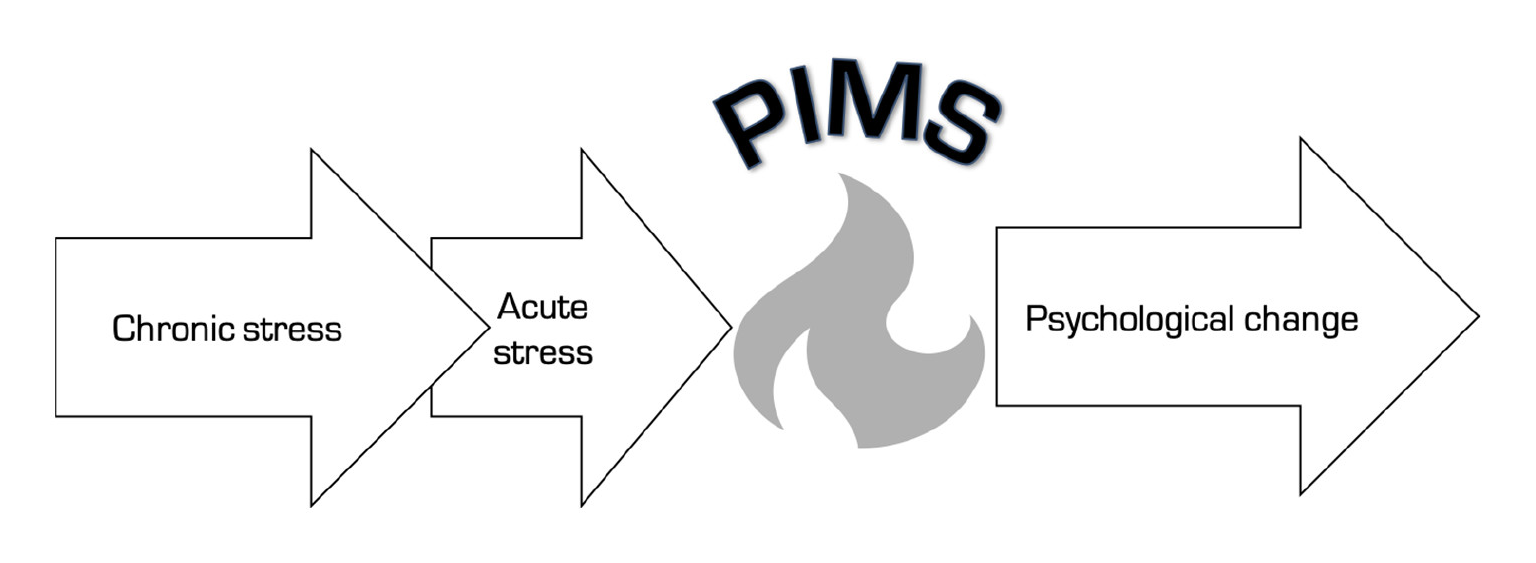
To summarise, the authors claim that psychosis – though they mostly avoid this word in favour of the term "pivotal mental state" – is a period of elevated neuroplasticity generally triggered by a sudden period of *acute stress* following a long period of *chronic stress*. This is mediated by the 5-HT2A receptor, the same receptor which mediates psychedelic states. This is interesting because it suggests that serotonergic psychedelics are mostly not generating their corresponding experiences by accident – they push a button which evolution has already hard-wired into our system, normally used to increase neuroplasticity and reset the system's behavioural patterns in times of crisis.
I find it remarkable that this extremely meta-level evolutionary strategy evidently worked enough times that it is part of our genome. It's like evolution wants to say: *Okay, this organism's behavioural strategy no longer fits its environment. Why don't we let it roll the dice – and give it a chance to find a new one?*
Sometimes I like to explain this with a hypothetical. One can imagine a wolf which lives off salmon in the local river. Perhaps our wolf suffers an encounter with a bear down at these hunting grounds and develops an aversion to water. This maladaptive behavioural pattern continues for some time, during which the *passive coping* mechanism helps it manage the stress of hunger. But this is insufficient for survival, and eventually the animal is driven to the point of starvation, at which point a *pivotal mental state* is triggered. If it's lucky, the creature overcomes its behavioural aversions, and it learns to feed itself once again.
I'd speculate that while this might be how evolution "wants" a pivotal mental state to go, in practice the internal states of modern humans are so complex that when we experience a psychotic episode – things can sometimes go quite nonlinear.
>
> { style="max-width: 512px; width: 100%" }
>
> **Figure 1.** Process-based representation of the pivotal mental state (PiMS). Chronic stress is the primer and acute stress is the trigger of a PiMS, which functions as a mediating state for rapid psychological change.
>
>
I think this is a reasonable model of psychosis and the psychedelic experience. The paper itself is backed by a comprehensive literature review covering a wide range of evidence associating stress response with 5-HT2A receptor upregulation, and I feel comfortable making the authors' hypothesis load-bearing. The authors are also careful to discuss this process in a constructive light. I have friends who have gone through such experiences, and I've used this paper before to help them understand why they might have experienced what they did.
But we are interested in the 5-HT1A receptor, which is only mentioned once in this context. There's an earlier paper which gets into the interplay between the 5-HT1A and 5-HT2A receptors:
### [Serotonin and brain function: a tale of two receptors](https://journals.sagepub.com/doi/full/10.1177/0269881117725915) (Carhart-Harris and Nutt, 2017)
From the abstract:
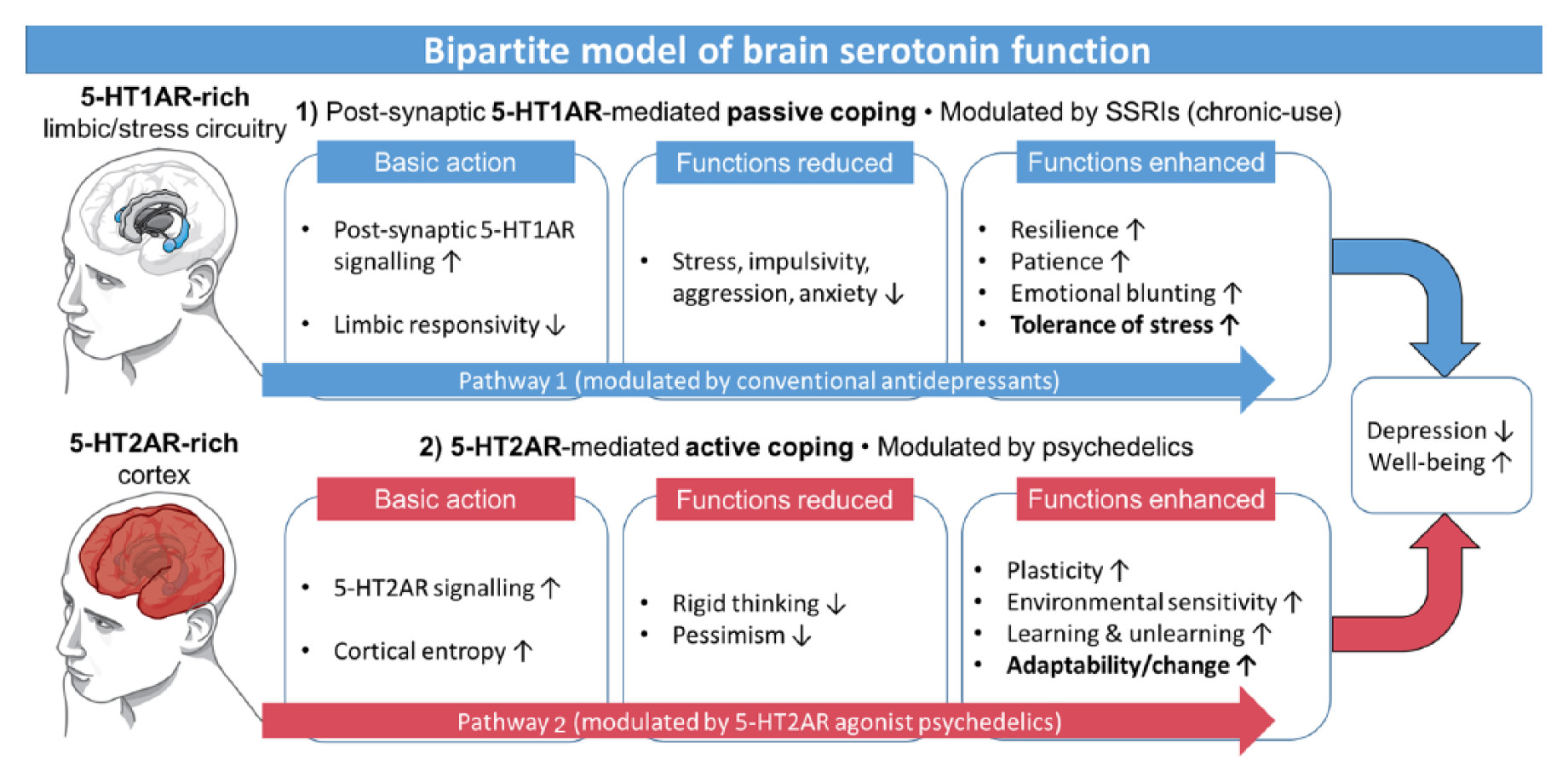
> Previous attempts to identify a unified theory of brain serotonin function have largely failed to achieve consensus. In this present synthesis, we integrate previous perspectives with new and older data to create a novel bipartite model centred on the view that serotonin neurotransmission enhances two distinct adaptive responses to adversity, mediated in large part by its two most prevalent and researched brain receptors: the 5-HT1A and 5-HT2A receptors. We propose that *passive coping* (i.e. tolerating a source of stress) is mediated by postsynaptic 5-HT1A receptor signalling and characterised by stress moderation. Conversely, we argue that *active coping* (i.e. actively addressing a source of stress) is mediated by 5-HT2A receptor signalling and characterised by enhanced plasticity (defined as capacity for change).
The authors go into a fair amount of detail on receptor expression, receptor sensitisation mechanisms, and so on. We see a satisfying duality between *chronic stress* management with 5-HT1A receptor mediated *passive coping* and *acute stress* management with 5-HT2A receptor mediated *active coping*:
>
> [{ style="max-width: 512px; width: 100%" }](https://journals.sagepub.com/doi/full/10.1177/0269881117725915)
>
> **Figure 3.** A two-part or 'bipartite' model of brain serotonin function. Model proposes that brain serotonin mediates adaptive responses to adversity via two distinct mechanisms: one mediated by postsynaptic 5-HT1A receptor signalling in aid of stress moderation (pathway 1) and the other mediated by 5-HT2A receptor signalling is aid of more substantial adaptive changes (pathway 2).
>
>
It is shown that post-synaptic 5-HT1A receptor signalling is implicated in negatively modulating aggression, impulsivity, anxiety, and stress – but it is never actually explored what *passive coping* really is, subjectively. The authors note:
> Moreover, selective 5-HT1A receptor antagonists or full 5-HT1A receptor agonists are not available for human use (beyond the very low doses used in PET imaging), and so cannot be used to incisively inform on this matter.
*Well* – there's a particular nonselective 5-HT1A receptor agonist that I'm thinking of, which notably has *very different* phenomenology to most 5-HT2A agonists. So, I'm willing to speculate: if what conventional psychedelics do is turn the *active coping* dial all the way up, perhaps what *five* does is turn the *passive coping* dial all the way up? Then perhaps – *if we are comfortable working with this assumption* – by studying the subjective effects of *five* we may be able to better understand how this passive coping mechanism actually works.
## What does 5-MeO-DMT *feel like*?
While no two experiences were the same, I found that my *five* experiences mostly tended to follow a common trajectory. The onset would be characterised by an intense bout of turbulence followed by a period of relaxation over a period of fifteen minutes or so. However, this is not terribly descriptive; so I'll provide a detailed review of what *five* does across different sensory modalities.
### Visual perception
With my eyes open and a low dose of *five*, I found my visual field fragmented into myriad small polygonal shards, each filled with distinctive "[film grain](https://en.wikipedia.org/wiki/Film_grain)" type noise. This was a very subtle effect, and it was difficult to pin down what characteristics made an individual shard appear distinct from its neighbours.
{ style="max-width: 512px; width: 100%" }
The view from the window of the Maloca while on a very light dose of five. This replication is made using the *Crystallize* filter in Adobe Photoshop, which is not perfect; ideally the polygonal segments would attempt to fit the contours of the image.
At a slightly higher dose, the shards would merge together again – or perhaps, their borders followed the outlines of objects so precisely as to be unnoticeable – while the film grain effect remained.
{ style="max-width: 512px; width: 100%" }
The same view with a slightly higher dose of five.
At this dose range, five seemed to engender few other open eye perceptual distortions. We tested the [*tracer tool*](https://qualiacomputing.com/2020/10/09/modeling-psychedelic-tracers-with-qris-psychophysics-toolkit-the-tracer-replication-tool/) and observed the expected [blue tracers](./2023-10-08-the-second-qri-psychophysics-retreat.html#september-2023-second-session). At one point I studied my co-participants' faces – but I didn't see much more than simple [ringing artifacts](https://en.wikipedia.org/wiki/Ringing_artifacts).
I will confess that I struggled to draw any conclusions from these experiences – [Roger Thisdell](https://x.com/rogerthisdell) was able to make better sense of them, and I recommend his writeup, [On Pure Perception](https://heart.qri.org/retreats/2023-canada/roger-thisdell/on-pure-perception.html). By comparison, the *eyes closed* experience taught me much more about the dynamics of *five*.
Replication work by [Scry Visuals](https://scry.art). See the trip report in my [other post](/posts/2023-10-08-the-second-qri-psychophysics-retreat.html#september-2023-second-session) for more details.
I mentioned earlier how my *five* experiences would typically follow a trajectory from a state of high turbulence to one of high stability. With my eyes closed this was most apparent; initially I would typically see my visual field filled with heterogenous black and white shapes similar to those shown above, and as time progressed this would coalesce into something more homogenous.
Curiously, colour was rare; sometimes I would see an iridescent sheen not unlike the skin on a soap bubble. Other participants noted that in this state, vivid colours seemed to be correlated with low valence. I'm not sure what to infer from this.
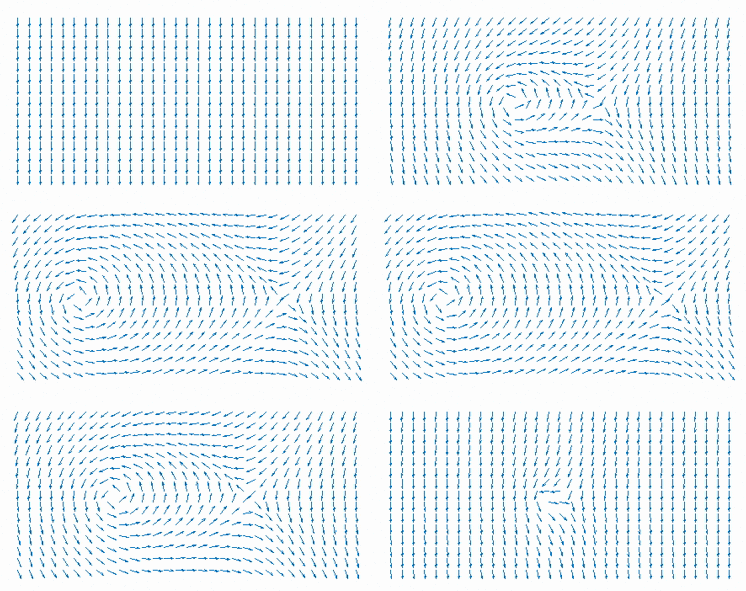
If you study the visualisation above, you will notice a large number of small [topological defects](https://en.wikipedia.org/wiki/Topological_defect) – *vortices* and *antivortices*, in the language of [*vector field topology*](https://cgl.ethz.ch/Downloads/Publications/Papers/2020/Gun20b/Gun20b.pdf). As the experience progressed, these topological defects would tend to collide with and annihilate one another, until the field was fully *disentangled*.
{ style="max-width: 384px; width: 100%" }
Vortex-antivortex formation and annihilation. Animation from [Brian Skinner](https://gravityandlevity.wordpress.com)'s post on [ribbonfarm.com](https://www.ribbonfarm.com), [Samuel Beckett's Guide to Particles and Antiparticles](https://www.ribbonfarm.com/2015/09/24/samuel-becketts-guide-to-particles-and-antiparticles/).
I found a mathematical process which generates similar patterns: the [*XY model*](https://en.wikipedia.org/wiki/Classical_XY_model) from [statistical mechanics](https://en.wikipedia.org/wiki/Statistical_mechanics), which simulates the dynamics of topological defects in a field. A *temperature* parameter specifies how much noise is added to the simulation. Above criticality, [*vortex-antivortex pairs* freely dissociate](https://en.wikipedia.org/wiki/Berezinskii–Kosterlitz–Thouless_transition), and below criticality, they wander around annihilating each other until the field is empty once again.
A simulated run of the two-dimensional XY model, from [Evgeny Demidov's personal website](https://www.ibiblio.org/e-notes/Perc/xy.htm). Hue corresponds to spin orientation. Watch as the topological defects cancel each other out.
I wish to note that the replication and these simulated dynamics are not *quite* right – Andrés later shared a video of simulated [*nematic turbulence*](https://en.wikipedia.org/wiki/Liquid_crystal) with us which I felt bore an even closer resemblance to what I saw.
Simulated [two-dimensional active nematic turbulence](https://www.youtube.com/watch?v=clcnmBSx1c4), from [turbulenceteam](https://www.youtube.com/@turbulenceteamms/videos) on YouTube.
[Liquid crystals](https://en.wikipedia.org/wiki/Liquid_crystal) are one class of nematic systems, and nematics in general seems like a really interesting field. I'll have to return to it in future.
[{ style="max-width: 384px; width: 100%" }](https://www.benjaminoutram.com/#/liquidcrystals/)
[*Schlieren*](https://en.wikipedia.org/wiki/Schlieren) texture of a nematic liquid crystal. These [Maltese cross](https://en.wikipedia.org/wiki/Maltese_cross)-shaped topological defects are known as "boojums", after the creature in [Lewis Carroll](https://en.wikipedia.org/wiki/Lewis_Carroll)'s [The Hunting of the Snark](https://www.poetryfoundation.org/poems/43909/the-hunting-of-the-snark). Photograph by [Benjamin Outram](https://www.benjaminoutram.com).
### Auditory perception
I have little to say on *five*'s effect on auditory perception, other than that many participants including myself reported tinnitus after using it. I think this is relevant harm reduction information – I've not seen this discussed much elsewhere. Anecdotally, said tinnitus tended to increase in intensity after lower valenced experiences, and decrease after higher valenced experiences.
After one session, I had a particularly bewildering experience where I found that my tinnitus varied in intensity based on my head's position and orientation in space. It felt like I was moving my head through some kind of invisible standing wave pattern – I joked nervously that I had become sensitive to the WiFi in the room. Not entirely unreasonable, given that the wavelength of *2.4 GHz* radiation is *12.5 cm*, which was around the size of these standing waves. This disappeared after I left the room and came back in again.
By several days after the retreat, my remaining tinnitus had resolved on its own. I have since found myself [wondering](https://twitter.com/cube_flipper/status/1739547299918041483) whether there is an important distinction between tinnitus which is the result of physical injury and tinnitus which is a purely subjective phenomenon.
### Somatic perception
*Five* has a rather hectic body load on the come up, which again tends to follow a trajectory from turbulence to stability. As I described one trip, in my [previous writeup](/posts/2023-10-28-attention-and-awareness.html):
> Extremely high frequency buzzing sensations raced across my skin, themselves cohering into greater and greater patches of synchrony as time went on.
In my subjective experience, [*valence* is primarily felt in the *somatic fields*](https://twitter.com/cube_flipper/status/1759395140383432783). This was unchanged on *five*. However, while *five* has a popular reputation for engendering intense bliss states, I found that my experiences with it covered a wide valence gamut, from creamy and soft to highly jarring and dissonant states which required a lot of equanimity to handle. I asked around the other participants and it was fairly common for people to report that their experiences were split three ways between negative, neutral, and positive valence. We suspect that there are a number of *attractor states* within this space, though I remain unsure how to reliably access the positive ones. More research required.
Most often it just left me in a state more emotionless and grey than anything I've experienced sober, profound if only for its sheer *neutrality*. Typically I'd find myself on the floor of the Maloca with my whole body vibrating while my [vision strobed black and white](/posts/2023-10-28-attention-and-awareness.html), feeling for all the world like an animal predator who had just learned why you don't try to eat toads.
{ style="max-width: 256px; width: 100%" }
As it transpires, the toad poison is rather effective at paralysing large mammals.
The process of visual field *disentangling* described above seemed to have a higher-dimensional analogue in the somatic fields. I often observed a high degree of correlation between somatic and visual field states – or at least, what I observed in my visual field often resembled a two-dimensional projection of a higher-dimensional process:
> A typical thing that would happen to me on *five* would be that I'd *feel* some three-dimensional phenomenon in my somatic field, and then *see* a two-dimensional version of it projected onto my visual field – generally *dark grey* on an empty *light grey* background. This is quite handy, because it makes it very easy to inspect whatever's going on.
If I found that the disentangling process got stuck on some unpleasant pattern of contraction, I'd be able to study its silhouette in order to figure out what was happening. I also found that how I directed my attention had an influence over this disentangling process, granting agency over where regions of *expansion* and *contraction* might be applied. Often, however, attempting to meddle with the disentangling process would only make things worse, and in most cases it was best to simply rest in a state of *expanded awareness*, leaving it to do its own thing:
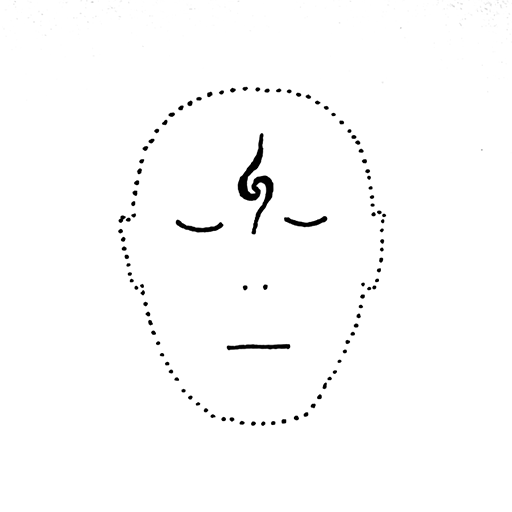
> In this case, I simultaneously watched and felt this thing swirl around inside my head, and realised that by focusing my attention on it I was only entrenching it.
>
>
> { style="max-width: 192px; width: 100%" }
>
> A vortex between my eyes.
>
>
>
> I'd been introduced to the idea that *the only mental move is expansion* by Andrés and Roger only a couple of days beforehand, and suddenly I had a first hand appreciation of what this meant. This pattern of *contraction* was actually just a focal point between adjacent wavefronts of *expansion*! In the *five* state, this was a rather profound foreground-background inversion – *I* was no longer the unpleasant sensation, but instead *I* was also the waves of expansion around it. Having come to this realisation, I was able to relax my attention – and this somatic cyclone began to dissipate, before ultimately blowing away to the periphery.
As the fields smoothed out over time, the valence would increase in sync. I found myself wondering whether this process had some deeper consequences, perhaps resolving unseen psychological or neuromuscular tension.
I did notice *five* had a rather pleasant [muscle relaxant effect](https://x.com/nickcammarata/status/1718326022750294275), not too dissimilar to ketamine. On the comedown when standing up and moving around I felt very loose and limber and very much enjoyed doing deep leg stretches – and one other participant had a lot of fun with *five*-assisted yoga. A couple of participants did however experience localised muscular tension in their lower backs after using *five* – which in both cases had to be worked out with a massage gun.
## How does 5-MeO-DMT *work*?
So here we have two things: On the *pharmacological* side, a 5-HT1A-mediated passive coping mechanism; and on the *phenomenological* side, cross-sensory-modal disentangling phenomena.
I'd like to speculate as to *five*'s therapeutic mechanism. Quite consistently, it seemed that the amount of healing precipitated by a given trip was closely related to the amount of *positive valence* experienced. This was a common sentiment across other participants. Asher writes about *positive valence* in his [5-MeO-DMT FAQ](https://heart.qri.org/retreats/2023-canada/asher-arataki/5-meo-dmt-faq):
> The texture of positive valence on 5-MeO is very subdued relative to other positive experiences one might have (e.g., orgasm, MDMA), to the extent that it doesn't feel right to use the word *positive* or *enjoyable*. Rather, it has a lot more in common with the sensation of release and letting go, similar to deep meditative states that I have experienced (except with a much higher intrinsic intensity/energy).
>
> I remember being surprised after my first positive experiences (at low doses) thinking "this doesn't feel good; it feels healing", realising that the value of this state of consciousness was primarily therapeutic (rather than recreational).
*Positive valence* in this context also seemed closely related to the depth of *disentanglement* experienced. Andrés expands on the notion of *disentangling* in his post, [Self-Organizing Principles Reduction](https://heart.qri.org/retreats/2023-canada/andres-gomez-emilsson/self-organizing-principles-reduction.html):
> As discussed in a [QRI essay](https://qri.org/blog/digital-sentience) about the boundary problem, many of the "algorithms" of the mind could be things like applying a repulsion uniformly from the surface of every point along a tangled cable. Doing this can automatically and gracefully disentangle the cable.
>
> I think that 5-MeO-DMT could be thought of as doing something quite similar to that. It is instantiating a very simple principle all across the board that leads to the disentanglement of internal tension.
I'd like to speculate that when we use *five*, we get to see what happens when this disentangling principle is instantiated upon the observable parts of our consciousness. At the same time, this might just be the *tip of the iceberg* – if this disentangling principle is *also* instantiated upon the less easily observable parts of our consciousness, then this is what results in its deeper therapeutic and psychological benefits.
Going a little further, I'd also like to speculate that this is the principle upon which a *passive coping* mechanism operates – it's just too subtle to notice in normal sober life. In this state, it would be responsible for compensating for ambient stress levels with slightly elevated mood and muscular relaxation, resulting in a positively-biased outlook and corresponding behavioural patterns.
Going *even further*, I'd like to suggest that this *passive coping* mechanism should not be viewed as a *reactive* phenomenon – but rather, rate of 5-HT1A receptor signalling could be better regarded as a fundamental parameter responsible for adjusting the rate at which experience is fabricated or defabricated, keeping our world models in homeostasis between a *low complexity*, *high valence* state and a *high complexity*, *low valence* state. This can alternatively be seen as an axis from [*underfitting* to *overfitting*](https://qri.org/blog/5meo-vs-dmt#underfitting-vs.-overfitting) – and striking a balance between these is of course critically important for the survival of any given organism.
Perhaps then *five* is best regarded as a substance which turns this parameter's dial all the way up. At the limit, this constitutes a state of total defabrication in which *everything* is disentangled – pure, undifferentiated awareness. Understanding *five*'s dynamics and understanding this parameter's dynamics would then be one and the same task.
### What are the *dynamics* of *five*?
I'd like to offer a quick sketch of the dynamics as I understand them. I'll note that I consider most of this to be highly speculative.
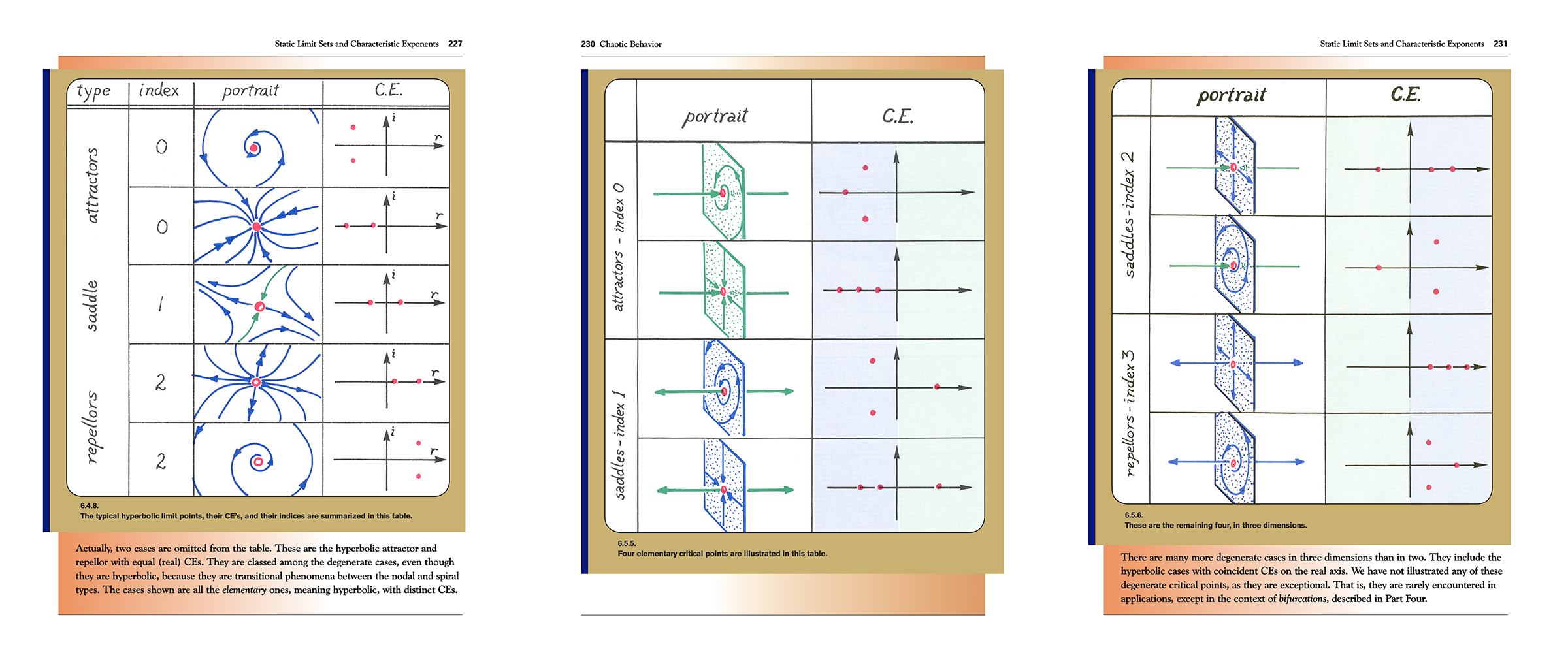
Our subjective experience is built out of topological defects much like the *vortices* and *antivortices* shown in the previous section. These are the [*critical points*](https://cgl.ethz.ch/Downloads/Publications/Papers/2020/Gun20b/Gun20b.pdf) in the fields which govern [flow of attention and awareness](/posts/2023-10-28-attention-and-awareness.html#do-attention-and-awareness-follow-a-branched-flow-structure). They appear and disappear in a highly situation-dependent fashion, sometimes as the result of low level sensory input, and sometimes as the result of high level *predictions* we make about sensory input. They can become easier to observe under the influence of [psychedelics](https://twitter.com/cube_flipper/status/1752903935755760103) or [dissociatives](/posts/2023-08-01-ketamine.html#how-does-ketamine-work). Some only exist for fractions of a second, while others may persist for a very long time.
[{ style="max-width: 512px; width: 100%" }](../../images/random/psychophysics/five/abraham_and_shaw_1.png)
A catalog of two-dimensional and three-dimensional *critical points*, from Abraham & Shaw's [Dynamics, the Geometry of Behavior](http://www.aerialpress.com/DYN/). [*Bifurcation theory*](https://en.wikipedia.org/wiki/Hopf_bifurcation) concerns the evolution of these topological features.
Often they are responsible for providing stable fixed points around which objects can be [reified](/posts/2023-01-18-an-introduction-to-steven-lehar-part-iii.html). When they arise in our somatic fields they can [serve to guide motor output](/posts/2023-08-01-ketamine.html#how-does-ketamine-work). They can associate semantic *meaning* with somatic *feeling*. When these give rise to maladaptive behavioural patterns they are informally known as [*bodymind knots*](/posts/2024-05-29-what-is-a-bodymind-knot.html) – these might be considered a form of traumatic [*stuck prior*](https://www.lesswrong.com/posts/i9xyZBS3qzA8nFXNQ/book-summary-unlocking-the-emotional-brain), and can often stick around for much longer than they are welcome.
[{ style="max-width: 341.33px; width: 100%" }](../../images/random/psychophysics/five/abraham_and_shaw_2.png)
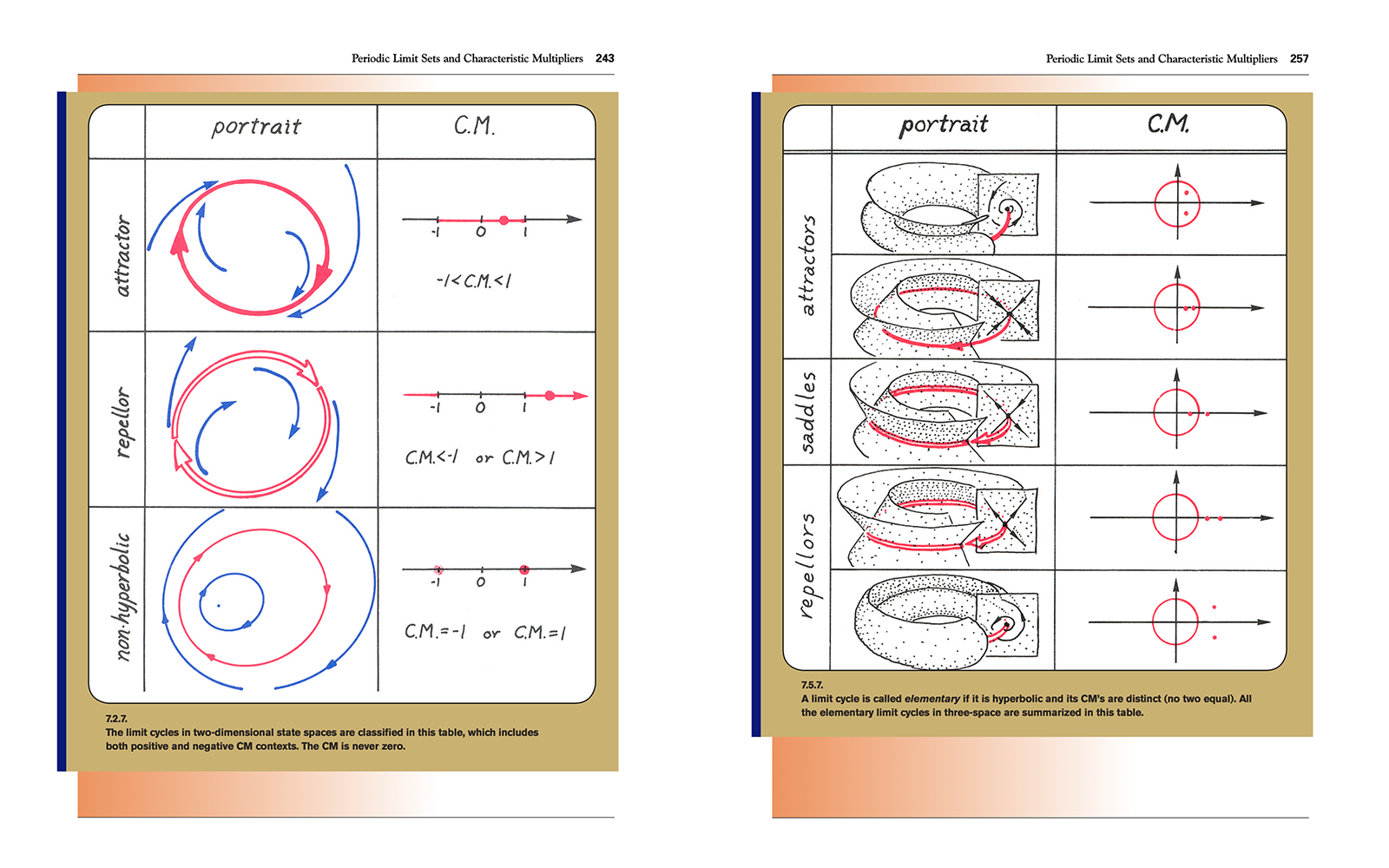
A catalog of two-dimensional and three-dimensional *limit cycles*, also from Abraham & Shaw. Consider, however, that while vector field topology is fully classified for two dimensional systems, in three dimensional systems it's mostly unknown – because you get [*strange attractors*](https://twitter.com/cube_flipper/status/1755036822873485681) and *chaos*.
*Five* changes the parameters of the fields within which these topological defects are embedded, raising the [*temperature*](https://qualiacomputing.com/tag/psychedelic-thermodynamics) such that they might move around or be spontaneously created or dissolved – a little like [virtual particles](https://en.wikipedia.org/wiki/Virtual_particle) in quantum foam, or the *XY model* shown above.
I think that "stress" as it is accumulated by an organism may be equivalent to an excess of these topological defects, and that passive coping mechanism counteracts stress by adjusting the rate at which these topological defects defabricate spontaneously. 5-HT1A agonism with *five* results in a mass defabrication of these topological defects, equivalent to an extreme disentangling of the fields – and hopefully, the more maladaptive patterns don't reappear when the *five* wears off.
One might also, of course, call this [*neural field annealing*](https://www.youtube.com/watch?v=pM9k1I3VPOg).
### What happens when you disentangle the fields *all the way*?
I couldn't possibly comment, because I did not go that deep with *five* – but a handful of the other participants did. Before reaching breakthrough level, a couple of participants reported a state of [*boundless space*](https://www.dharmaoverground.org/dharma-wiki/-/wiki/Main/MCTB+Boundless+Space,+The+Fifth+Jhana/) similar to that sometimes approached through meditation.
*What's beyond the [edge](https://twitter.com/cube_flipper/status/1714687948556562600) of your visual field?* Perhaps this is what happens when enough topological defects are dissolved for attention to *expand* out of the visual and somatic fields entirely – creating a sense of *infinite space*.
These people generally reported this stage and beyond to be extremely high valence states. Perhaps if the [Symmetry Theory of Valence](https://opentheory.net/2021/07/a-primer-on-the-symmetry-theory-of-valence/) is true, these topological defects could be viewed as a class of broken [symmetries](https://smoothbrains.net/posts/2023-02-18-the-state-of-play-in-symmetry.html); and to dissolve them all would mean walking the *valence gradient descent landscape* all the way down.
### What happens when your disentangling gets *stuck*?
Most interesting gradient descent landscapes are full of local minima; this one is no different. Attempting to ride this one all the way to the bottom is a bit like trying to rip down all your [Chesterton's fences](https://en.wiktionary.org/wiki/Chesterton%27s_fence) at once – which is about as risky as it sounds.
Often my experiences would start off with the visual field in a highly [*anisotropic*](https://en.wikipedia.org/wiki/Anisotropy) configuration, and then trend towards an [*isotropic*](https://en.wikipedia.org/wiki/Isotropy) configuration over time before resolving entirely. In this case, after taking *5 mg* – the visuals congealed into a highly irresolvable, [*frustrated*](https://en.wikipedia.org/wiki/Geometrical_frustration) configuration, strobing relentlessly, searching for a ground state it would never find.
This is a [Belousov-Zhabotinsky reaction](https://www.youtube.com/watch?v=zN-nDxaatwU), an example of a nonlinear chemical oscillator. The top half is in an [*anisotropic*](https://en.wikipedia.org/wiki/Anisotropy) configuration, while the bottom half is in an [*isotropic*](https://en.wikipedia.org/wiki/Isotropy) configuration.
At the same time, my body was overtaken with an overwhelming sense of vibratory dissonance – like I was a piano upon which somebody had struck a particularly [vulgar interval](https://en.wikipedia.org/wiki/Tritone). I tried my best to just sit with it without flinching, but the chaotic [beating pattern](https://en.wikipedia.org/wiki/Beat_(acoustics)) was extremely challenging to track with my attention.
I felt like I'd been presented with an torturously difficult *qualia puzzle*, one which would take a lifetime to solve. I gauged that this particular experience was a write-off, and opened my eyes – and which point the frustrated visual field configuration disappeared and was replaced with a vibrating depth map.
{ style="max-width: 512px; width: 100%" }
My view of the ceiling after I opened my eyes.
Slowly everything wore off – after making some loud dinosaur noises to help shake out the [bad vibes](https://twitter.com/algekalipso/status/1774561864950944196) – and I was left with a fairly typical afterglow. It seemed that no harm was done, but I couldn't help but feel that if I'd lacked the equanimity to manage this experience then I could have hurt myself quite badly.
---
## Commentary
We experienced so much on the retreat that I could easily write a whole lot more, but I must stop for now. I haven't even covered the significance of *expansion* to the depth that I would like, yet – but perhaps that topic deserves a whole post to itself.
I'll reiterate that *five* worked best when we generated *positive valence* experiences – but these were so difficult to make consistently that I am forced to remain skeptical of its safety in therapeutic applications.
Ultimately, the most important work may be in further development of our phenomenological models insofar as they might inform our general understanding of consciousness. There's a few questions I'd yet like to answer:
- What can the dynamics of *five* tell us about the dynamics of the phenomenal fields?
- What dynamics make a system tend towards *frustrated* and *satisfied* states?
- What are the neural correlates of *frustrated* and *satisfied* states?
- What are the ideal system parameters for disentangling *frustrated* states?
- Why does targeted *attention* generate targeted *expansion*?
- Can the notion of *disentanglement* be mathematically reduced to *expansion*?
Answering these questions might also help us understand what makes for a reliable therapeutic protocol. Perhaps we could involve an active facilitator who can guide the participant's attention throughout the experience. Perhaps we might find that a fast onset puts the system into a supercritical state, causing it to tangle more easily – which we could avoid by using a route of administration with a slower onset. Perhaps there are other drugs which we could [combine with *five*](https://www.reddit.com/r/5MeODMT/comments/17qrdhu/combination_with_mdma/) to make the disentanglement process gentler.
Otherwise, the risk might only be worth it for extreme cases. I have friends with [fibromyalgia](https://www.reddit.com/r/Fibromyalgia/) who accumulate neuromuscular tension so rapidly that holding it back can be a full time job. I remain optimistic that for these people, *five* might be the perfect solution.
In many common dynamic systems, frustrated states can easily [consume](https://twitter.com/cube_flipper/status/1758394879154246004) entire landscapes. Development of disentanglement techniques is an honourable pursuit.
---