---
title: "An informal review of anthropic qualia states"
authors:
- name: "Cube Flipper"
url: "https://twitter.com/cube_flipper"
discussion-url: "https://twitter.com/cube_flipper/status/1803093151629861284"
---
A couple of months ago I visited Tucson, Arizona, where I attended [The Science of Consciousness Conference](https://consciousness.arizona.edu/) – a biannual gathering of an eclectic mixture of scientists and philosophers who descend upon the Sonoran desert to discuss the nature of consciousness in an open-minded environment.
[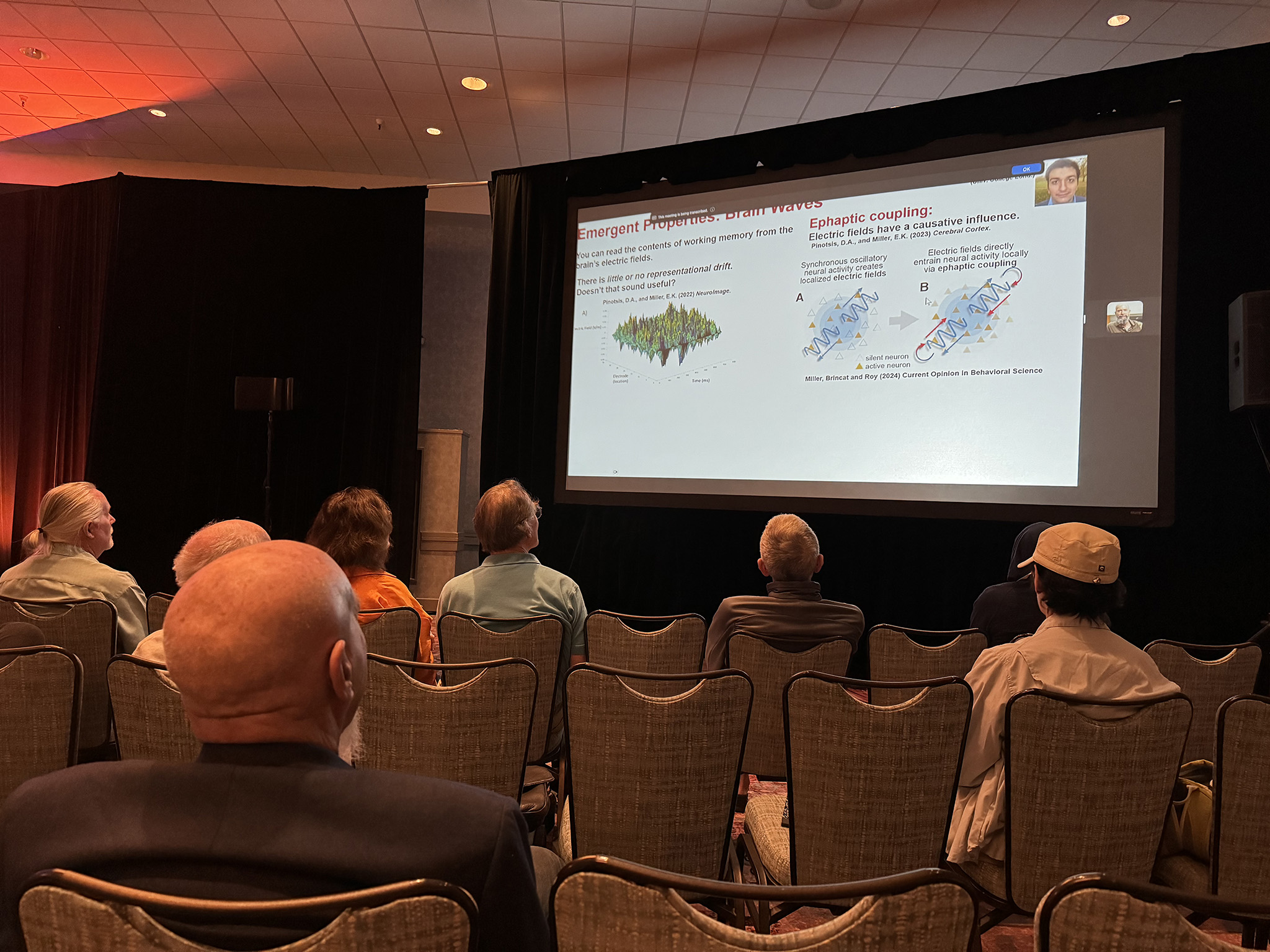{ style="max-width: 512px; width: 100%" }](../../images/random/qualia_states/tsc_earl_miller.jpg)
Watching [Earl K. Miller](https://twitter.com/MillerLabMIT)'s presentation on cortical oscillations.
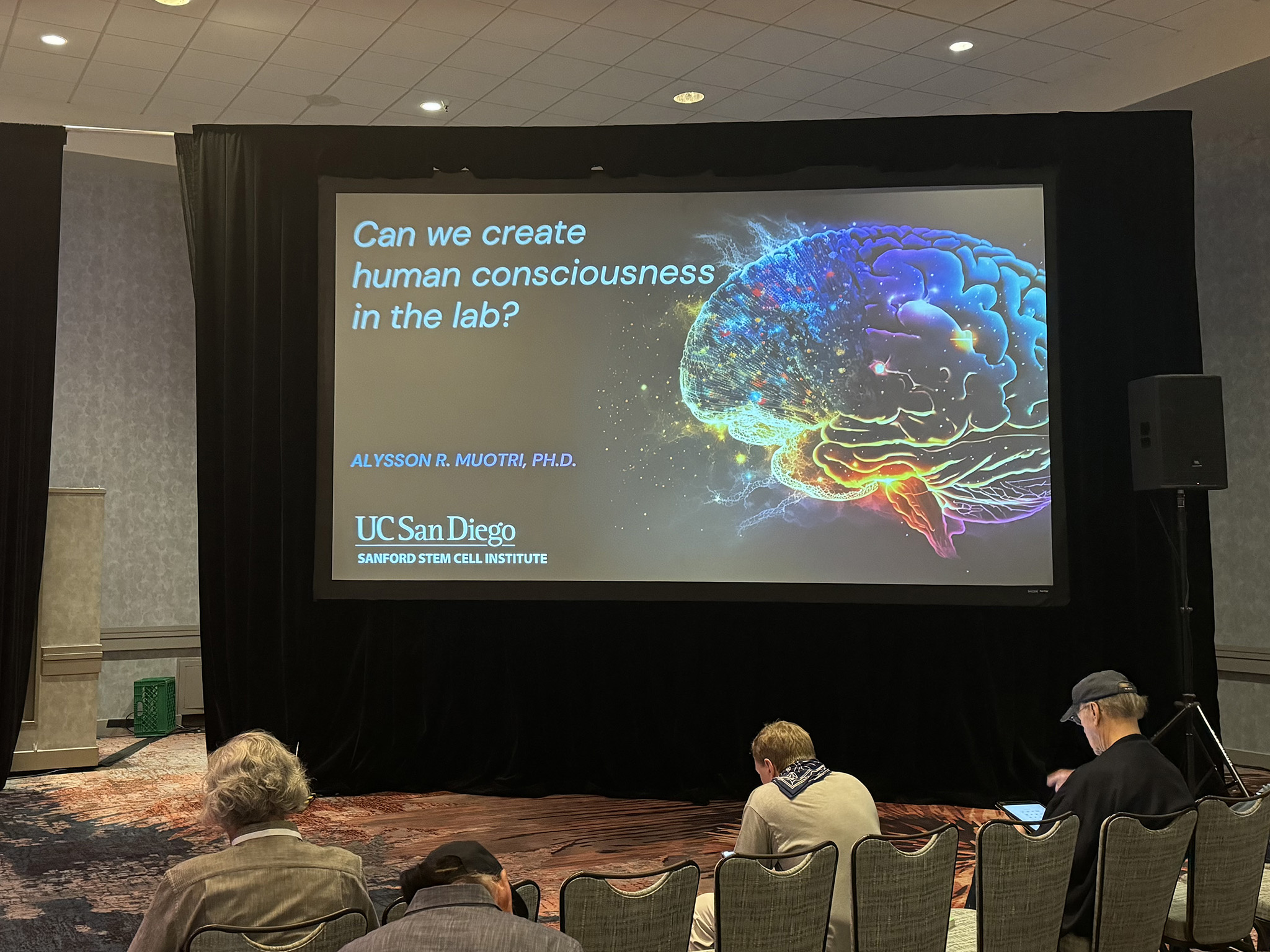
Some highlights included catching presentations by [Shamil Chandaria](https://twitter.com/shamilch) on [Bayesian brain theory](https://www.youtube.com/watch?v=Eg3cQXf4zSE), [Brian Lord](https://twitter.com/briantlord) on [transcranial focused ultrasound](https://www.frontiersin.org/articles/10.3389/fnhum.2024.1392199/full), and [Alysson Muotri](https://en.wikipedia.org/wiki/Alysson_Muotri) on whether or not [cerebral organoids](https://en.wikipedia.org/wiki/Cerebral_organoid) possess consciousness – but I was most overjoyed to finally sit down and compare notes with my fellow phenomenologist, [Brad Caldwell](https://twitter.com/Caldwbr), who had decided at the last minute to come all the way from Alabama.
[{ style="max-width: 256px; width: 100%" }](https://twitter.com/Caldwbr/status/1786865947992531325)
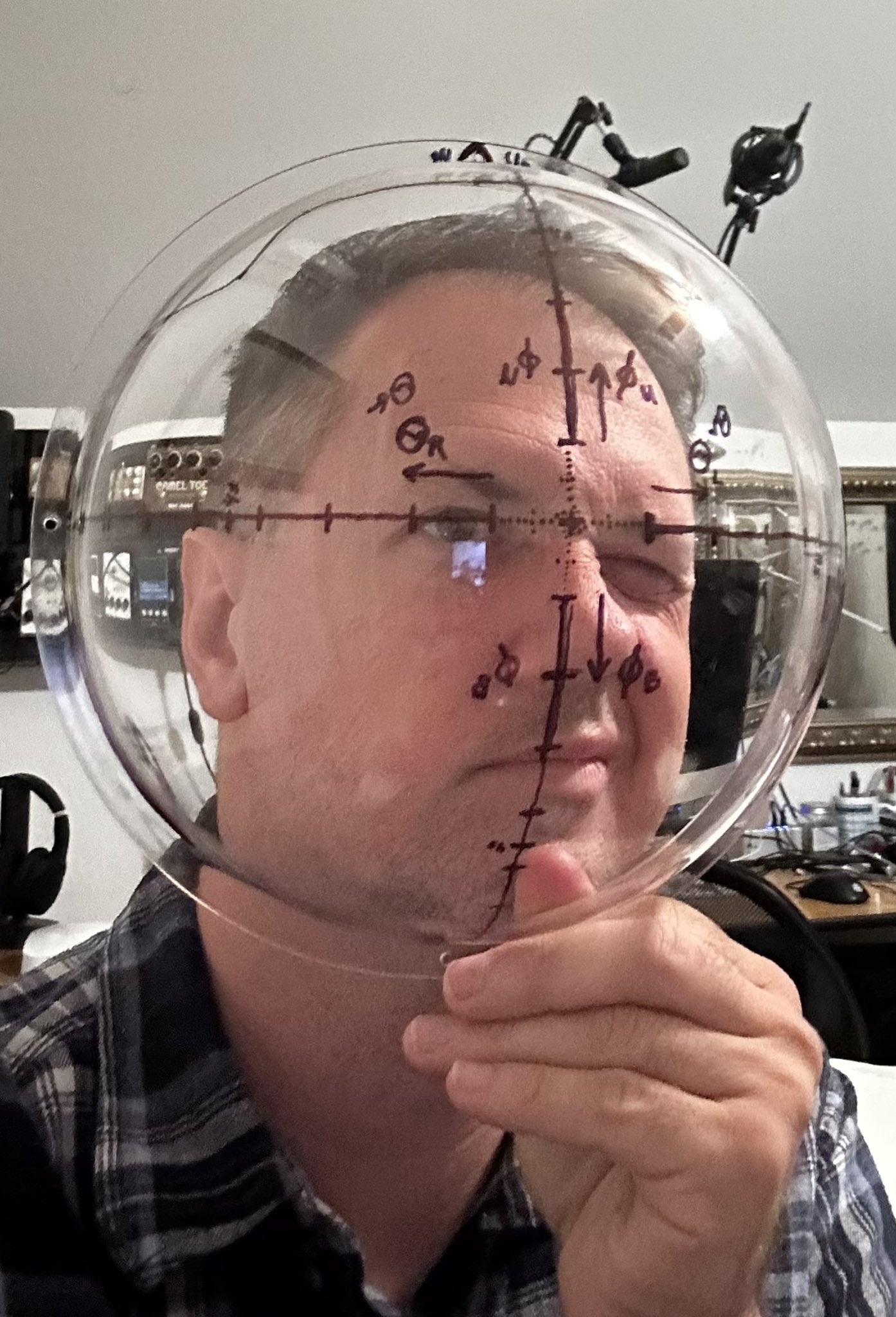
[Brad Caldwell](https://twitter.com/Caldwbr), exporing a [spherical coordinate system](https://en.wikipedia.org/wiki/Spherical_coordinate_system).
Brad is the author of [Rings of Fire](https://www.amazon.com/Rings-Fire-Brain-Makes-Consciousness/dp/B0B5K9WBNB), a 160-page magazine-style book which details an [original phenomenological framework](https://twitter.com/cube_flipper/status/1755787678875062472) for describing human qualia, while also speculating as to what their neural correlates might be. I was eager to sit down with him to establish the overlap between his framework and those used by other researchers like [Steven Lehar](http://slehar.com/wwwRel/Lehar.html) and [Andrés Gómez Emilsson](https://twitter.com/algekalipso). The conversations we had made my brain start to whir.
## What is *qualia structuralism*?
[Mike Johnson](https://twitter.com/johnsonmxe) first defined the terms *qualia formalism* and *qualia structuralism* in his treatise on consciousness, [Principia Qualia](https://opentheory.net/PrincipiaQualia.pdf#page=28):
> **Qualia Formalism**: *for any given conscious experience, there exists – in principle – a mathematical object isomorphic to its phenomenology.*
>
> **Qualia Structuralism**: *the mathematical object isomorphic to a conscious experience has a rich set of mathematical structures.*
I think Brad's project is a *qualia structuralist* project – as is my own. At my end, I have [previously](/posts/2022-10-01-an-introduction-to-steven-lehar-part-i.html#open-questions) attempted to define a prototype working model for a momentary *qualia state* – noting that at the time of writing I expected any actual *mathematical object isomorphic to phenomenology* to be far more general than this:
> From the top down, we have:
>
> - The *worldsim*, which contains:
> - the *worldsheet*, a *two-dimensional [surface](https://en.wikipedia.org/wiki/Surface)* where each point has both:
> - *depth*, a *scalar* value, and:
> - *colour*, a *three-vector* value; and:
> - the *worldfield*, a *three-dimensional [vector field](https://en.wikipedia.org/wiki/Vector_field)*.
I should also note that I have since stopped using the terms *worldsheet* and *worldfield* in favour of *visual field* and *somatic field*, respectively – and collectively, I shall refer to these as the *phenomenal fields*.
Much of what I do is simply gathering phenomenological reports from a wide variety of sources while attempting to synthesise them into a patchwork headcanon. I've now gathered enough research and personal experiences that I feel comfortable making further speculation as to the true structure of the phenomenal fields, but mostly I just wish to spread what I have out on the table so that others can take a look. Epistemic status: *work in progress*.
### Why would anyone want to do this?
I regard the construction of a model of anthropic qualia states as a step towards solving what Mike calls the [*reality mapping problem*](https://opentheory.net/PrincipiaQualia.pdf#page=62) – how do *physical states* map onto *qualia states*, and vice versa?
I like to think that such a model will have applications in a number of areas:
- In the immediate term, I hope that this will help improve the way we communicate about *qualia states*.
- In the short term, I hope that this will help inform how we might construct experiences or even neuromodulation protocols that manipulate *physical states* in order to generate [desirable](#what-is-valence-structuralism) *qualia states*.
- And in the long term, I hope that this will help inform how we might [construct experiments](/posts/2023-06-01-an-introduction-to-susan-pockett.html#experimental-testing) to test the viability of a given theory of consciousness, be it [*physical*](https://www.physicalism.com) or [*computational*](http://integratedinformationtheory.org), [*classical*](https://www.youtube.com/watch?v=tX8b3ng37Nw) or [*quantum*](https://www.youtube.com/watch?v=tkECK3RzEPM).
Because if there's one thing that the conference convinced me of, it's that coherent theories of consciousness may soon be [more urgently needed than ever](https://twitter.com/algekalipso/status/1784303132413219157).
[{ style="max-width: 512px; width: 100%" }](../../images/random/qualia_states/tsc_alysson_muotri.jpg)
Opening slide from [Alysson Muotri](https://en.wikipedia.org/wiki/Alysson_Muotri)'s presentation on cerebral organoids.
## Qualia space
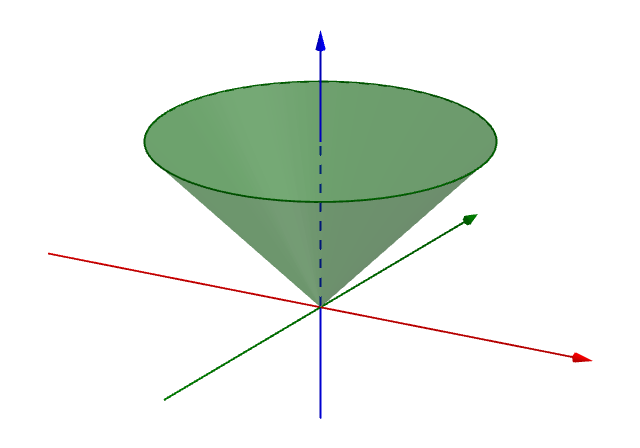
The mathematician [Richard P. Stanley](https://en.wikipedia.org/wiki/Richard_P._Stanley) proposed that [*qualia space*](https://philpapers.org/rec/STAQS) is a *[closed pointed cone](https://en.wikipedia.org/wiki/Convex_cone) in an [infinite-dimensional](https://en.m.wikipedia.org/wiki/Hilbert_space) [separable](https://en.wikipedia.org/wiki/Separable_space) [real](https://en.wikipedia.org/wiki/Real_number) [topological vector space](https://en.wikipedia.org/wiki/Topological_vector_space)*:
[{ style="max-width: 320px; width: 100%" }](https://en.wikipedia.org/wiki/Convex_cone#/media/File:Circular-pyramid.png)
A pointed cone *Q* does not contain both a nonzero state *p* and its negative *–p*. This is a way of formalising the proposition that *negative qualia* do not exist.
Maybe something like this would capture everything – but at the same time, this is far too wide a [state space](https://qualiacomputing.com/2020/01/18/a-big-state-space-of-consciousness/) for us to draw useful conclusions from.
The only qualia states we currently have access to are human ones, so starting with baseline human phenomenology – and incorporating edge cases from altered states, such as those facilitated by meditation or psychedelics – I'm going to explore the human sensory modalities and see what commonalities we can find between them. Perhaps we shall find that their state spaces are less [*disjoint*](https://en.wikipedia.org/wiki/Disjoint_sets) than we might [naïvely assume](https://twitter.com/nickcammarata/status/1772421899588428275).
Before we start, I'd like to call upon [Daniel Ingram](https://twitter.com/danielmingram)'s advice on [*insight practice*](https://www.mctb.org/mctb2/table-of-contents/part-i-the-fundamentals/4-wisdom-the-third-training/), in order to set the tone for this exercise in introspection:
> Insight practice can seem more daunting, complex, or bizarre than other forms of practice. However, it is oddly simple. There are [six sense doors](http://vimeo.com/250616410). Sensations arise and vanish. Notice this for every sensation. These are cave-man simple instructions, yet somehow people make them much more complex than they need to be.
## Phenomenal field unification
I often find myself returning to the question of whether or not the various [sensory modalities](https://en.wikipedia.org/wiki/Sense) – [*touch*](https://en.wikipedia.org/wiki/Somatosensory_system), [*sound*](https://en.wikipedia.org/wiki/Hearing), [*taste*](https://en.wikipedia.org/wiki/Taste), [*smell*](https://en.wikipedia.org/wiki/Sense_of_smell), [*vision*](https://en.wikipedia.org/wiki/Visual_perception), *and so on* – coexist within the same space. As I have written [previously](](/posts/2022-10-01-an-introduction-to-steven-lehar-part-i.html#i-have-four-senses-other-than-vision-are-there-multiple-worldfields-too)):
> One thing that *touch*, *sound*, *taste*, and *smell* share in common is that they are all *localised* phenomena – they happen at a particular location in space. We don't hear a sound *in our ears*; our brains perform some incredibly impressive calculations to estimate its location before injecting it into our *worldsim* as *localised worldfield pertubations*.
>
> So what gives these *pertubations* their distinctive *phenomenal character*? Without getting into too much depth, I'd say it's the dynamics of the oscillatory processes that *reify* them. Sound has high bandwidth and low spatial precision; touch has low bandwidth but high spatial precision – and their *afterimages* work in different ways, too. When music stops playing, you might continue to hear a short loop in your head; but *touch* afterimages tend to manifest as a persistent model of your immediate surroundings.
Firstly, I'll explore why I believe that these four modalities, amongst other phenomena, coexist within a unified *somatic field*. Then secondly, I'll explore how this might be reconciled with a *visual field* which contains a radically different sense modality.
### The somatic field
During my conversations with Brad, we discussed the state space of somatic sensations. In his phrasing: *an invisible three-dimensional canvas which can morph in [non-Euclidean](https://en.wikipedia.org/wiki/Non-Euclidean_geometry) ways*. Debatably, I suspect that this state space may also [support higher-dimensional phenomena](/posts/2024-05-29-what-is-a-bodymind-knot.html#can-the-phenomenal-fields-really-support-higher-dimensions).
So what about the sensations which inhabit this space? What structure do they have? As I wrote in my previous post, [What is a bodymind knot?](/posts/2024-05-29-what-is-a-bodymind-knot.html):
> A [body map](/posts/2023-06-30-the-oral-tesseract.html#what-is-a-body-map) can be a highly ephemeral thing. I can recall being quite young when I noticed how my sense of having a body would come and go as I ran my hands over my skin – just a hollow shell of sorts, its gossamer texture [sporadically illuminated](https://x.com/cube_flipper/status/1702351420475990020) by the spotlight of attention.
[Proprioception](https://en.wikipedia.org/wiki/Proprioception), [interoception](https://en.wikipedia.org/wiki/Sense#Internal), [equilibrioception](https://en.wikipedia.org/wiki/Sense_of_balance). [Mechanoreceptors](https://en.wikipedia.org/wiki/Mechanoreceptor), [thermoreceptors](https://en.wikipedia.org/wiki/Thermoreceptor), [chemoreceptors](https://en.wikipedia.org/wiki/Chemoreceptor). A gentle breeze over open skin. The warmth of the sun.
*Touch* sensations exhibit a tremendous amount of variety, but their commonality is that they all contribute to a unified body map, and can therefore be said to occupy a location in subjective space relative to one another. Many of these sensations develop semantic attachments over time which obscure their true nature, but by cultivating sufficient sensory clarity I believe the careful observer will find that these are all ultimately reducible to pertubations in the somatic field, which in some cases could be said to have a *spatiotemporal texture* in the region of interest – sometimes harmonious, sometimes noisy like television static.
By way of rudimentary examples, perhaps the sensation of a *pinprick* would correspond to a small, *sharp* deformation in the field; while something like *heat* might correspond to a [*drifting*](https://psychonautwiki.org/wiki/Drifting) effect with a particular noise profile – though I lack the clarity to tell.
[{ style="max-width: 512px; width: 100%" }](https://www.researchgate.net/figure/Waviness-and-roughness-8_fig3_260122002)
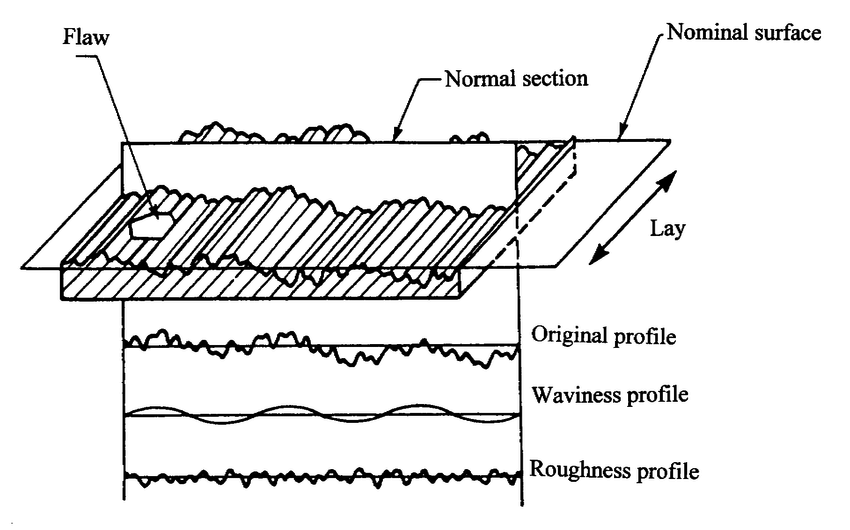
Mechanical engineers sometimes use the terms *lay*, *waviness*, and *roughness* to describe the textural characteristics of [surface finish](https://www.gdandtbasics.com/basics-of-surface-finish/). Perhaps we can crib from their lexicon.
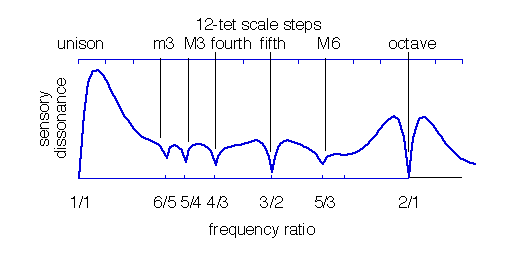
I think we can also work *taste* into this ontology. It's clearly spatially located, co-occurring with touch sensations on the tongue, of course – but they have a more striking phenomenal character. Perhaps taste could be built out of something like [*dyadic*](https://en.wikipedia.org/wiki/Dyad_(music)) vibrations, tuned by evolution towards [consonance or dissonance](https://en.wikipedia.org/wiki/Consonance_and_dissonance) in order to generate an attractive or aversive response in the organism?
[{ style="max-width: 512px; width: 100%" }](https://sethares.engr.wisc.edu/consemi.html)
A sensory dissonance curve, by [William A. Sethares](https://sethares.engr.wisc.edu). An interactive version is available [here](https://chromatone.center/practice/sound/dissonance/).
I feel hesitant to comment on *smell*, as I fear I'd be treading on the toes of our resident [perfume expert](https://twitter.com/algekalipso), who has [much to say on this matter](https://twitter.com/algekalipso/status/1492707919434944515). Andrés would [split the state space of scent qualia into two components](https://twitter.com/algekalipso/status/1272031842959409152):
> 1. Aromachemicals that are "character impact"
> 2. Flavor-like vibes
I think there's something to the idea of these things being vibrations, as subjects will reliably [sort different odours by pitch](https://link.springer.com/article/10.3758/s13423-013-0397-0). I have watched as Andrés ran a scent workshop at a Twitter meetup in [Dolores Park](https://en.wikipedia.org/wiki/Mission_Dolores_Park), passing around bottles of essential oils as people discussed whether they thought the [*may chang*](https://en.wikipedia.org/wiki/Litsea_cubeba) or the [*ylang-ylang*](https://en.wikipedia.org/wiki/Cananga_odorata) had a [higher frequency](https://twitter.com/algekalipso/status/1585154523123056641).
This aspect of smell is clearly also spatially located, but if I am sufficiently attuned I also find this additional component, which subtly permeates my sensorium and filters its global character. I believe that *emotions* work in a similar manner. For instance, I notice that my sensitivity to touch sensations varies tremendously from mood to mood – as if everything is run through a filter that might amplify or attenuate harsh frequencies, adjusting the global [timbre](https://en.wikipedia.org/wiki/Timbre) or [texture](https://en.wikipedia.org/wiki/Texture_(visual_arts)) of my experience.
Textures generated using [neural cellular automata](https://arxiv.org/abs/2111.13545). [Shadertoy](https://www.shadertoy.com) by [Anony](https://www.shadertoy.com/user/Anony).
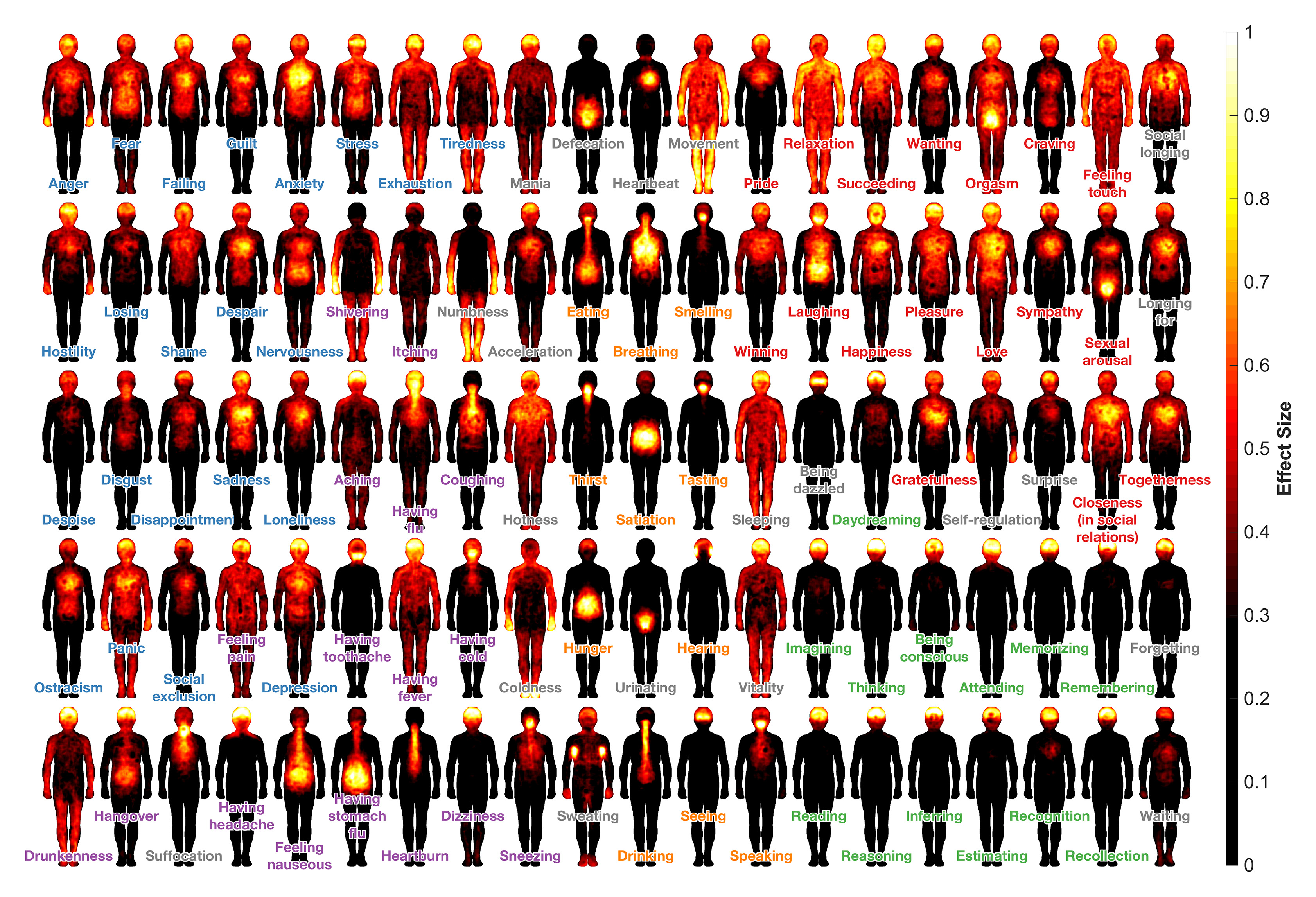
I also find that stronger emotions can manifest as concrete larger scale phenomena in specific locations; once I figured out how to [*feel emotions in my body*](https://en.wikipedia.org/wiki/Alexithymia) – as they say – when I place my attention upon my feelings of anxiety I notice [*grungling*](https://twitter.com/cube_flipper/status/1758394417118162989) patterns down in my gut; and if something startles me while driving then *fear* is felt as an attention-grabbing *knock* upon my heart.
[{ style="max-width: 512px; width: 100%" }](https://www.pnas.org/doi/10.1073/pnas.1807390115#fig03)
Aggregate data from online survey participants who were asked where they felt different emotions in their bodies. From [Maps of subjective feelings](https://www.pnas.org/doi/10.1073/pnas.1807390115) (Nummenmaa et al., 2018)
I'd also classify meditation-induced [*energetic phenomena*](https://en.wikipedia.org/wiki/Kundalini) and psychedelic-induced [*body load*](https://en.wikipedia.org/wiki/Body_load) as instances of the same – and will note that some of these can generate sensations *outside* the body map, or even dissolve it entirely.
Finally, the phenomenon of *sound* presents interesting challenges. Do we perceive sound *out in space* or *on the body*? In Brad's words, perhaps sound is [*revealed by its pertubation effect on the frames*](https://twitter.com/Caldwbr/status/1755065618213089549) – precise acoustic vibrations, mapped on to the somatic field in such a way as to orient the listener's attention to the location where the sound may have originated. Confusing maybe? I'll return to this idea when we [discuss how the visual and somatic fields map onto one another](#the-visual-field), because I think it operates on similar principles. In the meantime, I'd like to think that the observant [ketamine](/posts/2023-08-01-ketamine.html) user may have noticed sound and touch melting into one another while listening to [the right kind of music](https://emptyset1.bandcamp.com/album/skin).
I could easily devote a few thousand more words to the labourious task of exploring how many seemingly unrelated phenomena could be cut from the same cloth – but we need to move on, there are some points I would like to make. So, here's our invisible canvas: can we add some paint?
### The visual field
While I was at the conference, the meditation teacher [Roger Thisdell](https://www.rogerthisdell.com) published a [video](https://www.youtube.com/embed/ckuQloMaJx4). My flight out of Tucson was delayed, so I put it on while waiting around in the terminal. I was delighted to find that this video was all about collapsing the distance between the visual and the somatic:
> Most people start off with their experience constructed such that feeling is associated with the body – *obviously* – and I feel *here*, and I don't feel out *there*. But I can see the broader horizon around me and this seeing is happening kind of over *there*, so there's a distancing effect like that.
>
> Now, if you get sensitive enough, you actually come to realise that everything you *see* you also *feel*. So everything you see does trigger somatic sensations.
Roger goes on to describe the kind of practice by which one can learn how to observe these sensations:
> One way to increase your sensitivity to somatic sensations is a *lot* of body scanning meditation, really going into detail, becoming more attuned to finer-grained sensations. And then consequently after having done a lot of body scanning meditation – typically we do this *eyes closed* – then graduating to another type of scanning – *eyes open*, and scanning the whole experience space. Eyes open, not moving your eyes, and just *feeling* through the whole space.
>
> And even though you're not moving the center of your eyesight – the [*fovea*](https://en.wikipedia.org/wiki/Fovea_centralis) – you can scan through your awareness what is in all of vision, and notice that it does correspond to somatic sensations. For seeing – predominantly, particularly in the head. There's a sense that we see from our head. Or from our face. So what you feel will create subtle sensations.
But he also has a simple demonstration using a pen:
>
>
> Can you take something like *this* – and move in relationship to it, and notice that you can track sensations here? There's a *prediction* of, like, where it would stab you – particularly in the eye.
>
> The cool thing about recognising this connection is this is how we can begin to blend that sense of *inside* and *outside*, to recognise that it's not me feeling over *here*, and then the outside world being seen over *there*. It's this whole thing – *it's being felt* – this whole thing is my body, like an extension of my body.
>
> You'll start to get this connection, and then you'll can get into a lens of it's still like, well – there's seeing over *there* which then triggers feeling over *here* – and then we can kind of play with that, is the seeing *there* and the feeling *here*? And then maybe we can begin to bring the seeing *here* or bring the feeling out *there* – but eventually then we can see the emptiness of all that, collapse all that. And then there's an intimacy of feeling and seeing.
>
> So this is just a cool phenomenological hack, and when you really get this – this is how you begin to have the experience of *feeling the world*.
Talk about a [pointing-out instruction](https://en.wikipedia.org/wiki/Pointing-out_instruction). I recommend watching the full video, as well as finding a pointy object to play around with.
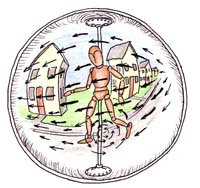
I recalled a conversation I'd had with Roger some time ago, in which he'd gently tried to steer me away from the [*bubble world*](/posts/2022-10-01-an-introduction-to-steven-lehar-part-i.html) model of perception from Steven Lehar's school of thought, resembling a homunculus in a fishbowl. *It joins up at the ears*, he'd said.
[{ style="max-width: 200px; width: 100%" }](http://slehar.com/wwwRel/cartoonepist/cartoonepist57A.html)
Steven Lehar's "bubble world" model.
I spent a few months mulling that one over. I think my body map has always been a bit [flaky](https://x.com/cube_flipper/status/1733652370830324077), and find I possess a fair amount of agency over "where" I might experience somatic sensations. I described one way of accessing this in [my post on bodymind knots](/posts/2024-05-29-what-is-a-bodymind-knot.html):
> The *somatic field* does not always seem to relate to the *visual field* in a consistent way. There's [a somatic puzzle of sorts](https://x.com/cube_flipper/status/1738831378064797965) which I like to prompt people with: *Blink your eyes, while maintaining awareness of sensations on your eyelids. Where are those located in space relative to your visual field?*
When I do this, I find myself able to [flip my body map between two interpretations](https://x.com/cube_flipper/status/1738834813963157996):
1. The somatic sensations form two small eyelids, suspended in front of the visual field
2. The somatic sensations form one giant eyelid, enclosing the visual field
If I continue to play with this I find I can eventually collapse the distance between the two. I open my eyes and I place my attention on the sides of my head, and I find that the *somatic field* and the *visual field* do kind of join up at the ears, in a messy, fuzzy way. If I observe carefully, although some of the somatic field spills off the sides, generally I do find there is a continuous, bidirectional mapping – a [*diffeomorphism*](https://en.wikipedia.org/wiki/Diffeomorphism) – from *somatic field* locations to *visual field* locations. If I hold the whole structure gently in awareness, the illusion of distance between the two seems to collapse just as Roger describes.
[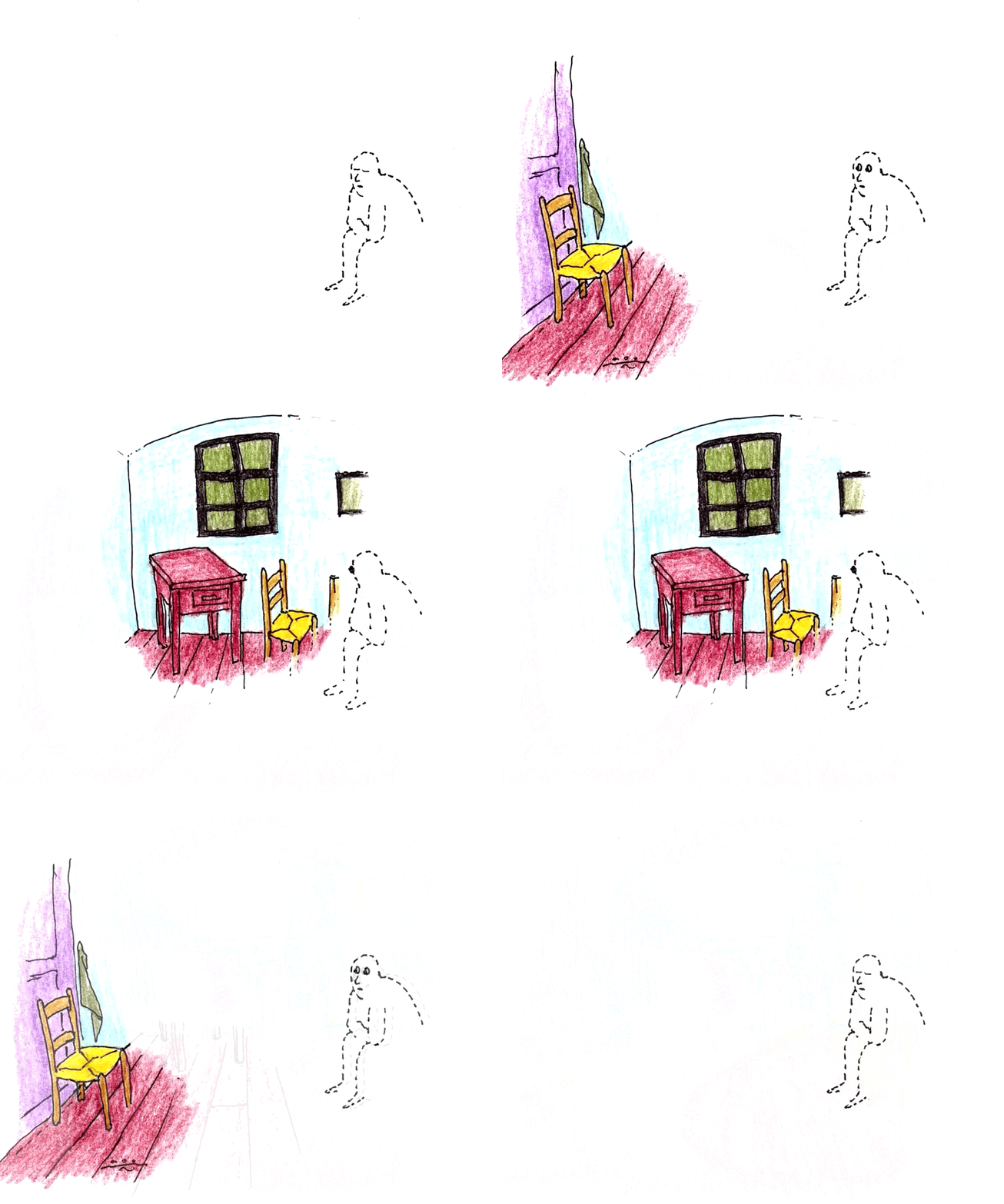{ style="max-width: 384px; width: 100%" }](https://www.youtube.com/watch?v=LJiXTCbFtu0)
Is your experience more like this...
[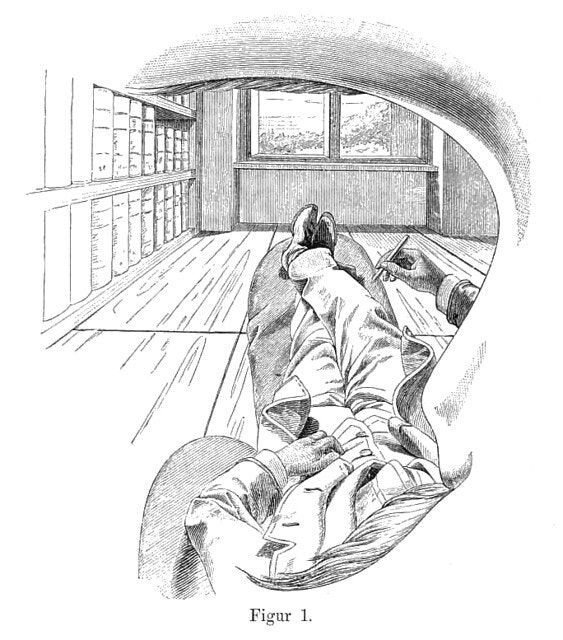{ style="max-width: 384px; width: 100%" }](https://en.wikipedia.org/wiki/Ernst_Mach#/media/File:Ernst_Mach_Inner_perspective.jpg)
...or like this?
I will confess I found this kind of alienating. I was a bit attached to being a *homunculus in a fishbowl*. I didn't want to be this weird distorted flat thing – I felt like I'd been hit with a dimensionality-reduction weapon.
This way of seeing warranted further interrogation. I constructed another experiment:
Hold your hand in your field of view, and use your other hand to simultaneously touch the *near* and *far* sides. Ask yourself the following questions:
1. Are the sensations on the *near* side of your hand in *front* of the visual field?
2. Are the sensations on the *far* side of your hand *behind* the visual field?
3. Are the sensations on the *near* and *far* sides of your hand meaningfully separate from one another?
When I do this I find the illusion of distance breaks down in a similar way. And, as Roger tells me, if I was to get fast enough at [*noting*](https://www.youtube.com/watch?v=s3VY0i3zW4Y) I would notice that it's impossible to put attention on both the *near* and the *far* side sensations at the same time – attention flickers between the two from [frame to frame](/posts/2023-10-28-attention-and-awareness.html#open-questions).
## Phenomenal field interference
Throughout the conference, myself and Brad had already been toying with the idea that the *visual field* could be embedded within the *somatic field*, and now Roger's video had shown how to feel into this idea.
Steven Lehar proposed that if the visual field is constructed from *non-linear waves*, and if the substrate underlying these could [adjust its refractive index](https://en.wikipedia.org/wiki/Gradient-index_optics) on the fly – increasing or decreasing the [wave propagation rate](https://en.wikipedia.org/wiki/Phase_velocity) – then this could be used to compensate for *depth* in a way that ensures that the [frequency spectrum](https://en.wikipedia.org/wiki/Spectral_density) of the waves reifying similar percepts remains invariant across a range of scales.
[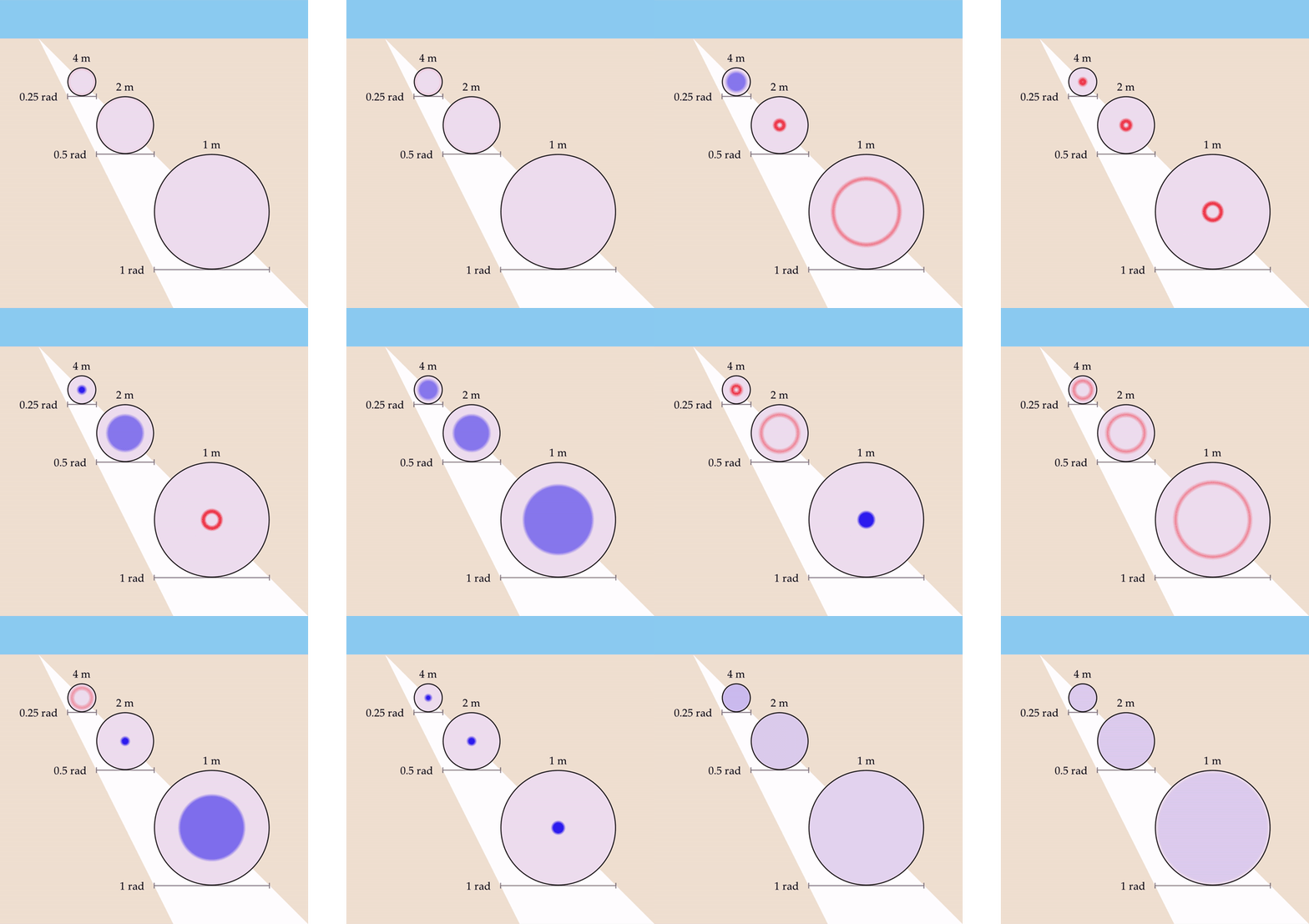{ style="max-width: 512px; width: 100%" }](/posts/2023-01-18-an-introduction-to-steven-lehar-part-iii.html#depth-maps)
Visualisation of circular percepts in perspective, with a uniform wave propagation rate on the left and an adjusted wave propagation rate on the right. Animation by [Scry Visuals](https://twitter.com/scrygl).
This is how a sense of *visual field depth* could be created, while ensuring that vibe-based [object recognition](https://en.wikipedia.org/wiki/Object_recognition_(cognitive_science)) still works. It would make sense that *somatic field geometry* could be constructed in a similar way.
Now, if the visual field operated on a different frequency band to the somatic, [perhaps a much higher one](https://x.com/cube_flipper/status/1800588941667733599) – and if the substrate underlying them could adjust the wave propagation rate at these different frequency bands independently, then if waves in these different frequency bands were mostly non-interacting then the spaces created at these frequency bands could exhibit different geometries while remaining co-located.
I said *mostly* non-interacting. If you understand Lehar's model, you'll also understand that as *depth* decreases, then *propagation rate* increases. Then perhaps as an object comes closer to you, its waves in the *visual field* would [interfere](https://en.wikipedia.org/wiki/Intermodulation) with the waves in the *somatic field* in a way that generates a *low-valence*, attention-grabbing aversive sensation on the corresponding part of the body? This could be an efficient way of [orienting attention](https://en.wikipedia.org/wiki/Superior_colliculus) or even implementing [obstacle avoidance](https://en.wikipedia.org/wiki/Obstacle_avoidance).
## An informal model
Once I'd returned from Tucson, I went out for lunch with a friend and we split a pair of chopsticks and spent some time pointing them at one another. We found that the effect is stronger when *someone else* is holding the pointy object – this might be a factor of *uncertainty* as well as something to do with the *self-other distinction* – [maybe the waves are going in opposite directions](https://x.com/cube_flipper/status/1788831012778385460).
There's so much more to explore. I hope the reader can see that this way of thinking is fruitful and can be used to propose novel hypotheses about subjective experiences – some of which might even be testable in the long run, with the right [psychophysics](https://en.wikipedia.org/wiki/Psychophysics) experiments.
I said I would try to update on my [previous model](http://localhost:8000/posts/2022-10-01-an-introduction-to-steven-lehar-part-i.html#open-questions). I will reiterate that I don't expect this to be remotely close to a complete model – though in that regard I suspect that Andrés may be [making some progress at his end](https://x.com/algekalipso/status/1785442028840730984). In any case, here is my current working model of typical human *qualia states*:
- There is a single *phenomenal field*.
- All sensations are *waves* within this field.
- Different [*sensory modalities*](https://en.wikipedia.org/wiki/Stimulus_modality) are distinguishable by the characteristics of these waves, of which the primary distinguishing characteristic is *frequency*, but there are also others such as *texture*.
- In some cases, the distinction is so unambiguous that it is meaningful to speak of *separate fields* for different sensory modalities, such as the [*somatic field*](#the-somatic-field) and [*visual field*](#the-visual-field).
- Within these separate fields, variable [*wave propagation rate*](https://en.wikipedia.org/wiki/Phase_velocity) is used to implement a variable [*metric*](https://en.wikipedia.org/wiki/Metric_tensor). This permits the separate fields to have separate yet [*diffeomorphic*](https://en.wikipedia.org/wiki/Diffeomorphism) geometric structure.
Now that we have established our model, we can celebrate by trying to break it. For instance, I am still perplexed as to how *colour* might fit into this model. It remains a special case, and I am no closer to figuring out [what it might be](/posts/2022-10-01-an-introduction-to-steven-lehar-part-i.html#what-is-colour) – though perhaps the visual field's [*elastic*](https://x.com/cube_flipper/status/1782840452443750829) nature will provide some hints. And did I also just implicitly claim that the unified phenomenal field is *two-dimensional*? That sounds like it needs fact-checking – but if that is the case, *that* seems like the kind of thing that could have implications for the *reality mapping problem*. And finally, how might all these things interplay with [*phenomenal time*](https://qualiacomputing.com/2018/11/28/the-pseudo-time-arrow-explaining-phenomenal-time-with-implicit-causal-structures-in-networks-of-local-binding/)?
These seem like great topics for future posts, but in the meantime, I welcome anybody who wishes to poke holes in this particular [smooth manifold](https://en.wikipedia.org/wiki/Differentiable_manifold). I'd love to hear from you via [email](mailto:admin@smoothbrains.net) or [Twitter](https://x.com/cube_flipper) – I welcome exasperated messages from meditators and mathematicians alike.
---
## What is *valence structuralism*?
Before we end, I'd like to return to the issue of [*valence*](/posts/2023-02-18-the-state-of-play-in-symmetry.html). In [Principia Qualia](https://opentheory.net/PrincipiaQualia.pdf#page=28), [Mike Johnson](https://twitter.com/johnsonmxe) also defined the terms *valence realism* and *valence structuralism*:
> **Valence Realism**: *valence (subjective pleasantness) is a well-defined and ordered property of conscious systems.*
>
> **Valence Structuralism**: *valence has a simple encoding
in the mathematical representation of a system's qualia.*
Presenting a compelling case for *valence realism* is beyond the scope of this document, but I should be clear that I consider this project to be both a *qualia structuralist* and a *valence structuralist* one. This means that I am also on the look out for phenomena which might constrain the possibility space of candidate theories of valence.
I want to ask: *where* do we feel valence? Do we feel valence in the *visual field*? I asked around; it seems that the straight answer is [*not really*](https://twitter.com/cube_flipper/status/1759395140383432783). This might seem like an obvious statement, but now we get to ask another question: why *don't* we feel valence in the visual field?
Is it due to a particular *geometry* or *dimensionality*? Its *frequency*? The *colour*? Is it because [the waves of attention flow in a particular way](/posts/2023-10-28-attention-and-awareness.html#do-attention-and-awareness-follow-a-branched-flow-structure)? What makes it so special? Lack of valence in the visual field has some interesting implications – namely, that there may be *sensoriums without suffering*, in [Nick Cammarata's words](https://x.com/nickcammarata/status/1795440156666958301).
What this tells me is that any theories of valence we come up with will need to take this into account – and that any psychophysics experiments we might craft to study them may need to focus on sensations in the *body*.