---
title: "Estrogen: A trip report"
authors:
- name: "Cube Flipper"
url: "https://twitter.com/cube_flipper"
discussion-url: "https://x.com/cube_flipper/status/1934295600742404541"
---
---
---
I have [gender dysphoria](https://en.wikipedia.org/wiki/Gender_dysphoria). I find labels overly reifying; I feel reluctant to call myself *transgender*, per se: when prompted to state my gender identity or preferred pronouns, I fold my hands into the [*dhyana mudra*](https://www.yogapedia.com/definition/6871/dhyana-mudra) and state that I *practice [emptiness](https://en.wikipedia.org/wiki/Śūnyatā) on the concept of gender*. Mostly people seem to vibe it, but sometimes it feels a little like weasel words. Other times, when I'm in a sillier mood, I'll tell people I'm *genderfluid* – if only because it sounds like something I'd put in my station wagon. Of course, my faithful Subaru Outback was made before 2008, which means it wants the [green, long-life genderfluid](https://www.amazon.com/Genuine-Subaru-SOA868V9210-Coolant-Gallon/dp/B007L72U1C/)...
I experience an ongoing [brain-body map](https://slatestarcodex.com/2013/02/18/typical-mind-and-gender-identity/) [prediction error](https://slatestarcodex.com/2017/09/05/book-review-surfing-uncertainty/) – my brain seems to expect a differently shaped body to the one I wound up with. I have been acutely aware of this since before I hit puberty. Out of shame and embarassment, I suppressed this, but I also made a promise to myself that if I hadn't come out by the time I turned thirty then I was allowed to get as weird as I needed to.
During the COVID-19 pandemic I went through a phase of using self-administered ketamine therapy to refactor a long list of maladaptive behavioural patterns, and eventually this particular issue became impossible to ignore. I had avoided reifying it for long enough, and this wasn't working for me – I had to try something different. One evening in July 2021, I sat down with a close friend. *I am going to put a large amount of ketamine up my nose*, I said. *Your job is to start asking me questions about my sexuality.*
Not long after, I had jumped through the relevant bureaucratic hoops, and subsequently found myself cycling home from the pharmacy with a paper bag filled with repurposed menopause medication – a starter pack of *100 µg/24 hr* estradiol patches, to be applied twice a week.
{ style="max-width: 384px; width: 100%" }
While the *physical* effects of estrogen are [well-documented](https://genderdysphoria.fyi/en/second-puberty-fem), back when I came out I had difficulty finding detailed phenomenological reports of the *subjective* effects of estrogen. I did wind up reading a large number of anecdotal reports on [Reddit](https://www.reddit.com/r/asktransgender), and found that in aggregate, people tend to report [positive subjective effects](https://www.reddit.com/r/asktransgender/comments/rfpokm/mental_effects_of_estrogen_hrt/). One could propose a number of non-exclusive hypotheses as to why – I'll attempt to review these later in this post.
How could I resist? It was time to find out for myself. I unboxed the patches and placed one on my stomach.
## What does estrogen *do*?
The [sex hormones](https://en.wikipedia.org/wiki/Sex_hormone) – [androgens](https://en.wikipedia.org/wiki/Androgen), [estrogens](https://en.wikipedia.org/wiki/Estrogen), and [progestogens](https://en.wikipedia.org/wiki/Progestogen) – are produced by the [endocrine system](https://en.wikipedia.org/wiki/Endocrine_system). They are released into the bloodstream in response to a range of regulatory factors – primarily the [hypothalamic-pituitary-gonadal axis](https://en.wikipedia.org/wiki/Hypothalamic–pituitary–gonadal_axis) – as a signal for distant cells to regulate a wide variety of bodily functions.
At the other end, [*receptors*](https://en.wikipedia.org/wiki/Receptor_(biochemistry)) are – very generally speaking – a class of proteins which can [change their shape](https://en.wikipedia.org/wiki/Conformational_change) when [specific molecules](https://en.wikipedia.org/wiki/Ligand_(biochemistry)) bind to them. Of these, [*estrogen receptors*](https://en.wikipedia.org/wiki/Estrogen_receptor) are primarily [*nuclear receptors*](https://en.wikipedia.org/wiki/Nuclear_receptor), although a smaller fraction of them are [*cell surface receptors*](https://en.wikipedia.org/wiki/Cell_surface_receptor). These are typically located in the cell's [*cytoplasm*](https://en.wikipedia.org/wiki/Cytoplasm) – but when activated, they pass through the [*nuclear membrane*](https://en.wikipedia.org/wiki/Nuclear_envelope), bind directly to DNA, and [regulate the expression of specific genes](https://en.wikipedia.org/wiki/Regulation_of_gene_expression). For comparison, [*neurotransmitter receptors*](https://en.wikipedia.org/wiki/Neurotransmitter_receptor) are primarily [*cell surface receptors*](https://en.wikipedia.org/wiki/Cell_surface_receptor). These are located in the [*cell membrane*](https://en.wikipedia.org/wiki/Cell_membrane) – and when activated might [allow ions to pass through the cell membrane](https://en.wikipedia.org/wiki/Ligand-gated_ion_channel) or [trigger other messaging systems within the cell](https://en.wikipedia.org/wiki/Metabotropic_receptor).
[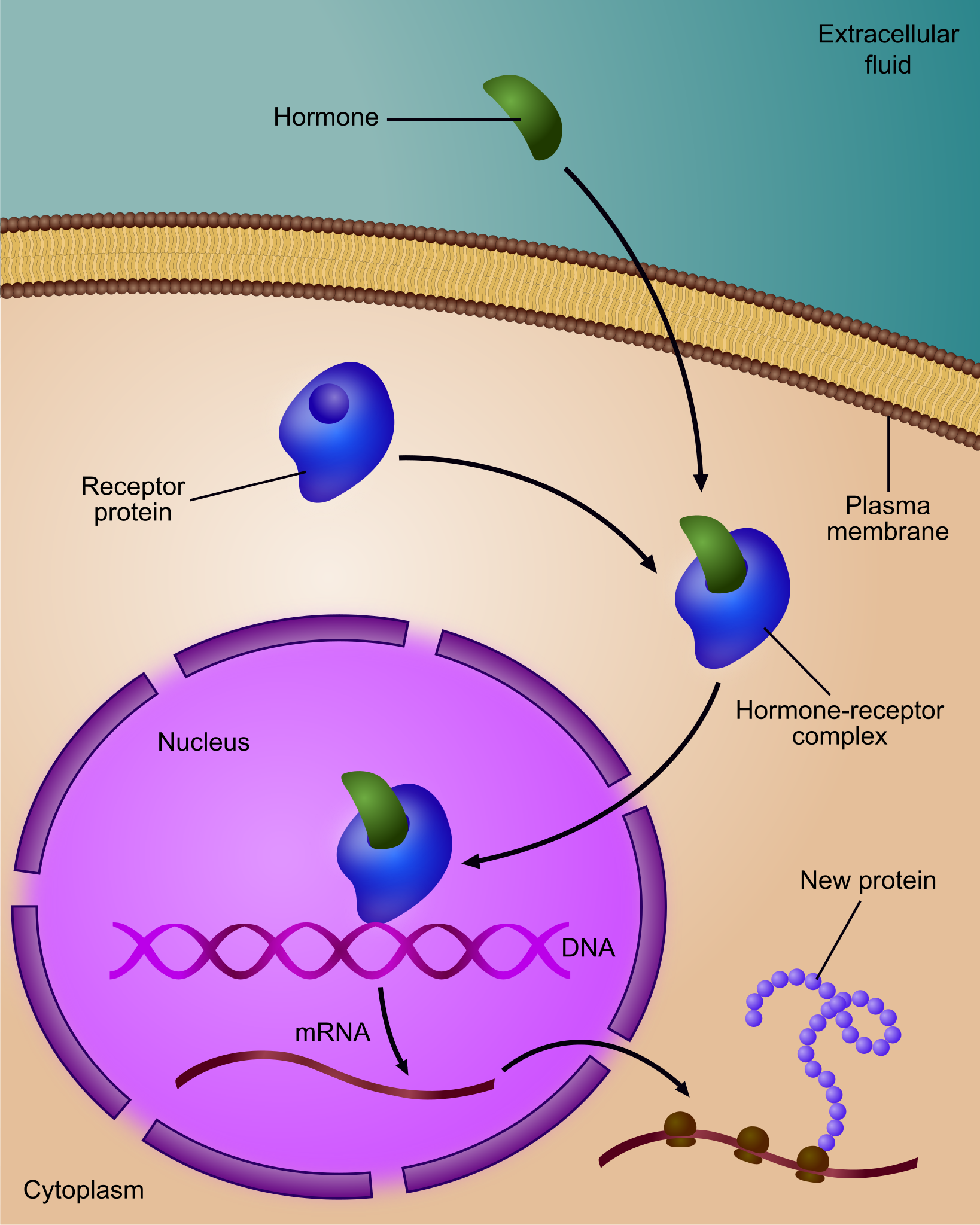{ style="max-width: 384px; width: 100%" }](https://en.wikipedia.org/wiki/Regulation_of_gene_expression#/media/File:Regulation_of_gene_expression_by_steroid_hormone_receptor.svg)
Illustration of a hormone receptor regulating gene expression, from [Wikipedia](https://en.wikipedia.org/wiki/Regulation_of_gene_expression).
Estrogen receptors are located throughout the body. Of these, there are two main types – [ERα](https://en.wikipedia.org/wiki/ERα) and [ERβ](https://en.wikipedia.org/wiki/Estrogen_receptor_beta). These have similar [binding affinities](https://en.wikipedia.org/wiki/Ligand_(biochemistry)#binding_affinity) for estradiol, but are expressed in different proportions in different bodily tissues, and can have different effects on gene regulation.
Estrogen receptors are of course also located in the brain. [The Role of Estrogen Receptors and Their Signaling across Psychiatric Disorders](https://pubmed.ncbi.nlm.nih.gov/33396472/) (Hwang et al., 2020) includes a map of where they are concentrated:
[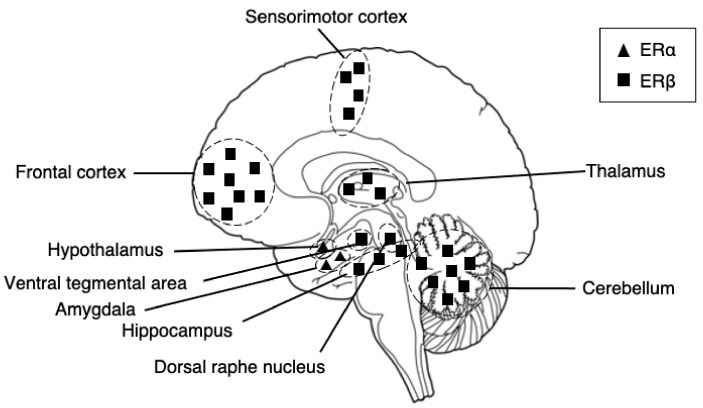{ style="max-width: 384px; width: 100%" }](https://pubmed.ncbi.nlm.nih.gov/33396472/#&gid=article-figures&pid=figure-1-uid-0)
**Figure 1.** A schematic diagram of distributions of estrogen receptor alpha and estrogen receptor beta in our brains. The receptors have a different predominance of expression in distinct regions. ERα is predominantly expressed in the [amygdala](https://en.wikipedia.org/wiki/Amygdala) and [hypothalamus](https://en.wikipedia.org/wiki/Hypothalamus), whereas ERβ is predominantly expressed in the [somatosensory cortex](https://en.wikipedia.org/wiki/Primary_somatosensory_cortex), [hippocampus](https://en.wikipedia.org/wiki/Hippocampus), [thalamus](https://en.wikipedia.org/wiki/Thalamus), and [cerebellum](https://en.wikipedia.org/wiki/Cerebellum).
It is not surprising, then, that estrogen can have an influence on multiple aspects of brain function, including neurotransmitter levels. There's a recent review paper which covers the latest information we have on this. From [The impact of estradiol on serotonin, glutamate, and dopamine systems](https://www.frontiersin.org/journals/neuroscience/articles/10.3389/fnins.2024.1348551/full) (Bendis et al., 2024):
[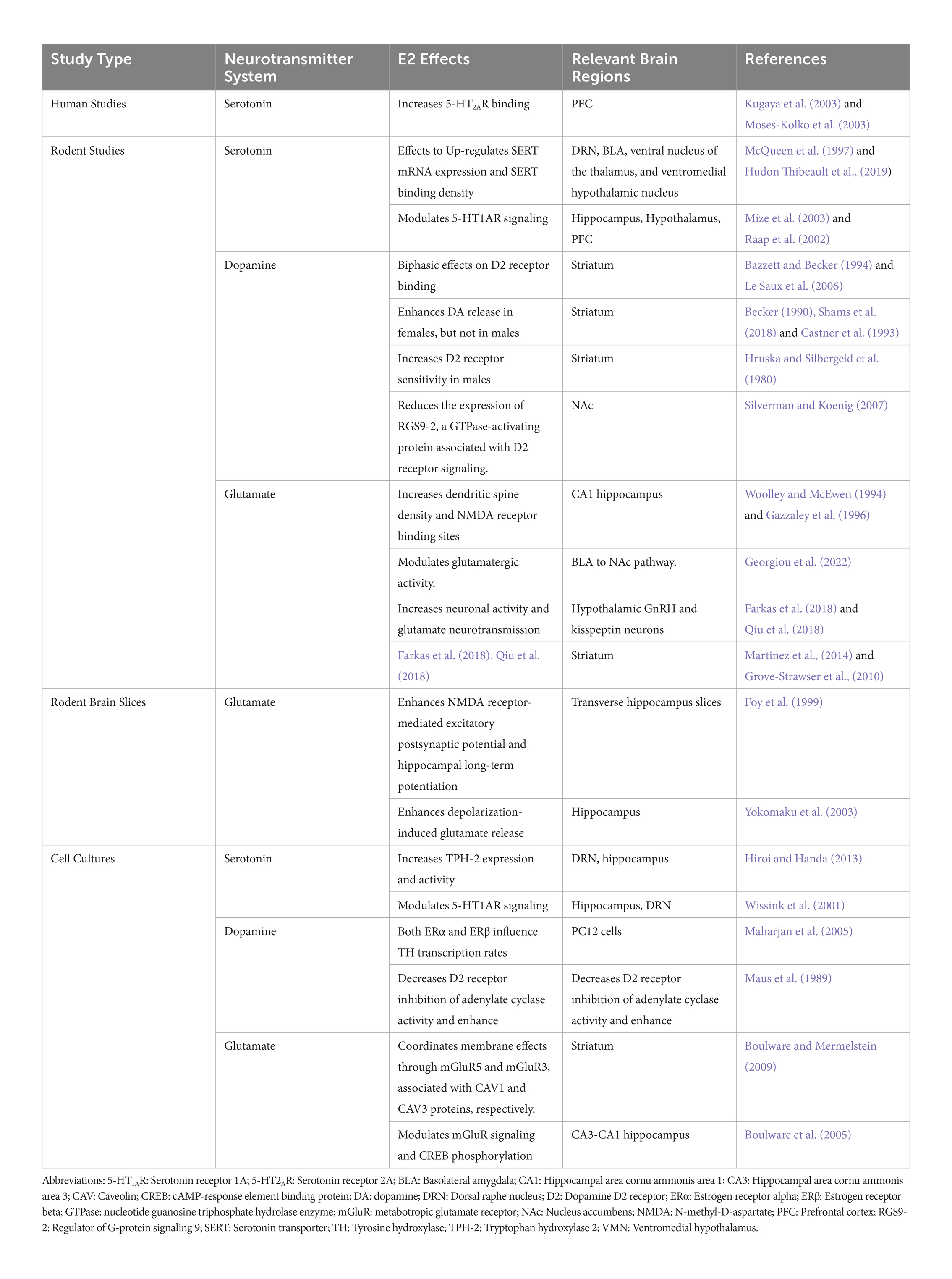{ style="max-width: 384px; width: 100%" }](https://www.frontiersin.org/files/Articles/1348551/fnins-18-1348551-HTML-r1/image_m/fnins-18-1348551-t001.jpg)
**Table 1**. Summary of the main findings on the role of estradiol on serotonin, glutamate, and dopamine systems.
> Estradiol is a steroid hormone that influences the serotonergic, dopaminergic, and glutamatergic systems. Estradiol exerts its effects through classical mechanisms by binding to nuclear estrogen receptors α, and β, or through nonclassical mechanisms through binding to membrane bound estrogen receptors α, β, and [GPER](https://en.wikipedia.org/wiki/GPER).
The effects are so wide-ranging that any review I can write will no doubt oversimplify things. That said, I'd like to highlight two findings relevant to neurotransmitter levels:
- [*Serotonin*](https://en.wikipedia.org/wiki/Serotonin) synthesis is upregulated by ERβ via [tryptophan hydroxylase](https://en.wikipedia.org/wiki/Tryptophan_hydroxylase) transcription.
- [*Dopamine*](https://en.wikipedia.org/wiki/Dopamine) synthesis is upregulated by ERα and downregulated by ERβ via [tyrosine hydroxylase](https://en.wikipedia.org/wiki/Tyrosine_hydroxylase) transcription. Potentially, they work in tandem to maintain homeostatic levels, but ERα has greater influence at higher estradiol levels.
These neurotransmitters are, of course, [stereotypically](https://x.com/AskYatharth/status/1615157727625637888) associated with *mood* and *reward*.
Estrogen receptors can also upregulate or downregulate production of neurotransmitter receptors. However, most of the evidence we have for this is from [binding assays](https://en.wikipedia.org/wiki/Ligand_binding_assay) performed on *rats*. As stated in another review paper, [Sex hormones affect neurotransmitters and shape the adult female brain during hormonal transition periods](https://www.frontiersin.org/journals/neuroscience/articles/10.3389/fnins.2015.00037/full) (Barth et al., 2015):
> Evidence from neuroimaging findings to link estrogen and the
serotonergic system in humans are still relatively sparse. Animal
data support ovariectomy to decrease [5-HT1](https://en.wikipedia.org/wiki/5-HT1_receptor) binding, [5-HT2A](https://en.wikipedia.org/wiki/5-HT2A_receptor) binding and expression, and [5-HT transporter](https://en.wikipedia.org/wiki/Serotonin_transporter) binding sites and expression. These findings have
been shown to be reversible with estrogen replacement therapy.
This process involves several steps: First, researchers remove the ovaries from female rats, and then divide them into two groups – one receiving estrogen treatment and the other serving as a control. Next, finely sliced brain samples are taken from both groups and exposed to a radioactive ligand, which binds to the receptor of interest. Finally, these radioactive samples are used to [create images on radiosensitive film](https://en.wikipedia.org/wiki/Autoradiograph), which is then developed and analysed.
[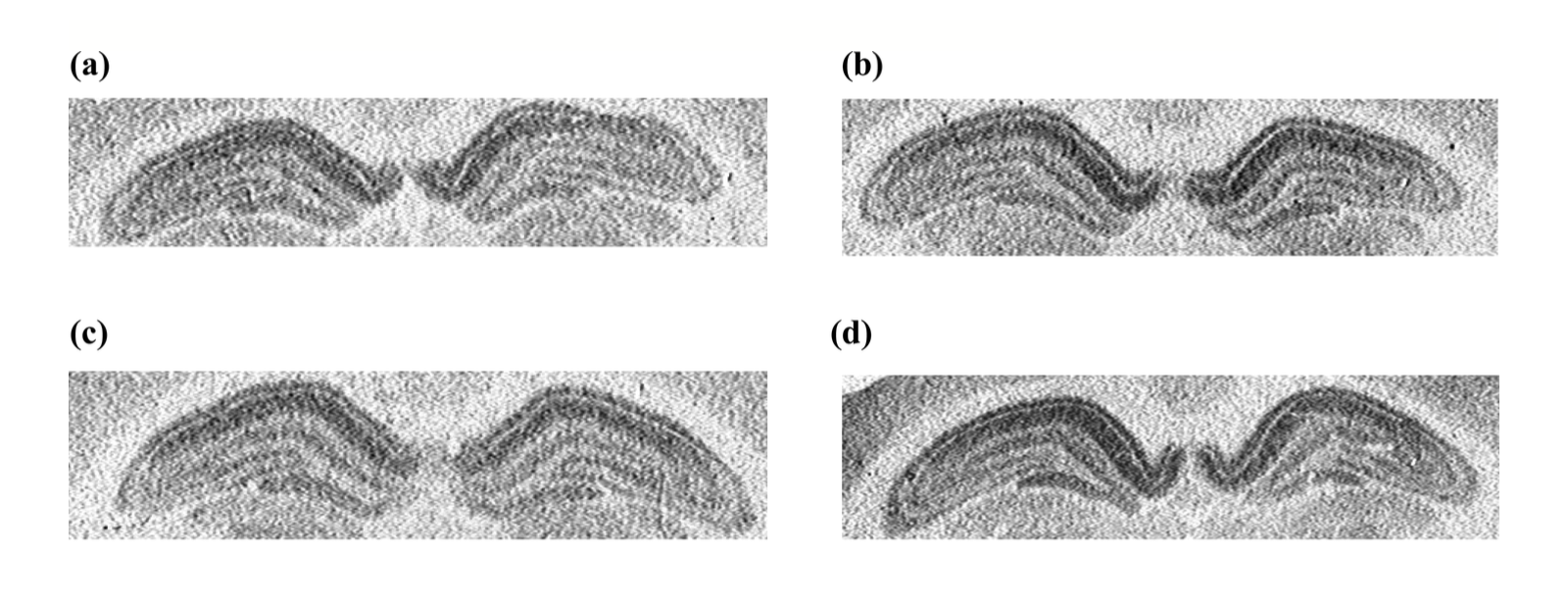{ style="max-width: 512px; width: 100%" }](https://www.ncbi.nlm.nih.gov/pmc/articles/PMC6740259/)
Autoradiographs of 3H-[MK-801](https://en.wikipedia.org/wiki/Dizocilpine) binding in the hippocampus of female rats which received: **(a)** a sham surgery with no ovariectomy; **(b)** ovariectomy and injection with a control substance; **(c)** ovariectomy and *40 μg/kg* estrogen; **(d)** ovariectomy and *0.5 mg/kg* progesterone.
This is not the kind of procedure we generally perform on humans. Additionally, these preclinical rat model studies concern ovarectomized female rats and are intended to inform treatment programmes for postmenopausal human women – so their relevance to humans starting from an androgenic baseline is possibly somewhat limited. Still, there's a [couple](https://academic.oup.com/endo/article-abstract/131/2/662/2496261) [of](https://www.sciencedirect.com/science/article/abs/pii/096007609500075B) these studies I'd like to highlight, which found estrogen caused:
- [*NMDA receptor*](https://en.wikipedia.org/wiki/NMDA_receptor) upregulation in the [CA1 region](https://en.wikipedia.org/wiki/Hippocampus_proper#CA1) of the [hippocampus](https://en.wikipedia.org/wiki/Hippocampus).
- [*5-HT2A receptor*](https://en.wikipedia.org/wiki/5-HT2A_receptor) upregulation in the [forebrain](https://en.wikipedia.org/wiki/Forebrain), particularly the [anterior frontal cortex](https://en.wikipedia.org/wiki/Prefrontal_cortex), [anterior cingulate cortex](https://en.wikipedia.org/wiki/Anterior_cingulate_cortex), [primary olfactory cortex](https://en.wikipedia.org/wiki/Primary_olfactory_cortex) and the [nucleus accumbens](https://en.wikipedia.org/wiki/Nucleus_accumbens).
That said, there *do* exist a [couple](https://pubmed.ncbi.nlm.nih.gov/12900319/) [of](https://www.fertstert.org/article/S0015-0282(03)00973-7/fulltext) studies assessing the influence of estrogen on 5-HT2A receptor binding in humans, using a radioactive ligand and [positron emission tomography](https://en.wikipedia.org/wiki/Positron_emission_tomography). In both studies, five postmenopausal women were assessed both before and after hormone replacement therapy, and both found estrogen increased 5-HT2A receptor binding in [prefrontal regions](https://en.wikipedia.org/wiki/Prefrontal_cortex). The resolution is pretty low, but see for yourself:
[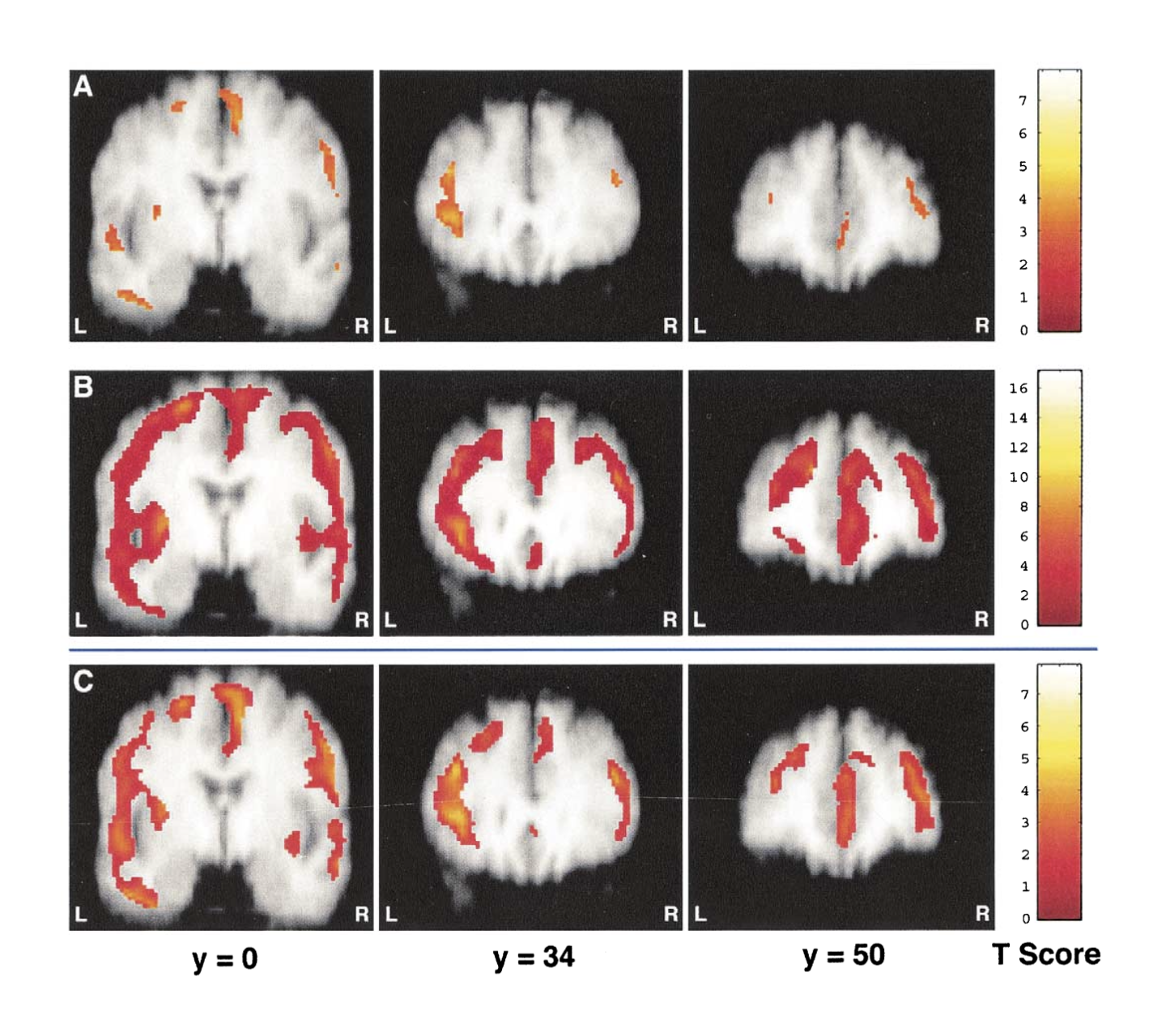{ style="max-width: 384px; width: 100%" }](https://www.fertstert.org/article/S0015-0282(03)00973-7/fulltext)
Regions where 5-HT2A receptor binding potential increased following hormone replacement therapy. **Row A** and **Row B** indicate estradiol and combined estradiol and progesterone treatment respectively, with a voxel threshold of *P* < 0.01. **Row C** indicates estradiol treatment, with a less strict voxel threshold of *P* < 0.05.
Alright, so what are these *NMDA* and *5-HT2A* receptors responsible for? These are glutamate and serotonin receptors, respectively – and these are also the specific receptors that are [*antagonised*](https://en.wikipedia.org/wiki/Receptor_antagonist) by [ketamine](https://psychonautwiki.org/wiki/Ketamine) and [*agonised*](https://en.wikipedia.org/wiki/Agonist) by most [serotonergic psychedelics](https://psychonautwiki.org/wiki/Serotonergic_psychedelic). If recreational drugs targeting these receptors can engender euphoric subjective effects – what might estrogen be capable of?
## What does estrogen *feel like*?
The subjective perceptual and psychological effects of estrogen are wide-ranging and subtle. I'll start by discussing the more mundane sensory changes I experienced before moving on to those which might be more nebulous or ineffable.
#### Dosage
At the time of writing, I've been on and off estrogen for a period of nearly three years. My initial dosage was one of the *100 µg/24 hr* [estradiol](https://en.wikipedia.org/wiki/Estradiol) patches, but I doubled this after a short while. I have also tried *2 mg* [estradiol valerate](https://en.wikipedia.org/wiki/Estradiol_valerate) pills, twice or three times daily – though this turned out to be too low, and I wound up switching back to patches. I have found using patches to result in the most striking and noticeable subjective effects. I have not yet tried injected estrogen, though I anticipate doing so before long.
Additionally, at one point I tried taking a *300 mg* [progesterone](https://en.wikipedia.org/wiki/Progesterone) suppository. This made me feel quite stupid the following day, so I did not try this again.
### Gustatory perception
I've long been in the bad habit of rolling out of bed and grabbing a Monster Zero straight from the fridge first thing in the morning, and I tend to follow this up with Diet Coke throughout the day. This means that I'm fairly attuned to the taste of artificial sweeteners, so naturally the change in taste perception was the first thing I noticed – within a day or two of first putting the patches on, I found that *sweet* things tasted *sweeter*; and *sour* things tasted both *sweeter* and more *metallic* – and the cinnamon taste in my standard reference Diet Coke really *shone through*.
This was rather exciting; I was not expecting to find that the [primary tastes](https://en.wikipedia.org/wiki/Taste#Basic_tastes) were not in fact primal, but in fact could shift around inside a lower-dimensional [latent space](https://en.wikipedia.org/wiki/Latent_space). This got me theorising – as I wrote [elsewhere](/posts/2024-06-18-an-informal-review-of-anthropic-qualia-states.html#the-somatic-field):
> Perhaps taste could be built out of something like [*dyadic*](https://en.wikipedia.org/wiki/Dyad_(music)) vibrations, tuned by evolution towards [consonance or dissonance](https://en.wikipedia.org/wiki/Consonance_and_dissonance) in order to generate an attractive or aversive response in the organism?
### Olfactory perception
It took me a little while before I noticed any change to my sense of smell, but this was more a factor of encountering the relevant stimulus. It was boys. Boys smelt different.
Much earlier in life, I'd had to convince myself I was gay by using the fact that boys smelt *really good*. This was very much no longer the case, and I began to notice wide variation in the way boys smelt, which sometimes was really quite unpleasant – *oniony*, even.
### Somatic perception
I have somatic sensory issues. Skin sensations have always been overwhelming – my mother will confirm that I would scream if she attempted to dress me in wool, and in adulthood I avoid buying clothing with sleeves. By default, my skin feels like a bag of white noise – and when things get bad it can feel like my whole body is covered with randomised pinprick sensations, like minuscule [topological defects](/posts/2024-03-01-5-meo-dmt.html) in the [somatic field](/posts/2024-06-18-an-informal-review-of-anthropic-qualia-states.html#the-somatic-field).
This has interfered with my ability to experience intimacy; simply lying in bed with somebody could be a stressful time for me. Estrogen ramps all of this way down in intensity – it's a tremendous relief.
Perhaps my cleaning habits can provide an objective measure. Because things like sweat on my skin or leftover food in my mouth constitute intolerable sensory distractions, I'd tend to shower up to four times a day and brush my teeth about as often – since starting estrogen, I'm much less neurotic about both of these things.
A less turbulent nervous system also seems to be less disruptive for sleep. Beforehand, I took it for granted that I would often wake up throughout the night in a state of discomfort, whereas while I am on estrogen I reliably wake up in the morning feeling well-rested.
### Visual perception
It's fairly common to hear reports of [colours becoming more intense after starting hormone replacement therapy](https://www.reddit.com/r/MtF/comments/xcr66g/color_on_estrogen/). I'm familiar with how [serotonergic psychedelics can produce this effect](https://psychonautwiki.org/wiki/Color_enhancement), but I can't say I observed any such thing myself. What did change was my sense of *space*.
This one's quite subtle – it was the kind of thing that was more noticeable when I experimented with deliberately spiking my hormones. I'll do my best to explain. It's as if I took the entire volumetric representation of the space around me and increased the degree to which every point within that could influence the location of every other point, recursively. This allows everything to elastically settle into a more harmonious equilibrium. This effect is basically identical to what a small dose of psychedelics can do, specifically a tryptamine like [psilocybin](https://psychonautwiki.org/wiki/Psilocybin_mushrooms) or [DMT](https://psychonautwiki.org/wiki/DMT).
It's hard to say what the utility of this might be. The balance between entropy and harmony is an important one – too much entropy and it's hard to tell signal from noise, and too much harmony and you might miss important details. I did feel that with a more parsimonious model of the space around me, I got better at driving – though my friends would say I got more *confident* at driving. Competence might be orthogonal to confidence, but I maintain that parallel parking is much easier now.
### Motor output
I ride my bicycle every morning – this is my primary meditative practice. I am also surrounded by steep hills, so I noticed within a couple of days that I could not activate my quads and hamstrings as hard as I was used to. This happened much faster than could possibly be accounted for by muscular atrophy, so I surmised that this must be a neuromuscular phenomenon. Later on I switched back to my own hormones for a short period, and once again the change was quite rapid. There was nothing quite like the rush of *powering* uphill once again.
Being less strong honestly sucked pretty bad, and this required some psychological adjustment. The flipside of this was that I found estrogen to be a *superb* muscle relaxant, and ultimately this made the effect a net positive.
Around the time I transitioned was also the period when I was exploring some quite extreme ketamine-assisted [myofascial release](https://www.fasciaresearch.com/literature/sensory-innervation/InnervationExcerpt.pdf) techniques in order to shake off a lifetime's worth of accumulated tension from things like bad ergonomics and social anxiety. I'd say estrogen has been partially instrumental in getting me from a place where I'm constantly attacking myself with a foam roller and massage gun just to feel comfortable in my own body – to one where massage is more of a light maintenance task, like a bird preening its feathers.
### Emotional modulation
I have spent a big chunk of my life navigating chronic emotional disaffection – high school sucked, and later I had an acute week-long dissociative episode when I was twenty-one which I'm not sure I ever quite came back from. Suffice it to say I lived an emotionally stagnant existence for most of my twenties – so when the hormones opened things up, I got quite attached to my new feelings.
Funny things were *funnier* – I recall a moment about a week after I started the hormone treatment, when I laughed at something I saw on YouTube – the surge of joy was like an electric cauteriser through my breastbone. Music [*works*](https://www.youtube.com/watch?v=XGWbIw8oK9I) now. I can lean in to the sense of affection I feel towards my friends. I cry more frequently; but this is clearly critical for releasing tension that would otherwise remain below the surface.
There's another side to all this. I have had to navigate a number of situations where I now found myself unable to dissociate from some issue in my life that had been bothering me – I *had* to do something. Often this felt destructive; in retrospect there's things I could have handled with far more grace and care, but instead I chose to drive a bulldozer through them.
For better or worse, this is what the hormones can do. It's a bit of an epistemic nightmare – do I take action to deal with the thing that's bugging me, or would it be better to skip my hormones for a day or two and see if I consider things differently? I can only recommend entering into this groundless game of instrumental hormone manipulation if one is comfortable taking responsibility for epistemic frame-shifting.
### Attentional modulation
I'd engaged with a number of deliberate psychological interventions in the lead-up to coming out, with the general aim of managing my social self-awareness. I knew I needed the confidence. If I was to socially transition, I'd need to not get too overwhelmed or hung up on what other people thought of me.
Of these, the most effective was [Michael Ashcroft](https://x.com/m_ashcroft)'s [extremely straightforward course](http://expandingawareness.org) on [Alexander Technique](https://en.wikipedia.org/wiki/Alexander_Technique). I wrote about this in my writeup on [attention and awareness](/posts/2023-10-28-attention-and-awareness.html):
> Here's how I usually explain it to people: You have *awareness*, which corresponds to everything currently in your sensorium. Then you have *attention*, which is a subset of that – like the beam of a spotlight – and most importantly, you have *agency* over it, you can choose where to point it and how wide or narrow you would like it to be.
Sometimes we might feel that our attention is involuntarily yanked around by invisible aversive forces that are seemingly beyond our control – for instance, I might find it challenging to make eye contact with people at a party, and spend the whole time with my attention collapsed and pointed at the floor.
I think what Alexander Technique does is [teach mindfulness of this class of phenomena and how to *expand* attention out of them](https://x.com/m_ashcroft/status/1807008725548363845). Prior to transition, I deliberately experimented with this form of attentional modulation – primarily in the kind of social setting that I would normally find overwhelming, but also just while riding my bicycle outside. I think this kind of practice has a lot of potential for helping undo the archetypal trauma-induced behavioural patterns displayed by socially anxious autistic people. Personally I found it to be remarkably effective, and after some months of this I felt that my anxiety disorder was mostly in remission.
So it was a humungous letdown when I found that all of this got *significantly harder* on estrogen. I cringed my way through social events, and returned to staring at the floor – but I didn't let this stop me. I thought of it like Goku training in the [one hundred times Earth gravity chamber](https://dragonball.fandom.com/wiki/Gravity_Machine). I just learned it all again from scratch.
## How does estrogen *work*?
If someone feels that they'd rather have a feminine body, estrogen is going to satisfy this desire – *within reason*. This is obvious. I'm more interested in finer-grained, *bottom-up* rather than *top-down* sensory phenomena. What are the other reasons that estrogen might *feel good*? I'd like to propose a number of theories – I'll try to order them from least speculative to most speculative.
What should my [null hypothesis](https://en.wikipedia.org/wiki/Null_hypothesis) be? [Would estrogen make someone without gender dysphoria feel good too?](https://www.reddit.com/r/DrWillPowers/comments/fcxboa/the_story_of_how_i_screwed_up_a_dose_calculation/) Is it just a miraculous coincidence that estrogen just so happens to fix other issues that tend to be correlated with gender dysphoria – or do people with gender dysphoria suffer from an innate neurochemical deficit which can be corrected by hormone therapy?
### Estrogen is like the opposite of ketamine
Transgender writer [Zinnia Jones](https://zinniajones.com) suffers from [depersonalisation-derealisation disorder](https://en.wikipedia.org/wiki/Depersonalization-derealization_disorder), and found that her symptoms were *dissolved completely* when she started hormone replacement therapy.
The phenomenology of depersonalisation-derealisation is notoriously difficult to describe, but Zinnia has written the single best description of it that I've ever read. From her blog post, [Trip report: Lamotrigine, a drug to treat depersonalization](https://zinniajones.medium.com/trip-report-lamotrigine-a-drug-to-treat-depersonalization-e8171e165813):
> There was no point where I didn’t feel somehow removed from the world around me – this disconcerting sensation was present from my earliest memories. As a child I just didn’t really see the point of practically anything I was doing, or that anyone else was doing; it held no real emotional resonance or meaning for me. Whatever interests I chose to pursue felt more like an obligatory way of filling time, not something that had any value or importance in its own right.
>
> I always felt the lack of spontaneity characteristic of depersonalization disorder, and whenever I chose to say anything, it felt rehearsed and acted out as if I had to engage my every word and action manually. Most of the time I would choose to say nothing at all. My feelings seemed to be kept at a distance, happening as something separate from an interior "me" who didn’t truly experience these emotions and seemingly couldn't be touched by them. I was painfully conscious of all of these things.
She continues with a visual description which I found particularly fascinating:
> In sufferers of depersonalization, symptoms can become more prominent in the form of sudden attacks – and it gets worse the more you keep thinking about it. Later that night, I step outside to get some air, and the thought enters my mind that the trees, cars, and houses on our street could just be particularly elaborate Lego pieces. The clouds in the night sky could easily pass for a simple rendering in Blender. Isn't at least half of what we see practically a hallucination that's filled in by our brain without us even noticing? If all these things were just renderings, it seems like it would be easy to take advantage of that.
>
> I can almost envision everything on our street coming apart piece by piece like an exploded technical diagram. The asphalt, the curb, the patches of grass, all of them could just lift into the air and drift apart, nothing but thin surfaces, almost like abstractions or mere representations. If I were to take a shovel and start digging a hole in the road, it would just be an indentation in that surface, pushing it to extend a bit in one direction or another – but underneath it, nothing. The houses along the street are just outgrowths of the surface, a sort of puckering in it, like a ball on a rubber sheet to demonstrate how gravity is the curvature of spacetime.
When I read this, I could not help but think two things:
- Wow, *this sounds just like my life*.
- Wow, *this sounds just like being on [ketamine](/posts/2023-08-01-ketamine.html)*.
I related very strongly to both her description of feeling distanced from life – as well as her description of the [visual field](/posts/2024-06-18-an-informal-review-of-anthropic-qualia-states.html#the-visual-field) being – as she has written [elsewhere](https://www.reddit.com/r/asktransgender/comments/7t1z1w/comment/dt9e6xx/) – *nothing but some strange infinitesimally thin surface stretched over infinite hollowness*. Both of these effects increase when I experiment with ketamine, and I also notice that both of these effects reverse when I use estrogen. In particular, the way in which estrogen alters [attentional modulation](#attentional-modulation) also seems responsible for an increase in [amodal perception](https://slehar.wordpress.com/2014/09/12/amodal-perception/), which in turn makes the visual field feel less *hollow* – though I don't necessarily regard this as *desirable* or *undesirable*. It just is.
[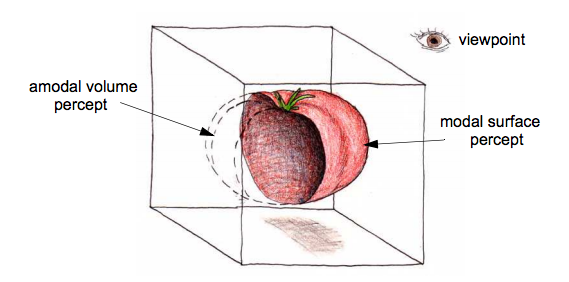{ style="max-width: 400px; width: 100%" }](https://slehar.wordpress.com/2014/09/12/amodal-perception/)
Illustration of amodal perception, by [Steven Lehar](/posts/2022-10-01-an-introduction-to-steven-lehar-part-i.html). I found estrogen made objects feel less "hollow".
I'd also previously read [Scott Alexander](https://x.com/slatestarcodex)'s blog post, [Why Are Transgender People Immune To Optical Illusions](https://slatestarcodex.com/2017/06/28/why-are-transgender-people-immune-to-optical-illusions), in which he speculates that if ketamine is an *NMDA receptor antagonist* which causes depersonalisation – and if estrogen *upregulates NDMA receptor expression* – then it's possible that changes to the NMDA receptor network could be what's responsible for the relevant changes in phenomenology.
[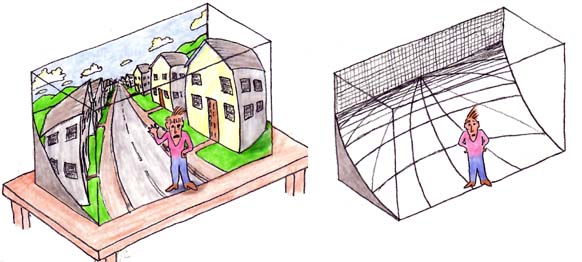{ style="max-width: 400px; width: 100%" }](http://slehar.com/wwwRel/cartoonepist/cartoonepist12.html)
Illustration of the visual field, by [Steven Lehar](/posts/2022-10-01-an-introduction-to-steven-lehar-part-i.html). I found estrogen made it feel less "flat". Can you imagine how this would make someone's internal world simulation feel less "fake"?
Right now I don't have much to add beyond: *wow, I think this checks out*. The question remains – does estrogen correct some kind of underlying *NMDA receptor expression deficit*, which ultimately leads to the psychological problems correlated with gender dysphoria – and, how does this relate to gender dysphoria itself?
### Estrogen is like being on a mild dose of psychedelics all the time
There's a psychedelic research paper I'm a fan of – [Phenomenology and content of the inhaled *N*, *N*-DMT experience](https://www.nature.com/articles/s41598-022-11999-8) (Lawrence et al., 2022) – in which the authors scrape ten years' worth of comments from the [r/DMT](https://www.reddit.com/r/DMT/) Reddit community, and tabulate different aspects of the [somatic](https://www.nature.com/articles/s41598-022-11999-8/tables/2), [visual](https://www.nature.com/articles/s41598-022-11999-8/tables/3), and [entity encounter](https://www.nature.com/articles/s41598-022-11999-8/tables/4) phenomenology by how frequently they were reported.
Much of my personal research simply consists of reading a large number of Reddit comments. As such, I sorely wish for there to exist an equivalent paper to the DMT phenomenology one, but which scrapes [transgender](http://reddit.com/r/asktransgender/) [support](https://www.reddit.com/r/AskMtFHRT/) [subreddits](https://www.reddit.com/r/TransDIY/) for subjective reports instead. However, until such time as one exists, the reader may just have to take my word for it when I claim a particular effect of estrogen is "commonly reported".
One effect "commonly reported" by people just starting estrogen is that [colours appear more saturated](https://www.reddit.com/search/?q=estrogen+color). From a [typical comment](https://www.reddit.com/r/MtF/comments/1dxe691/comment/lc1eyab/) on an [r/MtF](https://www.reddit.com/r/MtF/) thread [asking if anyone experiences colours more vibrantly](https://www.reddit.com/r/MtF/comments/1dxe691/anyone_on_hrt_do_any_of_yall_see_colors_more/):
> Yes! I was at the art museum yesterday and I became utterly infatuated with a shade of blue I've never seen before. Sat and stared at it for like 15 minutes.
>
> Then again, I may just be happier now.
Referring back to the DMT phenomenology paper, *vivid* or *hyperintense* colours were reported in 25.2% of experiences. Personally, I didn't experience any shift in colour perception, but I did find the other [visual perception](#visual-perception) changes I experienced to be distinctively *psychedelic* in nature – as I mentioned earlier, particularly reminiscent of a tryptamine like [psilocybin](https://psychonautwiki.org/wiki/Psilocybin_mushrooms) or [DMT](https://psychonautwiki.org/wiki/DMT). This is especially noticeable when I deliberately spike my levels with an extra patch, and on some days I suspect I even notice a slight amount of increased [symmetrical texture repetition](https://x.com/MatthijsCox/status/1611363519093694465).
Replication of psilocybin visuals, by [Symmetric Vision](https://www.youtube.com/@SymmetricVision) on YouTube.
Estrogen is known to *upregulate 5-HT2A receptor expression*, which is of course the same serotonin receptor which is agonised by most [serotonergic psychedelics](https://en.wikipedia.org/wiki/Psychedelic_drug). It seems quite reasonable to me to assume that this is what's responsible for the various reported sensory enhancements in addition to the [changes in mood](#emotional-modulation).
I now have an additional question. In addition to correcting some kind of *NMDA receptor expression deficit* inherent to the gender dysphoric neurotype, does estrogen also correct a *5-HT2A receptor expression deficit* – or does tripping on estrogen *just feel good*?
### Estrogen loosens the bodymind
As [mentioned above](#motor-output), I found estrogen to be an incredibly powerful muscle relaxant. Using the [Bayesian brain](https://slatestarcodex.com/2016/09/12/its-bayes-all-the-way-up/) model to understand this, it seems as if my nervous system holds [*priors*](https://www.lesswrong.com/w/priors) for how tense every muscle in my body should be in response to a given situation – and these priors are *relaxed* under the influence of estrogen.
I have to credit estrogen with helping fix a number of long-standing neck and upper back problems which I've been dealing with for most of my life. It's sufficiently powerful that I am skeptical that I would have been able to fix these issues while I was on testosterone. Notably, these issues don't return when I stop taking estrogen.
The effects feel more foundational than this, however; estrogen feels like it reshapes my body map itself, [smoothing out knots](/posts/2024-05-29-what-is-a-bodymind-knot.html) – like an elastic membrane being tightened, or a soap bubble reaching equilibrium. I've seen it "commonly reported" that estrogen makes people feel *more embodied*, and I suspect that this is what people might tend to mean by that.
Demonstration of [curve-shortening flow](http://en.wikipedia.org/wiki/Curve-shortening_flow), from [Anthony Carapetis' personal website](https://a.carapetis.com/csf/).
Could this be related to the serotonergic activity? Might the estrogen be unwinding a lifetime of accumulated neuromuscular trauma through a form of low-dose psychedelic therapy? I suspect this effect is also responsible for my [changes in mood](#emotional-modulation) – do emotions resonate more freely through a more parsimonious bodymind?
### Estrogen downregulates autistic sensory sensitivity issues
There's a [Mike Johnson](http://x.com/johnsonmxe) post I relate to, proposing a novel theory about [autistic spectrum disorders](https://en.wikipedia.org/wiki/Autism). From [Autism as a disorder of dimensionality](https://opentheory.net/2023/05/autism-as-a-disorder-of-dimensionality/):
> Every circuit has its own [natural density/dimensionality](https://en.wikipedia.org/wiki/Hausdorff_dimension) it's designed for, and my intuition is that organs closer to the brain are designed to have higher dimensionality. In some sense this makes them more capable of general processing, but also more prone to the particular deficits expressed in autism, with the brain as the apex of this hierarchy.
>
> Over time, civilization has thrown humanity increasingly high-dimensional challenges, leading to evolution progressively 'dialing the dimensionality knob up' on our nervous systems. Perhaps we can view dysfunctional autists as those who overshot the human nervous system’s current 'Goldilocks zone' for dimensionality and have nervous systems dominated by static/turbulence as a result. There may be different 'flavors' of autism, depending on which brain regions and tissues have elevated dimensionality.
When I read this some years ago, I had something of an *I'm in this picture and I don't like it* moment. I don't know that his theory is necessarily true, but I certainly felt that my own sensorium was *dominated by static/turbulence*.
{ style="max-width: 256px; width: 100%" }
Static is used as a recurring motif in the anime [Serial Experiments Lain](https://en.wikipedia.org/wiki/Serial_Experiments_Lain), in which it is strongly hinted that the protagonist experiences sensory sensitivities.
As [mentioned above](#somatic-perception), I found that estrogen toned down my ongoing somatic sensitivities to more manageable levels – and there's a handful of trans women I've spoken to who agreed with me that it turned the static down.
Autism tends to be [diagnosed more often in those assigned male at birth](https://www.cdc.gov/mmwr/volumes/74/ss/ss7402a1.htm), and there's a fair amount of research into the [links between hormone levels and neuroatypicality](https://www.frontiersin.org/journals/endocrinology/articles/10.3389/fendo.2024.1371148/full). Some researchers have even [proposed estrogen as a therapeutic target](https://pmc.ncbi.nlm.nih.gov/articles/PMC5193073/#__ffn_sectitle) for autism spectrum disorders.
Additionally, as [Scott Alexander](https://x.com/slatestarcodex) mentions in [Why Do Transgender People Report Hypermobile Joints?](https://www.astralcodexten.com/p/why-do-transgender-people-report), [*people with autism are about 8x more likely to be gender divergent than the general population*](https://www.theatlantic.com/health/archive/2016/11/the-link-between-autism-and-trans-identity/507509/). Certainly this fits popular stereotypes of trans women, at least in my corner of the internet. Scott speculates:
> My guess is something like joint issues → poor proprioception → all sensory experience is noisy and confusing → the brain, which is embodied and spends most of its time trying to process sensory experience, learns a different reasoning style → different reasoning style is less context-dependent (producing symptoms of autism) → different reasoning style when trying to interpret bodily correlates of gender (eg sex hormones) → transgender.
Personally, I don't have any joint issues, and I think that his theory of dyphoria could be simpler than this. Perhaps autistic sensory sensitivities mean that the brain is constanly dealing with having to reject overly noisy sensory input, leading to a stressed out, overly tense, disembodied nervous system – and this is what ultimately manifests as dysphoria? However, this would only explain *sensory dysphoria*, and not *gender dysphoria*.
I also find that [ketogenic dieting](https://en.wikipedia.org/wiki/Ketogenic_diet) helps with my sensory issues – as well as [gabapentinoids like phenibut and pregabalin](https://slatestarcodex.com/2019/07/18/know-your-gabapentinoids/) – presumably by *reducing glutamatergic signalling*. Occasional [neural annealing](https://opentheory.net/2019/11/neural-annealing-toward-a-neural-theory-of-everything/) through mild doses of [serotonergic psychedelics](https://psychonautwiki.org/wiki/Serotonergic_psychedelic) is also quite helpful. It's difficult to say whether it's the glutamate or serotonin system which is the root cause, but perhaps estrogen is particularly effective because it delivers changes to both?
### Estrogen can produce a psychological shift from autistic to schizotypal
A couple of years ago [Ely](https://x.com/ElytraMithra) recommended that I read the paper, [Autistic-Like Traits and Positive Schizotypy as Diametric Specializations of the Predictive Mind](https://journals.sagepub.com/doi/10.1177/17456916221075252) (Andersen, 2022). It turned out to be the most interesting paper I read while writing this post. The author proposes that the archetypal behavioural traits observed in [*autism*](https://en.wikipedia.org/wiki/Autism) and [*schizotypy*](https://en.wikipedia.org/wiki/Schizotypy) – like variation in attentional modulation, theory of mind, and exploratory behaviour – are downstream from a fundamental *oversensitivity* or *undersensitivity* to sensory [prediction errors](https://slatestarcodex.com/2017/09/05/book-review-surfing-uncertainty/), respectively:
> It has previously been argued that autism-spectrum conditions can be understood as resulting from a predictive-processing mechanism in which an inflexibly high weight is given to sensory-prediction errors that results in overfitting their predictive models to the world. Deficits in executive functioning, theory of mind, and central coherence are all argued to flow naturally from this core underlying mechanism.
>
> The diametric model of autism and psychosis suggests a simple extension of this hypothesis. If people on the autism spectrum give an inflexibly high weight to sensory input, could it be that people with a predisposition to psychosis (i.e., people high in *positive schizotypy*) give an inflexibly *low* weight to sensory input?
Andersen carefully describes the terms *autism* and *schizotypy* as he uses them in the paper, emphasizing that these categories should be viewed as flexible and not defined by dysfunction:
> In this article I refer to this axis as the *autism-schizotypy continuum*. For convenience, I refer to people on either end of this continuum as being an "autistic type" or a "schizotype", although it should be understood that there are no clear-cut "types" and that these differences are continuous rather than categorical.
>
> According to these models, everyone falls somewhere on the autism–schizotypy continuum, and neither autistic-like traits nor positive schizotypy represent dysfunction. Instead, each side of the continuum is accompanied by its own set of cognitive-perceptual strengths and weaknesses. People high in autistic-like traits are detail-oriented, have a focused attentional style that allows them to ignore distractors, have some advantages in sensory-discrimination abilities, and have highly developed systemizing skills, allowing them to learn and use complicated rules-based systems.
>
> People high in positive schizotypy tend to be imaginative and creative and have a more diffuse attentional style (compared with the average person) that allows them to switch their attention more easily. There is also some evidence that people high in positive schizotypy tend to direct their attention toward highly abstract, "big-picture" concerns rather than focusing on details.
Andersen proposes that in the case of schizotypy, lower sensitivity to prediction errors permits sensory input to flow further up the predictive processing hierarchy, which is what results in the observed behavioural traits:
> In autism, inflexibly high precision weighting of sensory input means that prediction matching tends to take place at relatively low levels of the processing hierarchy. Inflexibly low precision weighting of sensory input with positive schizotypy would have the opposite effect. Because the schizotype is, on average, handling fewer sensory-prediction errors than the autistic type (because they pay attention only to the large errors and ignore the smaller ones), prediction errors will tend to propagate farther up the processing hierarchy, affecting values, goals, and beliefs at higher levels of abstraction.
At this stage, I had to ask myself if the hormone I'd been taking which seemed to reduce my symptoms of autism was doing so by reducing an inherent oversensitivity to prediction errors? If this was the case, might it also be pushing me further towards the other end of the *autism-schizotypy continuum*? What might that look like? The paper has this to say about schizotypal patterns of belief:
> Although the autistic type may rely more on culturally inherited high-level belief systems, the schizotype's proclivity for tinkering with high-level priors may lead to the construction of relatively idiosyncratic high-level belief systems. In our own culture, this could manifest as having odd or (seemingly) unlikely beliefs about high-level causes. This may include beliefs in the paranormal, idiosyncratic religious beliefs (e.g., being "spiritual but not religious"), or believing conspiracy theories, all of which are associated with positive schizotypy.
I'll outline some of the psychological changes I've noticed in myself since starting estrogen. The term "schizo" is used very informally in today's internet vernacular, making it difficult to discuss these concepts in a sensible manner – but if the reader is comfortable playing armchair psychologist, perhaps they can judge for themselves whether the following makes me more "schizo":
- Increased predisposition towards [*associative thinking*](https://www.cell.com/trends/cognitive-sciences/abstract/S1364-6613(23)00094-3). Activities like tarot are more appealing.
- Increased predisposition towards [*magical thinking*](https://x.com/cube_flipper/status/1757637512682692991), leading to some idiosyncratic worldviews. This can probably be gauged by the [nonsense I post on Twitter](https://x.com/cube_flipper/status/1800179966992400775).
- Increased experience of [*meaningness*](https://meaningness.com) in day-to-day life. [This felt really good](#emotional-modulation).
- Increased *mentalising* of other people's internal states, resulting in a mixture of higher empathy and higher social anxiety. I'm somewhat more neurotic about potential threats.
- Decreased [*sensory sensitivity*](#somatic-perception).
- Decreased [*attentional diffusion*](#attentional-modulation), contrary to what the paper predicts.
- Decreased *systematising* and *attention to detail*, for instance with tedious matters like finances.
Armchair diagnoses aside, I do wish to assert that these psychological changes are quite similar to the kind of psychological changes I tend to experience while on a mild dose of psychedelics. So far as the pharmacology goes, there is an argument to be made that psychedelics induce a temporary state of psychosis via 5-HT2A agonism. From [Pivotal mental states](https://journals.sagepub.com/doi/full/10.1177/0269881120959637) (Brouwer and Carhart-Harris, 2021):
> The psychotomimetic (psychosis-mimicking) effects of classic 5-HT2A receptor agonist psychedelics have been well documented. Importantly, psychedelics are felt to be useful models of *incipient* psychotic states that may be more likely to display psychedelic-like phenomena, such as changes in perception, cognition and ego functioning. Conversely, established psychotic disorders such as schizophrenia are more likely to feature characteristics of *rigid* cognition such as fixed delusions. Selective 5-HT2A receptor antagonism attenuates the main characteristic subjective effects of LSD, psilocybin and ayahuasca and the intensity of psychedelic states is reliably predicted by 5-HT2A receptor occupancy.
It's important to note that the authors are specifically discussing *psychosis* rather than *schizotypy*, and I couldn't find any evidence that *schizotypy* involves 5-HT2A receptor signalling. That said, given the two are related, and given that estrogen *upregulates 5-HT2A receptor expression*, could estrogen be responsible for increased positive schizotypy via a similar mechanism to psychedelics?
---
## Commentary
I'd like to review what I've claimed so far:
- Estrogen *upregulates NMDA receptor expression*, which may result in:
- [Decreased depersonalisation and derealisation](#estrogen-is-like-the-opposite-of-ketamine)
- Estrogen *upregulates 5-HT2A receptor expression*, which may result in:
- [Increased "psychedelic" phenomenology](#estrogen-is-like-being-on-a-mild-dose-of-psychedelics-all-the-time)
- [Increased "bodymind" flexibility and sense of embodiment](#estrogen-loosens-the-bodymind)
- [Decreased autistic traits](#estrogen-downregulates-autistic-sensory-sensitivity-issues)
- [Increased schizotypal traits](#estrogen-can-produce-a-psychological-shift-from-autistic-to-schizotypal)
First of all, I should note that I don't expect these claims about estrogen phenomenology to generalise from trans women to cis women, and I'd also be cautious about generalizing neuroendocrinological findings from postmenopausal women to people starting from an androgenic baseline. All this aside, I think this should be mostly sufficient to explain why estrogen might make somebody *feel good*, especially if they are predisposed to depersonalisation, disembodiment, or autistic sensory sensitivities. However, I don't think we're that much closer to understanding whether hormone replacement therapy is actually correcting some kind of *innate deficit*.
Innateness of gender identity is a difficult topic to discuss. Here we are in 2025, and different political factions are motivated to claim that *gender dysphoria* is either a [*genuine phenomenon*](https://genderdysphoria.fyi/en/causes) or [*just a delusion*](https://x.com/cube_flipper/status/1909409074619543977). Theories abound, and one of the more colourful – and *confronting* – treatments of the topic was written by [Ziz](https://sinceriously.blog-mirror.com)... [who is currently in jail](https://x.com/kenthecowboy_/status/1884393311827550716). From [Intersex Brains And Conceptual Warfare](https://sinceriously.blog-mirror.com/intersex-brains-and-conceptual-warfare/):
> The simplest explanation which fits the data (including nonbrain intersex conditions) is that sexual differentiation is a fragile rube goldberg machine, prone to random breakage. I speculate that humans have intersex brains so often because of evolution pulling out all stops for large brains and breaking things as a side effect.
Any honest public appraisal of the topic is likely to be clouded by politics, and given the current political climate, it seems unlikely that research may continue. Which is a shame, because I suspect research into [prenatal hormone exposure](https://www.nature.com/articles/s41598-020-72486-6), [neuroanatomical variation](https://pubmed.ncbi.nlm.nih.gov/34030966/), and [atypical endocrine signalling](https://www.reddit.com/r/DrWillPowers/wiki/meyer-powers_syndrome_faq/) are promising avenues of exploration.
While I don't think people should have to convince the medical system of the validity of their internal experience in order to justify a hormone prescription – other people *do*, and I don't think this is likely to change anytime soon. So I think this research is *important* – not least because this is an issue that directly affects an unusually productive and talented segment of society, many of whom I consider my friends.
### Phenomenology of gender dysphoria
Here's how I'd like to thread the needle. Gender dysphoria occupies an unusual epistemic status within a society not known for [taking phenomenology seriously](https://cosmicindigestion.substack.com/p/around-here-we-take-our-phenomenology), because – at least in liberal spaces – people's self reports are generally never questioned.
I'm not complaining – I don't think this is a bad thing, even though I can be picky with my metaepistemics sometimes. What I would like to see is further development into phenomenological models of gender dysphoria. [Existing models](https://genderdysphoria.fyi/) are already quite comprehensive, covering phenomena from high-level [*social dysphoria*](https://genderdysphoria.fyi/en/social-dysphoria) to low-level [*physical dysphoria*](https://genderdysphoria.fyi/en/physical-dysphoria) – but I think they could utilise *even more* detail, as it may provide essential clues to what's going on.
[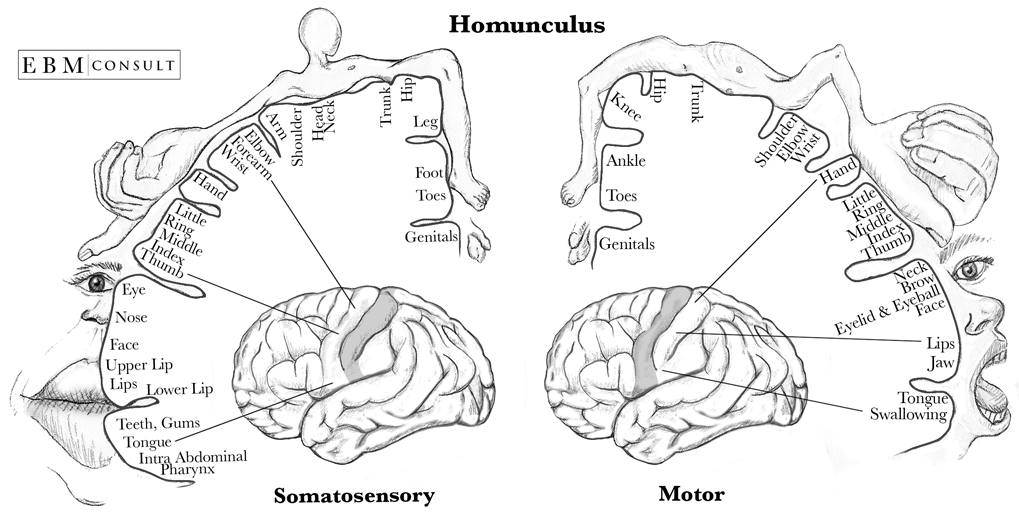{ style="max-width: 512px; width: 100%" }](https://www.ebmconsult.com/articles/homunculus-sensory-motor-cortex)
The [somatosensory cortex](https://en.wikipedia.org/wiki/Primary_somatosensory_cortex) is a long thin section of cortex which wraps around the brain like a headband. It is located just posterior to the [motor cortex](https://en.wikipedia.org/wiki/Motor_cortex), which follows a similar shape. [Electrode studies on live humans](https://www.ncbi.nlm.nih.gov/pmc/articles/PMC5830421/) have revealed the shape of their respective homunculi.
The low-level phenomenology of [brain-body map mismatches](https://slatestarcodex.com/2013/02/18/typical-mind-and-gender-identity/) seems like a big part of the puzzle. There's an old friend of mine, a loud-mouthed transman with a thick Queensland accent who swears up and down that he's got a *fuckin' ghost cock, mate*. Certainly the prevalence of phantom penises is [well-documented in the literature](https://www.researchgate.net/publication/348950276_Phantom_Penis_Extrapolating_Neuroscience_and_Employing_Imagination_for_Trans_Male_Sexual_Embodiment). What's going on there? My understanding of the [somatosensory homunculus](https://en.wikipedia.org/wiki/Cortical_homunculus) is that it can be quite [flexible with its representations](/posts/2023-06-30-the-oral-tesseract.html), so why might it persistently render a body corresponding to the opposite gender?
This wouldn't be a [smoothbrains.net](https://smoothbrains.net) post if it didn't have some nonsensical spitballing at the end. My usual psychedelic research requires me to entertain all kinds of metaphysical schizotheories – so I'm not averse to considering all kinds of theories of gender dysphoria, including ones incorporating [*morphogenetic fields*](https://x.com/cube_flipper/status/1671342436294221826), [*bodymind knots*](/posts/2024-05-29-what-is-a-bodymind-knot.html), [*past lives*](https://x.com/KanizsaBoundary/status/1809314763345908004), or even [*vector field topology*](https://x.com/KanizsaBoundary/status/1808991203570209226).
Could it be the case that gender dysphoria is a morphic resonance phenomenon – and estrogen helps access the cosmic feminine unconscious by loading a different configuration file from the akashic records? *Who can say.* After all, if estrogen does make me more schizotypal... *why not lean into it*?
---
## References
#### Hormone replacement therapy
- [Gender Exploration](https://www.lesswrong.com/posts/KznQLLpDprpwqcAKD/gender-exploration) by [sapphire](https://www.lesswrong.com/users/deluks917) on [LessWrong](https://www.lesswrong.com) (2024)
- [An Introduction to Hormone Therapy for Transfeminine People](https://transfemscience.org/articles/transfem-intro/) by [Aly](https://transfemscience.org/about/#aly) on [Transfeminine Science](https://transfemscience.org) (2024)
#### Gender dysphoria
- [Typical mind and gender identity](https://slatestarcodex.com/2013/02/18/typical-mind-and-gender-identity/) by [Scott Alexander](https://x.com/slatestarcodex) on [Slate Star Codex](https://slatestarcodex.com) (2013)
- [Why Are Transgender People Immune To Optical Illusions](https://slatestarcodex.com/2017/06/28/why-are-transgender-people-immune-to-optical-illusions) by [Scott Alexander](https://x.com/slatestarcodex) on [Slate Star Codex](https://slatestarcodex.com) (2017)
- [Trip report: Lamotrigine, a drug to treat depersonalization](https://zinniajones.medium.com/trip-report-lamotrigine-a-drug-to-treat-depersonalization-e8171e165813) by [Zinnia Jones](https://zinniajones.com) on [Medium](https://zinniajones.medium.com/) (2018)
- [Intersex Brains And Conceptual Warfare](https://sinceriously.blog-mirror.com/intersex-brains-and-conceptual-warfare/) by [Ziz](https://sinceriously.blog-mirror.com/author/Ziz/) on [Sinceriously](https://sinceriously.blog-mirror.com) (2019)
- [The Neuroanatomy of Transgender Identity: Mega-Analytic Findings From the ENIGMA Transgender Persons Working Group](https://pubmed.ncbi.nlm.nih.gov/34030966/) (Mueller et al., 2021)
- [Why Do Transgender People Report Hypermobile Joints?](https://www.astralcodexten.com/p/why-do-transgender-people-report) by [Scott Alexander](https://x.com/slatestarcodex) on [Astral Codex Ten](https://www.astralcodexten.com) (2023)
#### Autism and schizotypy
- [Autism as a disorder of dimensionality](https://opentheory.net/2023/05/autism-as-a-disorder-of-dimensionality/) by [Mike Johnson](http://x.com/johnsonmxe) on [opentheory.net](https://opentheory.net)
- [Autistic-Like Traits and Positive Schizotypy as Diametric Specializations of the Predictive Mind](https://journals.sagepub.com/doi/10.1177/17456916221075252) (Andersen, 2022)
#### Estrogen
- [Sex hormones affect neurotransmitters and shape the adult female brain during hormonal transition periods](https://www.frontiersin.org/journals/neuroscience/articles/10.3389/fnins.2015.00037/full) (Barth et al., 2015)
- [The Role of Estrogen Receptors and Their Signaling across Psychiatric Disorders](https://pubmed.ncbi.nlm.nih.gov/33396472/) (Hwang et al., 2020)
- [The impact of estradiol on serotonin, glutamate, and dopamine systems](https://www.frontiersin.org/journals/neuroscience/articles/10.3389/fnins.2024.1348551/full) (Bendis et al., 2024)
- [Meyer-Powers Syndrome FAQ](https://www.reddit.com/r/DrWillPowers/wiki/meyer-powers_syndrome_faq/) by [Dr. Will Powers](https://www.reddit.com/user/Drwillpowers/) on [r/DrWillPowers](https://www.reddit.com/r/DrWillPowers/) (2025)
#### Estrogen and the glutamate system
- [Estradiol selectively regulates agonist binding sites on the N-methyl-D-aspartate receptor complex in the CA1 region of the hippocampus](https://academic.oup.com/endo/article-abstract/131/2/662/2496261) (Weiland, 1992)
- [Effects of estrogen and progesterone treatment on rat hippocampal NMDA receptors: Relationship to Morris water maze performance](https://www.ncbi.nlm.nih.gov/pmc/articles/PMC6740259/) (El-Bakri et al., 2004)
#### Estrogen and the serotonin system
- [Estrogen increases the density of 5-Hydroxytryptamine2A receptors in cerebral cortex and nucleus accumbens in the female rat](https://www.sciencedirect.com/science/article/abs/pii/096007609500075B) (Sumner and Fink, 1995)
- [Increase in Prefrontal Cortex Serotonin 2A Receptors Following Estrogen Treatment in Postmenopausal Women](https://pubmed.ncbi.nlm.nih.gov/12900319/) (Kugaya et al., 2003)
- [Widespread increases of cortical serotonin type 2A receptor availability after hormone therapy in euthymic postmenopausal women](https://www.fertstert.org/article/S0015-0282(03)00973-7/fulltext) (Moses-Kolko et al., 2003)
#### The serotonin system
- [Serotonin and brain function: a tale of two receptors](https://pubmed.ncbi.nlm.nih.gov/28858536/) (Carhart-Harris and Nutt, 2017)
- [Pivotal mental states](https://journals.sagepub.com/doi/10.1177/0269881120959637) (Brouwer and Carhart-Harris, 2021)
- [A role for the serotonin 2A receptor in the expansion and functioning of human transmodal cortex](https://academic.oup.com/brain/article-abstract/147/1/56/7273051) (Luppi et al., 2024)