The third QRI psychophysics retreat, part I: The form jhāna
Posted on 4 October 2026 by
Wow, was it really three years since the previous two Qualia Research Institute psychophysics retreats? Am I experiencing the opposite of time dilation?
This time around, we gather in Tepoztlán, México, not solely to research psychedelics – though the local retreat center Tandava is playing host to some 5-MeO-DMT psychophysics – but also to study the subjective experience of the eight jhāna.
What are the jhāna? The jhāna are a series of eight progressively refined states of meditative absorption, each defined by the presence or dissolution of specific phenomenal qualities – moving from focused concentration accompanied by intense bodily pleasure through to a state of pure, still equanimity devoid of mental content. These concentration states appear to be somewhat consistent across multiple contemplative traditions. In the Pāḷi Canon, the first four jhāna are known as the rūpa jhāna or form jhāna, and the final four jhāna are known as the arūpa jhāna or formless jhāna – and other traditions categorise the jhāna along similar lines.
The jhāna are of interest to us for a number of reasons. Firstly, some of these states are reported to be orders of magnitude more pleasurable than ordinary waking consciousness – while their non-addictive and even healing qualities contradict popular intuitions about wireheading. This has interesting implications for common objections to theories of hedonistic utilitarianism. Secondly, we’re going to need to understand how the jhāna work, if we’re ever going to build the jhāna helmet. And finally, the convergent nature of the jhāna makes them a more repeatable object of study than psychedelic altered states – so perhaps they could provide a much-needed Rosetta Stone for consciousness, for translating between subjective states and physical ones? We’ll cover this angle in part two.
To investigate the jhāna, we convened a fourteen-participant, ten-day jhāna retreat from 25 May 2026 to 3 June 2026. Personally, I cannot jhāna, as chronic headaches prevent me from engaging with concentration meditation practices – so my contribution is limited to a more clerical role, handling post-retreat interviews with participants. This document serves to aggregate subjective reports, so actually defining what a jhāna is is beyond its scope – but no shortage of material is available on this matter, some dating back thousands of years:
Papers:
- Toward a Unified Account of Advanced Concentrative Absorption Meditation: A Systematic Definition and Classification of Jhāna (Sparby and Sacchet, 2024)
Literature:
- The Samaññaphala Sutta by The Buddha (circa 5th century BCE)
- The Visuddhimagga by Buddhaghosa (circa 5th century CE)
- Mindfulness, Bliss, and Beyond: A Meditator’s Handbook by Ajahn Brahm (2006)
- Practicing the Jhanas: Traditional Concentration Meditation as Presented by the Venerable Pa Auk Sayadaw by Stephen Snyder and Tina Rasmussen (2009)
- Right Concentration by Leigh Brasington (2015)
- Mastering the Core Teachings of the Buddha, Part III: The Samatha Jhanas by Daniel Ingram (2018)
Blog posts:
- Nick Cammarata On Jhana by Scott Alexander on Astral Codex Ten (2022)
- Throwing My Hat In The Jhana Ring by Roger Thisdell on Medium (2024)
- The Varieties of Jhanic Experience by Wystan Bryant-Scott on Substack (2026)
Our methods
At the retreat, QRI would have questionnaires for participants to answer, and they’d also have a micro-phenomenologist at the retreat, conducting structured interviews to academic standards for an Imperial College London study – so those angles were covered. Additionally, they would also have artists working on visual replications of their experiences – similar to those recently published by Roger Thisdell.
At my end, some months prior to the retreat, I sought advice from a veteran academic friend on the matter of how to actually source the detailed phenomenological reports we’d need in order to develop a structural understanding of the jhāna. My friend described how you can imagine a spectrum from ethnography and phenomenology on the left, all the way to qualitative interviews and questionnaires on the right. If what you’re after is richness – and the other work is being done anyway, why not focus on just doing a really good ethnography? As he said:
Be a biologist, not a physicist. Rather than looking for three or four field equations, just start to document the flora and the fauna which exist in some meaningful variance – and maybe there are structural things you can say beneath that.
But I do want the field equations.
To this end, I simply conducted free-wheeling interviews with the retreat participants, gauging for myself what was salient in the moment. The bulk of each interview would comprise a methodical traversal of the concentration states the participant experienced. When it made sense to, I’d avoid employing technical language or proposing models of my own – unless the Pāli or English technical language was already well-established, or it was clear that I could simply trust the participant not to replace their worldview with mine.
Optimistically, I’d capture enough information for a case study or two – or at least a informal but detailed blog post. In the end, I had time to conduct interviews with eight out of the fourteen participants, prioritising the people who had the deepest and most comprehensive experiences – Andrés Gómez Emilsson, Anna Eiserbeck, Eliade Weismann, Ethan Kuntz, Sasha Putilin, Taru Hirvonen, Wystan Bryant-Scott, and ykidch.
Access concentration
The meditation coach Wystan Bryant-Scott helped facilitate the retreat, and one day prior he held a guided meditation explaining what practices we should experiment with while on the retreat – which was also transcribed and printed out for participants. This began with clear instructions for establishing what is known as access concentration – a heightened state of absorption used to lead into the jhāna state. There were three practices he recommended:
- Whole-body awareness: Open the aperture of attention to the entire body at once – crown to toes, side to side, including any subtle sensation beyond the skin in peripersonal space. Notice physical, emotional, and energetic phenomena as a single field. If something pleasant arises, savor it without collapsing the aperture onto it. If something unpleasant arises, don’t collapse onto it either – let it be in the open field. When attention narrows or drifts into and latches to thought, gently release, re-orient, and return to expanded attention on the whole bodily field.
- Loving-kindness (mettā): Draw attention to the heart region. Call to mind a being it is easy and natural to wish well for (or yourself). Use supportive phrases and mental imagery, anything that makes their presence vivid to you – may you be happy, may you be well – as scaffolding. The phrases or supportive imagery, memories, associations, etc. are not the object; the felt response in the heart: warmth, brightness, glow, sparking is. Once that feeling is stable enough to hold attention on its own, drop the scaffolding, rest in the feeling, and allow it to gather strength and pervade the space of the body and beyond.
- Breath at the nostrils (ānāpānasati). Attend to the physical sensations of breath at the nostrils, philtrum, or upper lip. Do not track in-versus-out, compare temperature, or note fine-grained texture. That fine-grained discrimination is a vipassanā-vectored move and will break up the object, preventing absorption. Don’t worry about depth of breath; relaxed diaphragmatic breathing is preferable but not the purpose of the exercise. Simply maintain relaxed, stable attention on the spot and return whenever distracted.
I would generally begin my interviews by asking about which of these practices the participant was working with. Of those interviewees who experienced jhāna, the majority – Andrés, Anna, Eliade, Ethan, Taru, and Wystan – were using breath at the nostrils. Meanwhile, ykidch used whole-body awareness, in order to avoid accumulating pressure in the head, as happened to him on a previous retreat. Sasha was an exception – he decided to try to skip the first four jhāna entirely and go straight for the formless realms. We’ll discuss his technique in a later section.
Cube Flipper: If you were using access concentration, how did you establish it?
Anna: By focusing on breathing at the tip of my nose. That was usually it. I played around a bit – I also tried mettā – but 90 or 95% of the meditation was breath. When I sit down and start focusing on breathing at the tip of my nose, the deeper I go, the more concentration builds up, and the more clearly awareness is focused in this area. It stays stable rather than wandering somewhere else in my body. If my mind is very active and jumpy it takes more time, and it feels like I’m slowly bringing awareness more and more to just this part. When I get more concentrated, even when a thought arises, it only causes a slight movement in a certain direction – I can catch it early and bring it back exactly here. I know I’ve built enough focus when I can stably stay in this area.
Cube Flipper: Does it feel like balancing a pencil on its tip? Or is it a stable attractor that becomes effortless to keep attention on?
Anna: I think you could say it’s like an attractor. The more I get into it, the easier it gets to keep the focus there.
My own experience of breath at the nostrils – when it wasn’t triggering my headaches – was that this could be quite a powerful technique. Once stable attention was established, it was not long before the rest of the body map started to fade away. The sense of space would start to disappear from around the object of attention, while the sensations that remained would sometimes drift down to my navel.
Participants were, of course, free to experiment. Eliade spent some amount of time studying how eye saccades interfered with attentional stability:
Eliade: Previously I’ve really used ānāpānasati – breath meditation here at the septum–philtrum junction. But instead of paying attention to the breath, you pay attention to the tactile sensations in this region. You’re not looking for the rise and fall of breath, or the vectors or the intensity; you’re trying to sustain the monotonic quality, the pure whiteness of breath. Ānāpānasati works really well when you have a long time to build up, because the breath nimitta is this pure, clear, bright thing that’s extremely stable. One of my other practices is visual defabrication – trying to suppress saccades. Through the retreat I was using both eyes and taking an orienting object, so that the entire field of objects all around became extremely simple and lost their object quality. They merged together to the point that you couldn’t differentiate two things apart.
Cube Flipper: So you’re already getting boundary-dissolution stuff – and this is still just access concentration?
Eliade: I can get to this state in about two or three minutes. And Taru recently gave me an eye patch – now I only have to deal with the saccades of one eye.
Wystan was able to give quite a detailed report into his experience of access concentration, and the bizarre effects it can produce:
Cube Flipper: What is access concentration like for you, and what object of attention are you typically using?
Wystan: Most of the time on this retreat I was using the sensations of breath here at the nostrils. Having done a lot of this practice over the years, the sensations of the skin around the region of the nostrils kind of merge into this coagulated energy blob that isn’t really differentiated much between the in- and out-breath. There’s a kind of tremor and vibration present in it – but if I pay attention to that, we’re going in a vipassanā direction, and that’s not what we’re doing. So I pay attention to the smooth textural quality within the volume. The location changes depending on how concentrated I get: at first it starts right at the nostrils, then it moves slightly off the skin, and it’s just this energy blob. As soon as I go there – and this gets stronger the more baseline concentrated I am – there’s a kind of boom. It lights up the rest of the body. Most of the time, if I’m here for a second or more, pīti and sukha are just on.
I would like to understand why this works. Why is it that taking attention off the body and concentrating it in one tiny place frequently generates unusual subjective effects? I have a handful of ideas:
- If phenomena exist only in relation to one another, you can imagine that the body map is constructed from many interdependent relationships between sparse sensory signals. If you remove most of those sensations and relationships except for one tiny region, does that region then lose most of the information from which it derived its stable character?
- Does taking attention off the body map free up the underlying neuronal substrate to do whatever it likes? What does it get up to when nobody’s looking? What happens when you flood it with attention once again?
- Does concentrating attention in one tiny place saturate the underlying medium – resulting in nonlinear behaviour? In optics, this is known as the Kerr self-focusing effect, in which the intensity of the electromagnetic radiation changes the refractive index of the medium in a way which focuses more radiation in the same place. In a fiber optic cable, such a feedback loop would melt the cable – but what might happen in a human mind?
The form jhāna
Wystan also provided instructions for recognising each jhāna by its phenomenal qualities. These were drawn from the teachings of Leigh Brasington and Rob Burbea:
Transitioning into the first jhana:
- If a jhāna factor is present (especially pīti): shift attention to it and ride it up.
- If only pleasant sensation is present: switch attention from your method to that sensation. The concentrated mind applied to pleasant sensation sets up a feedback loop – attention strengthens the pleasantness, which deepens concentration, which strengthens the pleasantness. With no further effort, this can go nonlinear and erupt into the first jhāna.
The five jhāna factors:
- Vitakka: directed thought (early sutta sense: actual cogitation; later: initial application of mind to object)
- Vicāra: sustained thought/sustained application
- Pīti: rapture; five grades, from fine sparks to all-pervasive saturation with effervescent texture
- Sukha: pleasure, happiness, in an attenuated form contentment; antonym of dukkha
- Ekaggatā: unification of mind, collectedness, coherence
Of these jhāna factors, I find pīti and sukha to be of specific interest, as they describe two families of somatic textures which can arise within the body map either during meditation or in waking life. They can be quite pleasurable, and are also useful for identification of specific form jhāna states. I’ll save the speculation for a later post, but my general understanding is that pīti has heterogenous or anisotropic microstructure described as noisy and powdery, whereas sukha has homogenous or isotropic microstructure described as smooth and creamy.
At one point, I thought to ask Wystan if he considered that the different jhāna could be characterised exclusively in terms of pīti and sukha:
Cube Flipper: Are the qualitative changes between J1 and J2 primarily characterised by the changes to pīti and sukha and their distributions in the body? Is there anything else you think characterised it?
Wystan: Not really.
Cube Flipper: Is it the same for the next one? And all the way through the form realms?
Wystan: Yes – it’s really just changes in the dynamics of pīti and sukha.
In the form jhāna part of my interviews I chose to allocate a fair bit of time to discussion of pīti and sukha. Why focus on just two of the five factors? Partially I was just following my intuition – pīti and sukha have fairly concrete qualitative aspects – specific locations, frequencies, and textures – which could conceivably be related to neural correlates. They also carry significant variance across the form jhāna. Our participants also related to these frames and were able to talk about them in a startling amount of detail.
By comparison, vitakka and vicāra are less interesting to me, given that they are more things you do with your attention than phenomenal qualities of experience. Ekaggatā, meanwhile, is more a global, structural quality of experience, and in hindsight perhaps I should have paid it more attention.
Throughout the post, I’ll present candid transcripts from interviewees, followed by tabulated report data, when it makes sense to do so. Alongside these, we’ll also present visual replications of the form jhāna, developed by the visual artist Symmetric Vision. Later in the post, we will discuss some trends we observed involving pīti and sukha and their corresponding spatial locations, frequencies, and textures as they relate to specific form jhāna. In the meantime, let’s look at J1:
First jhāna
Wystan’s instructions for entering J1:
Entered from access concentration when pīti arises and you turn attention fully to it (or to a pleasant sensation that grows into it). Pīti can be strong and even shocking – full-body buzzing, electricity, involuntary grin, tears, laughter – or quieter and finer. Sukha pervades alongside. Some thinking likely remains (vitakka-vicara): Whoa, this feels amazing.
The bath-powder simile: The body is “permeated and pervaded, suffused and filled” with rapture and pleasure born of seclusion.
Stabilize by: Allowing and encouraging pīti-sukha to pervade the whole energy body, not clamping or analyzing, enjoying it openly.
I interviewed eight participants, seven of whom experienced J1. I’ll present a number of transcripts – we’ll begin with the pseudonymous ykidch, who gave a typical report of entering J1 from access concentration:
Cube Flipper: Could you reliably enter some absorption states from here?
ykidch: Yeah, so when I was able to stabilize concentration, then I was able to enter a pretty stable J1. Like, whole body vibration… I would sit for half an hour, an hour or so, and then I’d be like, okay, this is nice – let’s move to the next thing.
Cube Flipper: In your own terms, how would you characterize this J1 state?
ykidch: When it was really stable, there’d be a nucleus of pīti, and it would travel very fast through the entire body.
Cube Flipper: Okay. Were you doing anything with your attention in this state? Like were you deliberately guiding the pīti or not messing with it?
ykidch: Like the actual spread of the pīti? No. I was not.
Taru was able to give me a fairly evocative description of the pīti arising at J1. This exchange is representative of the kind of questions I would ask to establish common ontology:
Cube Flipper: How did you go from access concentration into J1?
Taru: I started reliably getting pīti very quickly. That was day four, I would say. That’s when I explored J1 – but then I started finding that kind of exhausting, so from then on, I tried to be quick with the intense pīti and go for the sukha pretty quickly.
Cube Flipper: Do you feel comfortable identifying pīti and sukha when they come up – given that they are Pāli jargon words?
Taru: Yeah, I mean to me pīti seems like it’s these waves of buzzing pleasure. The way it forms – it races from the bottom of my body up to my head.
Cube Flipper: Next, I would like to ask about the fine textural qualities of the pīti. Are you comfortable describing it in, say, frequency domain terms or textural terms or similar?
Taru: Sure. I think the strongest pīti I experienced was very electric and also coarse-grained. That happened during lying down meditation. It felt like electricity moving inside my body.
Cube Flipper: Where was it mostly located? Was it pretty much exclusively skin-bound or was it volumetric, inside the body?
Taru: I’d say that initially it’s felt on the skin but the waves are volumetric.
Cube Flipper: How did you get from access concentration to the pīti arising? Was there a particular attentional move you used?
Taru: Actually, the pīti starts appearing on its own at some point, while doing breath focus.
Cube Flipper: Was the pīti harmonious, or was it noisy? Did it have a particular frequency band?
Taru: The waves of pīti were not very smooth in particular. They felt kind of jagged, they were racing up the body.
Given his lifelong experience, Wystan achieved very deep jhāna, and gave a rather vivid account describing a mostly even distribution of pīti throughout the body which also included increased concentration in the central channel. I include this report in order to provide contrast with the others:
Cube Flipper: We’ll start with pīti. I’m interested to ask about where it’s experienced, what kind of texture it has, and anything else interesting that comes to mind.
Wystan: For me, it shows up full body from jump. It wasn’t always that way. It most commonly isn’t that way unless someone is quite concentrated, more often it’ll show up somewhere localized. It might not be until a mature J1 before it goes full body. For me, it’s full body right now. It’s more locally intense along the central column of the body, up through the crown of the head. It’s like there’s a higher density of vibration at that frequency, but it’s distributed throughout the full body.
Cube Flipper: Okay, now where you’re saying it’s located – is it like an even mixture between being volumetric inside the body or rendered exclusively on the skin?
Wystan: Both. For me, right now, there’s almost like a central column or a rod. Okay. I mean, it’s not actually a rod. It’s not a solid structure, but it’s like the vibrating volume is…
Cube Flipper: So it’s like a spinal rod down the center. Do you think that all forms a torus?
Wystan: Um… Yeah, it’s kind of tor—
Cube Flipper: Does it connect to the crown of the head and the perineum?
Wystan: I don’t really feel it down in the perineum. I mean, now that you’ve mentioned it, my attention has moved down there and it’s there too – but by default, it’s not particularly salient down there.
Toruses tend to crop up from time to time in both the meditation and psychonaut literature, and the reason I got excited was because I suspect they might be related to the macrostructure of the world simulation. Often it’s the case that someone describes that their entire experience turned into a torus, or that they experienced a torus intersecting their body. However, in this case, I think that attempting to relate the central column to the mouth of a torus was inconclusive.
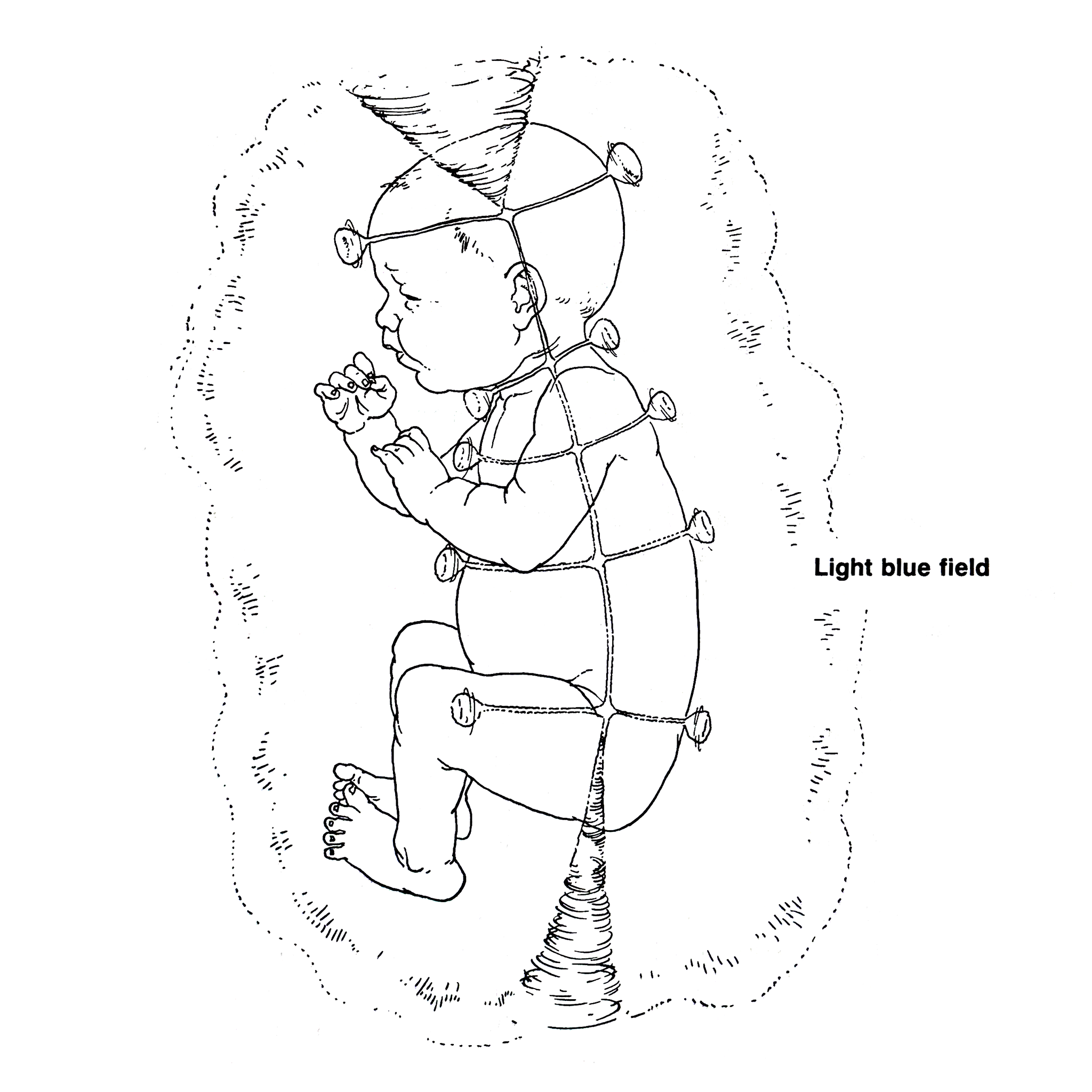
Eliade has quite remarkably clear access to his somatic experience, and we were able to spend some time discussing the most appropriate way to mathematically model his pīti:
Eliade: Most of my experience was with pīti, was of point bodies. Sometimes these are extremely near zero dimensional, but they might in general be a third or a fourth the size of a grain of jasmine rice. For the most part, pīti of that size radially decays very fast, so you have a more concrete central body and then this decay which is still coherently this object.
Cube Flipper: Do you think the grains are like Gaussian functions?
Eliade: I did think that it was much more Gaussian.
Cube Flipper: Yeah, okay. It seems to me like the generating function is either something a bit like a Gaussian splat, where you have randomized Gaussians flipping in and out – or it’s more like a laser speckle pattern kind of texture, if you’re familiar with that.
Eliade: As far as pīti goes, they were like phosphenes or hard grains of silica. These were slightly painful, even though they had pleasure in them. All of my pīti is anchored – even across the sense of dimensionality shifting in the body, the relative position of this set of pīti was fixed. The point bodies themselves have some axial vibration around a point, but I never once saw a full system alignment of vibrations.
Cube Flipper: Yeah, that makes sense. One of the models me and Ethan were discussing was very basic – it’s that pīti phases are uncorrelated, while sukha phases are correlated. Another model was the idea that pīti is very precisely located in time and space, whereas sukha might well be precisely located in the spectral domain. So these two things trade off against one another in accordance with the Fourier uncertainty principle.
Cube Flipper: It’s interesting to me that there doesn’t seem to be something in between the two. You mostly just get like admixtures of the two.
Eliade: Yes, I agree. A perfect linear combination, you have one or the other that is really strong and they just combine without mixing – but because I never got to J3 where all pīti subsides, I can’t really say what this quality is in isolation.
Cube Flipper: Ah, yeah, good point.
Eliade: There’s a little bit more I can say about pīti. During this relatively light jhānic experience, I was able to dissociate my mind from the full body, and as I do this, the whole thing starts to decay – but in the maybe 20 seconds I have, I can look around. What I see is these little point bodies that are vibrating with a very tiny amplitude at something like 5–6 Hz. I never noticed or felt the sense that any of these axial vibrations were rotating on their axes.
Cube Flipper: Yeah, interesting. Let me think about it for a moment, what the implications might be. So they’re all volumetric, true 3D volumetric, would you say?
Eliade: Yeah, I’d say 3D volumetric, but they are pretty close to the limit nearing a point body sometimes.
Cube Flipper: Yeah, okay. So, when they’re oscillating, they’re not blinking in and out of existence, they’re moving back and forth?
Eliade: That’s right.
Cube Flipper: Huh.
Eliade: So I do have some temporal frequency pīti, but these tend to be much larger granules. They might be about 6 mm size or larger. This temporal frequency, it was much, much slower than the pīti that was vibrating axially. Rather than being fixed, it would disappear out and then a very light, similar body would appear somewhere else. All of the other pīti in my experience is just fixed in place or vibrating around their anchors.
Cube Flipper: Okay. So when I hear this, I think, what’s going on in the cortex? What’s going on in the somatosensory cortex that might conceivably generate this? This feels very incompatible with holographic consciousness theories, which I would expect to give you something more like a speckle pattern.
I’m entranced by this discussion because I see phenomena like pīti as not just jhānic factors but also potential building blocks of experience. It’s well established that receptive fields in primary visual cortex are well-modelled by two-dimensional Gabor functions, and – ambiguously – during migraine aura it’s possible to get the hint that the visual field is constructed out of many overlapping Gabor functions:
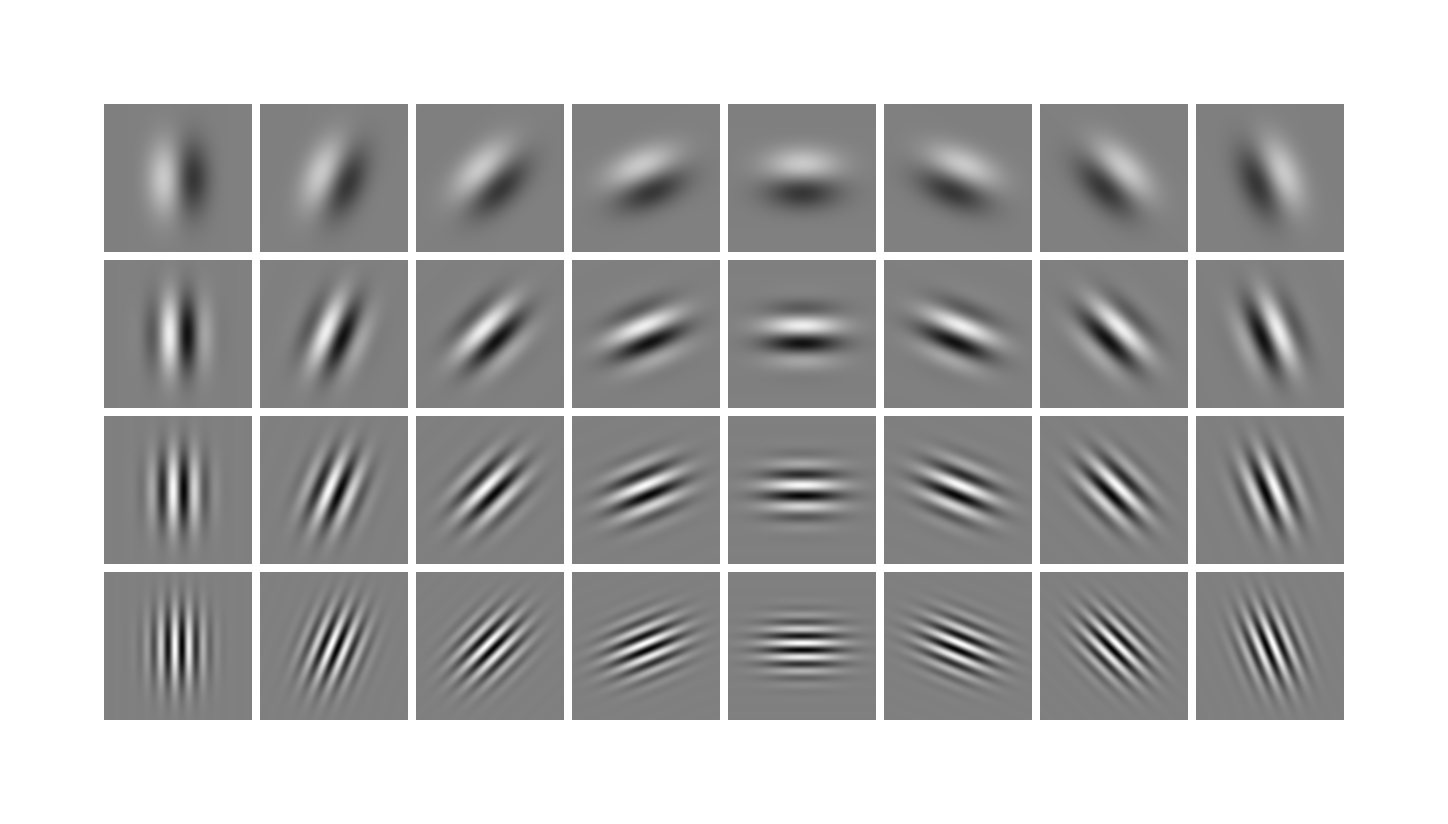
What if the somatic field used analogous basis functions? The mathematics behind Gabor functions is simple – they are just a Gaussian envelope multiplied by a sinusoidal wave, notable for achieving an optimal tradeoff between spatial and frequency domain uncertainty. What Eliade describes is something different – Gaussian blobs whose center positions oscillate sinusoidally. These aren’t Gabor functions, but they could also serve as a viable basis function.
Is it possible that the somatic and visual fields are Gaussian splats, Gabor splats, or something similar? I suspect that if they are, then that’s only part of the story. Eliade’s account is but one report, but if others could contradict or corroborate this, perhaps we’d be a little further on our way towards understanding the microstructure of the world simulation.
| Participant | Factor | Intensity | Location | Frequency | Texture |
|---|---|---|---|---|---|
| Anna | Pīti | Present | Attention on center of the head; pīti grows until whole body is filled | Initially super small, in the range of millimeters | Glittering particles; blinding radiant light |
| Sukha | Sometimes a slight amount | — | — | — | |
| Eliade | Pīti | Present | Whole body | Particles a third to a fourth the size of a grain of jasmine rice vibrating axially at 5–6 Hz; also larger granules around 6 mm vibrating temporally, much slower | Speckle pattern; phosphenes or hard grains of silica; like an extremely dense set of point bodies |
| Sukha | — | — | — | — | |
| Ethan | Pīti | Soft | Body map and all of space are kind of bleeding into each other; pīti is not so much volumetric as it is embedded in surfaces | If the body map is tuned out, there’s no reference scale | Like running your hand over leg hair |
| Sukha | Softer still | — | — | Like an air current over leg hair; like cotton candy that melts | |
| Taru | Pīti | Very intense | Races from the bottom of the body up to the head; on the skin then volumetric; initially felt on the skin and then volumetric | Coarse-grained | Waves of buzzing pleasure; electric; not smooth, jagged |
| Sukha | — | — | — | — | |
| Wystan | Pīti | Present | Full body; sometimes localised to the central column up through the crown of the head; both volumetric and on the skin | Like a flickering light | Like a mist cloud that is having light flash through it; television static; noisy |
| Sukha | Present | More internal than on the surface of the skin; starts localised to the heart area and then fills the body schema | Coherent; if there are any lumps in it, those smooth out | Silky, creamy; strong smoothing effect | |
| ykidch | Pīti | Present | An initial nucleus that would spread through the whole body | Between gravel and sand | Travelling waves |
| Sukha | — | — | — | — |
Second jhāna
Wystan’s instructions for entering J2:
With the stilling of directed and evaluative thought, the mind unifies and an inward confidence arises (sampasāda – “internal assurance”, a quality Burbea highlights). Pīti comes down in intensity and is more refined, less coarse, and the sukha becomes predominant factor.
The lake simile: Water welling up from within rather than poured in from outside.
To enter: From J1, soft intention toward greater stillness and unification; relaxed, extended exhale, letting the pīti descend and drain out somewhat, tune down your smile if smiling, and shift attention to the sukha, which may feel more heart-centered and less upwardly eruptive.
Anna reported that placing attention in different bodily locations was associated with different form jhāna – the head for J1, the heart for J2, the belly for J3, and out and below the body for J4. I get the impression this is fairly common for people starting the jhāna, until the pīti and sukha become delocalised. Curiously, she also reported specific colour associations – white for J1, dark green for J2, sky blue for J3, and finally transparent in the case of J4. Nobody else reported colour associations – except for Andrés, with orange for J2 and potentially white for J3; and Eliade, with white for J2. Anna’s report for J2 is as follows:
Cube Flipper: So what happens after J1? Do you tend to go from J1 directly to J2? Is there a J1 to J2 transition, or is J2 something you normally enter by itself?
Anna: I tend to go from there to J2. I’ve played around with it a bit. The first four ones, they are bound to locations in my body or out of my body. In J1 I feel attention being focused in my head and specifically towards the center of the head. If I shift attention, upward, for example, it intensifies the feeling and I get more of the whole body, with a strongly radiating brilliant light sensation. If I go more up and towards the front I get a much more relaxed feeling. Maybe that’s too much detail.
Cube Flipper: Oh cool. There’s never too much detail – certainly not around here. So, the attentional move that you do to get from J1 to J2 is spatially localized?
Anna: Yes, to go to J2 I specifically bring my attention from my head to my heart area.
Cube Flipper: It doesn’t sound like you’re specifically dialing into a particular textural quality of experience – it’s mostly spatially located rather than textural?
Anna: What I’m intentionally focusing on is shifting the location of attention. This more or less automatically goes along with changes in the energy that I feel.
Cube Flipper: Okay, so you’ve moved your attention down to your heart area. How would you describe the pure textural qualities of the what you were feeling in your body – how did that change during the transition?
Anna: This feels like a gradual change, like as if the qualities of J1 are gradually tuned down and the energy I feel for J2 is gradually ramped up. The trembling will stop. I feel my muscles relax. My breathing will relax as well. There is a bit of a time lag – the glittering sensation and the white colour will be fully gone when I arrive fully in J2.
Anna: Then what I first start to see – and this goes hand in hand with the feeling – is a dark green energy. Very reliably. The visual sensations I get are quite stable, quite consistent. The first thing I see is a very very fine green dust or mist throughout my whole body. It will also glow a bit outside of the body. This builds up first, and then I will also notice the sensation I get, it’s very wavy so it feels very harmonized, very in balance. Sometimes I also see these waves directly in front of me.
Cube Flipper: What does the texture feel like? What is the microscale structure of it like? What sort of adjective would you put on it?
Anna: It’s so very soft and fine. There’s no hard boundaries. Like dust or mist.
Cube Flipper: Like finer particulate than previously?
Anna: Yes, much finer in a way that I can’t perceive individual particles. They’re so fine. I could… If I went into it, I could sense how fine it is. Mist or haze is more fitting. Or glow fits best.
Anna: There is another element to it. I see green waves that wrap around my body like a spiral. This spiral itself, it has a waveform… It goes in waves, it feels very enveloping, a bit like a hug.
I am interested in whether the jhāna form a continuum and how strong the attractor states are, so I was quite interested in how abrupt the reported transition was and if there was any overlap between the jhāna. From an earlier discussion with Wystan, my understanding is that the attractors form deeper basins depending on how deeply concentrated someone is.
I asked Taru about the textural qualities of the sukha:
Taru: When I feel like J1 is happening, usually the pīti comes even without me having a smile on my face – but at that point, I do put a smile on my face, because it helps with maintaining the pīti, because it somehow seems to boost it. But also it helps me with reifying feelings of sukha in my head and face area.
Cube Flipper: How would you contrast the textural or frequency domain or spatial qualities of the sukha with the pīti?
Taru: Sukha seems to be smoother. It’s much more peaceful.
Cube Flipper: Would you compare it to, say, a particular food taste or texture, or maybe there’s a particular visual texture you’re reminded of?
Taru: Let me think. It’s like a juicy peach or something like that. Yeah, pretty much. Like canned peach. Not the taste, not the colour, but the texture.
Cube Flipper: Okay, that’s good. When I’ve experienced sukha… I had a long conversation with Wystan once, comparing it to cream.
Taru: Yeah, actually that’s also pretty close.
I have a pet theory that sukha is something like a smearing of sensations in the spatial domain, a transmutation from heterogenous sensations into homogenous ones. Something about this tradeoff from spatiotemporal domain certainty for spectral domain certainty increases the valence of the sensations. Perhaps this is hard to visualise. I think of it as a little like staring deeply into a region of uniform colour in your visual field. As you become more absorbed in it, do you feel that you can no longer tell where exactly you are?
Participants typically described sukha using terms like silky, smooth, or soft, though personally I think of it as particularly creamy. I believe this phenomenon is present during a wide range of sensations, including the experience of joy, the taste of fatty foods, 5-MeO-DMT, orgasm, and jhāna meditation.
Fat taste, sometimes known as oleogustus, is sometimes regarded as the sixth basic taste. I think that evolution figured out how to generate this pleasant sensation in the mouth in order to motivate us to eat fatty foods. Have you ever drunk a glass of wine alongside a fatty meal? I recommend studying how the fat taste smears the taste of the wine around before and after taking a bite.
During the transition from J1 to J2, participants consistently described a reduction in pīti and a shift in the balance of the two factors towards sukha – in absolute terms the sukha may diminish somewhat as well, but it becomes the predominant factor. Ethan described his experience of sukha during J2 as follows:
Cube Flipper: We should talk about J2. How do we get to J2?
Ethan: So, J1 is agitating. Riling up. Like, a good chunk of it is just not doing that so much. The way I was doing it – I was paying more attention to the sukha, more attention to the way things diffuse and smooth and merge into each other. This is where a huge amount of the flexibility of the body map came from. At one point my arm felt like it was all the way across the room and I was like, huh, that’s just flexible!
Cube Flipper: This squares with Wystan’s description – as soon as he’s dialed into sukha, that’s when the body map wants to do the curve-shortening flow thing.
Ethan: Yeah, when I was in university and I was fucking around with this I turned my body map into a sphere, with appropriate application of pīti to get it jazzed and ready, and then sukha to get it smooth.
Cube Flipper: So, when the sukha arose where did the sukha arise? Was it evenly distributed a little bit like the pīti was?
Ethan: Almost. It was like the pīti was very uniform, some of the time. Like, the, head, heart, gut, everywhere thing does kind of hold up. There were definitely instances where it was actually very flat, everywhere at once, boom. No localization.
Cube Flipper: How would you describe its texture, in adjectival terms? What would you compare it to?
Ethan: So just like this was my pīti—
Ethan moves his hand gently through his leg hair
Ethan: —this was my sukha.
Ethan moves his hand through the air above his leg
Ethan: Not the sensation on the hand, but the sensation on the hair, from the wind. It’s really, really, really soft. You know how cotton candy melts in water? It’s like all of experience turns into cotton candy, and if you’re inclining towards it, it melts into your mouth.
Cube Flipper: So you’re aerosolising water over it as you’re encountering with your attention, or something. It’s like you have some particulate sensation with an inchoate frequency distribution that self-organizes as soon as you attend to it.
Ethan: From the perspective of the jhãna, yes, but that doesn’t mean it’s actually irregular. That’s important.
Cube Flipper: Sure. So, does the sukha have any characteristic spatial texture?
Ethan: You know, if your lips are in a reasonable condition – the smoothness of that, before the layer of saliva comes off. It’s very slick, in a certain way. Slick and soft. One thing that happens that’s really cool – after I exit the second jhãna, my hands feel like they’re smoother than usual. So, as for frequency – high, very high. It’s hard to find gaps in it, and when you do, they smooth over.
Cube Flipper: When you transitioned from J1 to J2 did the pīti change much?
Ethan: Oh, absolutely. After the sukha gets added, it’s much, much sharper. The amplitude goes down a lot and it’s even smoother than it was – and this pīti was already very smooth. The thing that was relevant to me operationally was that for J1 it is very easy to localize any particular sensation that’s happening wherever. I could easily get to any particular touch receptor, basically. Whereas in J2, the way the pīti has been transformed by melding with the sukha – it’s a good bit harder. The information about where stuff came from has somewhat degraded.
Some participants described sukha as making the body map malleable, inducing a kind of smoothing effect as it seeks a new equilibrium. Ethan also compared this to a diffusive process, and the heat equation. Myself and Wystan also speculated that pīti is like turning the temperature parameter up, adding noise to the body map, while sukha is like letting the heat equation run, smoothing out the noise. Do the healing properties of sukha partially come from the way this unravels bodymind knots?
It’s an open question where exactly in the nervous system phenomena like pīti and sukha might reside. As with all somatic field phenomena, I have to consider whether they might be occurring in the central nervous system, in the brain’s map of the body – or out in the peripheral nervous system, in the body itself?
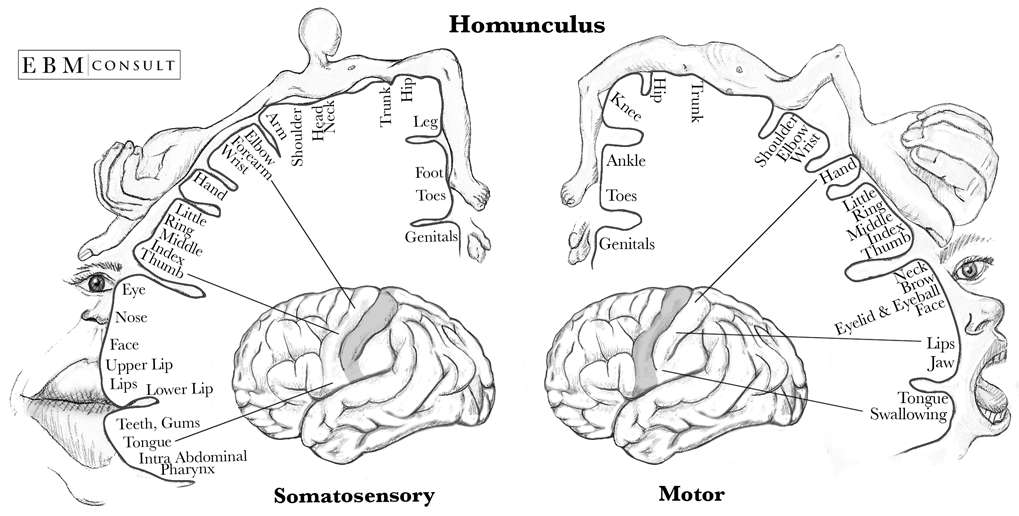
I am aware that Leigh Brasington is sympathetic to a neurotransmitter based model of the jhāna – associating opioid receptors with sukha – but if I am being honest this struck me as underdeveloped, though perhaps I should ask him for more details.
If we consider whether a peripheral nervous system jhānic locus might be the case, the next question is whether it might be related to specific touch sensations. Touch itself is actually an incredibly complex set of sensory networks. The four classic mechanoreceptors involved in touch reception are:
- Ruffini endings, responsible for static stretch less than 10 Hz.
- Merkel cells, responsible for static touch from 0.3–20 Hz, peaking at 5–15 Hz.
- Meissner corpuscles, responsible for moving touch from 3–100 Hz, peaking at 20–40 Hz.
- Pacinian corpuscles, responsible for extremely fine moving touch from 20–1000 Hz, peaking at 200–300 Hz, with thresholds down to 0.1 µm.
There’s also hair follicle receptors to consider, as well as free nerve endings, which might contain some number of TRP channels. This is a large family of ion channel receptors, including various chemoreceptors and thermoreceptors, including TRPV1 and TRPM8 – also known as the heat and capsaicin and cold and menthol receptors, respectively.

The way these networks interact is obviously extremely complicated – but I do wonder if with careful attentional modulation it could be possible to excite or sensitise specific touch networks within the central or peripheral nervous system. Perhaps with careful study of the specific frequencies of pīti and whether it respects central or peripheral nervous system geometry as it spreads, we should be able to rule out specific hypotheses?
Andrés was running logistics as well as meditating during the retreat and found this quite distracting, so when I interviewed him didn’t have much in the way of specific jhāna phenomenology to report – though we had an extensive discussion about pīti and sukha, of course. He had some of his own theories about touch networks and the way they interact:
Cube Flipper: If you were to take a hypothetical somatic microscope and zoom all the way in, what do you think pīti and sukha might look like?
Andrés: A somatic microscope?
Cube Flipper: Yeah, just like you can zoom in and you can see a visual representation of exactly what’s going on in the somatic field somehow. Up to you how you would choose to represent that.
Andrés: I would say it is a kind of parallelism between different layers of the somatic field. As if we are like isosurfaces or something – like there’s several layers that we have, and we don’t notice them most of the time, but if you energize the field in the right way, you can notice the different layers.
Andrés: Sukha in particular seems to be a vibrational dynamic that happens between the layers, and when the layers are parallel, there’s some standing wave patterns that can emerge in there. Then when the sukha is traveling, it’s those standing waves traveling across the body. So, because they’re just one frequency, you get isosurfaces – all the surfaces are at the same distance to each other, which is an excellent medium for wave propagation.
Cube Flipper: When you say different layers, what do you mean? There are different classes of nerve endings which are sensitive to different frequency bands, and things like stretching, pressure – there’s about four or five of these.
Andrés: Imagine different fields that are usually a little bit obliquely arranged relative to each other. Let’s say one is the itchiness field, and another one is the heat field, and another one is the pressure field, and there’s like pain fields as well…
Cube Flipper: These all straightforwardly correspond to different receptor classes – like you do actually have menthol receptors for cold and TRPV1 for heat and so on.
Andrés: I would hypothesize – just based on this conversation and the retreat phenomenology – that it is something along the lines of an itchiness layer and a heat layer. If they’re actually stable and parallel to each other, then some waves can travel between them, and they get kind of confused – like the tension can be shared between them. I don’t think that’s happening in the body, I would imagine that’s happening in the somatosensory cortex, which might have these layers, which have different information.
Andrés: I suspect that the coupling between these layers is more of an artifact of the way the system is implemented than something that like evolution necessarily wants – or, maybe the coupling between the heat layer and the itchiness layer in this particular experience – it’s a hack to get pleasant consonant waves to travel throughout the body. I would say that pīti and sukha are some standing wave patterns that arise in the interstices between these different information layers with different vibrational modes.
Andrés found himself to be quite sensitive to things like noise, at one point he ran a sensory deprivation experiment he called the Jhāna Suit 3000 – in which he meditated in a recliner wearing an eye mask, face mask, gloves, hoodie, and his trousers tucked into his socks – the latter as a ward against mosquito bites. What he actually discovered was that this made him extremely itchy, overheated, and uncomfortable. This said, he was able to channel the irony of this situation, and transmute his discomfort into sukha – so he was riffing on this experience when proposing ideas about itchiness and heat.
| Participant | Factor | Intensity | Location | Frequency | Texture |
|---|---|---|---|---|---|
| Anna | Pīti | Fully gone | — | — | — |
| Sukha | Present | Attention moves from head to heart; sukha throughout the whole body; it will glow a bit outside of the body | Much finer in a way that individual particles can’t be perceived | Green dust or mist; very fine, soft | |
| Eliade | Pīti | Subsided to non-distracting | A lot of body geometry, especially internal, is gone | Between 2–6 Hz | Low amplitude Chladni plate covered in baby powder |
| Sukha | Present | — | — | Flat and smooth, not quite creamy; like the nobleness of the moon | |
| Ethan | Pīti | Lower amplitude than J1 | Melding pīti with sukha degrades location information | — | Smoother than J1 |
| Sukha | Present | No localisation | — | Slick and soft, like saliva on lips | |
| Taru | Pīti | Present | Clearer boundaries; less diffused | — | Occasional waves; like freeing up trapped bubbles |
| Sukha | Present | Around the head and face area | — | Juicy peach, canned peach | |
| Wystan | Pīti | 80% down from J1 | Shifts back to being mostly on the skin | — | — |
| Sukha | One third down from J1 | — | — | — | |
| ykidch | Pīti | Lower amplitude than J1 | Arose from chest or head | Higher frequency than J1 | — |
| Sukha | Pīti-to-sukha ratio varied from 8:2 to 2:8 | Arose from chest or head | High, very high; hard to find gaps in it, when you do, they smooth over | Luminous warm glow |
Third jhāna
Wystan’s instructions for entering J3:
Pīti fades away completely. What remains is a quieter, more refined sukha, closer to deep contentment – a “pleasant abiding” saturating the body. Mindfulness and equanimity become foregrounded.
The lotus simile: Flowers immersed in cool water, saturated through from roots to tips.
To enter: From J2, soft intention toward letting the rapture settle; extended exhale, letting the pīti descend and drain out entirely, tune down your smile if smiling, the underlying happiness remains and refines.
Wystan had a very straightforward description of J3 – he reports that pīti is entirely gone, and only a small amount of sukha remains:
Cube Flipper: We’re moving from J2 to J3 now?
Wystan: The pīti goes down in J2, the sukha becomes more predominant. Then the pīti goes completely away in J3, and the sukha goes way down until it’s like a tenth of what it is in J2. It’s very quiet in comparison.
Cube Flipper: Same distribution throughout the body?
Wystan: Yeap.
Cube Flipper: It’s even for you? Because I’ve heard other reports where it moves down in the body.
Wystan: So for some people… In my opinion, these are imperfections in their jhāna. If they had stronger concentration, if their jhāna was better… In less strong versions, pīti feels more up here, J1 feels more up here. J2 will be more here. J3 will be more here. J4 is kind of like—
Wystan gestures to his head, chest, stomach, and through the floor
Wystan: That’s a very common pattern.
Cube Flipper: That’s interesting! That’s actually interesting. That’s more interesting to me than the perfect version, because it illustrates this particular progression.
Wystan: Which is quite common across people.
Cube Flipper: I wonder why that is?
This was the third time somebody corroborated the head, heart, gut, everywhere pattern for the form jhāna – modulo some slight variation in how J4 was described. I’m quite interested in where this comes from, but I’m also quite short of ideas. Are the form jhāna as attractors related to these body locations, or are they more universal than that?
I’ll confess that I don’t really think of the jhāna as something belonging to contemplative practices. Rather, if you think of nervous systems as resonant systems, I think that a good working hypothesis is to model the jhāna as outlier, low-entropy resonant modes which nervous systems can navigate into and inhabit by accident. Leigh Brasington reports in Right Concentration that about 10% of his students, upon encountering descriptions of the jhāna, recognise them as something they discovered how to do as children. Unless there’s something special about human nervous systems, I’d be surprised if other vertebrates and perhaps other animals in general did not also inhabit equivalent attractor states.
Evolution must surely be strongly incentivised to prevent organisms from accidentally getting sucked into trance states at inopportune moments, but it also suggests to me that there must be something special about the jhāna given that evolutionary incentives have not completely blocked their access. I suspect that modifying a nervous system in this way would sacrifice some other desirable qualities it possesses.
Returning to the head, heart, gut, everywhere pattern – I have to wonder if an animal with a drastically different body map would experience a different set of jhāna, or if these attractor states are more universal than that? What kind of jhāna might a fish or a centipede be able to access? As Wystan reports, in deeper absorption states, the jhāna can be experienced independent of the presence of a body map, with pīti-sukha flooding the entirety of subjective space. Does this suggest that indeed the form jhāna are natural kinds?
ykidch had quite an interesting report on the effect of J3 on distracting touch stimuli:
Cube Flipper: All right, shall we mosey on to J3? How did you transition to J3?
ykidch: I think the first thing I noticed was my smile. So I turned it down.
Cube Flipper: What happened when you did that?
ykidch: Unlike J1 and J2 there was no drastic transition. It felt to me like – this is just a metaphor – if my body was glowing an orange color, then the color would fade out uniformly. So it felt kind of like dissipation of intensity, of pleasure. Very uniformly – there was no place in the body where it started.
Cube Flipper: So how would you describe the texture of pīti and sukha within this state?
ykidch: Pīti I don’t think I experienced and sukha was flat.
Cube Flipper: Did the sukha highlight any bottlenecks in the body or ambient tension or anything like that?
ykidch: Ah, good that you mention it. Sometimes tension will arise, yes. Sometimes the tension will turn up here or sometimes… Oh yeah, the mosquitos and the flies would cause it. Like, I’m transitioning, or I’m in J3, and then a fly lands, and then my attention gets drawn to it – but then I experience this feeling of, like, oh, this is a little bit unpleasant. I might have felt some localised vibratory sensations – and then this gets covered up with, oh, this is not too bad.
ykidch: I would tend to probe it – am I in J3 or not? The way I did that was – for example, with the flies, I’d ask, is this uncomfortable? And the answer would be no. Sometimes, when I was sitting for long periods of time – after J2, some of the pain would start to return. I had an interview with Wystan where I said, the pain just started returning, and then it was a very boring experience. And he said, yeah, no, that’s not jhāna. So the next time I tried to get into J3, some of the pain returned, but the pain had this quality where it doesn’t mean much. It feels pleasurable. I feel the nociception.
During the course of preparing for the retreat Ethan and myself ran a trial interview with an anonymous correspondent who amongst other interesting reports was able to tell us about the time he was stung by a bee while sitting in J8. This apparently had quite transformative effects on the pain sensations. Ethan and myself half-jokingly discussed arranging to poke someone with a needle while they were in J8. Wystan said he was game for this – but we never got around to running this experiment.
Anna had some of the most striking form jhāna reports, her experiences consistently including vivid colour components:
Cube Flipper: Okay, so what happens when we move from J2 to J3? What does that feel like?
Anna: So I do that by moving my attention from the heart area to my belly area. I get a transition phase where the J2 energy gradually fades away and J3 energy builds up. The colour that I see, it changes to the color of a bright blue sky without clouds. It’s an association, but it very much makes me feel like I contain a bright blue sky within my body. It feels almost two dimensional, because this color is very evenly spread. It’s not like a mist or haze which contains a bit of transparency, it’s fully saturated, it’s saturation is at 100%.
Cube Flipper: When you’re experiencing this blue, is it like you are in your head looking down at the blue, or is something else going on? Is it like the blue is experiencing itself? Is the blue flat or volumetric, is it two dimensional or three dimensional?
Anna: So I still have the three dimensional body feeling, and I can put my attention either on individual body parts, or on the whole body at once, and I know it feels three dimensional, but what I see is almost two dimensional. I will see, for example, the contour of my hand filled in with this bright blue, and it’s the same in all locations within the contour. It’s very clearly defined and restricted to the inner part. It’s not like with J2 where it’s glowing outward, it’s very much only within the contour. It’s a very strong contrast from inside to outside.
Anna: If I focus on, for example, my hand, I will see it fully filled with this bright blue. If I focus on one finger and see the bright blue, it will feel as if it still contains the vastness of the whole sky as well. So the vast feeling is the same everywhere, even if the surface area is smaller.
Cube Flipper: It’s almost like every small patch of space also contains a very large amount of space?
Anna: That’s the feeling that is associated with it, yes.
Cube Flipper: That’s interesting. I’d like to zoom in on that, but I’m not entirely sure what kind of language is appropriate. How would you describe the change in somatic texture from J2 to J3?
Anna: What it feels like is very monotonous, very stable, very much like one thing. So J2 feels soft, J3 feels more like a surface. Like one color that fills everything evenly. There’s no variation at all, no particle I could find, it’s like a super even surface, where every single part feels like each other.
Cube Flipper: Are there other aspects of J3 you think we should discuss before we move on to J4?
Anna: There’s the emotional aspects that go along with it. It feels very content and very stable, vast and crisp and fresh and clear. It’s very much like being one self-sustaining unity?
Given a generous reading of Anna’s description – I found it really curious how Anna and Ethan both described the pure sukha in J3 as scale invariant, in the sense that it would be the same no matter how far you zoomed in:
Cube Flipper: What happens if we go to J3?
Ethan: J3 is almost entirely sukha, with a finite number of bounded asterisks. I’m so serious about this. Basically everything is sukha. Everything is super smoothed out. Like, I really like the analogy of, you mean curvature flow’d the thing and it’s all smooth now – but, there are finitely many fixed points.
Cube Flipper: What do you mean by a fixed point? How would one experience a fixed point?
Ethan: I guess the thing is, if everything was totally smoothed out, you wouldn’t experience shit. There has to be, a little, like—
Ethan makes popping noises
Ethan: —around in order to have a sense of whoa, this is smoothed out. The primary thing which comes to mind is expansion and contraction. The peacefulness of the sukha – it’s settling in to a stable configuration, where it’s not really expanding into consciousness more, it’s not contracting out, it’s like—
Ethan makes whistling noises
Ethan: —if that was total, you’d be gone. So…
Cube Flipper: There must be some sort of fly in the ointment somewhere?
Ethan: Yeah. There are a few quirky little bits. I guess noticing that at all is one of those bits. Maybe the faculty of mindfulness is one of those bits in the typical case, where in order to notice that you’re in the state, you require some stuff that’s relatively independent of it, and this is a thing that also influences the state and how it’s configured.
Cube Flipper: So what more do we have to say about J3? As we have moved to a predominantly sukha regime, has the texture of the sukha changed at all?
Ethan: In J2, the sukha can have many very fine textures, it seems. Maybe dependent on how it mixes with pīti exactly. Like, the cotton candy example, stuff being slick – these are somewhat incompatible with each other. In J3, stuff seems to be just like super duper uber smooth.
Ethan: Imagine you see something gray and you’re like, okay, I’m gonna zoom in, see what’s up with that. There are many ways to compose a gray image by distributing black and white pixels – but J3 is like you keep zooming in and it still remains gray.
What happens if we also view sukha as one of the building blocks of experience? In Stephen Grossberg’s model of the visual system, visual experience is constructed from two complementary processes – boundary completion and surface filling-in. The orientation columns of the primary visual cortex perform edge detection – these are the oriented, Gabor-like cells we encountered earlier. Grossberg’s theory claims that the dynamics governing the visual field automatically connect these together into invisible boundaries, and the regions they bound are then painted with colour by diffusion.

This is used to explain phenomena like the Kanizsa triangle, in which one can sense how the boundary completion and filling-in processes “want” to paint a white triangle into the visual field where none exists. Given consistent descriptions of sukha as a smooth texture within the body contour… might there be something a bit like the somatic equivalent of visual filling-in going on with sukha, in which it is used to paint contiguous regions of body map in between sparse sensory inputs represented by point source pīti? If sukha is in fact a filling-in process, perhaps its dynamics could be studied by inducing a sharp localised discontinuity – like the insect bites mentioned by ykidch and the needle experiment we proposed?
| Participant | Factor | Intensity | Location | Frequency | Texture |
|---|---|---|---|---|---|
| Anna | Sukha | J2 energy fades, J3 energy builds up | Attention moves from heart to belly; sukha only within the body contour; a single finger contains the vastness of the whole sky | No variation at all; no particles to find; super even | Bright blue sky without clouds; evenly spread, saturation at 100% |
| Ethan | Sukha | Everything is sukha | All of space | Scale-invariant; keep zooming in and it still remains the same, unboundedly | Super smooth; mean curvature flow |
| Taru | Sukha | One or two waves of pīti left | Very diffuse, radiating 1.5 m around the body | — | Subtle, diffuse |
| Wystan | Sukha | 10% of what it was in J2; very quiet | Evenly distributed throughout the body | — | — |
| ykidch | Sukha | Noticed smile, turned it down | — | — | Flat |
Fourth jhāna
Wystan’s instructions for entering J4:
Sukha itself fades. What remains is pure equanimity, clarity, and a bright awareness pervading the body – neither pleasant nor unpleasant. Perception of the breath may stop.
The white-cloth simile: The body covered from head to foot with pure, bright awareness, nothing unpervaded. Canonically: upekkha-sati-parisuddhi – purity of mindfulness due to equanimity.
To enter: From J3, soft intention toward complete stillness; let sukha fade away entirely, again may be aided by an extended exhale, letting any remaining smile relax away, taking the quiet stillness in/around the body as object.
This is the platform for the formless states. Before attempting to transition further, progress to the point where any residual impression of breath is entirely absent and the body is already beginning to fade away naturally. Don’t rush it. Enjoy!
The four formless attainments (arūpa) are not deeper in a bodily sense; they are progressive refinements of perception. The body recedes and disappears.
At J4 only Wystan, Anna, and Ethan remained; ykidch was unsure if he ever had a complete J4. Despite being the least complex form jhāna state, this did not limit what people had to say about it:
Cube Flipper: I should ask about pīti and sukha in J4.
Wystan: Yeah, they’re gone.
Cube Flipper: They’re both gone? What actually does remain?
Wystan: Depending on how dereified the body schema is, there may just be the bare sense of a kind of hollow, transparent, incredibly still body schema. Or if the body schema is gone, there’s just the sense of the stillness. So the object – if you like – in J4 is just the still space, the still volume that’s remaining when the pīti and sukha are completely gone – but it still has the spatial coherence and uniformity set up by the pīti and sukha. That global coherence stays in J4, which is why J4 is a fucking banger.
Cube Flipper: It sounds good.
Wystan: It feels amazing, in fact, better than the previous three, because it’s just like this uniform spatial volume without any perturbation.
Cube Flipper: With the body map, still, right?
Wystan: Yeah, the rough blobby body map is still going to be there, or it’s going to be gone and there’s just going to be the stillness.
With mention of spatial coherence and uniformity, Wystan is talking about the jhānic factor of ekaggatā – a quality of unification of mind, in which the graph of point to point connectedness within experience is more dense than usual. This facilitates rapid equilibrium or harmonisation across experience – like a mixture of fluids rapidly homogenising – except that instead of fluid diffusion, we are talking about diffusion of vibrations and textures throughout the bodymind.
It also occurred to me to ask Wystan if there was any cognitive enhancement arising from this purified and clear state, something I should perhaps have asked about more:
Cube Flipper: I would be interested in how easy it is to think, if that’s your baseline – is it cognitively enhancing?
Wystan: Oh, I would think so. I mean, anecdotal personal experience, but like coming out of J4 is pretty optimal for pretty much any task. You’re coming out of a still baseline into your ability. I mean, this is why it’s so good for insight practice, but why it’s good for insight practice is why it’s good for any task.
Anna’s description of J4 was similar to Wystan’s, just retaining an ethereal body schema:
Cube Flipper: How would you describe the transition from J3 to J4?
Anna: I move my attention out of the body, down into the earth. I let it go deeper and deeper. Visually, my body becomes more and more transparent, and this is linked to feeling lighter and less emotional. So, when I arrive in J4, my body will feel transparent or invisible. I can still feel and very faintly see the body contour. It’s very thin, it’s like with a soap bubble, depending on which way the reflections go I will see a shimmer or otherwise it’s almost invisible.
Cube Flipper: What somatic textual qualities exist in this state?
Anna: I feel like my body is empty. The texture that is there… It feels like there’s no texture to talk about, it just feels like space.
Cube Flipper: So all the sparkles, all the previous texture – is it mostly gone?
Anna: It’s all gone. What remains is the contour. It can look a bit like glass, though it feels lighter than that. I can get the visual impression that I’m a glass figure, but usually this dissolves into something fully transparent and empty, and I get the sensation of the outline of my body. This will also depend on how deep I am in J4. So what comes closest to it is a soap bubble.
Now that the states we are discussing are more abstract – Ethan got into his element, providing a much more abstruse description of J4:
Cube Flipper: So, what do we do to get to J4?
Ethan: As mentioned, J3 is super duper peaceful, equilibriums everywhere. Even the irregular points that are constantly supplying something – it’s not really like a vibration, it’s more like a silent vibration, like everything is in equilibrium with it. To go to J4 you release those. Those become flexible. Maybe slowly flexible, but they are flexible. They’re pulled by whatever they’re connected to into something globally smooth.
Ethan: You know what J4 does? J4 takes the local principle of stuff being in equilibrium and says – not only are we going to make this a global principle, we are going to construct things such that the local principle of equilibrium induces the global principle of equilibrium. It is doing the false vacuum collapse and it is constructing things such that false vacuum collapse is workable. It’s pretty fucking sick, and it is chilled the fuck out.
Cube Flipper: Yeah, is it remarkably silent? What is going on with the body map?
Ethan: The body map is a suggestion. It’s about as substantial as if someone drew a reasonably accurate stick figure on a piece of paper. It’s like form at this point is asymptoting to formlessness.
Before wrapping up the form jhāna, I also wanted to ask Ethan what he thought about the global pīti-sukha trend we observed:
Cube Flipper: Can you explain what you think the trends are with regards to pīti and sukha?
Ethan: If I was to describe how I think other people will describe it and how this will fit into typical models – J1, basically all pīti. J2, nearly all sukha. J3, actually pure sukha. J4, neither.
Cube Flipper: How do the spectral qualities of the pīti and sukha change throughout this progression?
Ethan: Generally everything gets smoother as you go up.
Cube Flipper: It gets smoother, but it doesn’t increase in frequency?
Ethan: You do in a quirky way. The bulk thing that’s happening is a smoothing, and because you have this smoothing, you get a stabler background with which to notice and bring into awareness and then resolve various things – and then you move on to relatively higher frequency things. In order to notice extremely fine changes, you need a sufficiently stable background. If your background is not sufficiently stable, you can’t possibly notice stuff that’s that fast.
I found this description somewhat relatable – I can describe how I think it relates to my own meditation practice. I don’t meditate very often, but when I do, I generally practice whole-body awareness. When I do this, I often notice a large number of oscillatory processes scattered throughout my body, mainly in the limbs and chest. I’m agnostic to what they represent – whether or not they are related to the circulatory or nervous systems, or whether they represent processes in my body or in my mind’s representation of my body. Mainly they just represent superfluous background gunk floating around in my bodymind, decreasing overall sensory clarity and stability. What this generally cashes out to is a more anxious and uncertain disposition.
When I place my attention on one of these oscillatory processes – I typically find something like a chaotic, asymmetric swirling shape wobbling around in my chest, partially phase-locked with my heartbeat. If I can develop sufficient clarity into its structure, it often just spontaneously disappears. I’m not really sure what exactly is going on here – perhaps my mind needs to learn how to predict its behaviour, and when this happens, the system cessates. If I keep doing this, I eventually run out of larger oscillations to dissolve, and start uncovering more and more fine grained, high frequency oscillatory processes. These are pretty much entirely bunched up against the inside of my body shell, not unlike whispering gallery modes.
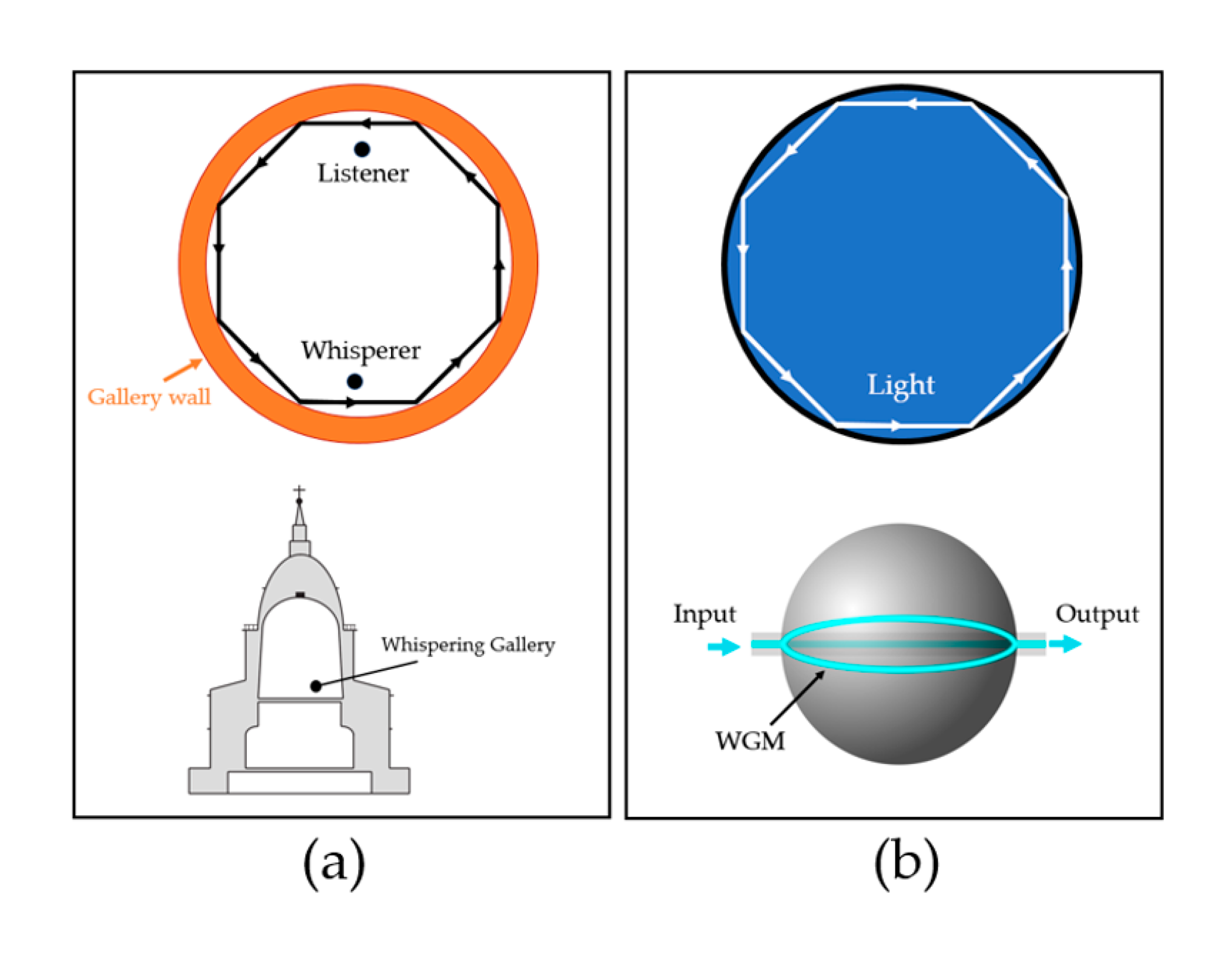
Generally I lack the attentional stability to work with these, so that’s where I tap out – but I imagine that if I was able to dereify them all the way, I’d wind up experiencing something like the extremely stable background that Ethan describes. In any case, in hindsight I think I was focusing on the wrong thing by asking about absolute or relative frequencies for sukha – rather, maximal sukha is a limit approached as higher and higher frequency background radiation is removed.
| Participant | Factor | Intensity | Location | Frequency | Texture |
|---|---|---|---|---|---|
| Anna | Neither | Emptiness; no texture to talk about; just space | Attention moved out of the body; outline of the body remains; only a faint shimmer of contour | Still | Soap bubble; shimmering; holographic effect |
| Ethan | Neither | Super peaceful; equilibria everywhere; chilled the fuck out | Body map is a suggestion, about as substantial as a stick figure; asymptoting toward formlessness | Not like a vibration; like a silent vibration | Globally smooth |
| Wystan | Neither | Only the sense of stillness | Body schema is either hollow, transparent, incredibly still, or gone entirely | No perturbation | In a strong J4 it’s just bright white |
| ykidch | Sukha | Very subtle | — | — | Heaviness; the thing between feeling raw sensation and feeling something; disappearing into nothing |
Discussion
In this section, I’ll go through the form jhāna in sequence, providing a summary of the reports made by participants, speculation I made, and any general trends we observed. I’m interested in modelling the jhāna as states with decomposable structure; considering factors like pīti and sukha as building blocks of experience.
Access concentration techniques
So far as access concentration techniques go, most of our participants were using breath at the nostrils:
- Whole-body awareness: Two participants; Sasha and ykidch.
- Loving-kindness: No participants.
- Breath at the nostrils: Six participants; Andrés, Anna, Eliade, Ethan, Taru, and Wystan.
Participants reported a variety of subjective effects upon initial entry to J1. It remains ambiguous why breath at the nostrils was effective. I speculated that:
- If the body map is constructed according to the principles of dependent origination, removing most of the graph of interconnected sensations lets the remaining subgraph develop its own character on its own terms.
- Taking attention off most of the body map except for one tiny place frees up the underlying neuronal substrate to do its own thing.
- Concentrating attention in one tiny place saturates the underlying neuronal substrate in that location, resulting in nonlinear behaviour like the Kerr self-focusing effect.
Form jhāna phenomenology
The following participants reported on the form jhāna – with generous inclusion criteria, in which those who claimed only partial access are included:
- J1: Seven participants; Andrés, Anna, Eliade, Ethan, Taru, Wystan and ykidch.
- J2: Seven participants; Andrés, Anna, Eliade, Ethan, Taru, Wystan and ykidch.
- J3: Five participants; Anna, Ethan, Taru, Wystan and ykidch.
- J4: Four participants; Anna, Ethan, Wystan and ykidch.
In first jhāna, participants mainly reported the presence of the pīti factor in the body, sometimes correlated with placing attention on the head. Wystan gave a particularly deep report including the presence of a central column; I got excited about toruses. Eliade gave a very detailed description of pīti as little Gaussian-like point bodies vibrating on an axis at something like 5–6 Hz. I suggested that if the visual field is constructed from Gabor functions, perhaps pīti in the somatic field might be constructed from oscillating Gaussian functions.
In second jhāna, participants reported the presence of sukha in addition to pīti, sometimes correlated with placing attention on the heart or chest. Participants described sukha as silky, smooth, or soft; I compared it to a smearing of sensations in which trading pīti for sukha entails trading spatiotemporal domain certainty for spectral domain certainty. I think that the connection between sukha and creamy or fatty flavours is not shallow; I think sukha is employed by evolution as a reward mechanism. Sukha also appears to aid with healing by making the body map more malleable; Ethan compared this effect to the heat equation and curve-shortening flow.
In third jhāna, participants generally reported the disappearance of pīti, leaving sukha remaining. Transition to this state was sometimes correlated with placing attention on the gut or belly. We discussed the head, heart, gut, everywhere trend; I wrote up some speculation on the jhāna as nervous system attractor states which evolution cannot quite eliminate for some structural reason unknown to us. There was an interesting report from ykidch about sukha transforming unpleasant touch stimuli. Anna reported feeling like space contained a very large amount of space; Ethan reported on being able to zoom in on experience and everything remaining the same. I spent some time comparing sukha to the somatic equivalent of visual filling-in, as per Stephen Grossberg’s model of the visual system.
In fourth jhāna, participants typically reported the disappearance of both pīti and sukha, sometimes correlated with moving attention down through the floor or spreading it everywhere throughout experience. Most participants reported that their sense of a body map was extremely marginal at this stage. I discussed the ekaggatā factor with Wystan, who also reported on the cognitive enhancement effects of this state. I discussed the pīti-sukha trend with Ethan. I discussed my own bodily awareness and dereification practice, and I speculated that sukha is less the kind of thing which has an innate spectrum and more that it is the background radiation left behind as higher and higher frequency oscillations are dissolved. Given its presence at the surface of the body map, this also reminds me of whispering gallery modes.
We observed two macroscale phenomenological trends across the form jhāna:
- The pīti-sukha trend, in which different form jhāna are reported to have consistent relative proportions of pīti and sukha.
- The head, heart, gut, everywhere trend, in which different form jhāna are reported to be accessible by concentrating attention in specific locations in the body.
As I understand, these pretty much square with what’s documented in the literature. In hindsight, I didn’t quite interview with enough specificity to be able to tabulate data for all participants; we should be able to do this next time around. In the meantime, I spoke with Wystan to tabulate his own experience of both of these trends:
| State | Pīti | Sukha | Locus |
|---|---|---|---|
| J1 | 100% | 100% | Head |
| J2 | 10% | 80% | Heart; chest |
| J3 | — | 10% | Gut; belly |
| J4 | — | — | Everywhere; through the floor |
Form jhāna factors
So, what are pīti and sukha? I currently have more questions than I have answers for:
- Are the form jhāna exclusively characterised by their pīti and sukha?
- Are pīti and sukha natural kinds; do they exhaust the category to which they belong?
- Are pīti and sukha truly building blocks of experience?
- Are there visual, auditory, gustatory, or olfactory equivalents to pīti and sukha?
- Are there equivalents to pīti and sukha present in other animals?
- Why do the form jhāna generate pīti and sukha in the specific relative quantities they do?
- Why do pīti and sukha correlate with specific attentional loci?
- Why does it make sense to associate pīti and sukha with textures like chalky and creamy?
- What is the statistical distribution of pīti – is it random, is it Poisson-disk sampled?
- Is it reasonable to generalise pīti and sukha to lower intensity phenomenal factors present outside jhāna, or is this an abuse of terminology?
I consider all of these questions to be worthwhile targets for future research. If you have any opinions on these matters, I invite you to get in touch. I’ll also see you again in part two, in which we’ll cover the phenomenology of the formless jhāna.