The third QRI psychophysics retreat, part II: The formless jhāna
Posted on 5 October 2026 by
This post will follow the format of the previous post, covering the research I performed at the QRI jhāna retreat, in Tepoztlan, México earlier this year. We’ll go through the formless jhāna one by one, summarising transcripts from the post-retreat interviews I held with our participants, and attempting to synthesise those reports into coherent models. Alongside these, we’ll also present visual replications of the formless jhāna, developed by the visual artist Symmetric Vision.
In part one, I proposed that the jhāna could provide a much-needed Rosetta Stone for consciousness – fixed points for translating between subjective states and physical ones. Personally, I think that this is a cosmically urgent matter – given that consciousness may well be philosophy with a deadline, to quote from a recent Scott Alexander blog post.
As we shall see, it seems that the formless jhāna have significantly simpler internal structure than the form jhāna, and they also trend progressively simpler from J5 to J8. I think that if we walk backwards from cessation all the way to waking consciousness, then we can characterise the transitions through the jhāna as a series of symmetry breaking events as more and more degrees of freedom are added. It follows from this that we should then be able to characterise the formless jhāna by their corresponding symmetry groups – as Mike Johnson has proposed before. To provide a concrete example – if someone reports that the only thing remaining at J8 is the sense of time, we can use this type of claim to narrow down the set of groups which might describe J8.
If we can observe those same symmetry groups in neuroimaging data – perhaps with a specific focus on the difference between cessation and J8 – this might then take us one step closer to finding the correlates of consciousness, and ultimately how the structure of waking consciousness itself comes to arise. I’ll cover this in much more depth in the discussion section, but in the meantime, I’ll present our formless jhāna transcripts.
The formless jhāna
In contrast with the form jhāna, the formless jhāna are characterised by their lack of – well – form, which we take to mean anything which can be said to have a definite, formed shape within experience, be it visual, auditory, or somatic. In most situations we are talking about the presence of the body map, though this might also include incredibly subtle aspects of experience – for instance, someone might not notice that they are still rendering the sense of the walls in the room in which they are meditating. Wystan tells me that for J5, that has to go.
As I understand, part of what characterises these states is a significant or complete reduction in metacognitive faculties. This introduces significant challenges for those attempting to observe and report upon the nature of the formless jhāna. I was quite confused as to how these states were observable at all until I spoke with Wystan, who clarified that they are really only observable through memory after the fact:
Cube Flipper: …with, say, J5 – how do you know this? As you don’t have much metacognition at the time, and you have to reflect on these things afterwards?
Wystan: Like in psychedelic states, you have a memory of the state, coming out of it.
Cube Flipper: Oh, really? Okay. So you cannot analyse it from the inside, but, afterwards, it’s left an impression?
Wystan: Depending on the depth of absorption, basically. In a relatively shallow version, you still have some cognitive maneuverability, you can think verbal thoughts, in a not terribly absorbed version.
So it appears that observing the formless jhāna is less about exploring them from the inside and more about noticing that you weren’t doing something afterwards. This is subtle – I have to wonder how often people fall into such states by accident, and simply don’t notice them or think of them as remarkable.
Additionally, the qualities of experience which are dissolved by the formless jhāna are generally the type of foundational aspects of experience which we take for granted – like the sense of space or time itself. Asking someone to describe what it feels like when the sense of space dissolves feels kind of like asking a fish to describe what it’s like to be lifted out of water, when they have no prior conception of anything other than the comforting support of an incompressible fluid. That said, our particular scene likes to make a sport out of expressing the otherwise inexpressible, so here we are.
Only three of our participants were able to ascend all the way to J7, and only two to J8 – and return to tell the tale. However, one participant, Sasha, ran an experiment where he attempted to skip J1 to J4 and go straight to J5, and ambiguously he had some experiences to report as well.
Cube Flipper: How did your retreat go? What happened when you spent time meditating?
Sasha: I attempted to follow a plan, which was – don’t bother with the first four jhāna, just go directly to J5 – as deep as I can.
Cube Flipper: Why did you think that was doable for someone new to meditation?
Sasha: I wouldn’t call myself new to meditation – I’ve done a bunch of vipassanā, and I had cessations back in 2020. So, if you want to get into the formless jhāna, the traditional plan is – get access concentration, get some pīti going, enter J1, J2, J3, J4. There is a two-panel meme of a guy doing straightforward gymnastics and insane gymnastics. The traditional plan seemed like the insane gymnastics version. So many steps; you can skip that. How did I know if that makes sense? I tried doing some formless jhāna stuff even before coming to Tepoztlán. I attempted to so some focusing on the breath, which I didn’t like much. I also tried stretching out the space – I kind of liked that feeling.
Cube Flipper: This is very different to all the other people I’ve spoken to who have successfully gotten into the form jhāna. Nearly everybody was using breath at the nostrils.
Sasha: There’s a post on my blog – Zen and the art of speedrunning enlightenment – in reference to speedrunners, who try to complete a computer game in the shortest amount of time possible, who find insane skips to complete, say, a five-hour game in like two minutes. This sounded fun, and compatible with the goal of the retreat.
Cube Flipper: I’m on board with pragmatically hacking your way into these states.
While I endorse Sasha’s efforts, I’m sure there are people out there who will tell him this is a bad idea. All I can say is, I think he’s the kind of person who is capable of accepting responsibility if something bad happens in the course of self-experimentation.
Fifth jhāna: Boundless space
Wystan’s instructions for entering J5:
From J4, let the perception of the body and of form drop away. Attend first to the space the body occupies, then to space itself, expanding outward without limit. No edges, no boundaries – boundless space in all directions.
Brasington: drop the perception of form, attend to space, let it extend infinitely. Burbea: notice that the perception of “boundary” is itself a construction; loosen it, and infinite space appears as the natural perception of space without that imposed limit.
J5 is also known as boundless space or infinite space, depending on who you ask. My understanding is that the term boundless in this instance refers to boundarilessness, in the sense that there are no internal boundaries within space – if there was something within the space, it could move forever without hitting something. The term infinite may also refer to the sense that one could move infinitely far in a given direction, as well as the sense that each chunk of space contains an infinite amount of additional space.
I asked Anna about her experience with J5, which included an entity encounter, and her way of testing the property of boundarilessness:
Cube Flipper: When you transition from J4 to J5, how does that tend to go for you? What do you do, and what happens?
Anna: Initially I struggled with letting go of my body, there was some resistance. I might have told you – in meditation, a picture of the Hindu god Ganesha came up and showed me how it’s done – how to dissolve your body. It’s funny because this visual depiction helped me to do it myself.
Cube Flipper: What was that like?
Anna: He was there, with his blue elephant body in dark blue clothes and golden ornaments, and he was saying something like, let me show you how you can do it. Then his boundaries dissolved, and the content of his body was distributed throughout space, and the whole of space then felt like it contained Ganesha’s essence. This helped me to do it myself.
Anna: Another image came up, as a technique – which involved imagining a sphere and putting points of my attention on it, and then expanding the sphere outward. This was the strategy that I’ve been using. I focus my attention, then I diffuse my attention and expand it. So it’s in the room and it expands throughout space.
Anna: What happens is that my body contour dissolves. If I’ve fully reached J4, it will feel empty, there won’t be any energetic content within the body, but the body contour will still be there, and this it will follow my attention. It will dissolve and move outwards similar to the picture of Ganesha. It feels as if it gets distributed throughout space.
Cube Flipper: Would you say experience was genuinely three dimensional, or was it two dimensional like the visual field is?
Anna: It is three dimensional. I feel this process of dissolving going in all directions, behind my body and under my body – there’s a bit of a bias, it’s more pronounced towards the front and the top.
Cube Flipper: Is there a limit to it – if you looked at the sky like you normally would, it feels like the sky is just sort of there – would it feel like you can see past the sky?
Anna: This is what happens to me when I arrive in J5. But once this dissolving process happens, at some point it feels like the maximum expansion is reached – I mean, there might be further expansion but it’s not noticeable anymore at all – and my sense of spatialness and three dimensionality gets more and more pronounced. When I get there what I do to test whether I’m actually there is – I have my attention like a point somewhere in space, and I can send a point of attention outwards in one direction and see how far it goes. I realise, okay, I can go really far, I can go on and on and there is no boundary, it actually feels infinite.
Anna: What I do lose is the sense of size. Initially, when I sent the attention point out into space it felt like a distance of millions of light years, but when I did it in another meditation it felt like it could be any distance. It could be super small, like centimeters or meters, or it could be super big.
According to Wystan, transition to J5 can happen when people simply forget to place attention on the body. Lacking a source of illumination, the body vanishes – but as soon as you think to check, the body comes back. Apparently Sasha was running into this problem.
I was trying to understand if I might already have some grasp of what this feels like. Generally when I meditate on whole-body awareness, it feels a little like there’s a spotlight in my head illuminating my body with a conical light source. Sometimes, after about ten minutes or so, something happens to this light source – it feels a little like taking the spotlight off its target and pointing it at the ceiling instead, providing a diffuse, centerless source of illumination. Sometimes, however, this spotlight winds up pointing somewhere else entirely, in which case the body vanishes. Generally, however, when this happens I find it then illuminates some daydream-related mental content, which rules out the possibility of jhāna.
However, when I asked about his practice, Wystan described a more deliberate attentional maneuver, much like what Anna was doing:
Cube Flipper: Do you feel ready to move on to the formless jhāna? How would you describe the transition from J4 to J5?
Wystan: How I access J5 has changed over time. When I was first learning it, I tried a couple of different things – like the body boundary was malleable enough that I could kind of like blow it up like a balloon and follow it out.
Cube Flipper: Oh, I’ve heard of people turning it into a sphere, projecting incoming somatic sensations onto a sphere.
Wystan: Expanding sphere. That would work sometimes. Or, I would just, beam attention out into space. Any perceived solid resistance, just – boom, over, through, around, somehow, keep going, going, going, going, going and then I would get to this, boom, pop, wow, space. Boundless, no perceived resistance. I would usually go straight ahead, or if that wasn’t working for whatever reason I might have better luck going up at an angle.
I remained hazy on exactly what the term boundless referred to, so I wanted to ask Wystan for clarification:
Cube Flipper: What does boundless mean?
Wystan: It means there’s no felt perception of resistance in the field at all. It’s not literally infinite, it’s like you’re looking into a completely lightless void and you can’t see the other end of that. I can’t feel the extent of this at all.
Cube Flipper: So, when I look at the sky out there – naïvely, it should be rendered some arbitrary, almost infinite distance away – but it’s not. It’s rendered in a way that feels like it’s a finite distance away, like there’s a reciprocal law relating objective to subjective depth.
Wystan: Like the sky itself is like a boundary – take that away.
Cube Flipper: Like an echolocation that never comes back? Do you think you are doing something like sending a sonar ping out – with waves? Is that what makes it feel boundless?
Wystan: That’s descriptive of the transition, but once boundless space is established, there’s no sonar going out at that point.
The vision researcher Steven Lehar proposed that objective depth was related to subjective depth according to a reciprocal law – in which the scale of the world model shrinks as a function of depth. As we approach an infinite objective distance, the scale shrinks to zero – which means that everything appears as if painted on a flat skybox.
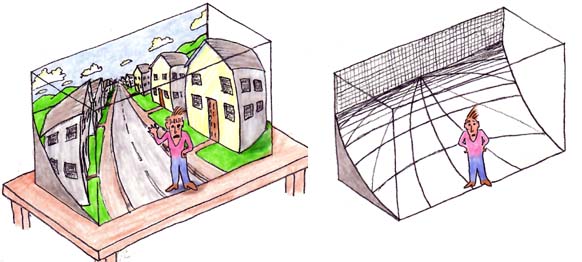
In a better developed version of Lehar’s theory, he suggests that variable wave propagation rate in the visual field could be used to render depth while keeping other qualities invariant. If this were the case, the velocity of the waves used to render the skybox would be the minimum wave velocity we normally experience. If the skybox were to be dissolved, perhaps the experience of seeing past the skybox is equivalent to the wave velocity finally dropping all the way to zero?
Cube Flipper: I’ve heard people use boundless in a very different sense, referring to the boundaries between felt or mental objects.
Wystan: Yeah, there are no objects in this state.
Cube Flipper: So should we be using different language for that particular thing, insofar as it’s something which dissolved much earlier in this progression?
Wystan: Boundaries is fine, you just specify what boundaries. Up through J4, you’ve dissolved all internal boundaries, both within your mind and attentional structure and also in the body schema. Then… you dissolve the container. Like, in the visual field, you can have internal boundaries there where you feel that objects are distinct, and that can go – but you still have a container.
Cube Flipper: The container sounds almost like a cavity, which waves can reflect around inside, and you get pings back from.
Wystan: Yeap. So up to J4 we’ve taken all the furniture out of the room. In J5, we take away the room.
The description of removing all the boundaries in the visual field reminded me a lot of something which can happen while on ketamine. I’ve written about this elsewhere – it’s as if things lose their thinginess turn into stuff. Amongst friends, I like to ask people, what’s your stuff-to-things ratio?

I now wanted to ask about the geometry of J5. What could possibly be said about the qualities of this otherwise featureless void?
Cube Flipper: I want to ask about the structure of space. Is space two or three dimensional?
Wystan: In J5, three dimensional. Definitely. It’s a pretty bog-standard three dimensional Euclidean space. The dimensionality is the same as J6 – it only gets fucky in the J6 to J7 transition.
Wystan: So, depending how good J4 was or how concentrated you are, the body will take a different amount of time to dissolve, and the sense of space – for me, it’s already quite 180° panoramic – but if the body is really completely gone, then the space is 360°.
Cube Flipper: Oh, interesting, so, the structure of the space is correlated with how much the body map has dissolved?
Wystan: Yeah, also the sense of a front and a back, or an oriented observer. You know, in a really good J5, that’s not really there.
Cube Flipper: In J5, do you think you can gauge distances within this space?
Wystan: Like, relative distance? No, relative distance is gone.
Cube Flipper: No distance metric. That conflicts with something Ethan claimed.
Wystan: There aren’t objects within the space by which you can judge relative distance. I can’t instantiate a ruler, nor is there anything here to work with.
Cube Flipper: What about angles?
Wystan: Ehh.
I’ll note that Wystan’s claims of three dimensional space conflict with his claim that the sense of front and back can disappear – either that’s one dimension missing, or he’s describing rotational or reflection symmetry. I’m interested in how the sense of space is constructed, and the reason I was asking about distance metrics and angles was because I was interested in what kind of space J5 is – is it an inner product space, possessing both distances and angles – or is it a metric space, possessing only distances? If neither, then it’s simply a pure topological space, in which points have neighbourhoods, but there is no notion of distances or angles. In this case, results are inconclusive, because Ethan and Wystan disagreed about the features of J5 and J6:
Cube Flipper: So we have landed in J5. We’re in the formless jhāna.
Ethan: Yeah. So I will note, I only did pretty sloppy formless jhāna. This round, at least.
Cube Flipper: Yeah, if you can describe some messy ones for me, that’d be fantastic. Like, half-in-half-out stuff gives me perspective.
Ethan: I was practically in a sloppy J5 a good chunk of the time – a J4 with extremely tiny bits of form left. What would happen is that these bits of form would dissolve and the full thing goes poof, and then five seconds later some other bit of form would pop up.
Cube Flipper: I’m pretty interested in the dynamics by which form disrupts formlessness.
Ethan: So, there are a few ways. One is like, if it catches your attention, basically.
Cube Flipper: If it catches your attention?
Ethan: We can work with an attention and awareness thing – if your attention is entirely on the sense of space and your awareness is just doing whatever, like this is kind of like a sloppy J5. Though, standards for attention are high, and also the attention and awareness dichotomy is suspect.
Cube Flipper: Yeah, I never really picked up on a difference between attention and awareness. They seem to be cut from the same cloth.
Ethan: The main thing is that you can be paying attention to something and be aware at the same time of many things in the sense that you would notice if they changed, but you’re not actively attending to them.
The term “sloppy jhāna” came up many times in the course of our discussions. This came about because I thought that incomplete instantiations of the jhāna were a worthwhile topic of discussion. As I’ve said elsewhere, about studying the effects of DMT:
My intent is not to chase a high-intensity experience every time, as I consider it more practical to study the phenomenology as it progresses from a to b to c than if I were to leap straight from α to ω.
I think it makes sense to extend the same principles to study of the jhāna. I’m less excited by highly abstract descriptions of deeply dereified states than I am by someone who can track the progress of the states for me all the way from a sober baseline. Also, as I mentioned earlier, I am also not interested in participating in discussions about what constitutes a “real” jhāna as a function of absorption.
I am reminded of what it was like when I learned to drive as an adult. Many of my friends are massive car nerds, and when I sought advice from them, they universally told me to learn to drive a manual transmission. Several weeks later, while turning right at a four-way intersection, I slipped my friend’s little Citroën into fourth rather than second gear, and would have crashed into the corner of a building if he had not already had his hand on the hand brake. The following year, I learned to drive in an automatic. I learned from this that sometimes the best kind of advice you can seek comes from someone who can remember the process by which they learned it.
Ethan: So. J5. When it’s done hard, exactly as described – boundless space.
Cube Flipper: You just got space? How do you know you just got space? How do you test this?
Ethan: If you had a body map, and if it was very stretchy, you could stretch unboundedly in any direction – but you don’t have a body map. You have this… knowledge-shaped object.
Ethan: If you have been sitting in J5 and then you think, hmm, maybe I should see if my sense of boundless space is actually boundless, you then might go and attempt to visualize something with extremely large spatial extent, or that needs to avoid intersecting with spatial boundaries. Like, one way that boundless space is boundless is that you can stretch along dimensions, and another way is that you can zoom in infinitely along dimensions.
Cube Flipper: You can zoom in? Like the example in J3 earlier where the closer you look, it’s still just gray?
Ethan: Yeap. In J5, the closer you look, it’s still just space – and you don’t lose track of how far you’ve zoomed. Important.
These are some curious invariants. Ethan is describing translational and dilational symmetries. I should check with Wystan if he was in fact describing rotational or reflection symmetry earlier, since if that’s the case, those four together compose the similarity group, though pending further investigation perhaps we should also consider the groups of linear maps or diffeomorphisms.
As mentioned earlier, Sasha decided to try to bypass the form jhāna and skip straight to J5. His technique also involved attempting to stretch out space:
Cube Flipper: You mentioned a move earlier where you would focus on space and try stretch it out. What are you doing there?
Sasha: First, you close your eyes, then you notice that the space is already kind of infinite. Like, there is London somewhere, and you could probably put it on your mental map. If you place an object an increasing distance away, you might also notice that space gets stretched by itself, and that this sensation of stretching the space is a mental motion itself. You can try doing the mental motion – oftentimes it feels like when I close my eyes, there is something that’s blocking it. Right now I’m closing my eyes and I’m trying to push through the wall – this takes some mental effort, and the game is basically just to make the walls disappear.
Cube Flipper: How much did you do this? Was this like the primary thing you were doing?
Sasha: It was my primary practice. I would be doing it five to seven, eight hours a day. I would say five of those hours would be a super high quality time where I would experience one of the most pleasurable kinds of experiences. I would rank very few experiences higher than that – it’s definitely better than MDMA, better than opioids.
Sasha: In the beginning, we arrived to our place. We were listening to a Rob Burbea talk, I decided to nope the fuck out – and you know, I do the stretching thing, my body starts to fade away – and this was literally one of the most pleasurable experiences of my life. So I’m like, well, I’m going to continue deepening that during the retreat. So I spent the next few days pleasantly annealing my regrets. The state is very high valence, but also it’s not quite meditative equanimity. I would call it equananimous, but it’s kind of neutral. It’s very pleasant, structurally simple. The pleasure comes from the structure of experience itself. I was to trying to pinpoint if it’s bodily pleasure – it’s definitely not.
Cube Flipper: Do you think you hit any of the formless jhāna?
Sasha: Well, define the formless jhāna. At some point I had this uniform space and I had no body for a couple of seconds. The state was quite wobbly because to stabilize it you need to be annealed properly. So, yeah, I didn’t quite stabilize it fully.
Cube Flipper: Did you go to Wystan or whomever and ask whether they thought that was J5?
Sasha: Well at some point he told me when we were speaking that it’s either a shitty version of J5 or not quite there yet, depending on who you ask. I consider it an 80% J5 speedrun basically.
In contrast with the other participants, Sasha emphasised the valence of the state he experienced – interestingly, basically nobody else had anything to say about the valence of the formless jhāna.
Sixth jhāna: Boundless consciousness
Wystan’s instructions for entering J6:
Turn attention from infinite space to the consciousness that is aware of infinite space. Since that consciousness pervades infinite space, it too is experienced as infinite. The shift is from object (space) to the knowing of it (consciousness).
Starting with J6, the descriptions of the formless jhāna are starting to get sufficiently abstract that I am having a hard time wrapping my head around them. Boundless consciousness? What might that refer to?
Ethan and Wystan had a disagreement over whether or not the sense of space drops out in J5 or J6. According to Wystan, in either J5 or J6 the sense of different dimensions – like front and back, left and right, or up and down – can drop out independently of one another. This is interesting to me in the sense that the formless jhāna might not be monofeatural – perhaps they are constructed of multiple subfeatures which might drop out independently of one another in specific circumstances.
I started by asking about the transition to J6, and for more specific details about what symmetries appear throughout the jhāna:
Cube Flipper: As you transition to J6 does the sense of space collapse?
Wystan: No, the dimensionality between J5 and J6 is the same. Space gets really fucky in the J6 to J7 transition, but in J5 and J6 it’s the same boundless space, you’re just tuning into a different quality.
Cube Flipper: Okay, so there’s no front and back, left and right, up and down symmetries that are dissolving one by one?
Wystan: Yeah, in good versions of the states, left-right, up-down, back-front, nuh-uh.
Cube Flipper: In sloppy versions, can you lose left and right before you lose the other ones?
Wystan: I’d say front and back is probably the last to go.
Cube Flipper: Oh, interesting. Does it normally follow a particular sequence?
Wystan: Even in the form jhāna, left-right doesn’t feel particularly salient.
Cube Flipper: So this is more of a J1 to J6 thing? Might these particular dimensions become symmetrical at any stage in the form jhāna up to the stages where you still have space?
Wystan: I think so. You’ve still got three dimensional space pretty well preserved in all of these states.
Cube Flipper: Is there any rotational symmetry?
Wystan: I don’t think I’ve explored that.
This is interesting when placed next to Wystan’s statement about three dimensional space persisting – he claims that each dimension was adopting reflection symmetry without collapsing or vanishing entirely.
I neglected to ask Wystan much about what consciousness refers to, but I did discuss this with Anna:
Cube Flipper:: What happens when we go to J6? What’s the attentional move, and what happens to experience?
Anna: I intentionally focus on feeling the consciousness in space and how that feels a bit like zooming in on a microscope. Something that was previously invisible then appears, but it’s not a visual sensation. It’s also not a feeling in the body, but a general feeling of energy.
Cube Flipper: How would you characterize the difference between J5 and J6? What makes boundless consciousness boundless consciousness rather than boundless space?
Anna: So J5 still feels like it has structure – it has dimensions, it has expansion. There can still be a sense of size or distance – something can be closer or further away, even if it’s not defined in a specific unit. In J6, I don’t get the sense of dimensionality anymore, I don’t get a sense of size. I lose the sense of… maybe it becomes one dimension.
Initially Anna experienced a lot of visual effects when trying to access J6 – she described these as holographic rainbow waves. She discussed this with Wystan, who confirmed that this was close to but not quite J6:
Anna: In the beginning, I saw something like a field made up of made up of waves – but apparently this is not what J6 is supposed to be. So I focused on looking through the visual sensations, and what I get then is one particular feeling. There is only this one feeling, this sensation. It feels like a subtle sensation, but it does not really have dimensionality, there is no distance there. There is only this one sensation, so there is nothing to measure distances by.
Cube Flipper: Okay.
Anna: I’m focusing on the feeling of it and not so much everything that might be connected to it. What comes closest for me is a feeling of recognition, of self-reference. I don’t see a structure, but if there was one, it would be like a loop…?
Cube Flipper: Like a loop?
Anna: Yeah, like a recursion.
Cube Flipper: Like attentional topologies looping back on themselves, or something?
Anna: Yes, yes. This is what comes closest to the feeling. It’s like something recognizing itself, but without further content. A visual analogy would be like there’s darkness and then there’s a very subtle light sensation. Just very simple.
Cube Flipper: Does this like model of like self-recognition or attentional loops or topologies, do you feel like this model is extendable to any of the other jhāna in the sequence we’ve just explored?
Anna: It feels to me that this is the minimal building block that the other states are made of, in much more complexity – but I could not exactly say how.
I find myself wondering if the self-recognition as Anna describes it is the most basic form of conscious self-reflection or metacognition. If so, this seems important for panprotopsychist theories of consciousness, which must find some way to define the difference between raw consciousness and self-reflective conscious states.
I also asked Ethan about how the consciousness in boundless consciousness works:
Ethan: In J6, you just know things. Or rather, knowing just happens.
Cube Flipper: Knowing just happens?
Ethan: When it’s going well, knowing just happens. If it’s going kind of iffy, then you just know things. If it’s going really interestingly, you just know things and knowing just happens and you know knowing just happens.
Cube Flipper: Oh, right. Okay.
Ethan: So, what is knowing? Good question. It’s very finicky in that it’s got to cash out somehow. The usual way this cashes out is through sensory contact prediction. It’s sort of making predictions about how this whole thing is going to route implicitly – but because these are thoughts, you can think thoughts unboundedly. You can think thoughts and get genuinely new information from computing new things unboundedly.
Ethan: So you are not subject to routing through space in order to know things. Or, this is one way to demonstrate that this is the case. More importantly and more directly, for sensory contact, you can just know things about particular tactile receptors or visual things without pulling up their spatial index first, so to speak. You just route very directly to them.
My read on this is that now that space itself is dereified, the graph of what connects to what within experience no longer depends upon spatial proximity – and given that thoughts are generally rendered in subjective space, information can now get from anywhere in experience to anywhere else without having to route through space. My prediction is that the graph of connections within thought space would now be free to become as dense as it pleases, which potentially carries risk of psychosis – but quite honestly, this is idle speculation, and I don’t really know what to think about these claims.
I also asked Ethan about the differing opinions between him and Wystan:
Cube Flipper: So originally with J5 we explored the idea that this was the last state with a distance metric. I think Wystan had some differing opinions around whether or not the distance metric was gone before J5 or whether it persisted into J5 and J6.
Ethan: I think that distance in J5 – yes. Or at least, typically – brain is flexible, so who knows for real. In my experience – yes. J6? No. You can have straight up asymmetries. You can think one unit in the x direction and then to get back you have to think two units.
Cube Flipper: What does that mean. What does that feel like. It doesn’t sound like you can do much thinking in this state. That’s abstract.
Ethan: Exactly. You get it. It is literally situated in the fraction of experience that handles abstraction. That is where a lot of the organizational principle for this sits.
Ironically, this abstract claim lacked a concrete example, so I found it hard to wrap my head around it. I later asked Ethan about it, and the example he gave was:
Ethan: Imagine looking at a leaf – all models of plants and leaves do not have to route through space in order to get to all the bits and pieces they need to communicate with. Space is a natural way to do all-to-all routing, but it’s still particular about the routes taken; I want space to be space, and consciousness to be consciousness and they do not have to be tightly entangled.
So, what does consciousness mean, in this context? I want to summarise the words our participants used:
- Wystan described it as like tuning into a different quality of experience.
- Anna described it in terms of self-references, loops, and recursion; as well as a minimal building block that the other states are made of.
- Ethan described it in terms of just knowing things, or knowing just happening, depending on depth of absorption.
Seventh jhāna: Boundless nothingness
Wystan’s instructions for entering J7:
Attend to the absence of any “thing” – no space-as-object, no consciousness-as-object, no content. Not blankness or unconsciousness but a clear, refined perception of no-thingness, of nothing-to-be-found.
Brasington: the perception of “there is nothing”. Burbea: notable for its kinship with emptiness teachings – a useful window into the fabricated nature of perception itself.
Anna was unsure if she reached J7, but we discussed her experience of nothingness anyway:
Cube Flipper: So rather than necessarily reifying it as J7, let’s just talk about your experience. What happened in that situation? I assume it started in J6 and then something happened?
Anna: Yeah. I came up with the strategy of looking behind everything. For example, at one point, a visual picture came up, of one surface of a cube – and I can look past it into the vast space of emptiness and nothingness that is behind it. Then, the sense of nothingness will grow or get deeper.
Anna: These states all feel like nothing, or almost nothing – but, and this is not so much a feeling that I get when I’m in it, rather when thinking about it later – it seems to me that the state of nothingness is like a valley. There’s a minimum, a deepest point, and there’s a range of different flavours that the nothingness can have. So it always feels like nothing because there’s barely anything, but there can be very subtle aspects of some things remaining.
Cube Flipper: I’m very eager to hear about the different flavors that nothingness can have. How many times did you do this one, do you think?
Anna: Not that many. In the beginning I got very short glimpses of nothingness, only seconds at a time. The more sustained states of nothingness I would say maybe five times or something.
Cube Flipper: That’s a decent number.
Anna: More and more it felt like an attractor, the deep, full nothing state where nothing is experienced anymore. It feels like once I’m in that nothing space, in this nothing valley, that I’m automatically pulled in that direction. So I will get deeper and deeper, more and more aspects start to fade away.
Anna: It all feels very subtle, it really all feels like nothing. I felt like I was in a contentless dream, but not sleeping. I was in this state and it was automatically pulling me deeper – and then there was a loud construction noise that started. When it first began, it didn’t bother me so much. I had a feeling of hovering around the noise, which tells me that I lost both the sense of gravity and the sense of my body, because it just felt like tension hovering around the sound. Then, as the sound continued, it brought me more and more out of the state, until I intentionally decided to get out of it. Though getting out of the nothing state feels a bit slow. It feels really natural for me to just stay in that state.
Cube Flipper: This is an incredibly large amount of words about nothing, I’m very impressed.
Anna: Yeah. I’ve thought about it.
Cube Flipper: Did you notice any cognitive or subjective effects afterwards?
Anna: Let me think. When I stay in J7 for a while, I’m slow to to get out of it. I will have the intention to that I could move out of it but it takes a while to even build up momentum to do that. At some point, enough momentum is built, and I will start slowly moving my fingertips, just to see – my body feels very stiff and almost like a statue that I’m bringing back to life.
Cube Flipper: Yeah?
Anna: Then, when I open my eyes, there’s an extremely strong contrast between nothingness and all this content. What lingers is a sense that while seeing things, I’m still looking behind them. It feels like I have both perspectives at once. It’s like with a camera when you focus on something further away – the sharp focus is further back, and the things in front become blurry. It feels like that, but I have both at once. It’s related to attention, I still see clearly, my vision is not impaired. I can do it now. It’s a bit like everything is two dimensional and I’m looking into the depth behind it.
This reminded me a lot of the discussion I had with Wystan about looking past the skybox in J5. Was Anna accessing boundless space factors in day to day life?
Ethan had a comparatively brief description of boundless nothingness for us:
Cube Flipper: We should go to J7.
Ethan: Nothing. Blessed nothing.
Ethan: If J6 is like every individual piece of the field is tuning up, then J7 is like every individual piece of the field is tuning down. There is no possibility of thing talking to thing. All communication stops, and as a consequence – nothing. But, they’re still unified, in that they’re all tuning down. So there’s this sense of nothing – but it’s definitely nothing-ing, it’s emptying out. The way this cashes out phenomenologically – it’s like voids get voidier, and the gaps between things get larger.
Wystan was able to give me a comprehensive description of how the transition between the formless jhāna varies as a function of depth, as well as a recap of what sloppy versions of J5, J6, and J7 are like.
At my end, I’m trying and failing to find something interesting to say about this definitionally empty state. We’re at the stage where these states are so devoid of information that it makes more sense to discuss what happens immediately adjacent to them – when you break them. What degrees of freedom don’t they have? As they say, a string can be slack in many ways but tight in only one.
Cube Flipper: What happens when you transition from J6 to J7?
Wystan: In this boundless space that is aware of itself, a little bit of metacognition comes up that subtly orients to the fact that there’s nothing in the space. You have to come out of the absorption just a little bit and then reflect on it – oh, there’s nothing here – then the sense of boundlessness collapses. The boundaries don’t come back, but the sense of boundlessness goes. The distance metrics also don’t come back, so – in a good version – the nothing doesn’t feel big or small, but it doesn’t feel boundless. The three dimensionality is gone.
Cube Flipper: So, each one of these, like J5 to J6 to J7, feels like stepping back and then dialing into a new quality?
Wystan: A bit.
Cube Flipper: There’s no admixture of these qualities – do you only get to choose one thing, or can you have a mixture between J6 and J7 or J5 and J6?
Wystan: Similar to the previous transitions, if you’re in sloppier versions of the state, the transition might be more like a fader.
Cube Flipper: So in this one, you’re dialing into nothing. Is there anything going on with the nothing? Is there anything changing, are there any dynamics?
Wystan: In a really strong, stable version of J5 and J6, there isn’t discernible fluctuation in the space.
Cube Flipper: In a sloppier version?
Wystan: You know a jello cube? The space might be a little wobbly.
Cube Flipper: That’s way more interesting to me than the perfect version. It’s the things that break that tell us the interesting stuff about consciousness. A very smart friend of mine would always say, a good way to study the dynamics of a system is by its failure modes. If the failure mode is something like a minor artifact where the jhāna is not perfect, that’s really educational, I think.
Wystan: Yeah. I think if you’re looking for the computational properties… the imperfections in the relevant jhāna are very informative.
Cube Flipper: Are there any equivalent artifacts in a sloppy J7?
Wystan: Yeah, the nothing can wobble in a similar way. It’s like a little bit of somethingness comes back. It’s like a little bit of the sense of space comes back. I’m tuning into a very sloppy J7 now. It’s like little fluctuations of space or thinginess show up.
How perplexing. I cannot help but feel that there must be something happening structurally which generates the sense of nothing, but what?
Eighth jhāna: Neither perception nor non-perception
Wystan’s instructions for entering J8:
Extremely subtle. Perception is so refined it can barely be said to be present, but it is not absent either. Difficult to describe because the conceptual apparatus that would describe it is itself almost not operating. Approached by letting go of even this perception of “nothing”.
Only two participants were able to access J8 – Ethan and Wystan.
Now we’re at J8, this is my excuse to tell the story about how all this started. Last year, I joined the Emergent Phenomenology Research Consortium, an organisation striving to – amongst other things – help the medical system understand the full gamut of human phenomenal experience. While I was at the Science of Consciousness Conference in July 2025, I put a message out to other EPRC members attending the conference to see if they would like to meet up. Niffe Hermansson, a researcher with the Trace Institute, responded to my message. Our conversation turned to a very detailed discussion of the formless jhāna, and amongst other things, Niffe claimed that the only thing remaining at J8 – immediately before cessation – was the sense of time itself.
This piqued my interest, because this was the first time I’d heard the jhāna described in terms of what mathematical properties they possess. I later related this discussion to Ethan, who iterated on this – claiming that the last remaining phenomenal property at J8 was not time, but rather the more fundamental property of continuity. These discussions snowballed, eventually leading directly to this research project, and much later it was very nice to see Niffe visit us in Tepoztlán, albeit only after the jhāna retreat section had finished.
I asked Wystan what he thought about the sense of time as it related to J8. He didn’t think it was present at all:
Cube Flipper: What happens when we go to J8?
Wystan: It turns out that there’s a subtle tensing and a collectedness around nothing, and when the mind lets go of that… The only thing you can say is that you’re not unconscious. It’s similar to states I’ve experienced in lucid dreamless sleep. In J8, there’s no body, no sense of orientation, no sense of space, and no sense of time.
Cube Flipper: Oh, there’s no sense of time? I remember Niffe was telling me that the characteristic aspect of J8 is that the last thing to go is time. Is there much change in time perception between J5, J6, J7, J8?
Wystan: I’d say J5 and J6 are roughly equivalent. Quite radically dilated, but there’s still a sense of time. In really good versions of the state, it’d be hard. You can only say that there’s a sense of time relative to something like J7 or J8, where there’s even less – but, compared to ordinary waking sense of time, it’s pretty absent.
J8 is the final jhāna before one starts hitting cessation states. Looking at the jhāna in reverse order starting with cessation, one might say that the only thing that defines J8 is that which separates it from cessation. Somehow these two states are distinct, despite the complete lack of informational content:
Cube Flipper: What’s the difference between J8 and cessation?
Wystan: You’re conscious.
Cube Flipper: Then you’re not conscious?
Wystan: Yeap.
Cube Flipper: What characterises conscious and not conscious, here?
Wystan: In J8, there’s still a bare registration of wakefulness occurring, but there’s no reportable content.
Cube Flipper: Is the thing that characterises J8 continuity of experience? Continuity in the sense that might you have a curve on a graph and every point in the curve has neighbours.
Wystan: Yeah, sure. It’s not a discontinuous state.
Exploration of cessation is beyond the scope of this research project. Handily, phenomenology of cessation is fairly well documented – I recommend the following video:
That said, I did ask Wystan about how he enters cessation, as well as for contrast with J8:
Cube Flipper: What do you do when you incline towards cessation?
Wystan: There are different ways to incline towards cessation. I’m not particularly good at it, but you emerge from J8. Coming out of the jhāna sequence, emerging from J8, you can incline towards one of the three characteristics and have fruition that way.
Cube Flipper: So you have to step out a little bit and then incline towards anattā or anicca or dukkha?
Wystan: Yeap. Then three doors phenomenology will kick in at that point.
Cube Flipper: Is there such a thing as a sloppy cessation?
Wystan: No. You’re fucking out.
Cube Flipper: That sounds like its defining aspect – even though there’s a few ways to cessate, there’s only one way to be cessated. So what about J8? Can you have a sloppy J8?
Wystan: Less so than the other ones. In terms of the sloppiness of J8, it’s really just – how long are you in it and how stable is it. It’s not so much like discernible reportable differences in the state itself.
Cube Flipper: It sounds like… there’s only so many asymmetries to work with as you go all the way up the stack.
Wystan: Uh-huh.
Cube Flipper: I would love to try to enumerate those at some point.
Perhaps it’s the case that the enumeration of these symmetry breaking events, starting with cessation and working all the way back to waking consciousness, should be viewed as one of the ultimate goals of this research project. At the very least, I would be quite satisfied with that as a result.
Since our initial discussions before this project, Ethan has been exploring a variety of models relating to the formless jhāna – which we’ll cover in a future post. For now, he continued to flesh out the tuning model he used to describe J6 and J7:
Cube Flipper: All right. Take us to J8.
Ethan: So, if J6 is tuning up, and J7 is tuning down, guess what J8 is?
Cube Flipper: Not tuning at all.
Ethan: Exactly. Now, curiously, they’re sort of… actively not tuning. You know how a buffer solution in chemistry resists change in acidity?
Cube Flipper: Oh, I’m actually not familiar with that.
Ethan: Well, you get the idea. It’s actively going towards equilibrium – so, not quite equilibrium – there’s a little bit of something going on, but they’re not tuning. Then cessation is like, for real they’re not tuning. They’re inactively not tuning.
Cube Flipper: This seems very different to your established concept of continuity as the defining difference between J8 and cessation. You might need to spell that one out for me.
Ethan: So, given that they are actively not tuning, there is a continual dynamic occurring, and because it doesn’t have any particular content, the only remaining thing is continuity.
Cube Flipper: Okay. Is that it? Have we made it? Did we make it through all of the formless realms…?
Ethan: Yes we have.
This brings us to the very end. Perhaps it is only fitting that the final thing to break is continuity.
Discussion
Formless jhāna phenomenology
The following participants reported on the formless jhāna – with generous inclusion criteria, in which those who claimed only partial access are included:
- J5: Four participants; Anna, Ethan, Sasha and Wystan.
- J6: Three participants; Anna, Ethan and Wystan.
- J7: Three participants; Anna, Ethan and Wystan.
- J8: Two participants; Ethan and Wystan.
In fifth jhāna, participants generally reported dissolution of a body map into a three dimensional space which remains present but boundless. The definition of boundless warranted some exposition – a more accurate term might be boundarilessness, in the sense that boundaries within space have dissolved. Participants reported that they could test this by sending attention out indefinitely in any direction without meeting resistance. I compared this to being able to see through the skybox. This might also mean that boundaries between objects have dissolved. I compared this to the visual phenomenology of ketamine.
Wystan claimed that when the body map dissolves the sense of space can go from 180° panoramic to 360° spherical; additionally, the front and back dimension can go symmetrical, dissolving the sense of an oriented observer. I also asked Wystan about angles and rotational symmetry, but he was unclear on these. Ethan and Wystan disagreed over whether J5 retains a distance metric. Wystan claimed that there was nothing left within the space by which measurements could be made. Ethan claimed that distance was typically still present in J5, and described being able to stretch or zoom in indefinitely, while also never losing track of how far he had zoomed. This all has consequences for whether J5 is an inner product space or a metric space and whether it implements the similarity group or some other such group.
In sixth jhāna, participants reported turning attention away from space itself – and here their reports start to diverge. Wystan described tuning into a different quality of the same boundless space. Anna described the quality which remains in terms of self-references, loops, and recursion; we speculated that this might be one of the minimal building blocks of experience. Ethan described it in terms of abstract knowing.
Wystan reported that the sense of space did not dissolve, but that all three dimensions could develop reflection symmetry independent of one another – though this might also happen anywhere between J1 and J6. Anna reported three dimensionality dissolving entirely, along with any remaining sense of size or distance – she speculated that maybe it becomes one dimension. Ethan claimed the distance metric is now gone, and described the sense of knowing in this state as like no longer needing to route information through space. Distances in J6 could be asymmetric, such that thinking one unit in a given direction might take two units to think back.
In seventh jhāna, participants were no longer able to describe the state in direct terms – instead they could only describe it in terms of deviations or wobbles away from some ideal version of the state. Anna suggested that these deviations might have specific flavours to them, suggesting this quality is not unidimensional. Anna also described this state in terms of looking into the emptiness and nothingness behind everything.
In other conversations, Ethan claimed that the only thing remaining here is the sense of nothingness – which has no absolute value, but can only be described as either growing or shrinking. Wystan stated that space gets really fucky at the J6 to J7 transition. He also claimed that the sense of boundlessness disappears, but that this doesn’t mean that boundaries come back – something else is going on. Perhaps this state represents the final dissolution of self-reference, as per Anna’s description of J6.
In eighth jhāna, there was little left to describe the state. Our prior going in was a conversation with Niffe Hermansson in which he claimed that the only thing remaining in J8 is the sense of time itself. Wystan claimed that in J8 there was no sense of a body, orientation, space, or time. He contrasted J8 with cessation, saying there was a bare registration of wakefulness occurring which was otherwise devoid of content.
Ethan claimed that instead of time, the actual thing remaining is the more fundamental sense of continuity. It bears mentioning that he originally made this claim some months ago and that this was part of what made me consider that studying the jhāna by their mathematical qualities was tractable.
Formless jhāna symmetries
Why are we interested in symmetries? A symmetry is a transformation you can apply to something which leaves it unchanged. For example, a triangle has six symmetries – there are three axes across which it can be reflected, and three rotations – 0°, 120°, and 240° – which leave it unchanged. Likewise, a circle has infinitely many symmetries – an infinite number of reflections and rotations which leave it the same. In this respect, we might also say that a triangle is less symmetric than a circle.
This concept is formalised as a symmetry group – a set of possible transformations of some structure, and the ways in which they can be composed or chained together. So, the symmetry group of an equilateral triangle is the dihedral group D3 while the symmetry group of a circle is the circle group S1.
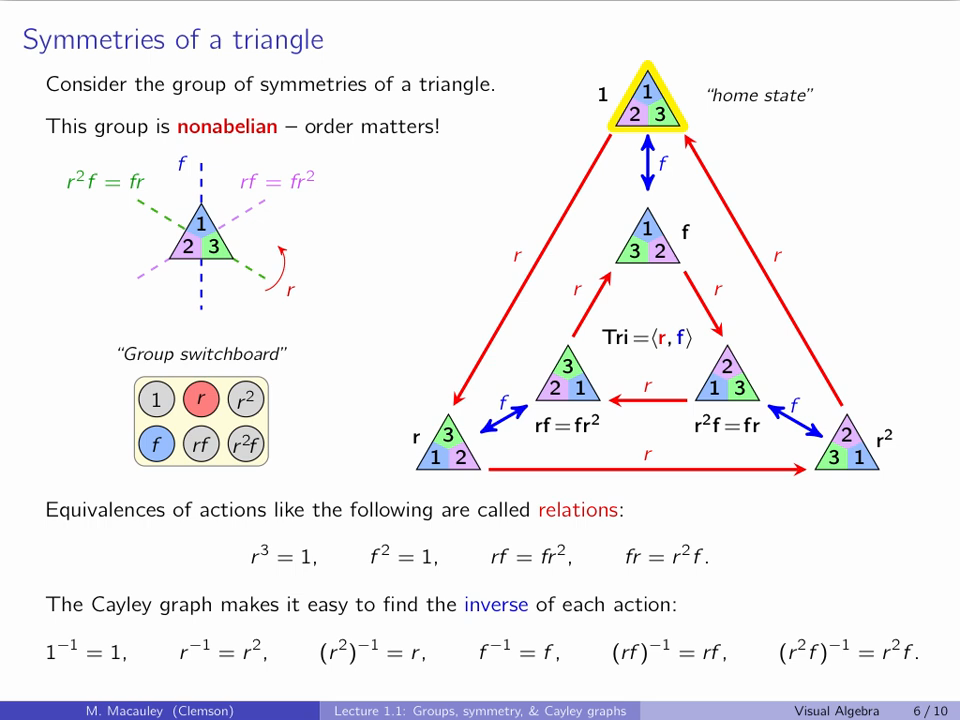
This is relevant for phenomenologists, because it gives us a formal way of classifying subjective states based upon their invariants. When a participant notices that they can’t tell left from right within experience, or how far they have zoomed in – they are reporting on a symmetry. When they notice a new symmetry appear, this means that the group of transformations that leave the experience the same has become larger – the experience has become invariant to more operations.
This is relevant for moral philosophers, insofar as they are interested in arguments for or against Mike Johnson’s Symmetry Theory of Valence. This theory proposes that given a mathematical object isomorphic to the qualia of a system, the mathematical property which corresponds to how pleasant it is to be that system is that object’s symmetry. If participants reliably report that more pleasant jhāna have larger corresponding symmetry groups, I would consider this evidence in favour of this theory.
This is relevant for neuroscientists, because somebody studying neural correlates of the jhāna might then look for commonalities between the symmetry group reported by a given participant and the state space explored by their brain while it is in a given jhāna. If we can characterise the difference between cessation and J8 in terms of what symmetries are broken and then isolate the corresponding neural correlates – we might well have just isolated the neural correlates of consciousness. If we can characterise the symmetries which break as we traverse from J8 all the way to waking consciousness – we might well have just discovered a mathematical recipe for day to day experience.
I think we have enough to go on that I could work through the formless jhāna one by one and tabulate the various qualities and corresponding symmetries they were reported to possess. Due to the sparseness of the reports we have to work with I expect there will be gaps in this model; I consider those to be targets for future research.
| Quality | J4 | J5 | J6 | J7 | J8 | Cessation |
|---|---|---|---|---|---|---|
| Geometric form | ||||||
| Body map | Present; hollow, transparent, incredibly still | Absent; my body contour dissolves | — | — | — | — |
| Oriented observer | Present; the sense of space is already quite 180° panoramic | Absent; if the body is really completely gone, then the space is 360°; the sense of a front and a back, or an oriented observer, that’s not really there | — | — | — | — |
| Boundaries | Internal boundaries dissolve; we’ve taken all the furniture out of the room | External boundaries dissolve; we take away the room | — | Even boundlessness collapses; the boundaries don’t come back, but the sense of boundlessness goes | — | — |
| Properties of consciousness | ||||||
| Metacognition | — | — | Present; self-reference, loops, recursion; knowing just happens; you are not subject to routing through space in order to know things | Absent; all communication stops | — | — |
| Nothingness | — | — | — | Present; no absolute value, only growing or shrinking; a range of different flavours that the nothingness can have | Absent; there’s a subtle tensing around nothing, and the mind lets go of that | — |
| Continuity | — | — | — | — | Present; not a discontinuous state; no particular content, the only remaining thing is continuity | Absent; you’re conscious, then you’re not |
| Properties of spacetime | ||||||
| Spatial dimensionality | — | Present; three dimensional, definitely; boundless space in all directions | Disputed; I don’t get the sense of dimensionality anymore; an option, a suggestion vs. it’s the same boundless space, you’re just tuning into a different quality | Absent; the three dimensionality is gone | Absent; no sense of space | — |
| Temporal dimensionality | — | Present; radically dilated | Present; radically dilated | Present; even less sense of time | Absent; no sense of time | — |
| Distance metric | — | Disputed; in my experience, yes vs. relative distance is gone; I can’t instantiate a ruler | Absent; you can have straight up asymmetries | — | — | — |
| Angles | — | Unclear; ehh | — | — | — | — |
| Geometric symmetries | ||||||
| Translational | — | Present | — | — | — | — |
| Dilational | — | Present; you can stretch along dimensions; you can zoom in infinitely along dimensions; you don’t lose track of how far you’ve zoomed | — | — | — | — |
| Rotational | — | Unclear; I don’t think I’ve explored that | — | — | Present; no sense of orientation | — |
| Reflection | Present; even in the form jhāna, left-right doesn’t feel particularly salient | Present; the sense of a front and a back, or an oriented observer, that’s not really there | Present; in good versions of the states, left-right, up-down, back-front, nuh-uh | — | — | — |
Modulo uncertainty, conflicting statements, and gaps in our reports, I think we are now ready to start speculating as to what symmetry group corresponds to each jhāna – though this also marks the point at which I am reaching the limit of my mathematical capabilities. Soliciting language models for direction generates proposals which vary moderately in their details, which I’ll take as a cue to keep my speculation brief.
For reference, I’m not the only person exploring symmetry as a tool for modelling subjective experience. I also recommend these links:
- Towards Consciousness Engineering (Hodak, 2025)
- Path integrals and orbifolds: What is it like to be a cube? (Flipper, 2025)
- A Primer on the Symmetry Theory of Valence (Johnson, 2021)
- Hole Argument and Inverted Qualia (Liu, 2024)
- Principal bundle geometry of qualia: Understanding the quality of consciousness from symmetry (Oizumi et al., 2025)
- Inverting qualia with group theory (Taylor, 2025)
Formless jhāna symmetry groups
There is a principled way to organise this class of proposals. Prior to Felix Klein’s 1872 Erlangen program, the additional geometries outside Euclidean geometry – such as hyperbolic geometry or projective geometry – were all considered to be separate disciplines. Klein’s insight was quite simple – he defined a geometry as a pair – a space plus a group of transformations acting upon it, from which an infinite algebra of invariants may be derived.
Let’s start with space. What shape is our phenomenal space? I’ve spent a fair bit of time thinking about this question as it pertains to waking consciousness, but asking the same question for the comparatively simpler jhāna states seems much more tractable. In the case of the equilateral triangle, the space was the group D3 – but in the case of subjective experience, there’s a few basic candidates we can can start with:
- ℝ3 – Three dimensional space
- ℝ3 × ℝ – Galilean four dimensional spacetime, with time kept structurally separate from space
- ℝ4 – Four dimensional spacetime
If we choose a space, we may then consider what invariants it possesses – the generators, as they were called earlier. Adding a generator is equivalent to removing a phenomenal property – that transformation is no longer detectable to an observer – and likewise, removing a generator is equivalent to adding a phenomenal property. If Wystan claims that it’s impossible to gauge absolute lengths within a given state – perhaps that suggests he’s added a generator which removes absolute lengths.
For illustrative purposes, here are some of the generators available on ℝ3. Each one of these adds a transformation to the group:
| Generator | Symbol | Parameters | Adds | Removes |
|---|---|---|---|---|
| Isotropic strain | ℝ+ | 1 | Uniform scaling | Absolute lengths |
| Deviatoric strain | SL(3)/SO(3) | 5 | Volume preserving anisotropic scaling/shear | Angles |
| Tilting rotation | SO(3)/SO(2) | 2 | Rotation of the preferred axis | A preferred axis |
| Axial rotation | SO(2) | 1 | Rotation around the preferred axis | A preferred direction |
| Translation | ℝ3 | 3 | Displacement of the preferred point | A preferred point |
| Inversion | {±I} | 0 | Orientation reversal | Chirality |
And a corresponding table of the Klein geometries which may be constructed from these:
| ℝ3 ⋊ (H × Z) | Scale varying | Scale preserving | ||
|---|---|---|---|---|
|
Orientation varying Z = ℝ× |
Orientation preserving Z = ℝ+ |
Orientation varying Z = {±I} |
Orientation preserving Z = {I} |
|
|
Volume preserving H = SL(3) |
Affine GL(3) · 12 |
Affine+ GL+(3) · 12 |
Unimodular SL±(3) · 11 |
Unimodular+ SL(3) · 11 |
|
Metric preserving H = SO(3) |
Similarity O(3) × ℝ+ · 7 |
Similarity+ SO(3) × ℝ+ · 7 |
Euclidean O(3) · 6 |
Euclidean+ SO(3) · 6 |
|
Metric and axis preserving H = SO(2) |
Axial similarity SO(2) × ℝ× · 5 |
Axial similarity+ SO(2) × ℝ+ · 5 |
Axial SO(2) × {±I} · 4 |
Axial+ SO(2) · 4 |
|
Frame preserving H = {I} |
Homothety ℝ× · 4 |
Homothety+ ℝ+ · 4 |
Inversions {±I} · 3 |
Translations {I} · 3 |
Such geometries form nested hierarchies – a partially ordered set, where an arrow is equivalent to enlarging the symmetry group by adding a generator. This may be displayed as a lattice:
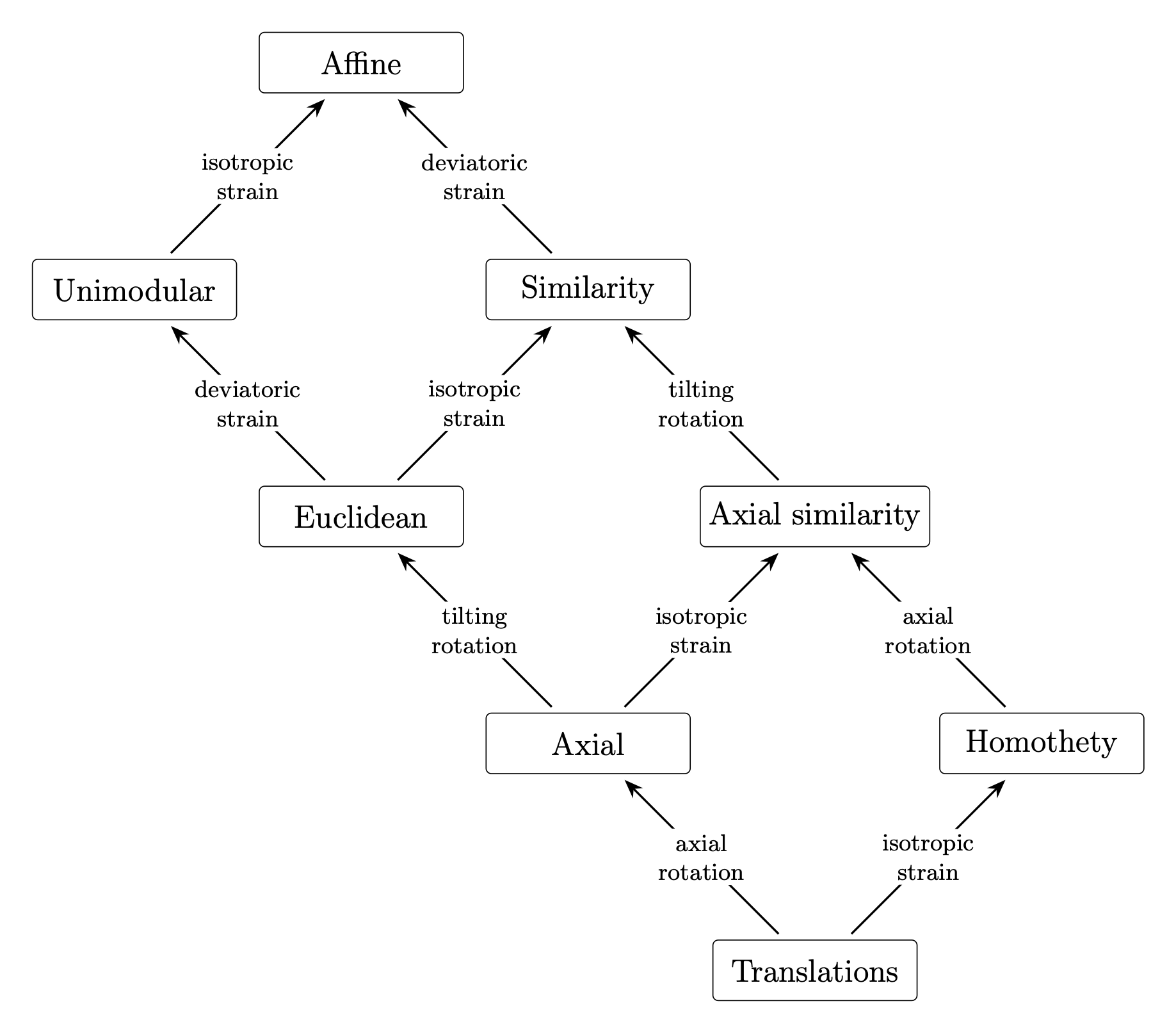
Let’s take the Euclidean group as an example, as it has some interesting properties – for example, it’s the first group with a distance metric. You need both lengths and angles in order to have a distance metric, so adding either of the deviatoric strain or isotropic strain generators removes the distance metric. Meanwhile, the transformations which the group does possess – translations, rotations, and optionally reflections – preserve the distance metric.
If Ethan then reports that J6 has a distance metric, then the space he’s describing must be at least the Euclidean group or one of its subgroups. If Wystan then claims that relative distance is gone at J6, then perhaps the state he’s experiencing is what you get if you add the isotropic strain generator to the Euclidean group – namely, the Similarity group – and Ethan and Wystan might disagree about what constitutes J6.
So, the question for us is – what geometries best correspond to each jhāna, and do they form a coherent hierarchy? If the formless jhāna factors compose independently, this means that the jhāna form a lattice, and the path from J5 to J8 is then just one path through that lattice.
Most combinations of spaces and generators could be weak or unstable – but like the table of nuclides, we might also expect to find some islands of stability out there, too. If we find we can predict those out-of-gamut pseudojhāna in advance, perhaps this would lend credence to this research program.
Given our current data set, I’m skeptical that we’ll be able to get that far – I didn’t even realise I’d be using group theory to try to model the jhāna until I started reviewing our transcripts. Next time, I’ll be able to plan ahead, asking different questions of our participants – and perhaps our participants might also have the time to study some group theory in advance. At best, we should at least be able to assign a set of geometries to each jhāna, to be narrowed down in future.
Either way, completing this model would involve a three step process:
- Tabulate the reports. Complete the table shown earlier, with phenomenal qualities as rows and states as columns, recording whether each property is present, absent, unprobeable, or disputed. Now that we understand the problem space better, with the benefit of hindsight we should be able to construct a much more comprehensive list of candidate properties – for example, I neglected to ask explicitly about preferred points, directions, or axes, along with temporal metrics.
- Tabulate the generators. For each state, attempt to derive a list of generators – and from these, the corresponding group. Note that some properties – for example, the distance metric – might correspond to multiple generators. Disagreements can be handled by maintaining separate per-participant variants.
- Check the transitions. Test whether each transition from one state to the next corresponds to clean addition of generators. If it does not, this may indicate a transition of a different kind – for example, rather than gaining a symmetry, the space might lose a dimension.
Formless jhāna symmetry group mappings
Anyway, here’s what I do feel comfortable saying about what groups relate to what jhāna, at present:
- J5A: Ethan claims that the distance metric is retained, so this could potentially be the Euclidean group E(3), if the metric is consistent with Euclidean geometry. We’ll also need to pick a group for the time dimension, but I’m reluctant to do so just yet.
- J5B: Wystan claims that relative distance is gone. If only absolute distance were gone, then we could use the similarity group Sim(3) – but if relative distance is also gone, that would rule this out. If affine structure such as collinearity and parallelism remains, then we could use the affine group Aff(3), instead. Again, I don’t think we have enough information to pick a group for the time dimension.
- J6A: This one is puzzling, as Anna claims that you don’t get the sense of dimensionality anymore, and Ethan claims that the state has an asymmetric quasimetric where d(x, y) ≠ d(y, x). I’ll refrain from comment.
- J6B: Wystan claims that this state preserves a sense of boundless space – you’re just tuning into a different quality. He also claims that dimensions can collapse at any stage in the progression, independent of specific jhāna – though it’s unclear if he’s talking about individual dimensions collapsing, or whether, if the axes remain distinguished, individual dimensions can adopt reflection symmetries. I’ll also refrain from comment.
- J7: If this state has no absolute value, only growing or shrinking, then it may correspond to an ordered, one-dimensional space with no preferred point or sense of scale. If affine ratios are preserved then Aff+(ℝ) could be appropriate – otherwise, if only topology and ordering are preserved, we might have to resort to the orientation-preserving homeomorphism group Homeo+(ℝ), though I suspect we might need to reserve that one for J8. Additionally, if Anna is correct about this jhāna having a range of different flavours – then perhaps this group could have more than one dimension.
- J8: If only continuity remains, then the only structure preserved by the state is its topology, so we could use Homeo(ℝ), or Homeo+(ℝ) if temporal ordering remains – if it’s even possible to reverse time. However, these groups are infinite dimensional – so, unlike the finite dimensional groups above, invariance under all homeomorphisms cannot realistically be inferred exhaustively from a finite set of phenomenal transformation probes.
Some additional notes on this:
- Though people described a sense of time dilation, I didn’t ask enough questions about time, so I’m just focusing on the ℝ3 space for now.
- If we do ask about time, and nobody describes transformations which tilt space into time or vice versa, then we could focus on the ℝ3 × ℝ space rather than ℝ4. GPT-6 Astra suggested looking at ℝ, E(1), Aff+(1) or Aff(1) for the temporal component.
- I only asked about distance metrics, but if the phenomenal property which disappears between J5 and J6 is the sense of absolute length, then this corresponds to adding the isotropic strain generator, taking us from the Euclidean group to the similarity group. If some adventurous meditator could figure out how to remove the sense of angles, instead, then this would correspond to adding the deviatoric strain generator – taking us to an equiareal pseudojhāna corresponding to the unimodular group.
- I also did not focus on valence as much as I could have. If we are interested in valence, once we are more confident in our chosen group mappings, we should check to see whether the group parameter count decreases as we progress from J5 to J8. Such a finding would work in favour of the Symmetry Theory of Valence.
Conclusion
I didn’t know what I was looking for when we started this project. The reason I’m here is that I think it’s important for us as a civilisation to find a robust and precise formalism for how we model consciousness – as they say, for the benefit of all sentient beings. So it says on the qri.org homepage:
Founded in 2018, the Qualia Research Institute (QRI) is a 501(c)(3) non-profit dedicated to developing a mathematical formalization for subjective experience and its emotional valence.
At my end, I’m not a neuroscientist or an expert in neuroimaging, but what I can do is attack the problem from the phenomenological side. We’ve been trying to figure out how to construct a mathematical object isomorphic to a system’s phenomenology for what seems like a long time now – mostly focused on waking consciousness – and it’s refreshing to feel like we are making some progress, by virtue of the formless jhāna providing simple, convergent reference states to work with.
My initial strategy was to simply hold candid interviews with our participants about the formless jhāna, review the transcripts, and see if any patterns emerged. I did not know in advance that group theory would prove to be the most appropriate model for tracking phenomenological invariants.
We’re not done yet. Our data set is small – only three participants were able to access J7, and only two made it to J8. Many cells in the table of phenomenal qualities remain empty or disputed – and since I wasn’t planning on using group theory, the questions I asked were inadequate. I now have a much better idea of what is required, and I’ve even sketched out a list of questions I’d like to ask future participants. Some of these questions might seem abstruse – but Ethan was startlingly creative when it came to figuring out ways of probing the relevant phenomenal qualities, so perhaps at a future retreat he could assist with designing a guided meditation for checking things like whether or not one can perceive angles while inside a jhāna.
The real payoff would be to connect all this phenomenological study back to neuroscience. I haven’t discussed cessation in depth yet – but whatever changes between J8 and cessation must surely be the minimal signature of consciousness. If that transition can be isolated in neuroimaging data, then what might be found may well be the neural correlates of consciousness.
The Meditation Research Program at Harvard Medical School has a paper currently in preprint, using a variety of statistical methods to analyse ultra-high-field fMRI recordings of three participants who can achieve cessation inside an MRI machine. Additionally, they have another preprint which uses machine learning techniques to analyse similar recordings for the purpose of classifying the jhāna. I cannot help but wonder if careful analysis of recordings like these might surface state space invariants equivalent to the phenomenological invariants we are coming to associate with the jhāna.
Compared to before the retreat, I now feel much better oriented towards this project, and hope we get the chance to complete this line of work someday. One more retreat with sufficient participants should likely do it – or if that proves logistically infeasible, I may just resort to conducting interviews with people over the web. If you happen to know any advanced meditators who can both access the formless jhāna and also have a strong mathematical background, or at least possess a mindset compatible with understanding mathematics – please don’t hesitate to get in touch.
Open questions
Whenever I write a post like this I generally find myself with a large number of loose ends. To provide direction for future inquiry, here’s some of the questions I’d still like to find answers for:
- What if the space has a different topology, for example a torus?
- What if the space has a different geometry, for example projective or conformal geometry, as might be the case for the visual field?
- What if the space has elliptic or hyperbolic curvature?
- How should we handle form – that is, somatic sensations, or colour in the visual field. Might form be variation in local curvature within the space?
- How should we handle attention? Might different modes of attention influence the geometry of experience?
- How should we handle approximate symmetries? These appear to be handled poorly by the group theory paradigm – perhaps something like spectral decomposition is required?
- I reviewed groups up to the general linear group GL(5, ℝ), limited by the kinematic interpretation. This encompasses linear transformations; what if we need to consider nonlinear transformations? Might all nonlinearities be inherently asymmetric and thus noticeable – and equivalent to prediction error?
- Whatever happens during cessation, it appears to leave no trace reportable by a participant. What does cessation then tell us about the interaction between consciousness and its substrate? Is leaving some change to the substrate a prerequisite for what we consider to be conscious experience, or does experience continue during cessation, despite it leaving no trace?
- If the “table of nuclides” model turns out to be appropriate, why should we expect some states to be more stable than others?
Interview questions
Not knowing in advance what kinds of patterns or structure we might uncover in the jhāna, my interview style was deliberately informal and exploratory in nature. Now that I have found myself using group theory as a model to understand the jhāna, I feel better informed to compile a list of interview questions I can use at a hypothetical future retreat. I workshopped the following list of phenomenal properties with GPT-5.6 Sol. Best to consider this a draft:
Properties of space
- Dimensionality: How many independent spatial directions are available?
- Preferred point: Is there a point in space which feels like the “center”, independent of whether a body map is available?
- Preferred direction: Is there a direction in space which feels like “forward”, independent of whether a body map is available?
- Preferred axis: Is there a direction in space which feels like “up”, independent of whether a body map is available?
- Absolute scale: Does everything have a definite scale, or can objects be rescaled without change in perception?
- Relative scale: Can one object be said to be larger than another, independent of whether an absolute reference scale is available?
- Chirality: Can the experience be mirror reversed along any of the available dimensions without any change in perception?
- Distances: Can one point be said to be farther away than another?
- Angles: Can an angle between two lines be perceived?
- Parallelism: Can two lines be experienced as parallel, independent of whether distances or angles are available?
- Betweenness: Can one point be said to lie between two others?
- Collinearity: Can three points be said to lie on the same straight line?
- Collinear segment ratios: Given three points on the same straight line, can one segment be experienced as twice another, independent of whether an absolute reference scale is available?
- Adjacency: Can one thing be said to be “next to” another, independent of whether a distance metric is available?
- Continuity: Is subjective space an unbroken continuum, or are there discrete points or patches?
- Curvature: Is subjective space locally flat, or could straight lines curve towards or away from one another?
- Compactness: Is subjective space compact, or could you travel out to infinity without looping back on yourself?
Properties of time
- Dimensionality: How many independent temporal directions are available?
- Preferred point: Is there a point in time which feels like “now”?
- Preferred direction: Can one point in time be said to occur “before” or “after” another?
- Absolute duration: Does everything have an definite duration, or can durations be rescaled without change in perception?
- Relative duration: Can one duration be said to be longer than another, independent of whether an absolute reference duration is available?
- Chirality: Can the passage of time be reversed without any change in perception?
- Adjacency: Can one moment be said to happen “next to” another, independent of whether a temporal metric is available?
- Continuity: Is subjective time an unbroken continuum, or are there discrete moments or segments?
Properties of consciousness
- Somatic field: Is there a body map?
- Visual field: Is there a skybox?
- Boundaries: Do there exist distinct objects or regions within the field?
- Dynamics: Can some property of the state change or “wobble” over space or time? If so, how?
- Metacognition: Is thought self-reflective? Can one mental object be compared with a previous iteration of itself? Can two mental objects be compared with one another?
- Nothingness: Is there a phenomenal quality of “nothingness”? Does it vary over space or time?
- Valence: What was the valence of the experience? How does it compare to other, neighbouring experiences?