On the phenomenological shift known as stream entry and its implications for consciousness
Posted on 24 February 2026 by
Late last year, the rationalist community leader and artificial intelligence researcher Eliezer Yudkowsky claimed that chickens do not have qualia:

This caused something of a stir – for what seem to me like obvious reasons. Apparently Eliezer has said similar things before, in a 2014 Facebook post – the pig post, as an animal welfare researcher friend referred to it:
To spell it out in more detail, though still using naive and wrong language for lack of anything better: my model says that a pig that grunts in satisfaction is not experiencing simplified qualia of pleasure, it’s lacking most of the reflectivity overhead that makes there be someone to experience that pleasure. Intuitively, you don’t expect a simple neural network making an error to feel pain as its weights are adjusted, because you don’t imagine there’s someone inside the network to feel the update as pain. My model says that cognitive reflectivity, a big frontal cortex and so on, is probably critical to create the inner listener that you implicitly imagine being there to ‘watch’ the pig’s pleasure or pain, but which you implicitly imagine not being there to ‘watch’ the neural network having its weights adjusted.
When Eliezer’s tweet went viral, Portuguese writer and Twitter personality Guy – also known as Rival Voices – was attending the rationalist campus and convention center Lighthaven in Berkeley for their yearly writing residency Inkhaven. He saw an opportunity for a blog post trying to unpack why Eliezer might believe what he does. Guy works with the philosopher Ned Block’s framework, which distinguishes between phenomenal consciousness and access consciousness. From Wikipedia:
P-consciousness is raw experience: it is moving, colored forms, sounds, sensations, emotions and feelings with our bodies and responses at the center. These experiences, considered independently of any impact on behavior, are called qualia.
A-consciousness is the phenomenon whereby information in our minds is accessible for verbal report, reasoning, and the control of behavior. So, when we perceive, information about what we perceive is access conscious; when we introspect, information about our thoughts is access conscious; when we remember, information about the past is access conscious, and so on.
Guy thinks this framework should be helpful for understanding Eliezer’s stance. As he speculates in his post, Eliezer Yudkowsky Thinks Chickens (and Babies) Aren’t Conscious and I Know Why:
After looking over the transcripts, posts, and videos, I think that Yudkowsky’s belief is that phenomenal consciousness = access consciousness. Or, no P without A. He thinks you don’t get to have a “what-it’s-like” unless you can reflect on your own mental states. In other words, he thinks that:
Conscious experience only arises when the brain runs a sophisticated, self-referential, cognitive algorithm.
From that one belief follow all the wild bullets he bites.
Personally, I’m not so sure the distinction between phenomenal and access consciousness is so clear cut, but that’s another story. My own take is that I think that Eliezer simply misidentifies a certain type of self-reflective cognition with consciousness itself, or perhaps what matters is this is what he chooses to value. Maybe this is to be expected for someone who has spent most of his life thinking about cognition and intelligence?
Why does this matter? Well, if there are moral judgements we’d like to make around animal welfare, human welfare, and even artificial intelligence welfare, these should depend heavily on what philosophical stance we adopt with regards to consciousness. Suffice it to say, the stakes are high. As I’ve said before:
If an ungrounded metaphysics becomes the dominant stance in an upcoming machine age, the resulting confusion may have unpredictable ethical consequences. The need for a robust theory of consciousness becomes more urgent every day.
At my end, identifying phenomenal consciousness with a phenomenal field feels intuitively obvious – that there could be no other ground of being, and that cognition of the kind which Eliezer might identify with value is but one particular state which might be rendered within this field. I’ve tried to articulate this informally on Twitter:
I experience a phenomenal field. I am comfortable taking this as axiomatic. Everything I know to exist lies within this field. Vision, touch, sound, taste, smell – all waves within these manifolds, the characteristics of which can be known to some degree of precision within spatiotemporal or corresponding frequency domain. The existence of anything else is inferred solely from what I can observe within this field.
Some things may be claimed to be inside and others not (perhaps they lie “outside”, or below the noise floor of what may be confidently observed). That which one experiences as “inside” is what I take to be “within phenomenal consciousness” (I am somewhat agnostic on how fuzzy a distinction this may be; see here also on the “unconscious” or perhaps (scare quotes) “access” consciousness).
This is a reductionist view; I will maintain that if someone develops clear enough introspection capabilities then they will recognise that even thought is ultimately rendered as subtle perturbations within these fields (often as imaginal vocal tract movements and corresponding imaginal audio, though there are plenty others).
I think this makes sense from both an evolutionary and computational perspective. What are these phenomenal fields actually doing? It seems to me that the visual and somatic field serve the purpose of binding together sparse sensory impressions into a unified world simulation. Most, if not all of the valence – i.e., most of that which I value – is concentrated in the somatic field. This somatic field valence provides what is essentially the loss function and gradient descent landscape for the dual tasks of collision avoidance and maintaining bodily integrity. It’s absurd for me to imagine that this is an evolutionary innovation which happened somewhere between the chicken and the human – and that chickens do not feel pain as somatic field tension just as I do.
I think Eliezer’s introspection capabilities must be lacking, and that this has lead him to confusion about the source of value within consciousness – or at least I think he must not have investigated his own phenomenology proportional to the importance of the topic. I do think that the phenomenal fields as I describe them are relatively easy to observe – but maybe that’s just me. I also do not think that they disappear in the absence of the kind of cognitive reflectivity Eliezer describes.
Pragmatically, I have claimed elsewhere that I think a fat line of ketamine should be enough to reversibly melt away many layers of cognition while leaving the visual and somatic fields – the qualia – intact. I should also acknowledge that argument-from-ketamine feels at least somewhat intellectually lazy, so I’ll also claim that insight meditation practices should also lead to the true ground of consciousness. As Daniel Ingram says, in Mastering the Core Teachings of the Buddha:
Insight practice can seem more daunting, complex, or bizarre than other forms of practice. However, it is oddly simple. There are six sense doors. Sensations arise and vanish. Notice this for every sensation. These are cave-man simple instructions, yet somehow people make them much more complex than they need to be.
That said, if your timelines are short, ketamine takes only five minutes to kick in – so this may provide a more pragmatic option than hundreds of hours of meditation.
Phenomenological variation as the source of philosophical differences
I think the blogger Scott Alexander takes a similar view on phenomenal consciousness to myself. I’d like us to take a look at something he had to say recently, in his post, The New AI Consciousness Paper:
For some people (including me), a sense of phenomenal consciousness feels like the bedrock of existence, the least deniable thing; the sheer redness of red is so mysterious as to seem almost impossible to ground. Other people have the opposite intuition: consciousness doesn’t bother them, red is just a color, obviously matter can do computation, what’s everyone so worked up about? Philosophers naturally interpret this as a philosophical dispute, but I’m increasingly convinced it’s an equivalent of aphantasia, where people’s minds work in very different ways and they can’t even agree on the raw facts to be explained. If someone doesn’t have a felt sense of phenomenal consciousness, they naturally round it off to access consciousness, and no amount of nitpicking will convince them that they’re equivocating terms.
Personally, I feel some amount of discomfort at the prospect of studying phenomenological differences which might be used to outgroup people; for example, I know a number of people who actually do have aphantasia, some of whom are quite sensitive about it. Dhabi Ibn Musa, author of the website Spiritual Rationality, handles this topic with what I suspect is an appropriately dry pragmatism. From his page on somatic phenomenology:
I sometimes encounter people who say something like, “I don’t have this sort of phenomenology, therefore indeed it’s not universal/innate, therefore your model is wrong somehow.”
First off, and this is kind of an unfair move discursively: the people who say this seem to have both pretty strong trauma smells, as well as having other correlates of just poor introspection in other ways. So, while this is cursed to say, and indeed I mostly don’t say it to those people directly, I largely want to say, “look, this tracks with the rest of my model, sorry” – I would be very surprised if I met someone who didn’t have any trauma smells, but reported no somatic phenomenology.
Unfortunately, this is also still a reasonable objection in principle, and I both don’t have a smack-down argument for such people, and I have a very small probability on this being in the same sort of natural variation as aphantasia seems to be. So, no more claims here, but just recognizing “yup, that’s an objection.”
At the same time, I think that given that people like Eliezer want to stake moral judgements on their opinions about consciousness, the stakes are high enough that this topic is worth exploring. My primary questions are as follows. What makes the field-like nature of phenomenal consciousness difficult or unnatural to observe for some people? Or, more concisely, what makes phenomenal consciousness feel like the true ground of being?
Phenomenological shifts as the source of experiential clarity
I happened to be staying with a friend in Oakland at the time when Guy published his post. Another friend of mine, Sasha Putilin, was also attending Inkhaven, and invited me over for the afternoon to give a talk about my research. I took the time beforehand to sit down and catch up with Guy.

We wound up discussing our mutual experience of a strange phenomenological episode which might be what the meditators call stream entry, or sotāpanna – the first of four stages of enlightenment as described by the Pāli Canon. From Mastering the Core Teachings of the Buddha:
This stage, called Path (magga in Pali) also lasts just a moment, and after the first completed progress of insight it marks the first moment of the newly awakened being’s awakened life. It marks a permanent shift in baseline perception and brain function. It is as if you have flipped a huge switch that you can’t unflip, and new circuitry hums to life, circuitry it seems we build piece by piece during the stages of insight. The first time around, this is called “stream entry” or “first path” in the Theravada, the “fourth stage of the second path of five” or “the first bhumi” in the Tibetan tradition, and many names in Zen that are purposefully ambiguous, but “kensho” is the most common. I will go into a long discussion of the uses and perils of path terminology shortly. Regardless, after a subsequent new progress of insight it marks the attainment of the next level of awakening, whatever you call it.
I recorded our conversation and will include a transcript. I include this here because I think this is an example of the type of phenomenological phase transition which can change the felt sense of the structure of consciousness in a way which is relevant to our preceding discussion. I was also impressed by Guy’s observational skills; he describes the raw phenomenology in a candid manner which I think should be accessible to the average reader, and without making dharma jargon too load-bearing.
Guy’s experience
Guy described the context leading up to his breakthrough. In 2012, he was 22 or 23, and from reading the The Motivation Hacker developed an interest in lucid dreaming, and reading LessWrong’s Litany of Gendlin kindled an interest in focusing. He also developed an interest in meditation.
Guy: Fast forward to 2023 or 2024, and I have meditated on and off, I’ve done a short three-day silent retreat, I’ve read The Mind Illuminated – like, I’m into it, but I’m not really committed. One day sometime in April or May, I wake up – and everything in my life is ostensibly okay. Like you know, I’m fed, I have money, I have a girlfriend, I have a roof over my head and yet I’m still suffering massively. At this point, I make a decision that either I’m solving this or it’s game over.
Guy: I sit for one hour that day, and for one hour the following hundred days, then for two hours for like thirty days or so, and then for ten days I try to get to three hours, but never manage. After this, someone – and now we’re getting to the juicy part – someone on Twitter recommends I do a retreat, because I’m overdue. At the time, Nick Cammarata was posting a lot about jhāna, and I was very interested in this because my experience was marked by suffering and so the idea that you could have happiness on tap was insanely enticing.
Guy: So I sign up for the retreat – I do it together with my girlfriend, we go to Tenerife, we rent an Airbnb, and we’re doing it for a week. It basically works. I hit jhāna one, two… and five for sure. Like it’s just working and I’m feeling amazing, I’m feeling happy, I’m feeling all of this. On one of the last days, I don’t know if it was the 6th or 7th or 8th – it’s nighttime, and I decide that I want to go to a place where we would usually do a walking meditation.
Guy: The place that we were in, once you exited the door, you were immediately outside – like there was no stairs or anything like this. So, because I had been meditating, my concentration was quite high. I am exiting the door – and within, I think, less than a second – my awareness expands a lot. Almost immediately, a thought comes – like a thought that would grip me, about a bad relationship – and my awareness collapses in response. And I catch it. Like, whoa – what was that? And when I do the what was that move – something shifts, and lots of things happen.
Cube Flipper: I think I did a similar thing.
Guy: Yeah? Okay, cool. Cool. So one of the things that happened was I developed psychomotor retardation – like I’m moving really slowly. There’s also a shift, where how I describe it is that up until that moment my whole life there were basically two things.
Guy gestures alternately between his body and away from his body
Guy: Like, there was this, this is one thing, and then there’s that. All of that is else. It’s like, this, and everything else, and this is the main thing and then there’s everything else, which is not the main thing. It felt that in that moment, the main thing was not this anymore. This was now the same type or kind as everything else. It was not separate anymore, in a really strong sense, and the main thing was now way up and back there—
Guy gestures towards the space above and behind the back of his head
Cube Flipper: Ahhh – this is very, very relatable.
Guy: —and that was the main thing – and I was just part of this, I was not the main thing anymore. That felt horrible. That felt like dying. I kept hearing – row, row, row your boat, gently down the stream… merrily, merrily, merrily, merrily, life is but a dream. Which I found very cruel, because I did feel like I had died or was dying or was not alive – like something broke or died or something.
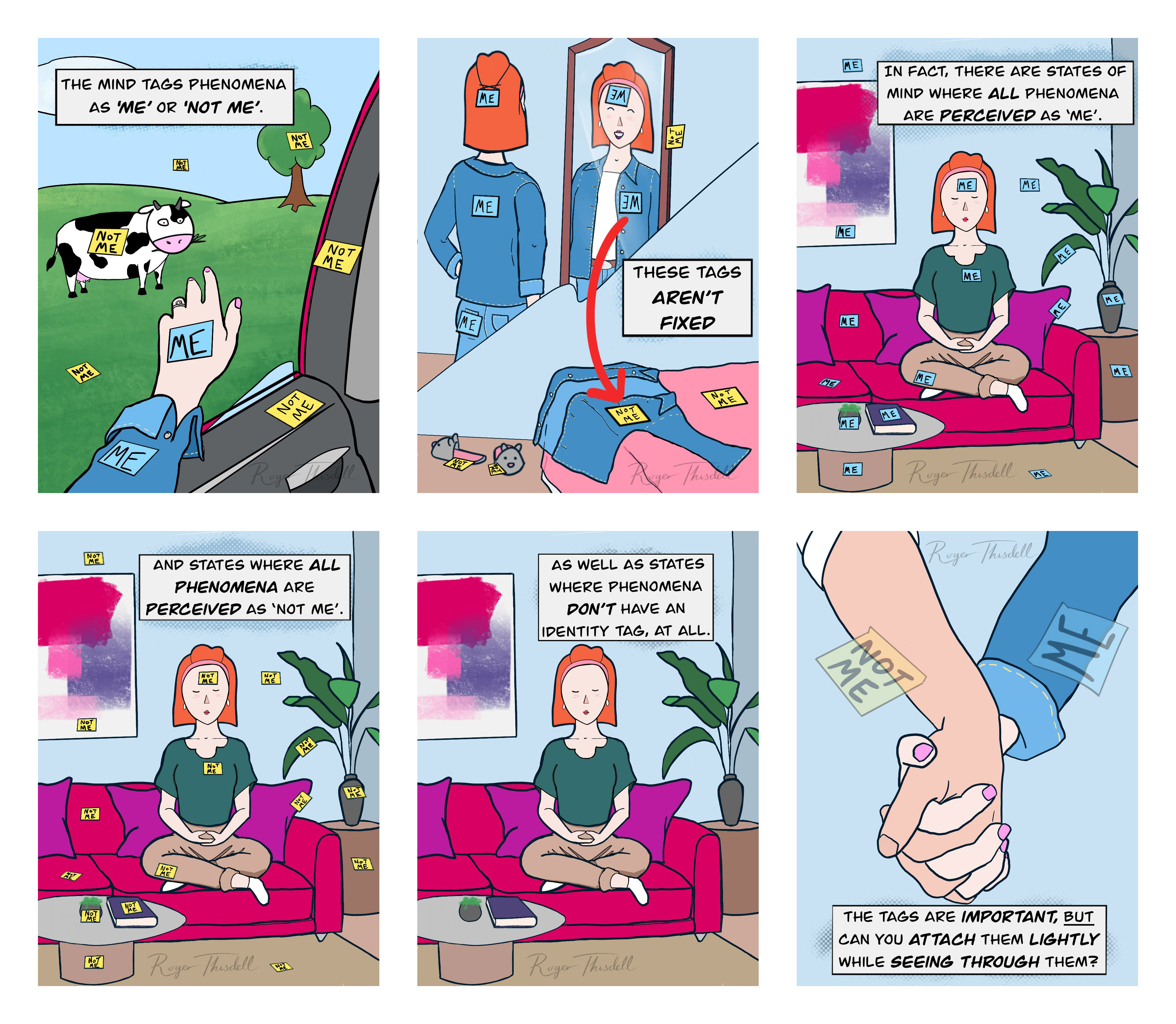
The context may be unclear from the transcript – I’m wishing we’d filmed a video. Guy is gesturing at different parts of his world simulation and describing which parts of this were identified as self, and which parts were identified as other. Beforehand, the self was identified with the somatic field and the parts of the visual field containing the body, and the other with everything else. Afterwards, these two things were not felt as separate anymore – they were the same type of stuff – and now the sense of an observer was positioned in an unfamiliar place behind Guy’s head.
Guy: So this felt bad for a while, but then ever since it’s been pretty good! So it’s like, you know, baseline valence is much higher, I can’t suffer or I can’t make myself suffer the way I used to. I now realize that I was making myself suffer, in a very meaningful sense. My awareness is much broader – like I think literally my field of vision is, like, really really large compared to how it was before. It’s also more, um, high-def. I know that you can have variation in definition because in lucid dreams I think sometimes they’re 4K or even more.
Cube Flipper: Oh, absolutely. Very DMT-esque.
Guy: It’s of course hard to remember, but I’m almost sure that before, the visual field itself was less clear.
Cube Flipper: Did you feel beforehand – or maybe afterwards – that this field can feel like it has a lot of, maybe, waves or noise or other things reverberating around inside of it? If so, do you think this was more apparent afterwards? Or is this… maybe not so relatable?
Guy: The visual field itself?
Cube Flipper: Mmm, yeah, or maybe the somatic field as well too.
Guy: I would not have described it like that. Like, if I were pushed to, you might say something like – that there’s less interference, less things clashing against one another and interfering – and so, like, the whole thing is more settled. That would make sense to me.
Cube Flipper: Wow, that’s a really clear description. That’s dope. Do you have much more you want to get into?
Guy: I think this is it. This was my experience.
I was very interested in why exactly this state of affairs was described as more pleasant. Perhaps once it’s easier to expand attention into the phenomenal fields themselves, this facilitates stepping out of the contracted attentional habits associated with trapped cognitive patterns? We’ll unpack this idea more later in this post.
My experience
I also found Guy’s description of the visual field as becoming more high-def particularly fascinating, as I’ve experienced eerily similar phenomena while using psychedelics – as well as much earlier in life when I’d had my own strange experience. I began telling Guy my own story, first explaining the events leading up to my own breakthrough. I was heavily bullied in the school system – and as an adult, despite working a chill job in a decent city and spending most of my time around kind and nonjudgemental people, I was still extremely anxious, and struggled to reset my trapped priors around social paranoia.
Cube Flipper: So I graduated from design school in 2011, and then I started working my first entry level web development job. My mental health was still kind of garbage. Just to paint a picture, this was a super relaxed gig, I was working like twenty five hours a week in a quite nice open plan office – wooden floors, ping pong table – with like four other people. Yet I was still spending a lot of time hyperventilating in the bathroom, doing weird and insane mental moves, like imagining all of my intrusive thoughts as – I called them the white worms – burrowing into my head, and then pulling them out, one by one. I was pretty insane.
Cube Flipper: I then went through a period where I was smoking a lot of weed, but I was also using that headspace to introspect on the ruminatory thought loops that I was dealing with. Mostly these were banal – like I’d go out and get extremely drunk on Friday night and then spend all Saturday micro analysing every awkward conversation I had. I think I figured out, like, the move – I couldn’t do it all the time, I kind of had to wait for it to happen spontaneously and seize the moment – but I would step out, like pop the stack out of the ruminatory thought patterns.
My working model of what cannabis does phenomenologically is add a little bit of noise to subjective experience. This seemed to help facilitate randomised breaking of thought loop patterns. My attention would expand out of the loop and into the actual phenomenal fields, which would contain a brief afterimage of what had been going on previously – maybe about 250 ms or so worth of thought loop content. This was just enough for me to observe what had been happening from the outside, shut down the process, and memorise it so that I could pattern match against it in future.
Cube Flipper: Today, I think I would have called that an expanded awareness move, as per Michael Ashcroft’s model – but I had no background in phenomenology at the time. I thought all of this stuff I was doing was the kind of stuff your average grown-up had to do in order to be not hopelessly neurotic – but I also thought that nobody spoke about this sort of thing with anybody else, because it’s hopelessly difficult to explain these ineffable mental moves. Many years later of course I found out about these people called the “Buddhists”, who have this all down to a fine art form – but at the time I only had the faintest exposure to their ways of thinking.
Cube Flipper: What I was reading at the time was – have you ever read Gödel, Escher Bach by Douglas Hofstadter? It takes you through Gödel’s incompleteness theorems, which describe how there are limits to what you can know about a formal system if you are inside a formal system. I got to the end of Part I, and I was like, hang on – what I’m doing right now is learning how to step out of formal systems. I can see the process from the outside, and pattern match on when this has looped so that I can shut it down. Now, according to Gödel and Hofstadter, if you’re inside a formal system, predicting whether it is going to loop is supposed be impossible. So you have to jailbreak out of it somehow.
Cube Flipper: At the end of Part I, Hofstadter starts talking about Buddhism. He brings up Zen koans. So I found a good translation of The Gateless Gate, and I read the whole thing, and I loved the Hyakujo’s fox koan, about free will, it goes:
The old man replied: “Now may I ask you: Is the enlightened man subject to the law of causation?”
Hyakujo said: “The enlightened man is one with the law of causation.”
At the words of Hyakujo the old man was enlightened.
Cube Flipper: I don’t actually know how soon afterwards this happened – I think what maybe happened was I smoked a ton of weed before bed and had a panic attack. I woke up the following morning, and there was just – no suffering, and the visual field – I wouldn’t have called it the visual field at the time, I would have described what happened as fisheye lens vision, it was a bit like what you described, it felt like I was up here somewhere—
Cube Flipper gestures towards the space above and behind the back of their head
Cube Flipper: —like a dot, or a camera behind my head, and the camera was a fisheye lens camera, and I was looking down at my body like it was on television. So, no suffering, and there was absolutely zero sense of free will whatsoever. I can quite vividly remember completely automatically getting up in the morning and walking down the flight of stairs to go and work my programming job and coming back home – with no suffering whatsoever. Very few thought processes – which was curious, because evidently I could still write code just fine. No emotions either – nothing positive, nothing negative, just water flowing downhill.
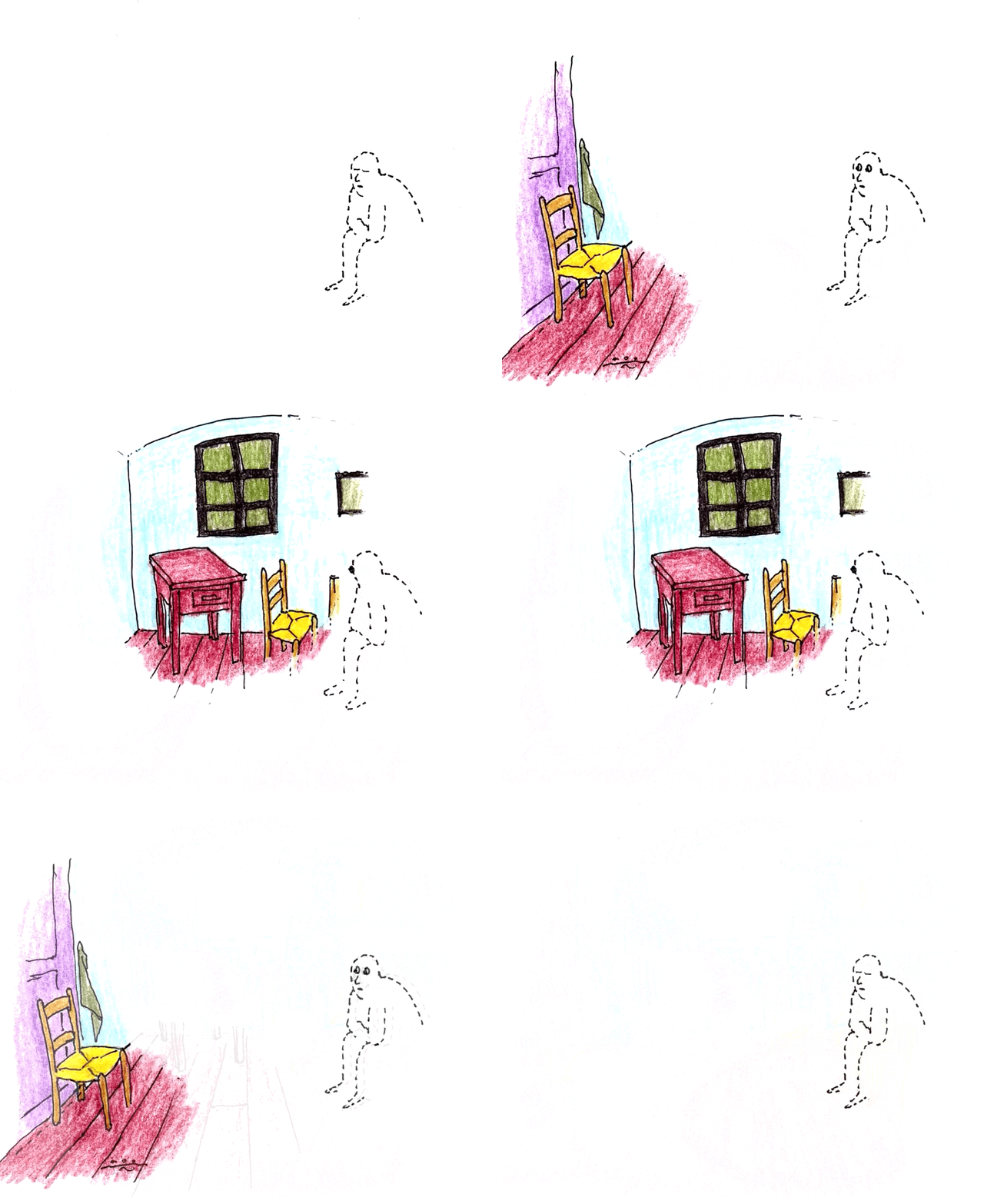
The visual field transformation was hard to describe. I think the difference between a regular lens and a fisheye lens should only be taken as analogy for the structural transformation which occured within my visual field awareness. Any image is ultimately just a projection of something more complex down onto a two-dimensional Euclidean plane, which entails some amount of geometric compromise – for example, straight lines may become curved. If the reader is interested in further exploration into the geometry of the visual field, I will refer them to the computer vision researcher Steven Lehar’s writeup on conformal geometry.
.jpg)
Perhaps what happened was that my attention was habitually contracted either into my own thoughts or into a small region around the center of my visual field – and the wide-angle fisheye lens effect is one way of describing what it feels like when attention expands all the way to the edge for the first time.
Cube Flipper: So I didn’t tell anybody about it, because I had no idea how to describe it. This lasted for about a week until it started to fade out. It disappeared over time, but the amount of day to day suffering I experienced afterwards was massively decreased, and I found myself much better acquainted now with the mental move to very rapidly step out of my thoughts, step out of a negative emotion as it arises. I can remember remarking to one of my drinking buddies, Sam, about a year and a half later – like, shit, bro, you know I don’t think I’ve been angry about anything for a year and a half. He was like, whoa. That’s pretty weird.
Cube Flipper: After that, three years later my dad passed away, and that was a massive fiasco and I kinda went back to the state of suffering I was in beforehand – but for that period of time my life was actually pretty reasonable. A lot of things were shit, but mostly I wasn’t reacting to things in bad ways.
Cube Flipper: More to the point, your description of feeling behind your head felt very, very relatable.
Guy: It’s good that you described yours, because I think that mine is slightly different, in the sense that – I didn’t feel that that was I.
Guy gestures towards the space above and behind the back of his head
Cube Flipper: Yeah, yeah, yeah.
Guy: I felt that that was the main thing – but that I was was or am this. That’s why it felt bad. It’s like, oh, I used to be this, which is the main thing, and now I’m still this, but this is the same as everything else, and that is the main thing. I’m not the main thing anymore, and that’s the part that felt bad.
Cube Flipper: Right, makes sense.
Cube Flipper: So I loved this, I thought this was awesome. Many years later I read about what dissociative episode phenomenology is like, and it sounded very similar to what we both experienced – even down to the cannabis trigger and strange visual distortions – except that the people on the depersonalisation/derealisation subreddit tend to regard it as quite bad.
Cube Flipper: I’m also impressed that – because the phenomenology is so weird and indescribable – anybody on that subreddit even found their way there in order to write about it in the first place. Suffice it to say, from reading many comments on there, it sounds a lot like what we both described. I’m glad you never got stuck in a place where you regarded it as negative. I get the impression that many of the people on there have been in quite a state of distress for a very long time.
Guy: Yeah. For me, I think the first while of adaptation felt bad, but ever since, it feels like my suffering got hard capped. It never feels like it gets as bad as it did.
Cube Flipper: I think part of it for me was, I don’t think I ever had a very strong sense of an I or a me or a self to begin with. I think I figured out, perhaps when I was about fourteen – oh, that’s the thing I can switch off. Like if people were tormenting me at school, then if there was nobody in here then there’s nowhere for anything to land. I don’t know if I did that skilfully or not, or if I was just dissociating – I also don’t want to claim not having a sense of self or anything like that, just that I really strongly relate to reports of depersonalisation.
For what it might be worth, while I was writing this, I described my own experience to my friend – who immediately recognised the fisheye lens effect. His candid description:
Woh, I had this the other day when I was on ketamine! I was walking through town, I was like a Lego person – like a zombie Lego person! It was kind of unsettling, but it turned out fine. It lasted about two or three hours until I became lucid again.
Awakening or depersonalisation?
Personally, I’m reluctant to specifically label either of our experiences as “stream entry”, preferring instead to engage with the phenomenology on its own terms. That said, I do think our respective experiences are comparable to common descriptions of stream entry as a shift in baseline perception – including such features as dissolution of self-view – though I should mention that the model outlined in Mastering the Core Teachings of the Buddha also expects a cessation event as a relevant signifier. I guess if this happened it’s possible neither of us noticed it. The core point I’d like to make is that such unusual states are real, and that members of various contemplative traditions have been observing and attempting to study them for thousands of years, and that academia is just starting to pay attention too.
I’d like to refer to the paper, Clusters of Individuals Experiences form a Continuum of Persistent Non-Symbolic Experiences in Adults (Martin, 2020), a cognitive psychology study of 319 participants from a variety of spiritual or secular backgrounds reporting persistent changes to their experience. Some key points:
- Participants typically described phenomenological phase transitions resulting in:
- A significant reduction in suffering.
- A significant reduction in self-referential thought – a shift from a highly individualized sense of self toward one that felt larger and less separate from the surrounding environment.
- Enhanced sensory clarity and wider perceptual awareness.
- The paper avoids classifying people’s experiences using established spiritual or phenomenological frameworks, though the transitions may be classified into “locations” on a continuum depending on specific phenomenological features.
- These transitions might be persistent or transient.
- These transitions could be triggered by meditation, drugs, or simply happen spontaneously.
- Whether or not these transitions are regarded as pathological or liberating may simply be a matter of circumstance. Clinicians often told participants that their descriptions showed similarities to depersonalization-derealization disorder.
Carmen’s experience
I don’t want to get too sidetracked. For the purposes of this post I’m less interested in classification of experiences than what clues the changes to the structure of experience might provide to what’s going on. As I asked before, what makes the field-like nature of phenomenal consciousness difficult or unnatural to observe for some people?
There’s a classic Twitter thread by someone called Carmen, describing her own phase transition complete with clear descriptions of attention as a field. I think these are very high quality observations:
I think I figured out how triggers affect the attentional field and how to undo triggers. Or, not undo exactly, but rather witness it and do a specific mental move such that when the trigger arises it gets rid of almost all the pain.
First, by attentional field I am referring to something I visualize as a mesh field with interconnected nodes, the field extending infinitely in all directions, occupying the same three-dimensional space as the world around me. When stimuli enter my awareness, they crumple a local part of the field, bending it out of shape, causing an unpleasant sensation, and then as the stimulus passes eventually that part of the field uncrumples itself.
It’s almost impossible to witness this field if you haven’t had the experience of your sense of self as a dot located roughly around the back of your head/neck, disappearing via untensing, and for the first time in your life instead of feeling like you’re playing a game in first person as the character, you’re like a camera watching your surroundings unfold. You witness stuff but there is no mental bandwidth devoted to maintaining that there is a person doing the experiencing, you’re just experiencing.
It is truly a mindfuck and it’s what some people I’ve heard refer to as “stream entry” (sorry, I haven’t read almost any meditation books or know the proper terms for stuff).
The reason why you can’t see the field before stream entry is because there is too much bandwidth/processing power being taken up by maintaining your sense of self at all times, such that you can’t investigate the rest of experience with much clarity. It enables you to switch from feeling like attention/awareness is centralized (always passing through the central self) vs decentralized (things are happening all around me in space, I am not doing anything to make them happen).
Okay, assuming you can see this field – when triggers enter my awareness in this three-dimensional mesh field, in the spot where they arise, that section of the field gets sliced off from the rest of the field. It moves violently, it hurts, because the force/vibrations are trapped and have nowhere to go.
The visual analogy I use for this is ocean waves, and how they roll into each other, no jerky movements or separation into parts. Compare this to eddies or whirlpools that get cut off into their own sections, or a wave running up against the edge of a cliff repeatedly, instead of flowing into other waves.
So I consciously untensed that local part of the field and reconnected the cut off section with the greater field, such that the trigger could reverberate through the bigger mesh field until it eventually lost momentum and died out, instead of being trapped and causing a kink in the system. It just flowed through and didn’t keep beating up against my psyche, causing pain. I witnessed that triggers can come and go, no harm done.
It is so matter of fact, yet so profound, I feel like an absolute fool but also I feel so relieved and empowered.
Witnessing the phenomenal fields
I don’t think Carmen’s descriptions of ocean waves, eddies, and whirlpools are at all metaphorical. I believe the key word here is bifurcation. If you imagine the attentional field as an invisible vector field overlaid over the phenomenal fields, which guides the flow of attention and awareness, the eddies and whirlpools which she describes are places where the flow of attention has bifurcated from the field at large, forming looped or knotted structures which persist over time.
One may learn to dissolve such structures through meditation – or shortcuts may be taken using drugs like cannabis, ketamine, and 5-MeO-DMT – and in the process of doing so observe their true structure. Such structures might include a wide variety of mental constructs – from smaller thought processes associated with specific semantic content to much more totalising, deeply entrenched ones like the sense of being a person or possessing a self.
The striking structural transformations associated with stream entry may simply be the side effect of dissolving one or more of these larger, load-bearing structures – reducing global tension and freeing up attentional resources to flood back into the phenomenal fields at large. This in turn may help facilitate further dissolution – converting more and more psychological turbulence into laminar flow.
Conclusion
We shall now revisit Eliezer’s claims. As he puts it in his 2014 facebook post, he does not believe there is experience without some kind of self-referential cognitive process:
What my model says is that when we have a cognitively reflective, self-modely thing, we can put very simple algorithms on top of that – as simple as a neural network having its weights adjusted – and that will feel like something, there will be something that it is like that thing to be, because there will be something self-modely enough to feel like there’s a thing happening to the person-that-is-this-person.
The accounts I present here suggest that this is pretty much completely backwards. Guy, myself, and Carmen all experienced a very similar phenomenon – a large-scale reduction of the kind of cognitive processing which Eliezer identifies with consciousness – all while subjective experience persisted and even became more vivid. Guy described his visual field as more high-definition; mine expanded into unfamiliar wide-angle geometry; and Carmen learned to observe her attentional field in great detail. Carmen’s key insight is that you might not be able to observe the field-like structure of consciousness before this happens because there is too much attentional bandwidth being monopolised by cognitive processes.
Straightforwardly, I suspect that identifying consciousness with a quote-unquote cognitively reflective, self-modely thing must be the position of someone who has never gotten out of the car, as we say – though I’d need to actually speak with him before I can be confident in this. I believe that if he did, it would be clear that cognitive structures such as what we call a self are merely arbitrary constructs within consciousness, and when they are dissolved, neither consciousness or its self-reflective qualities blink out with it. The visual and somatic fields retain their qualia, and the implication for chickens and pigs is that they likely have qualia too.
I’ll acknowledge that my claims are based on only a handful of observations – sample size three – so I can understand if the reader remains skeptical. I’ll reassert that the Persistent Non-Symbolic Experiences paper documented similar patterns in interviews across 319 participants, and that contemplative traditions have been cataloguing such transitions for thousands of years.
If there is one thing that I’d like the reader to take away from this post, it is that the structure of consciousness can be investigated empirically. If you remain sympathetic to Eliezer’s perspective, but you have also experienced such a state transition yourself, even if it was temporary – then I think you should consider updating on this. If you have not, I think you should fact-check my claims, and consider doing some phenomenological investigation of your own.
Implications for digital consciousness
As I mentioned earlier, the philosophical stance we take on consciousness has implications for artificial intelligence welfare, so I should cover this too. I think that whether or not someone experiences the structure of consciousness as a field may be the kind of thing which could influence someone’s preferred theory of consciousness. Deciding whether or not phenomenological reports provide accurate information about the physical structure underlying them represents a jump from phenomenology to ontology. Identifying consciousness with something more continuous domain than discrete domain – analog rather than digital – may in turn make physicalist rather than computationalist theories of consciousness more appealing.
Physicalism being true would imply that digital minds do not possess qualia which are related to their computational structure, and instead we must consider what qualia might relate to the structure of the physical substrate they run on. That said – as Ethan Kuntz reminds me – if the phenomenal fields have a diffraction limit, then this would prevent us from making claims about their continuity based on observations from the inside. Pending experimental investigation, this line of debate may have to remain an undecidable crux. At present, I’m most interested in exploring claims based on simplicity priors.
If someday we are forced to declare stalemate in the debate of physicalism vs. computationalism, a more pragmatic question may be how people with different ontologies can solve coordination problems together. If this is of interest to you, I hope to present future debate relating to this topic in a series of upcoming posts. Stay tuned.